When I read things like this, I can't understand whether american culture has gotten weirdly puritan or this is a wild exaggeration. There's such a huge distance between politely and respectfully expressing sexual interest in someone, especially in a BAR, and being creepy and offensive.
Edit: just to clarify, I've never lived in US or in countries in the similar #metoo zeitgest, so this is an uneducated view from the outside.
This leads to some men who don't understand the new boundaries having a very large overreaction and essentially saying that it's impossible or scary to 'chat someone up'. See also the men who won't work/game in mixed gender groups because it's "too difficult".
The new rules are essentially 'be respectful' and "there's a time a place" and 'politely accept no as an answer' and 'no one owes you shit'.
They aren't complicated rules.
Zero legal consequence -- social consequence or vigilante consequence was always a possibility.
> More recently, people have been pushing back on men who are inappropriate
What's considered inappropriate is precisely what's changing.
> The new rules are essentially 'be respectful' and "there's a time a place" and 'politely accept no as an answer' and 'no one owes you shit'.
Those have always been the rules.
What has changed is what counts as respectful, and exactly when and where are the allowed times and places.
There really are those pushing a message that any (non-reciprocated) sexual interest is disrespectful. Excluding work from allowed time-and-place and then "there's a time and place" excludes the places where one spends a great deal of one's time out of the house, with people one knows and can judge, and are likely to be prefiltered to have similar interests and socio-economic background. Work romances are still a huge proportion of how marriages start.
> They aren't complicated rules.
They are when the underlying terms are in the process of being redefined.
Men are expected to take the risk of approaching women. When they do that they have to know what the woman's boundaries are, because if they don't then they're labeled a creep or a sexual harasser (even though it could be a one time event). The consequences of this kind of failure can result in being ostracized or even a loss of your livelihood. Just a misunderstanding is enough in some cases and there are plenty of cases of false accusations too. Some men aren't going to take these kinds of risks, because instead they can just go home, watch porn, and play video games. We have evidence of this too - young men are having far less sex than young women.[0]
I think this might be a big problem going forward, because these young men are going to be less invested in society than previous generations. This could have all kinds of implications on the economy, but also the future path of society. We've read articles [1] about how surplus young men can cause society to become less stable. One of the important pieces is that the men that don't get married are less invested in society. Those articles were in reference to Asia, but I don't see how that couldn't also apply to the young men in the western world if they don't have any relationships.
The worst part is that I don't think this is something that can be changed.
[0] https://www.washingtonpost.com/business/2019/03/29/share-ame...
[1] https://qz.com/186066/this-lost-generation-of-young-men-is-t...
https://thewaterpipe.files.wordpress.com/2013/12/capture.png...
https://www.nationalreview.com/2018/06/netflix-five-second-s...
They aren't complicated rules.
This should be a poster in every bar.
I’ve never been in a context where that’s even acceptable. None of my friends pick up women (or are successful) and the only person I know in a long term relationship met his fiancé in middle school.
I dont think it’s Puritanism but it is being risk averse. I know how hard it is for women and how many creeps they do have to deal with so I’d rather not even create the possibility of coming off as one. Add to this the tinderification of the hiring market (see Google’s top 1% of intelligence) and dating scene have put the bottom 80-90% in a bit of a bind because in many large metro areas there are more straight men than women and women are not culturally expected to make the first move. Couple that with increased expectations and lower social cohesion and it becomes...well, expected.
Source - non-homeschooled straight 23 year old, never once asked a girl out.
The chances of a girl being offended by being asked out are relatively low in any case; most people are nice. They’re really, really low if you’re attractive. When an ugly, charmless or poor man asks out a certain kind of girl they’re offended not just at having been asked out, but that the thought even occurred. Most girls aren’t like that. They’ll deflect the question or say that they’re busy and make no effort to reschedule.
My email is in my profile for anyone who has similar problems.
I wouldn't worry too much about that, women are no different when it comes to creep distribution. We're all the same species after all. Granted, men don't normally get hit upon by women, so female creepiness manifests differently, and at later stages of a relationship. But it doesn't mean it's nonexistent.
That sounds like something from another planet. I don't mean to say that I disbelieve you; it's just that it's so different from my personal experience and my social circle that I have a hard time even imagining this. There's just always something happening, meeting someone from Tinder, chatting each other on Twitter (which, I must say, seems to be more hookup-friendly than Tinder even), bumping into people at parties... I mean, sometimes I catch the lonely vibe and don't go out for weeks, but I've never lost this feeling that there's always this life out there, and it happens to everyone who's not in something serious.
well for one, sex in college is extremely dangerous. the Obama administration basically threatened Universities to treat male students as guilty (not even guilty until proven innocent).
https://www.theatlantic.com/education/archive/2017/09/the-un...
Laura Kipnis had a wonderful essay about it, and as if to drive the point home it resulted in a series of absurd investigations by the University she works at.
http://5d5.3dd.myftpupload.com/wp-content/uploads/2010/08/Se...
I think approaching people to try to get them into bed is a lot like smoking. At one time, 50% of people in a bar were engaged in that activity. If you went to a bar in the evening, you knew that would be a part of the environment. That doesn't mean it wasn't annoying or awkward for the people being hit on who just wanted to enjoy an evening with friends. It's understandable too that as it becomes rarer, it also is more likely to be seen as creepy, just as smoking has become more offensive as it becomes more rare.
A human voluntarily showing up at a bar in the age of Tinder is a strong signal, too. So in theory the "creepiness" of assuming their intention to meet others as potential dating material should reduce as well.
And just like it would be gauche to go as a nonsmoker to a smoking bar and complain about the smoke in your face, it would be the same to go to a singles bar and complain about the unwanted attention of other patrons.
> But that still does not seem to explain the persistence of America’s sex recession, or its most extreme feature: how concentrated it is among men. Since 2008 there has been almost a threefold rise in the share of men under the age of 30 who claim to be having no sex. At the same time, the portion of sexless women increased by only 8%. A range of possible explanations for the disparity has been suggested, and the students seemed to corroborate several of them. Many felt men’s social skills had been especially eroded by over-reliance on technology. Overindulgence in porn meanwhile offered them an escape route from reality. Yet the most compelling answer, because it contains elements of all that and more, may be signalled by young people’s increasing reluctance to date.
> This is often blamed on the “hook-up culture” of college campuses. Yet casual sex and dating coexisted in the 1990s. It is also easy to exaggerate—now as then—how many people are hooking up. Half the Northwestern students said they rarely or never did. Yet they also rattled off reasons not to date which, among the men, who would traditionally take the lead in such encounters, included uncertainty about how they were even managed. Many considered the prospect of chatting someone up in a bar not merely daunting but possibly offensive. “Revealing that your intention in talking to someone is sexual? That’s hairy,” shuddered one man.
I didn't get comfortable "chatting someone up in a bar" until my mid 30s. After a few ~long-term relationships, and a failed marriage. And this was during the 60s-80s.
I can't imagine what it's like now.
Singles meetups organized around a shared hobby or activity are a million times better.
Source - I don’t get matches. And if I do, I’m boring.
I'm not sure why the author ends on such an optimistic note. Economy isn't great especially for millennials. 80% of Americans as a whole live paycheck to paycheck. Furthermore there are some signs that there will be another recession coming up. If anything these statistics are going to get worse.
https://www.npr.org/2018/11/30/672103209/why-arent-millennia...
https://www.cbsnews.com/news/millennials-are-much-poorer-tha...
https://www.cnbc.com/2019/01/09/shutdown-highlights-that-4-i...
https://www.theguardian.com/business/2019/jan/05/global-econ...
It’s true that the value of unskilled and low-skilled labor has dropped, but the value of skilled labor has substantially increased. Case in point: software developers are on average making $150k in salary alone in the Bay Area. Add bonuses, equity, and other cash and non-cash benefits: a good programmer can easily make over $200k. (I’m a millennial, and I find my own compensation incredible and unbelievable.)
Americans living paycheck to paycheck has more to do with spending habits than income. People in the United States continue to have the world’s highest purchasing power. On a large scale, living paycheck to paycheck has more to do with culture and discipline than level of income. (Exceptions exist: living in a high cost-of-living area with low/minimum-wage income, only having part-time temporary like PhD graduates who have to be adjuncts and TAs forever, etc.)
It also depends on your income source. People with low job quality end up with low living quality regardless how much they earn.
If it is coming from a busy job that for whatever reason feels pointless and or stressful, not having enough breaks, and long commute, etc..
That adds to all news about corruption, wars, conflicts, surveillance.. and people end up adopting pets more than willing to have children because they are seeking to have a free private time.
People have limited time & energy, so some percent are conceivably putting less effort into the difficult ways of relieving sexual tension (relationships) while favoring the easier ways to do so (pornography).
Porn has been one of the first industries to take advantage of technology, and the change in accessibility of porn is unparalleled. It went from something one was forced to sneakily travel to shady locations and physically purchase to something that we are accidentally exposed to or even advertised to on omnipresent screens everywhere in our lives.
And that isn't even going into the way the market has selected for 'more potent' forms of pornography- like the way that just about every fetish can be explored to depths that would shock/offend someone who doesn't share it. (something that probably has an isolating effect on relationships)
And it also isn't accounting for the new-ish industry of 'relationship replacement' style streamers- another economic activity that I believe must be competing with traditional 1 on 1 relationships.
Skip forward 40 years, I have a bunch of millennial kids. Their (for me discoverable) sexual encounters are extremely limited in comparison to mine and that of my wife, at that age.
Personally I do not think that the one (porn) has much to do with the other (limited). What I suspect is far more the lack of privacy and anonymity. Everyone in their age group seems afraid of the potential flack they will receive “when people find out I did X with Y”. And with the current over connectivity that seems a real possibility.
Whereas we, between 15 and 25, could disappear for a couple of hours / days, and the lamest excuse would enable you to get away with anything.
I truly do not envy this generation. It seems growing up, as in establishing your own personality and experiences, is so much harder.
Less a "competitive market of pleasure" and more a market for attention. Even a casual relationship is fairly high cost interms of time (and potentially money) something millennials (and gen Z) aren't known for having in abundance.
The internet has broadened the pool of potential mates beyond mere geography. Which makes finding a match easier, but makes all the matches nearby seem less desirable, and makes all the long-distance matches difficult. Particularly on a constrained budget.
It's no surprise that people are putting off marriage and starting a family if you don't want to raise children in the same situation you were raised in. It's a similar problem across the pond in Japan where people grew up in practically single-parent households due to the rigors of work potentially leading to Karoshi. So you have people either completely checking out of society, or focusing entirely inwards to avoid a repeat of history.
I think plenty of people fulfill their sexual needs through online means these days, which is a shame because real life experiences are much more emotionally enriching, with the added benefit that if you repeatedly engage sexually with a person you really like, it could form the basis of a relationship. Whereas in the digital space, one gets no long term return on the time invested/wasted.
I would challenge this and probably flag it as the core problem.
Most interactions with the opposite sex are emotionally draining and insipid and our digital interactions are almost always more rewarding.
The problem is that you have to wade through a ton of mud to get to the gold nugget that is someone you genuinely like to interact with.
Indeed, but this can be successfully counteracted to some degree by proper socialization, and by participating in social activities alongside a group of friends, which by virtue of creating social contexts, will lower the barriers to social interactions.
People spend too much time indoors in the company of their screens, and without adequate social training, anxiety will surely present itself when one is placed in the company of real people, especially of the opposite sex.
> The problem is that you have to wade through a ton of mud to get to the gold nugget that is someone you genuinely like to interact with.
Anything meaningful in life requires some level of effort. There's no way around it.
I'm curious if whatever is behind our lowering sperm counts is also playing a role in this.
Given the experience of my fiancee, a millennial who gave up on guys her own age, it seems like the guys who are sexually active(i.e. the ones not stuck on video games and smoking weed), are creeps and philanderers. Hook-up apps and technologically fueled cheating have definitely reduced the mystique behind committed, monogamous relationships among kids these days.
Also, title is misspelled. Two n's in millennials.
If I had to guess, I would say that a significant part of this phenomenon is tied to status concerns. Compared to Gen X, more people from the millennial generation appear to be openly obsessed with status. (Gen X cared about status, too, but from what I have seen it was considered "uncool" to care about status as an Xer, so you had to have some subtlety about how you obtained it.) Obsession with status is tolerated and even encouraged by peers, and is further reinforced by social networks and group dynamics.
* Flirt with someone who rejects you? You lose status.
* Seen by peers with someone of potentially lower status? You lose status.
* Hook up with someone when there are negative rumors about them? You lose status.
* Make out with someone who rejected a friend? You damage that relationship and either gain or lose status based on mysterious dynamics.
Status is felt as an invisible currency that affects your prospects for friendships, relationships, and your career. As such, losing it is seen as worse than an equivalent monetary loss. It's almost equivalent to "losing face" in East Asian countries, although the consequences are not quite as severe.
I would argue that there is actually an ongoing "status bubble" and that people are overestimating the value of status -- surely it can't be worth all that. For single people, though, it can be hard to drop out of the status game. Who wants to be seen as a "loser"?
Edit: I didn't really account for the gender disparity here, I've got some vague ideas but this was already treading too deep into speculation. Anyway, I don't think this can be fully explained by #MeToo concerns.
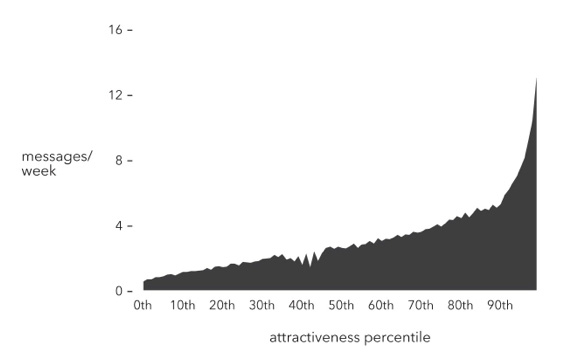
There is a pretty significant drop around the 85% mark for women. Which means that the bottom 80% of men are competing for the top 10% of women when meeting through online dating apps.
In a world where a more attractive individual is only a swipe away, it's much more likely that the less attractive individuals are getting far less sex.
This is just attractiveness. Consider other elements, like family pressures, possibilities of lawsuits / accusations (#MeToo), and other modern issues around sex. No wonder folks are spending less time hooking up.
[1]: https://i1.wp.com/www.brainpickings.org/wp-content/uploads/2...
How does this conclusion follow from the charts you’ve linked to?
Can also be read as "The portion of Americans aged 18 to 29 who have sex has slightly decreased, from 89% to 77%".
The book by Aziz Anzari "Modern Dating" suggests this may be a factor.
It's all of them, more or less.
They've pretty much all come up as a consequence to the internet, whether it be better organisation leading more effective communication of how (some) men make unwanted advances, dissemination of pornography or the paradox of choice in dating. You could probably throw on top of that pile greater entertainment choices that are not pornography, making the payoff for sex just too low when you can get instant gratification now.
>almost a threefold rise in the share of men under the age of 30 who claim to be having no sex
So are people actually having less sex, or are they just more willing to admit it?
Things like Facebook/Instagram/Tinder give the illusion that there are lots of attractive people out there when, in reality, those attractive people are unavailable to YOU because YOU aren't attractive enough. If you hold out for someone too far above your level, you're going to be waiting a while.
This has been documented in college professors. Divorce rates are quite a bit higher among college professors because the abundance of attractive members of the opposite sex makes them less satisfied with their partners even though those youngsters really aren't available to them.
- Upper-case Liberal Democrat become fascist, close-minded and exclusionary
- The left becomes a circular firing squad
- Republicans become more lower-case liberal
- People become atomized from one-another and no longer "disagree without being disagreeable," i.e., it's insults, snark, rhetorical spin doctoring, dismissiveness, censorship and blocking. Oh and power to the most easily offended.
- Victim hierarchy inverts power dynamics, rather than delivering equity for all, due to prevalence of mandatory equality of outcome.
In general, I think people have fashionablized and cargo-culted philosophical and political positions rather than maintained, mentored, practiced and restored them to their past meanings and values. Maybe it's partially due to the breakdown in social accountability because of mobile populations and partial anonymity/mostly unregulated nature of social media.
A half hour spent on pornhub vs. dealing with other people while making a diceroll on your health and safety? One is clearly more convenient and costs less by a very wide margin.
Unless, of course, you want to make children.