Basic Income should provide fundamental living cost support in a society that has no jobs so there is no "but" in there.
Edit: Keep in mind we already have Basic Income it's just conditional. UBI is different.
Can I do a few hours work for this guy without losing my unemployment? Yes.
Can I employ this person for a few hours without having to pay them while on paternity leave to make sure their kid gets a good start to life? Yes.
UBI doesn't really make sense as a replacement for unemployment insurance, unless benefits are really high. If you replace UI with a poverty-support-level UBI, it makes unemployment a lot worse for anyone but the lowest-paid workers.
UBI might reduce the perceived need for public funding of additional unemployment benefits in extended downturns (though if the be benefit level is poverty-support-level, probably not that much; that's more of a support for middle-income dislocation.)
If we picture a dystopian future where due to the rise of automation, increases in population, lack of education and ability, ~90% of people cannot realistically work in a productive jobs, I think it's a good time to experiment now what and how to keep all these people busy, preoccupied, and happy.
So I am all for these experiments but judging them based on whether people stay jobless is missing the point of UBI in such a fundamental way it's hard to understate that.
Most of the work people do today doesn't really need to be done, but we force people to do it anyway for various reasons. https://strikemag.org/bullshit-jobs/ (there's also a pretty decent free ebook on the subject by the author)
There's a virtually endless amount of unskilled work that could be done to improve the environment and people's lives.
https://medium.com/s/free-money/guaranteed-minimum-agricultu...
(I use agriculture as the catchy example because almost every community could use some amount of it, but it goes well beyond that)
20 hours a week is just my suggestion as a minimum that would allow for people to still job search if they choose to and could be averaged over a quarter or year or similar. Exceptions would be for those who would traditionally be on Medicare. Note: I think if UBI were implemented that Medicare and a lot of other programs should be replaced by it.
The problem is that I've heard many proponents of UBI sell it as exactly that, a way for people to get better jobs. And I can't really blame them, framing UBI as a way to make unemployment more comfortable is not going to be very successfully politically.
Not least because in developed countries alternative redistribution systems exist to make unemployment more comfortable (much more comfortable than UBI, potentially, since fewer people will be net recipients), but on the assumption that people will actually take a job if offered it. Arguing it's worth redistributing funds from those who need or want to work to those who prefer leisure is a much harder sell...
I generally align with your view, but I'm not convinced our definition is more "correct" than others. It would be nice to get the terminology straightened out.
The big fail is that the proposed way of giving it is the no "strings attached" method. A total waste of resources. If people get so lost, that they can't provide for themselves; how is money going to solve the situation? It can't and it won't. A societal characteristic is that their will always be levels. People that are taken care of are always at the lower level. UBI will only keep people at the lower rungs of society.
If UBI is ever going to be a reality it needs to come with guidance that helps people get out of the hole they are in.
The idea of a future with no jobs is silly. It will only come to be if that's what we make it. A job can be anything. I go out and I see ads for a local Palm reader. A BS job if there was ever any. But yet, it's been a business for at least 20 yrs. Don't tell me that people can't be creative and create jobs but without any force or guidance to help people out of the problem there will never be a solution.
I will go as far as saying that a future with a widespread no strings attached UBI will cause a future with no jobs.
> UBI encourages people to find work. Many current welfare programs take away benefits when recipients find work, sometimes leaving them financially worse off than before they were employed. UBI is for all adults, regardless of employment status, so recipients are free to seek additional income, which most everyone does.
Not increasing employment contradicts this claimed benefit.
https://www.yang2020.com/blog/ubi_faqs/benefits-universal-ba...
introduce basic income and people will make themselves useful.
And yet the US has full employment.
Could it be that Finland lacks jobs for some reason other than technology?
The US has “full employment” only under a definition of “full employment” that allows significant involuntary under- and un-employment to exist while still applying the label.
My point is that saying "people are happy but jobless" is missing the point of UBI.
UBI at this point is more an experimental pilot project to see what it does to people not to actually figure out how to pay for it which is another discussion also.
What it's not a pilot project for is to see if people get jobs as it's a proposed solution for a jobsless future for most.
At the other end we get better at making ever more stuff with less labour. That widget factory that used to employ 1000 people 50 years ago, now employs 10 for the same output. Now from a stuff buying point of view that's good, your products are cheaper so people can buy more. But what happens at the extreme. 0 employees in a factory? If everyone does that there aren't any employees to buy the stuff you've made.
Both of these trends are happening, both are unsustainable, sooner or later we are going to have to address them.
UBI is based on the assumption there will be no jobs because no one can deliver better value than technology rather than just a small job market. We already have the other Conditional Basic Income which is probably optimal as long as there is a solid jobmarket.
Cost. $3.8 trillion by many estimates. That's nearly 20% of America's GDP. How is it possible to pull this much money out of the American economy without crashing it?
Scope. I am of the opinion that one of the beauties of federalism is that policies can be tested first at the state level before we commit our entire nation. Why would a national government do this?
Necessity. I don't think we need to be paying anyone who makes over 50k (maybe not the right number, but there should be a cutoff). That just takes money away from those who need it.
If a supporter of UBI can respond, I'd like to discuss possible concerns and benefits.
The money isn't pulled out, though. It is redistributed to people, many of whom will immediately spend it, and others will invest it in various (hopefully efficient) ways.
> Why would a national government do this?
The problem of entry and exit. Say one state like Massachusetts implemented a UBI. Then we could expect many people to move to MA from surrounding states, or do whatever they can to have a legal address there. However I think there are possible solutions to this and a state-by-state implementation is actually possible. For example, Alaska has their dividend program and I think the results from that have been quite good.
> I don't think we need to be paying anyone who makes over 50k
I think I agree which is why I'm more in favor of a negative income tax or other means-tested system than true UBI. But if I were to argue in favor of an "everyone gets the same" program I'd say something like, implementation is somewhat less complicated, or it's easier to explain to the public.
Work is how you learn and often have some kind of basic dignity and meaning, not to mention how you eventually move up to better positions.
This is essentially what the Earned Income Tax Credit is, and what should be expanded rather than something that would dis-incentivize working at all.
$3.8 trillion would be about right if you set the benefit level equal to the poverty line for a single-person household, and then gave it to every many, woman, and child in the country, starting at birth, irrespective of citizenship or immigration status, while...
> That's nearly 20% of America's GDP.
...nearly 20% of GDP would be accurate for the benefit level you suggested, if you instituted it at that level today. Anything phased in over time would be lower even when fully phased in, because GDP growth per capita over the long term is more rapid than inflation.
If instead you took the poverty line for the median household size, divided by the median household size, and assigned that as the per person benefit (and still had no citizenship/immigration status test, and no phase in period, you'd drop the cost to about $2.2 trillion, or about double existing combined state/federal welfare spending.)
Any reasonable UBI will also be restricted to those legally present (and quite likely only LPRs, citizens, and nationals of the United States; maybe only citizens and nationals) and not initially start at a full poverty support level (meaning other programs will phase out rather than be big-bang eliminated.)
> Scope. I am of the opinion that one of the beauties of federalism is that policies can be tested first at the state level before we commit our entire nation. Why would a national government do this?
Because without authority for immigration controls, migration for benefits is a problem.
> Necessity. I don't think we need to be paying anyone who makes over 50k (maybe not the right number, but there should be a cutoff). That just takes money away from those who need it.
Means testing is additional bureaucratic cost to serve the same function that can instead be served by tax allocation, and you already need income-verification bureaucracy and income sensitive formulae on the income tax side, so the choice is between two bureaucracies duplicating function and one serving the function. The latter is clearly more efficient. There's going to be an income level beyond which, considering taxes which fund UBI, people get no net UBI payment; you don't need a cutoff in direct UBI benefits to acheive that.
At this point, we're down to conjecture. It will doubtless require higher taxes, which will quite possibly counter or outweigh any benefit of more money to spend. It's a big risk to take with the entire country.
> migration for benefits is a problem.
You don't have to have immigration controls, just establish residency requirements with a certain amount of time, holding down a job for however long, etc.
> Means testing is additional bureaucratic cost
Still doesn't make sense to send money to Jeff Bezos.
Necessity: Any sane UBI system is revenue neutral. So anybody with above average income is going to pay more in increased taxes than they receive in benefits. That's easier and fairer than a claw-back.
https://medium.com/s/free-money/after-universal-basic-income...
Why would reducing disincentives to work, as compared to means-tested welfare, rationally be expected to have anything like that effect?
Discourage bearing of children by pushing contraception and providing the poor and unemployed with free internet access, with streaming and online gaming, in order to occupy their time. Birthrates are already going down in the West, and probably a further push can be made here and there so that people are even less interested in children. Then, that underclass status won’t be passed on to another generation, it will stop with the first generation.
UBI actually injects money into the economy. Accompanying UBI would be reducing minimum wage to zero, managing inflation by increasing income taxes in higher brackets, and removing deductibles so that more tax is collected. By reducing minimum wages you encourage people to start up new companies — with no salaries to pay, you reduce startup costs significantly (there are still costs such as insurance, legal filings).
The whole point of UBI is to pay everyone the same guaranteed amount. If you start scaling back as income rises, what you are actually doing is a different scheme called Negative Income Tax. UBI basically pushes any wages into the taxable brackets immediately.
A national government would institute a UBI to encourage a mobile workforce, since reducing the cost of switching towns reduces the friction of moving to find better work. A UBI also reduces the level of exploitation of workers, so there would be less workplace induced chronic injury which is a net drain on the country. There will also be improved mental health as people aren't forced to work in dead end jobs just to make ends meet.
For the USA specifically, UBI would need to be accompanied by reformation of the health care system, basically completing the implementation of the Affordable Care Act so that health insurance is actually affordable, and not bound to employment. The USA will also need to implement similar systems of regulation of the cost of health care services and products.
Not if it is tax funded (EDIT: But, even then, it doesn't pull money out of the economy); it may, however, increase the domestic velocity of money, which has a similar effect to injecting money.
> Accompanying UBI would be reducing minimum wage to zero
Maybe, maybe not. I think it would be more sensible to reduce minimum wage to it's non-UBI target minus (annual UBI/2000hrs); with a $8000 UBI (about right for poverty support given median household size) and a $15 non-UBI minimum wage target, that would be an $11 minimum wage (with the current $7.25 minimum wage as target, it would be a $3.25 minimum wage.)
> managing inflation by increasing income taxes in higher brackets,
Using fiscal policy to manage inflation is probably not a great idea; let the Fed do that with monetary policy, and if you raise taxes (whether by raising rates in higher brackets or by taxing capital gains the same as labor income or both), do it for revenue not inflation control.
Not unless you're printing it; that's the only way to "inject" money.
> Accompanying UBI would be reducing minimum wage to zero
This is not a "standard part" of all UBI proposals. Some agree; some don't.
> managing inflation by increasing income taxes in higher brackets
Any specific numbers on who would pay what? I may not be rich now, but I don't really like the idea of having to pay a bunch of taxes if I do become wealthy some day.
On the managing inflation part, giving more people more money to spend would make money move around more and quite possibly increase inflation. For an example, let's say I own an apartment building and currently rent a unit at $400/mo. If everyone starts getting $800+/mo, I know I can double my rates without anyone complaining too much. I might not do it all at once, but it seems almost inevitable that this will cause a significant amount of inflation by giving a large class of people more to spend.
> reformation of the health care system
That seems like a whole other kettle of fish. We do have one of the most innovative health care systems in the world, and I'd hate to see that stifled. I had some bad stuff I needed treatment for, which I'd rather not detail specifically. I talked to others in countries with government healthcare who had the same problem, and had to travel here to get treatment as it's a rare condition with most of the good treatments on the bleeding edge. A friend of a friend's mother was diagnosed with stage 2 breast cancer; told to come back later as it wasn't advanced enough to warrant operation.
As someone who's had to rely on treatment not deemed standard by the government, I get twitchy when people mention single-payer etc. Had I been stuck with the treatment prescribed by the gov't, I'd likely be dead.
Lastly, regulating health care prices removes incentives to develop really cool new treatments. They may cost more than your average kidney, but some of the knew cancer biologics are amazing. My parents have friends who have gotten amazing results, though they did have to use a significant chunk of their retirement for said results.
A lot of people kept saying it is very expensive but they did not factor in that UBI replaces all current social welfare programs we have with a single program. When you compare both, it is not that expensive.
For an example, Social Security alone is ~5% of current GDP and ~4% for Medicare. [1]
> Expressed as a share of GDP, program costs equaled 4.9 percent of GDP in 2017, and the Trustees project these costs will increase to 6.1 percent of GDP by 2038, decline to 5.9 percent of GDP by 2052, and thereafter rise slowly, reaching 6.1 percent by 2092.
> Social Security’s annual cost as a percentage of GDP is projected to increase from 4.9 percent in 2018 to about 6.1 percent by 2038, then decline to 5.9 percent by 2052 before generally rising to 6.1 percent of GDP by 2092. Under the intermediate assumptions, Medicare cost rises from 3.7 percent of GDP in 2018 to 5.6 percent of GDP by 2035 due mainly to the growth in the number of beneficiaries, and then increases further to 6.2 percent by 2092.
[1]:https://www.ssa.gov/OACT/TRSUM/index.html
That's just two walfare programs alone; there are others like SNAP, unemployment, etc.
This is the conservative argument for UBI - liquidate social security and distribute the proceeds; do more good with the same money because we don't have to pay means testing overhead; smaller, less intrusive government as a bonus.
The reality though is that every single social security program has been put in place as the result of a tough political fight. That politics isn't going to go away with the introduction of UBI. There will be demands to keep or reintroduce each and every social security program that currently exists. Funding can't realistically come from this source.
My personal preference, very different from the above article, would be for a wealth tax that helps keep capital flowing, sort of like a company's dividend going back to investors. We the people are the investors in the wealthy's endeavors that led to that wealth. They keep the bulk, but they pay back some to all of us. If they don't make productive use of the wealth, something that benefits others, then their wealth slowly falls until they are like the rest of us.
By some measures of the wealth of the US, we have 100 trillion dollars in wealth and so 4% wealth tax would fund a 13k per person (including children) UBI.
My (perhaps naive) understanding is that rents tend to rise to a market equilibrium. Infuse the the aggregate market in an area with X dollars, and rents will rise to consume X.
I'd be curious to hear counterarguments to that point.
UBI (designed sanely) doesn't involve any net infusion of dollars (which would require government borrowing or printing money to distribute), it is paid for from tax revenues; it's a downstream redistribution, not an infusion.
At present, most unemployment benefits systems require the recipient to stay where they are, or move to places with better employment opportunities. This places a large burden on the recipient since they might already be in a high rent area and are not allowed to move to somewhere they can afford to live.
https://worldaftercapital.gitbooks.io/worldaftercapital/cont...
It reminds me of the scene in Battlefield Earth where the aliens with a superiority complex release starving humans into an abandoned building and they eat the first thing they see - a rat. Aha, man's favorite food must be rats!
Months later the word came back about fraud. And it was a doozy. The program was a general success, but there were SO MANY fraud cases. And I don't mean "missed a number" or "didn't understand that this asset mattered" or even "struggling but not legally struggling enough" - I mean blatant, totally unnecessary, how-are-you-not-ashamed fraud. As a liberal I found it shocking.
It's easy to allow this outrage to count for more than the actual money is worth, to ignore the many, many legit needy cases where people WEREN'T being like this.
I read once that the true difference between a liberal and conservative is not about compassion - both can be fully compassionate - but whether they are more outraged by someone in need being neglected or by someone not in need taking advantage of the offer of help.
I also think that most people don't actually see either side of this coin - they don't see the people in need getting help, nor those that abuse it. They hear about it and their emotions take hold (in either direction). And most of them, regardless of reaction, aren't hearing the actual truth.
It comes from your head. The statement itself is neutral, and for whatever reason, you're giving it a negative connotation. Most organisms on this planet evolved so as to expend less energy without necessity, humans as no exception.
That is not negative or positive - that's a normative judgment you give that statement.
But I'm doubtful that people are actually sitting around, twiddling their thumbs, doing _nothing_. Maybe they're not getting jobs per se, but I'm very curious about what they actually are doing with the time they'd otherwise have to sell.
Rather than us positing and projecting values, I'd love to see some data around this (though obviously I would love it somewhat less if it proved my optimistic viewpoint wrong).
Don't forget about the importance of relative status. At least some -- my guess would be a large majority, but part of the problem with these discussions is that everyone's just doing WAGs without much real data -- folks will want a) better than average educations for their children, b) nicer houses in safer than average neighborhoods, c) etc... and will work quite hard for it. And since these are positional goods, UBI will have no impact on their availability.
Personally, I tend to think that UBI is untenable for mostly other reasons (extraction by rentiers, for example).
This type of thinking needs to stop.
You don't get to enjoy our lavish society without contributing.
If you want food and a shack, you can already live this lifestyle for less than 5k/yr.
Hanging out with your family, playing sports, and helping animals will not keep an economy moving.
Unless I am inspired, I will not work for free.
I imagine the opposite would be true for myself, and I consider myself a hard worker.
https://en.wikipedia.org/wiki/Principle_of_least_effort
https://medium.com/the-mission/dont-use-rewards-for-motivati...
http://hepg.org/hel-home/issues/10_2/helarticle/the-case-aga...
I'm confused, was that ever the expected goal of basic income?
It's not something I've heard strongly voiced or considered, certainly surprised to see it defined as the aim of UBI as this article puts it. But then again there's a million definitions of UBI out there right now.
My main sympathy for a basic income is that "get people into jobs" so often comes up as an argument against all kinds of progressive changes (environment, shutting down harmful industries, automating bad jobs away, ...).
The goal of a basic income should be to let people without a job live a more fulfilling life.
If there was basic income where you still kept the $10,000, you would have a 0% marginal rate.
It's not clear how the finns designed their system. But Milton Friedman was actually for a form of basic income instead of social support, for this reason.
But a lot of the UBI movement likes to think that if given a long-term guarantee on a society-wide basis after a "vacation" period where people adjust to having the bottom rung of the hierarchy of needs guaranteed they would pursue higher actualization and often greater economic benefit to the society by doing so.
Its the difference between why a lottery winner will splurge it all in excess and vice and wind up bankrupt again while a hereditary millionaire can live a productive managerial life on top of a corporate hierarchy. The former lived without, had fortunes rain upon them, and treated it like evaporating water to be drowned in. The later had from birth, never went without, and thus never had to fear being without. They didn't know the scarcity or struggle and thus didn't overdose on excess since they always had it.
The opposites also happen. Lottery winners sometimes stay responsible with the money. Rich kids blow their family fortunes and end up destitute. But the disparity between them is the divide between the fleeting sensation of plenty and being immersed in it in perpetuity.
So for UBI advocates, the idea is that immersion in a basic standard of living would enable the masses to behave much like how the billionaire playboy philanthropist does on a smaller scale - learn more, expand your horizons, take more risks, and pursue your passions. If you don't feel like you could ever lose the basics, and everyone has them likewise, nobody is in a struggle to survive that breeds animal instinct anti-rational behavior like payday loans or buying lottery tickets. If you are instead struggling for splendor and prestige rather than food and shelter you have a lot more room to grow as a person, and for those that do they will be much more valuable to society as innovators than burger flippers.
I worry that greed is too baked in, and those that have would rather let the world burn before they give the current system up.
Wait, what? So, anyone who wants to have a job in the near-future must emulate the habits of some of the most impressive people in history? Wow.
I don’t know if this premise is true or just marketing hyperbole. But, if that’s what workers think is required of them, we are in for a scary future.
Isn't that how a lot of human progress works? The scientific viewpoint was once a pastime of educated elites. Now the world model derived from it is very much mainstream. (Though it isn't 100% universal) Reading, writing, and arithmetic were once elite and esoteric specialist skills, now they are basic requirements.
Mercy, humanitarianism, and individual rights are all fairly recent innovations in human history.
I don’t know if that’s true or hyperbole, but if that’s what workers think, we are in for a scary future.
Or a fantastic one.
Distribution of power: https://www.youtube.com/watch?v=rStL7niR7gs
Perception of relative wealth: https://www.youtube.com/watch?v=M3XYHPAwBzE
The redistribution of wealth can only be conducted voluntarily or at least somewhat voluntarily, without inviting inter-group conflict.
I worry that greed is too baked in, and those that have would rather let the world burn before they give the current system up.
Greed is baked in. Sorry, but that's just how people work in groups larger than about 450. However, far seeing elites can preserve the current order by creating works to uplift the common man and create community spaces of pride and joy. [1] This is also borne out in the historical record, as are the consequences when the elites do too little or imprudently do too much.
[1] -- I would say that we in the US have forgotten how to create public spaces of worth, and the trend is to take the activities of the common person and stratify them by class. This is a very bad trend, which speaks against the long term viability of our society.
In the old days in America one had the homestead act that would give you 160-640 acres of public land if you could improve it and live on it for 5 years. This program lasted from the 1862 till 1976 if you can believe it. That was a large chunk of capital one could get by working hard at creating wealth. Not sure if a new homestead act could work, but something similar where anyone can volunteer to do some hard and needed work for five years and at the end of it get a good payout that they can use at they see fit. Maybe $250,000. One could start a business, go to college, invest and live off the interest, etc. This I could get behind.
As for the land grant you're talking about, that's a huge, huge give-away right there; and, I'd note, in your hypothetical, you already inverted the sequence of events (be given land => you keep it, work hard => you get $250k).
All UBI does is recognize that, given how technological progress puts people out of jobs, we'd better find alternatives to distributing resources than what we do now, because we're going to end up with a lot of heads on spikes if we don't.
There is no reason that UBI isn't compatible with that, and a lot of its proponents would think that UBI will facilitate personal development and entrepreneurship.
There is lots of work to be done even in developed countries.
Also slacking (I am half a slacker on the way to ~zero) is toxic on the long run.
I always thought of universal income as way to allow me to grow without a burden. Learning, helping, producing (whether art, tools, ...).
It's supposed to help strengthen the social tissue.
When you consider that the group was selected from those receiving long term unemployment benefits (Finland has different types) and were by large unemployable, them staying healthier is important result.
That money isn't just pulled from the ether. Another citizen worked to produce that value which is distributed through UBI.
One happy person at the expense of someone else is not success.
Jobs are literally necessary for our society to function.
If everyone was jobless but 'happy', they wouldn't be happy when the food runs out. Or houses start to get old. Or iphones stop being built and websites are taken offline.
Economics are more important than a single individuals happiness, its our survival.
EDIT: Don't shoot the messenger. Fun ideas are not reality.
The alternate to basic income for the purpose of housing, health and food, is to provide a basic version of those resources at zero cost.
I may start calling this the "it is impossible to reduce inequality" fallacy.
If you gave everyone money, would things cost more? Maybe some things. Not everything, and not by 100.0% of the amount of money provided.
Because some of the money gets saved or used to pay down debts, not spent, and only makes people more secure rather than affecting prices. And not everything has the same price elasticity of supply. There are no practical resource limits on how many electronic devices or kitchen tables or wind turbines we can build. If more people can afford them, the price doesn't have to go up because the supply can go up at approximately the same price.
And the money comes from somewhere, unless you're outright printing it, so consumption goes down to some degree there when it goes up somewhere else.
The fact that you get the same amount of inflation you get by anything else that causes the poor to have more money is not a real problem. Getting $1000 and then paying $100 more for stuff is $900 better than the status quo.
Especially since the current problem is not enough inflation -- the Fed keeps wanting to raise interest rates and can't because as low as they are there is still no almost inflation. They keep missing their inflation target on the low side:
https://www.marketwatch.com/story/feds-bullard-says-interest...
Meanwhile everyone is saturated with debt, which inflation helps erode, so having a little more would be better.
I would say the root problem is all that debt, specifically the ongoing costs of servicing the debt. Staying alive does intrinsically require ongoing expenses for food, energy, shelter upkeep, personal grooming, etc. But the cost of these is dwarfed by the amount spent on rent (aka debt) for the space on which the shelter resides.
Basic income is really just a natural progression of the last several decades's policy of overwhelming monetary inflation. If the BI mostly goes towards just servicing debt then it's only increasing the speed of that debt treadmill and making people's financial position ever-more precarious - they then depend on both continuing to hold down their job, and conforming to whatever conditions will be placed on the BI.
The one sensible thing BI would do is allow people to have income in areas with low economic activity, which is great for those willing to "retire" to such areas. It's just not going to alleviate the pain of the average person having to "make rent" as everyone seemingly envisions.
For the exact same reasons minimum wage works, UBI works. You raise the floor and things inflate less than the floor is raised.
UBI has an added benefit to mitigate inflation in that long-term universal income becomes an exceedingly stable revenue source. There are thousands of retirement homes across the US that cost social security to live in - the business model is that the income is guaranteed, so the customer base and revenue is maximally reliable, so you can operate on razor margins because of hugely reduced uncertainty.
In that same capacity there would emerge UBI living accommodations meant to provide the "basics" for the whole value of the UBI. Even when not everyone uses them, their existence will act as a price floor on basic necessities to prevent them from inflating out of control - for the basic necessities with market price competition. That wouldn't include land or medicine, which can inflate in perpetuity because they are noncompetitive markets that should be more stringently regulated and socialized.
The sample of 2000 people were chosen from a group of unemployed people. I think the criteria for being randomly chosen was having been paid unemployment benefits during some range of dates.
So it's not representative of a real UBI at all: the point of UBI isn't to necessarily make things better for the unemployed but, rather, the large group of people who make very little money and barely get along.
Cashiers, cleaners, etc who can't live on their earnings, at least in big cities. Or self-employed one-person shops whose income stream is very choppy and who don't make much anyway. Real UBI would be universal so those who are working would get it too -- of course the UBI would increase your income and likely your tax percentage so it would mostly be taxed away from those who do earn a living.
The point of UBI is to cut down on bureucracy by removing various individual case-by-case subsidies (but bureaucrats would never vote for that) and make some base level of income predictable and reliable, mostly for people who make less than the lower middle class.
There are plenty of UBI proposals out there that are not universal (you don't get it once you hit a certain income threshold) and that don't replace other welfare programs. These are nontrivial differences that I don't think should be obscured.
Means-tested programs like that are, by definition, not unconditional basic income. So there are no UBI proposals that do that, since a proposal that does that is not UBI.
> and that don't replace other welfare programs.
It's unusual for a UBI proposal not to replace other means-tested benefit programs (though it may not do so immediately absolutely; my preferred implementation would, e.g., merely count as income against other programs qualifications and only shutter each of them completely when the UBI floor had reached above the point where it was possible to qualify for the one of the other programs.)
Yes, most UBI proposals (as designed by economists) tax earnings with little to know exemption. That is, we give you $15k per year, but start taxing you the very first dollar you earn rather than only taxing income about , say, $20k.
Yup; even in formal models of "utility-maximizing non-linear taxation", it's actually very common for optimal clawback rates to be fairly high for lowish incomes, because (1) this allows you to have a decent UBI for people who literally don't have any other income, while at the same time (2) any money you claw back early is money you won't have to pay out or claw back higher up in the income distribution, and this allows you to lower marginal tax rates a lot for the bulk of income earners, which is good for incentives - especially long-run incentives on skill acquisition and the like. Think of the break-even point where you're getting nothing on net and have to start paying into the system - you don't want that income level to be too high, or else the whole thing would become both unfair and infeasible to fund!
In the real world, UBI is mostly about slashing complex paperwork, and preventing marginal clawback rates as high as 100% or perhaps more(!). But a clawback rate of even 60% or perhaps a bit more, is in fact quite appropriate.
This doesn't seem very surprising to me – if anything, I would expect people on UBI to be less likely to get jobs, and this study seems like evidence against that.
What they didn't do (although some wanted them to), is also check the system on already employed people and checked if that changed their likelihood of staying in a bad job/finding a better job or anything like that.
Because that's the real idea behind basic income. not just giving it to the unemployed, but to everyone, with the hope that it would encourage people to find jobs better suited to them, and to allow people to take bigger risks.
(And one thing these trial do seem to show is that giving it out, and then removing it, is at least modestly disruptive.)
“Mr Simanainen says that while some individuals found work, they were no more likely to do so than a control group of people who weren't given the money.”
Note this means the headline is the opposite of the truth. And the quote is not to be found in the article. It’s how the author/editor chose to interpret a single individual’s statement, despite the overall finding being very different.
so the group who received the subsidy was already skewed by a previous selection process.
I don't see any mention of a control group in the experiment web site:
[0] https://www.kela.fi/web/en/basic-income-objectives-and-imple...
However, I personally feel that these ideas will lead to counterproductive results, that these sorts of transfers can lead to severe inflation and will lead to a higher unemployment rates, thereby dragging down the very GDP they are dependent on.
Unfortunately, both sides of this argument have little direct evidence to support their position... aside from tiny, partial studies such as the one in this article, which cannot give any meaningful insights into the complex macroeconomic effects of a larger UBI rollout, which will likely be singificant.
Everyone is at an impasse on this question.
A negative tax rate is one way to do it, it all depends what you want to encourage, and the implementation details of course. Negative tax rate would presumably only be paid to workers, so would be good for low paid workers. This particular study was for unemployed people, so wouldn't gain from negative tax. I don't know if this basic income continued to be paid when people got jobs, but if not would tend to disincentivise at least low paid work, it's unclear to me if at scale that would push up wages at the lower end due to lower supply.
Now, to you westerners $130/month might sound like nothing, but actually, with 3-4 children you are getting a regular salary for effectively doing nothing, without any extra conditions. And apart from the loss of the benefit for the 1st child if you get a job, nothing stops you from working and yet still collecting the benefit. It has improved the living conditions in Poland considerably, and families with children can now afford a lot more than they could previously. I personally know one company that lost a decent chunk of its staff to it - why work for you while I can get similar amount of money and stay at home? Of course the question of whether Poland can afford such a generous program is a different question altogether, but it cannot be denied that for many people this completely unconditional injection of cash is absolutely equivalent to UBI.
1. They are usually time limited. You can expect different behavior if you get financial security for limited time or for life.
2. Most studies seem to be externally financed (here the whole state vs a small population). The interesting part is if people are willing to pay for this within their community. Are you okay to pay for your slacking neighbor (even if she is the exception and UBI turns out to be overall good)?
Finnish society has already shown this willingness to pay. All mainstream political parties support the existing welfare state for the most part, and any Finn knows a few people who live on benefits and want to avoid any kind of hard work.
Furthermore, over the 20th century the Church and other forms of private philanthropy have dwindled away in Finnish society. The average Finn today does not want to have to make an effort to personally help out other people, and engage in uncomfortable social interaction, even if we are talking about their neighbours. (After all, those living in blocks of flats rarely even know their neighbours.) So, Finns are quite happy to have a wide social safety net provided by the state – even if it is sometimes "abused" – in order to save them the effort of returning to a charity model where real effort and personal interaction would be expected of them.
As it pertains to other people, I see it as a floor that will hopefully help people unlock their potential by taking some of the pressure off the exchange of time for wages and focusing it on the meaning of work.
If people want to do nothing beyond their UBI income, that's fine - but I don't see this being a widespread phenomenon. It covers the basics, and we have a tendency to yearn for more.
UBI is not "paying people not to work." That's more like typical unemployment - when people find jobs, the benefit goes away, creating a disincentive. With UBI, the benefit remains, (theoretically) encouraging risk taking.
This is not "paying people not to work" - that is a bad characterization of this trial, but maybe an accurate characterization of the dole. It's saying: Here's your minimum money, go and see what you can do.
For a local business owner, it's a big deal to take on a full time employee. If they have UBI, it is not. This makes it attractive and less risky for employers to give a few hours here and there.
The project in progress, however, saw people leave their existing jobs to, get this: go back to school full time so they could improve their lot, have children, or start businesses.
[Instead they got the rug pulled out from under them ~1 year into the program by the new government after being told they could rely on the program for 3 years]
I know it's a bit of snark, but your take is a bit simplistic and hand-wavy.
This means that you can take on part time jobs without freaking out that you will lose unemployment.
This also means (for local business owners) that you can hire people for part time / spec work without being concerned about long term effects. This is a big deal for small businesses.
The Labor Market Impacts of Universal and Permanent Cash Transfers: Evidence from the Alaska Permanent Fund https://papers.ssrn.com/sol3/papers.cfm?abstract_id=3118343
The study provides some interesting and insightful results:
>... we show suggestive evidence that tradable sectors experience employment reductions, while non-tradable sectors do not. Overall, our results suggest that a universal and permanent cash transfer does not significantly decrease aggregate employment.
It makes sense that jobs that can be moved elsewhere decrease a little, because people have more bargaining power.
It also makes sense, that there is no effect when jobs can't be exported. Employers just pay little more because UBI also creates demand.
People still like to buy stuff with all that UBI money. Someone has to work to make tings to sell. In large economic region–US or EU–the effect of UBI would have no noticeable effect to employment.
This is where indeed comes In handy need to prove you have applied for y jobs just us indeed to make up the numbers
The article has a single quote from a participant, and the rest is literally just opinion and thoughts.
There's nothing to get excited about yet.
It's going to be very interesting to read the report though, once it's published.
http://videonet.fi/web/stm/2019028/eng/
They are very open that the trial was not perfect and should be bigger / longer / better structured. Obviously economic experiments cannot control all variables.
Interesting that the majority of the UBI recipients switched back to standard unemployment.
There is a quote from a participant but the quote is much more convincing.
That's a very misleading title.
> Universal basic income, or UBI, means that everyone gets a set monthly income, regardless of means. The Finnish trial was a bit different
That's a huge difference. It encourages some of the unemployed people to stay unemployed. That's called "poverty trap".
This was not real UBI. Also, a 2-year long trial can be very misleading. People take very different choices knowing that they'll receive UBI for 2 years, or 10 years, or their whole life.
There's always the fact that Finland isn't exactly poverty-stricken as a country.
I would like to see this repeated on some real impoverished communities, with a guarantee of income for life, to see if they become more productive as a result.
UBI, as a result, may lock people forever in a jobless situation. UBI will not provide enough capital to bootstrap anything, it might disconnect you from people doing something. This can only increase the resentment between employed and unemployed classes. Granted, some will find themselves doing what they wanted to do their whole life (non-profitable) and couldn't because they had to put food on the table. But is this the case for everyone? I am afraid the rest will risk being marked "not useful" for life, and that doesn't sound like something that makes one happy...
Sorry, it is just my random philosophical thoughts and no real answers or pieces of advice here...
Technically, we all are receiving a UBI of $0 right now. The idea is just to increase that amount to cover rent and food.
If everyone's getting it, there is no stigma.
(Same disclaimer on random philosophical thoughts and no real answers)
> It was run by the Social Insurance Institution (Kela), a Finnish government agency, and involved 2,000 randomly-selected people on unemployment benefits.
So I'm curious what affect that had vs the general population's approach to finding employment. Particularly young people who may have never had a job before.
Yes, I can buy individual insurance, but moving off and on new plans is incredibly time consuming, and if you have a certain prescription that you are on or have something that is covered by an employer plan but may not be covered by an individual on then it's highly risky to leave.
As someone who spent time doing contract work, and working on my own business, this is what made me seek out work as an employee.
I cannot, and will not, play the game of paying for individual insurance. Employers can negotiate for better rates and better plans than you, as an individual, will ever be able to.
If you have a health condition or injury, the chances of which will increase each day that you're alive, the individual health insurance market is a disaster.
The first is stopgap rhetoric to prevent socialist-inspired rhetoric from making popular gains as traditional employment is eroded away.
The second is to point at UBI and go "See, if you give money to people who were made redundant in the labor market, they probably still won't be able to sell their labor" while doing everything to ignore the fact that the market has moved past certain people.
I just envision people buying all sorts of things without understanding what they're signing up for.
And from a U.S. perspective, I don't trust a system filled with rent-to-owns, payday lenders, and car dealer/financers stopping anyone from making bad choices.
I view UBI as a way to help ease the debt of many people, particularly those incurred because of lost wages (loss of job, illness). It could also ease the college debt issues because we could stop subsidizing college costs, leading to decreased tuition, and instead the colleges would have to compete with other uses of this money, something they do not have to do with direct college support programs.
The reality is that people don't need money. Money is important but what people need is a purpose and goals. Which a basic income system does not provide.
The problem is that the UBI seems to be coming from the taxes that other people, which may be a good first iteration to try something out, but it will fail in scale.
I will assume that the aim of these experiments is to find a way to provide for an ever increasing number of people at a time that the number and the quality of jobs is dropping, largely being replaced by automated systems. Last year the governor of bank of England voiced concerns about the automation stripping out jobs which could "lead to a rise of marxism"[1].
I find the idea of a UB Dividend[2], or social dividend[3] instead something which would have more chances to succeed. The main idea behind it is that everyone will be entitled to a dividend which will be funded by private companies. So instead of having the Apples and Googles of the world sitting on a pile of cash, they could put a portion of their earnings in a fund which would then be given back to everyone to allow them to continue to purchase their products and services.
1: https://www.independent.co.uk/news/uk/home-news/mark-carney-...
2: https://medium.com/dark-mountain/universal-dividend-a988c31c...
If you have more people than work that needs to get done I don't have a problem with the people who aren't working being able to live.
It sounds like perfectly ordinary social security from my perspective in Norway, perhaps with some of the requirements relaxed.
If people want to find out if basic income works it has to be given to a representative slice of the population. This has been done several times in North America (once in Canada, and twice in the US), as far as I can tell it was successful.
> Finland basic income trial improved happiness but not employment
It’s unfortunate the BBC chose that quote, as it misrepresents the outcome of the trial as _creating_ joblessness, rather than failing to _alter_ joblessness.
I think UBI would help people who are already employed in jobs that they hate, to find/invent meaningful jobs. A lot of employed people are miserable but just surviving doing things that they hate (because that's the only thing that pays and so are chained to their misery).
I think real UBI would create strong bottom up economies and get rid of value extractors, intermediaries and schemers. It would also help people move out of big cities back to rural areas where things are not so expensive
Isn't unconditional, you know, unconditional? As opposed to "From January 2017 until December 2018"?
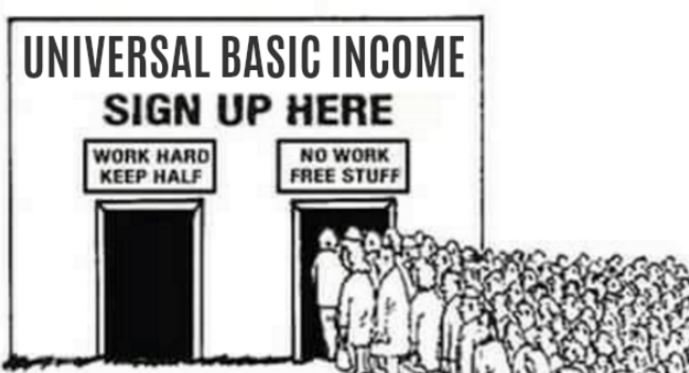
Work Hard, Keep Half v. No Work, Free Stuff
https://delvedc.com/wp-content/uploads/2018/04/Universal-Bas...
Vegetarianism did not lead an increase in animal population.
Policing did not lead to an increase civic engagement.
Prophylactics did not lead to an increase in birth rates.
...I wonder what other goals I could retroactively apply to social programs to show how they failed to achieve things they were never meant to address.
- participants selected only from long term unemployed - Finland was still in a period of austerity following recession (low hiring rate) - tiny sample population - limited period - stingy, the amount provided doesn't really provide a basic income
I'd rather support a system of federated capitalism where everybody owns and rents some amount of capital (financial, intellectual, social, etc.), along with a government that can provide for basic needs. Everyone has some nontrivial amount of power, and has to respect other people and their power.
Also Silicon Valley People: Let's have open borders and import unlimited numbers of low-skilled workers. Doing anything else is racist!