[1] https://en.wikipedia.org/wiki/Stirling_radioisotope_generato...
“The United States stopped producing bulk Pu-238 with the closure of the Savannah River Site reactors in 1988.[12][13][14]
Since 1993, all of the Pu-238 used in American spacecraft has been purchased from Russia. In total, 16.5 kilograms (36 lb) has been purchased but Russia is no longer producing Pu-238 and their own supply is reportedly running low.[15][16]”
Interestinly, it looks like Canada (Ontario, Darlington) are starting set up operations to make some in the near future.
http://www.planetary.org/multimedia/planetary-radio/show/201...
As an aside: There are some people who are very skeptical of both atoms and space exploration. I'm not sure what their motives are but given the amount of steel necessary to produce wind turbines, I'm unconvinced that "renewable" is actually "greener."
In light of the current geopolitical climate, it's probably better that NASA's (et al) plutonium should come from Canada vs. Russia.
The RTGs on both probes have decayed A fair amount at this point and are producing a lot less power.
10 years may seem short, but combined with an electrically powered thruster there is potential for doing types of missions we have not really been able to do before. That 10 years could be spent doing propulsion.
If you want to use it more in the science phase, use chemical rockets to get up to speed and then boot up the reactor in time to say, decelerate into orbit and you are looking at having the majority of that 10 years used at the destination.
My main concern isn't really the duration, but the reliability of the moving parts. But without plutonium, there are not a whole lot of other options for powering missions to Uranus and Neptune.
Still hard to imagine
https://en.wikipedia.org/wiki/Optoelectric_nuclear_battery
Its major, still undressed downsides are the requirement of expensive beta emitters, and synthetic diamond PV cells (everything else will die to beta particles)
You get around 15 years of useful work and 15% efficiency with current day technology.
It has no moving parts as RTG, has better power to weight than RTG, and has efficiency comparable to simple Stirling
This is a good point. Here's a picture of a Plutonium-238 oxide pellet (referenced from [1]):
https://en.wikipedia.org/wiki/Plutonium-238#/media/File:Plut...
It will always look like that if you have no way to dump the heat -- basically it's a heat source which is always on.
On the other hand a nuclear reactor that's never been activated will have fuel that looks like this (referenced from [2]):
https://en.wikipedia.org/wiki/Uranium-235#/media/File:HEUran...
This is no doubt oversimplifying things, since Pu-238 is a pure alpha emitter, whereas once it's been activated, the fuel in a nuclear reactor will generate all sorts of nasty radioactive isotopes which in turn release alpha radiation, beta radiation, neutrons, and gamma rays. It will be pretty safe while it's still cold though -- in fact if it ends up in the ocean it's really unlikely to hurt anything, since there is already uranium dissolved in sea water.
It think it's likely that the public relations nightmare NASA would have to go through to fly an actual reactor will be through the roof.
Kilopower is safer, because it would launch inert, and it avoids Pu so any failures would be less toxic.
Downplaying the usefulness of a technology because of imaginary protesters isn't very helpful.
I agree with the sentiment. Anti-science sentiments proliferate partly because science doesn't spend much on public outreach, especially compared to people who want to make a buck off scaring others about new technologies. NASA has been doing more and more PR work over the past few years, and that's great - but IMO in this case, they really need to get someone who looks and sounds confident, and who would go on national TV and say "Yes, we are totally sending a nuclear reactor to space, why wouldn't we?".
I think this is a good thing. And it seems they can use them if nothing else works.
Is this actually a thermo-acoustic engine, or some other kind of sterling engine? Or are they equivalent? The article doesn't seem to mention "acoustic" (or an equivalent).
Stirling engines can approach 50% efficiency [1], whereas thermocouples are usually less than 10% [2].
[1] https://en.wikipedia.org/wiki/Stirling_engine
[2] https://en.wikipedia.org/wiki/Thermoelectric_generator#Effic...
So a bit OT, I was wondering if anyone has yet thought about the solution of still using solar panels for them, but to also use a mirror to focus more light in the direction of the probe or a laserbeam?
I mean, theoretical I don't see why not, appart from being more expensive? Andd you could also offset the laser/mirror cost, because you only need them later on ....
(but to be on the safer side, I still would add a RTG)
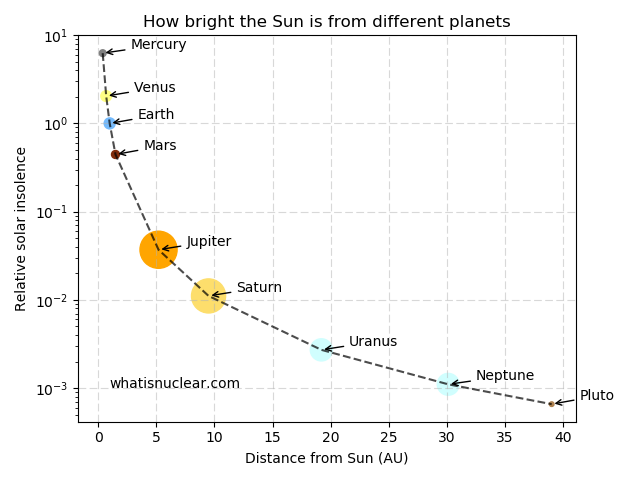
Say you have a mission to Uranus, you will need a mirror with 400 times the area of the solar cells to get as much power as they would in earth orbit.
Dibs on Solar Harvester
But if you use a laser?
I imagine it will be easier to focus it more precisely?
https://ntrs.nasa.gov/archive/nasa/casi.ntrs.nasa.gov/201700...
But apparently the 10 kW is modeled to weigh about 1800 kg, so no need to worry about one in a car any time soon.
Also, you need more than a few kilowatts to power a car. 10kW = 13.4 hp. It may work, but you won't break speed records...
Not really, since "moving parts" ...
I'll summarize some of the interesting points:
- The nuclear core (75kg of enriched uranium/molybdenum [1]) is designed to not go critical, even if it accidentally falls into the sea and is surrounded by water (which is a good neutron reflector). It only starts when you surround it with a neutron reflector made of beryllium (an even better neutron reflector, mainly due to less absorbtion). Combined with the fact that the reactor only gets nasty when it's been running for a while (and thus is already far away from earth) it is a lot safer than plutonium fueled RTGs.
- It would be very useful to reach far away destinations (like the orbit of Uranus, Neptun or Pluto) using ion drives, as they need to run for years and solar panels aren't effective far away from the sun.
- While there have been other attempts at developing nuclear reactors for space, most of them didn't go far. They could use an existing research reactor (Flattop [2]) for this project which already has all the required permissions to run, so a lot of paperwork could be saved for the Kilopower experiments.
- The Kilopower reactor is the first to use heatpipes instead of pumps for the heat transport and stirling engines for the energy generation. The first experiment was thus to show that the cyclic heat draw of the stirling engine would be safe, because usually nuclear reactors reach an equilibrium between heating up (and thus expanding slighty which slows down the reaction) and cooling down (which accelerates the reaction).
- Instead of the planned eight 125W Stirling engines, they're currently using two 70W ones from the Advanced Stirling Converter Project [3]. The other ones will be simulated using simple heatsinks.
- Theoretically it could run for hundreds of years (after 500 years less than 1% of the uranium will be used), but the Stirling engines will break much sooner than that.
[1] http://www.iaea.org/inis/collection/NCLCollectionStore/_Publ...
[2] https://en.wikipedia.org/wiki/Flattop_(critical_assembly)
[3] https://tec.grc.nasa.gov/rps/stirling-research-lab/advanced-...
2-5 W / kg.
Solar cells seem to be about 150 W/kg.
This is relevant for outer system exploration (beyond Jupiter) or maybe for night power on planetary / moon surfaces.