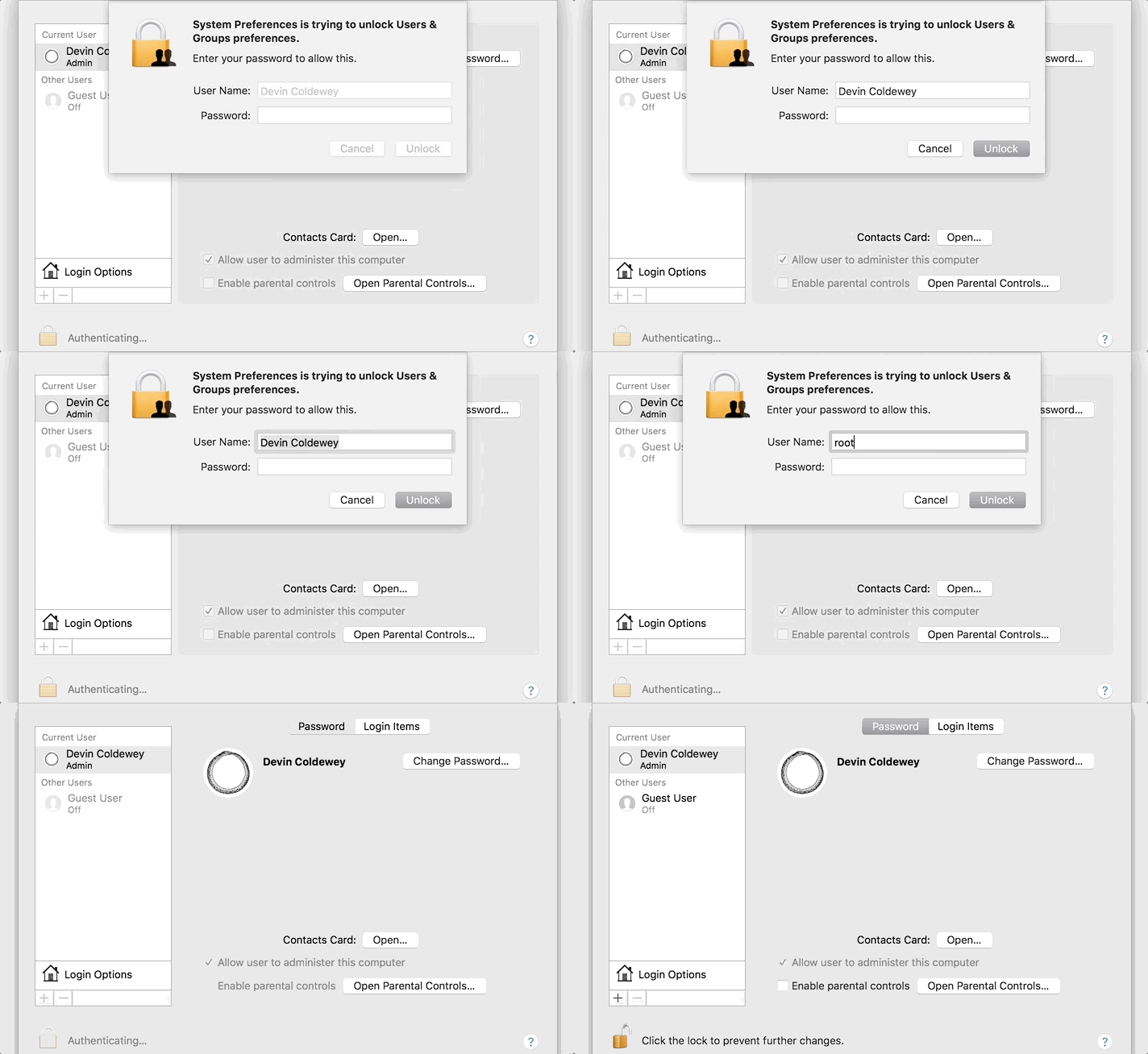
Software quality in macOS was important back when they were trying to get people to switch from Windows-based PCs to Macs. Nowadays, most people who were going to switch have already switched, so Apple has no incentive to keep up the same level of software quality anymore. They just have to keep people locked into their ecosystem (with iPhone etc.) enough that the barrier to switch out again is high enough.
There is no reason for Apple to improve macOS, since doing so won’t make anyone switch to Macs who hasn’t already switched, and not improving macOS won’t make anyone upset enough to switch back. Ergo, Apple leaves macOS to stagnate, and they will keep macOS at this bad-but-not-horrible-enough-to-switch level for the foreseeable future.
That’s my theory, anyway.
The core applications that I use (Firefox, Docker, VSCode, vim, ...) all work just as well on Linux, MacOS and Windows.
I have a Mac, because it's (at least previously) been pretty secure by default, doesn't require me to invest a lot of time sysadmining my own box, and lets me dip into a healthy ecosystem of commercial software useful to my hobbies (like photography.)
The software has definitely declined in quality, but not enough to massively annoy me.
If there is lock-in, it's on the hardware side. I've got an early 2013 MBP, still going strong, a bit dented but it's been around the world with me a few times, so that's understandable.
My workplace uses Dell XPS hardware, and that's good, but it still doesn't feel as solid to me. It's good, but it's not as good.
I think the hardware is the laurel Apple has really been resting on.
I could meet my main use cases on Linux quite happily, and dual-boot Windows for the rest. Right now the premium on Mac hardware, which only happily runs an increasingly decrepit operating system, isn't looking worth it. Previously, it was.
Edit: By the way, regarding the vulnerability, ANY password you use when you first attempt to login as root BECOMES root's new password. (Blank is a red herring.)
So if you're going to test this, maybe use something non-obvious. In a terminal, setting a strong password for root with "sudo passwd" is the quickest mitigation.
Ill-advised, but in a pinch, you can apparently 'secure' a machine you don't otherwise have access to by attempting to log in as root with a long random password you fail to remember. An admin on that machine can later change root's password with a "sudo passwd".
Also, it appears the "dseneableroot -d" command suggested elsewhere here fails in preventing root login.
That said, between this, the disk encryption bug, not being able to type "I" on an iphone you have to wonder what is going on. I recently upgrade my MacBook Pro to High Sierra and it's been plagued with problems (Weird red flash when displaying menus, hangs/crashes with external monitors etc.)
Then I look at switching away, and I lose all the OSX software I own, all the easy iOS integration, all those Pages documents etc.
Maybe I just need to build a cheap but upgradable Linux box and start trying to switch.
A lot of macOS users would actually prefer Apple to do less with it than what they are currently doing.
I’m not so sure about this — although it may be due more to the hardware side of their business: after the recent, disappointing iteration of their MacBook Pros I’ve heard a lot of people considering to switch (and actually switching).
Taken together with software quality issues, I wouldn’t be surprised if at least a subgroup of users are leaving Apple gradually. That subgroup being professional users, of course: Apple is still unassailed as a status symbol, and casual (+ mobile) users seem more than happy.
Remember that back when Apple made only computers, right before the iPod, they were on the verge of bankruptcy and barely profitable.
Since then their laptops have taken off, of course, and I have no idea how much money they make off them. But compared to the huge torrent of cash Apple makes off iPhones I can't imagine the beancounters see a huge amount of value in investing heavily in the parts of OS X that aren't shared with iOS.
Much like the importance of feeling safe in our own house, if the computer that houses our information suddenly makes us feel unsafe or exposed, we'll naturally seek other options unless the issue is, shall I say, swiftly fixed or easily fixable.
They can't afford to wait 2 years (or whatever) to update the phones, and Mac OS gets pulled along for the ride.
Of course all that changed when its only priority became to shift more iPhones, and everything became secondary to that.
For some examples, look at the impression of Microsoft and Windows when it comes to quality. It is only now starting to improve, with gigantic efforts from Microsofts side. Another example is Linux and usability, which have constantly gotten better (maybe still not good enough, but that's better left for another thread) but still many see Linux as "advanced" and only for power users. These are not perfect examples, of course.
What I mean is that I think it's bad strategy on Apple's part (if they're doing this deliberately), especially considering the resources they have at their hands. I wouldn't be surprised if Apple could increase it's desktop market share further by positioning themselves as high quality. However, it's a reputation they are losing fast.
I've heard of a lot of people switching away from Macs to Linux and Windows, especially with Windows building up their own official Linux subsystem now.
PC hardware is cheaper than Apple's, and hardware (even the "good stuff") becomes obsolete after 5 years anyway. Besides, most software is cross platform these days.
The only real good retention plan Apple has is that we can't release iOS apps without owning Apple hardware; there's a few Mac-specific software titles that certain professionals rely on; and a little bit of "it's overall higher quality than PCs" mindshare that some people still have either from the 80s and early 2000s, but that can't last long if Apple keeps this up.
The new MBP isn't attractive anymore. The software stagnates. The only reason I keep using Mac for usual use cases is just its wonderful collection of dictionaries (I like to constantly learn new languages). I wonder why no publisher ever bothered coming up with a decent dictionary software on Windows/Linux yet instead of making do with crappy online versions. If they did I'd happily just use a Windows + Linux dual boot machine.
I wouldn't be so sure about that. There are a lot of "about to switch" people out there, in both directions, who are just waiting for either the extra nudge or the extra reason to not switch.
At the logon screen, just pressing ESC got you to the desktop.
Incompetence seems to be a more likely fit here than that.
Now that Google Docs and Office 365 are "good enough" for most things, I would probably be happy to go back to Linux if there was a Linux machine that had comparable build quality yet was a bit cheaper than a Mac.
I know testing is hard, but a company with Apple’s resources shouldn’t be making slip ups like this. It suggests some real issues such as lack of unit/automated tests and/or sufficient release testing, which pretty urgently need addressing.
Anyone got any inside scoop?
Insufficient testing at today's Apple is not limited to software. They bragged about their extensive input testing lab [0] when the new line of Magic accessories was released, but the Magic Keyboard with Numeric Keypad launched last summer had all of its inventory pulled from the channel last month because users discovered that the model was so thin that its midsection bowed over time.
[0]: https://medium.com/backchannel/what-i-saw-inside-apple-s-top...
But since I don't work there, I have no good inside info. But just from gut feel, I don't think my anecdata is too far off the mark. Based just on the bugs made public, I just don't get the impression that there are testers at Apple whose sole reason for being there is to tear into a piece of software and break it. There was a bug a few weeks ago posted to HN that I commented on. I don't have a link without digging through my comments, but it was something along the lines of "how could a tester not find this in five minutes of exploratory testing?" This bug is similar. It would take more than five minutes, but were this my area to test I'd pick at it once in a while when I had a few minutes. As I pick at it, I wouldn't expect to find anything, but I've got a minute between builds, so instead of randomly clicking Facebook I'll randomly click this dialog. What did the dev forget? What weird state was not accounted for? Some kind of state overflow if I click the button enough times? Shove some Unicode in there, that didn't find anything; meh, maybe I ought to move o...hey, wait a minute. Did that thing just log me in as root?
But my gut says that Apple doesn't employ a lot of testers like that.
They’re now retreating from that strategy: https://factordaily.com/apple-to-pull-back-development-work-...
Are there any "(tech) household name" engineers doing system-level work on iOS/macOS these days? It seems like Google and Facebook have a slew of them.
I have a feeling that anyone who does would get fired for commenting here about it.
But I'm breaking my brain trying to figure out how in the hell a login attempt for "root" will enable it if it's disabled. Why is this is a possibility, to just enable root, no questions asked?
It would have to be that looking up the root account enabled it, maybe users go dormant or something, and this was a way to readd them? then once it was enabled it defaulted to a blank password, but you would think that it needs sudo to enable root in the first place.
But this does indeed seem to be an extra level of user-friendly stupid.
Apples user management is even more complex than most Unixes.
A guess: there's a code path in the UI that is only tested on "mac" accounts, not the root account that the system requires to exist. Something about the non-macness of the root account interacts badly with the UI that expects to be run on a mac users account.
TechCrunch, if you're reading this... please discourage people from reproducing the bug.
That should be much higher up in the article.
What should be done is that Apple releases fix to this problem.
https://gfycat.com/gifs/detail/sentimentalnaiveantelopegroun...
Otherwise the hole is still there for others to exploit.
If I give you a Mac logged in with an unprivileged account and you can use only the keyboard and mouse to gain root access, the security has failed.
I think you've conflated this with the attacker having (full) physical access to the machine, which conventionally means access to its ports and perhaps a screwdriver. This is not that.
edit: Screen sharing is is vulnerable not ssh. Either way its bad.
* a computer with remote login enabled
* a computer with the main login screen set to "username and password" mode
* a computer with a guest account
This would have been a pain for me when i was using parental restrictions to lock a 12 year old out of 18 hour a day Minecraft.
How are all bets off if they don't have access to a root user? This isn't Windows we're talking about.
- Can be mitigated by enabling the root user with a strong password
- Can be detected with `osquery` using `SELECT * FROM plist WHERE path = "/private/var/db/dslocal/nodes/Default/users/root.plist" AND key = "passwd" AND length(value) > 1;";`
- You can see what time the root account was enabled using `SELECT * FROM plist WHERE path = "/private/var/db/dslocal/nodes/Default/users/root.plist" WHERE key = "accountPolicyData";` then base 64 decoding that into a file and then running `plutil -convert xml1` and looking at the `passwordLastSetTime` field.
Note: osquery needs to be running with `sudo` but if you have it deployed across a fleet of macs as a daemon then it will be running with `sudo` anyway.
$ sudo plutil -p /private/var/db/dslocal/nodes/Default/users/root.plist
Edit: trying a little harder to dump accountPolicyData:
$ sudo defaults read /private/var/db/dslocal/nodes/Default/users/root.plist accountPolicyData | grep -oE '[[:xdigit:]]+' | xxd -r -pAs far as I know, possibility of root = root = pwn, game over, time to format.
Instructions from Apple: https://support.apple.com/en-us/HT204012
sudo dscl . -readpl "/Users/dan.koepke" accountPolicyData passwordLastSetTime/System/Library/CoreServices/Applications/Directory Utility.app
Edit > Change Root Password
If I remember correctly, one is supposed to make it public once patched or in event of no response, no?
Edit: What is "Responsible Disclosure"[0]?
To whom does he owe that obligation? Apple? The public? Both? Why?
edit: I should say, I did test this locally first so I don't know if a fresh machine that hasn't done it will do the same thing and let a remote account enable root.. Would like to hear if anyone tested it remotely WITHOUT doing it locally first.
Not sure if you'd get different results after logging in as root at the login screen...
My personal policy: If there's a workaround or mitigation, then full disclosure is more responsible. If there isn't then report to developers and CERT or similar. Never report only to developers, always have a deadline for full disclosure, and always have a third-party (CERT, Project Zero, etc) to disclose if you come under legal fire.
Also reminds me of https://youtu.be/BVL8_ne4WZo?t=19s
1) (Apple) 1 + 2 + 3 = 24 https://news.ycombinator.com/item?id=15538666
2) (Apple) Blank root password https://news.ycombinator.com/item?id=15800676
3) ...
There ARE areas more safety critical than desktop computing, you know.
- it is almost 2018 and copy pasting on an ipad/iphone is still a horrible, non-deterministic nightmare
I would really like to see a top 10 list of software blunders, I think everyone on HN would.
https://forums.developer.apple.com/thread/79235
(spotted by https://twitter.com/fristle/status/935670476214378496)
I should have known that updating to a new MacOS versions before 6 to 9 months have passed is a mistake. High Sierra is in my experience the buggiest MacOS release so far, not only security-wise. The system is not very stable and APFS reduced drive performance … :(
It is really ironic that a company, making billions of dollars and branding itself as the leaders of quality, stability and so on, to have this kind of vulnerability.
I have truly lost faith in Apple.
iOS 11 was the tipping point for me (can't delete photos using trash icon, wrong orientation when unlocking phone, random lag/freezes etc).
Apple just doesn't care any more.
   > and branding itself as the leaders of quality, stability
   > and so on
Should it happen ? Obviously not. But even popular open source software used by millions and developed by hundreds is not free of issues like this, like Heartbleed showed.
Protect yourself by changing root’s password: ⌘ (Command) + Space, Directory Utility, click the lock and enter your password, Edit -> Change Root Password…, then do NOT disable Root User.
Or open a terminal and do:
sudo passwdor just enter root with no password
dsenableroot -d
sudo passwd
I think it would be best to recommend an unambiguous
sudo passwd rootCome on Apple you have a quarter trillion dollars in the bank why don't you spend some on improving your software.
Sounds like something's wrong with your friend's computer, because neither of those issues are reasonable to expect no matter what your opinion of Apple's software is.
> But the submit button on their developer site is broken
Given the number of people who've successfully gone through that form, I'm willing to bet it's a content blocker extension that's blocking some dependency the form needs.
> And now shipping an operating system with a root account with no password by default.
The OS actually ships with root disabled. The bug isn't that there's no password (after all, a factory-set password isn't any more secure), the bug is that the login form is somehow re-enabling the root user when it's not supposed to be able to do so.
edit: I stand corrected. The 'require password' setting under Security Preferences didn't change, but other settings do. Yikes
System Preferences > Users & Groups > Login Options > Join > Open Directory Utility > Edit > Change Root Password
EDIT: My bad - editing was locked on that screen. Got it now...
EDIT2: Root user is disabled on mine. Is that enough, given that this bug seems to create a new root user each time? Should I enable root user and set a password rather than leave it disabled?
To me personally 10.6.8 + Security Updates + APFS is extremely close to the ideal operating system.
Real answer, APFS (which changes the Filevault encryption model to no longer be full-disk-encryption...) and Metal2 graphics (which has brought a variety of new gfx bugs into play, even for 1st party applications) are the big technical draws
For a full list of changes, review the marketing page or the developer release docs
- https://www.apple.com/macos/high-sierra/
- https://developer.apple.com/library/content/releasenotes/Mac...
(yes Apple can't be bothered to update their dev docs with the point releases. Documentation quality has fallen off dramatically since the 10.6 days)
Given the stream of bug reports on various apple sites, I have not upgraded any of my personal machines, and my employer has stated they will not be upgrading our machines in the near term.
"We are working on a software update to address this issue. In the meantime, setting a root password prevents unauthorized access to your Mac. To enable the Root User and set a password, please follow the instructions here: https://support.apple.com/en-us/HT204012. If a Root User is already enabled, to ensure a blank password is not set, please follow the instructions from the ‘Change the root password’ section."
1) open Directory Utility app (via Spotlight or other) 2) Click lock to make changes, log in with admin account 2) Click Edit -> Enable Root User 3) Click Edit -> Change Root Password… 4) Set a password 5) Do NOT disable root user!
If you disable the root user, the admin prompt will create it again with an empty password.
It seems like root has no password by default. Setting one is enough to close the hole. This is unbelievable!
Curious to see what's in /var/db/dslocal/nodes/Default/users/root.plist before trying this.
Well, sparing software. I've had intermittent phantom screen input using the latest betas on the X, making it infuriatingly unusable at times.
Instructions here: https://support.apple.com/en-us/HT204012
It seems like the best mitigation for the moment might be to enable the root user and set a password for it.
I've two factor authentication on my Apple account and now every time I use a new browser (or after clearing the Cache) and try to log into one of the Apple developer sites it sends me the authentication code to the same machine that I'm using. How is that two factor ?
I've an iPhone which is connected to the same account but it's not my primary phone so it's most likely not ON when I do this. I guess Apple tries to send the code to my phone and when it fails sends to the next online device which happens to be the same machine I'm using to log in. So all I have to do is click Allow and enter the 6 digit code which is displayed in a different app.
Your password is something you know. Your computer (which is associated with your Apple ID) is something you have.
If someone tries to log in using your password from another computer, your account is safe. If someone steals your computer but doesn't know your password, your account is safe. You're only in trouble if someone steals your computer _and_ knows your password.
SELECT * FROM plist WHERE path = "/private/var/db/dslocal/nodes/Default/users/root.plist" AND key = "passwd" AND length(value) > 1;
Set a good password there and disable the root account again.
Now people making use of this vulnerability will still be able to re-enable the root account (that's why it fail the first time - root is default off, but this bug enables it), but now there will at least be a useful password set.
    /etc/pam.d$ grep -RI nullok /etc/pam.d
    /etc/pam.d/authorization:auth       required       pam_opendirectory.so use_first_pass nullok
    /etc/pam.d/checkpw:auth       required       pam_opendirectory.so use_first_pass nullok
/etc/pam.d/screensaver:auth required pam_opendirectory.so use_first_pass nullokI initially saw this thinking it didn't affect Sierra or High Sierra.
Kind of ironic that you can easily get elevated privileges with it.
https://forums.developer.apple.com/thread/79235
Screenshot. http://oi67.tinypic.com/2h6embp.jpg
They'll not only have to patch the vulnerability but they'll also have to disable all of the root accounts that were inadvertently enabled. What a mess.
Update: And even after attempting it, checking Directory Utility the root user is still disabled. So I wonder if something 3rd party has enabled the root user and left it passwordless.
While Apple works on its fix, it offered a workaround for users concerned about the bug.
“Setting a root password prevents unauthorized access to your Mac,” the company explained.
"To enable the Root User and set a password, please follow the instructions here: https://support.apple.com/en-us/HT204012.
---
Edit - for me those Apple instructions didn't work. This seemed to:
Search for 'Directory Utility' in Spotlight and click it.
Click the lock to make changes
Select 'Enable root user' from 'Edit' on the main menu and set a password.
It does not work if you are not admin. It does not work if your root user is enabled and has a password set. If you tried the vuln, you should set a password for the root user ("sudo passwd root").
Do you think a hacker with ill-intent would have reported this issue at all?
Interesting...
Also the UX is different. Typing root on the fresh installed one fails, then resets the user text box to my name, and if I type root again it doesn't let me it.
On the upgraded laptop, if I type root, it sticks and clicking unlock twice gets me in.
"We are working on a software update to address this issue. In the meantime, setting a root password prevents unauthorized access to your Mac. To enable the Root User and set a password, please follow the instructions here: https://support.apple.com/en-us/HT204012. If a Root User is already enabled, to ensure a blank password is not set, please follow the instructions from the ‘Change the root password’ section."
https://techcrunch.com/2017/11/28/astonishing-os-x-bug-lets-...
https://images-na.ssl-images-amazon.com/images/I/51I4nsyt9AL...
- Open Directory Utility (/System/Library/CoreServices/Applications/Directory Utility.app)
- Authenticate with the lock icon
- From the Edit menu you can enable the root user and set a proper password (it would already be enabled if you had tried out the exploit)
Having that root user enabled isn't great overall, so it would be best to set a reminder to disable it using the same Directory Utility app once the security hole is patched.
It looks to me like my root user is disabled.
When I type "root" into the username field and click unlock (in System Preferences > Users & Groups) "root" is replaced with my username and the dialog shakes... I have to type root in each time, but it never unlocks. 10.13.1
Edit: trying it after logging out keeps "root" in the username field, but never logs me in... tried 20+ times
I've upgraded a through a couple versions of OS X on this machine - maybe that makes a difference?
Edit: changing the login method to "Name and password" under login options, then logout and login with "root" with empty password also works.
Fortunately, it doesn't work on cold boot with FileVault enabled, at least it doesn't appear so. `sudo su root` also doesn't work with an empty password.
https://www.reddit.com/r/linux/comments/7hj6v/i_use_my_login...
Maybe they need to re-think their hiring process, because clearly something is not working as it should.
2. Add a complex root passphrase and clean this up after the fix is released.
3. Reflect on how irresponsibly this serious security bug was ‘reported’, he didn’t just potentially miss out on $200,000, he put an enormous number of people at risk of local intrusions when instead if it was properly reported there’s a good chance Apple would have released a bug fix for this quicker thus reducing the potential impact and spread of misinformation.
https://en.m.wikipedia.org/wiki/Responsible_disclosure
https://support.apple.com/en-au/HT201220 (See ‘Security and privacy researchers’)
https://tctechcrunch2011.files.wordpress.com/2017/11/ooooooh...
"Can someone here explain to me what is the login dialog supposed to do? ... Ok. Then why the !@#% doesn't it do that???"
In the Spotlight Search type "Terminal" and press enter.
At the terminal type "passwd" and press enter.
The terminal will prompt you to change the password for "root".
Password change is the only protection until it is patched.
``` dsenableroot ```
utility; by first enabling the root user with a strong password, then disabling it with the
``` dsenableroot -d ```
option. It's heavily recommended to not leave the root user enabled.
I'm guessing it probably would've been a fairly big chunk of change.
High Sierra seems to be focused in Emojis. Urghh
Disabling root re-enables the blank password to root.
How to set root password.
https://finance.yahoo.com/quote/AAPL?p=AAPL
A higher risk, higher leverage bet: buy some put options the milisecond markets open:
I'm still on 10.12 Sierra. Long ago I stopped major updating when those releases were new. I learned to wait months or many months for bugs to be dealt with and for older software to be updated to be compatible with the new release. High Sierra provides nothing critical that Sierra does not provide, and thus, I am happy in my position as late adopter.
Until Apple forces me to with a required xCode update for the newest iOS SDK...>.>
sudo dscl . -passwd /Users/root $(uuidgen)
:/
https://en.wikipedia.org/wiki/Pyramid_Technology
Here's the email in which I reported it to the staff mailing list.
    Date: Tue, 30 Sep 86 03:53:12 EDT
    From: Don Hopkins <don@brillig.umd.edu>
    Message-Id: <8609300753.AA22574@brillig.umd.edu>
    To: chris@mimsy.umd.edu, staff@mimsy.umd.edu,
            Pete "Gymble Roulette" Cottrell <pete@mimsy.umd.edu>
    In-Reply-To: Chris Torek's message of Mon, 29 Sep 86 22:57:57 EDT
    Subject: stranger and stranger and stranger and stranger and stranger

       Date: Mon, 29 Sep 86 22:57:57 EDT
       From: Chris Torek <chris@mimsy.umd.edu>

       Gymble has been `upgraded'.

       Pyramid's new login program requires that every account have a
       password.

       The remote login system works by having special, password-less
       accounts.

       Fun.

    Pyramid's has obviously put a WHOLE lot of thought into their nifty
    security measures in the new release.

    Is it only half installed, or what? I can't find much in the way of
    sources. /usr/src (on the ucb side of the universe at lease) is quite
    sparse.

    On gymble, if there is a stray newline at the end of /etc/passwd, the
    next time passwd is run, a nasty little "::0:0:::" entry gets added on
    that line! [Ye Olde Standard Unix "passwd" Bug That MUST Have Been Put
    There On Purpose.] So I tacked a newline onto the end with vipw to see
    how much fun I could have with this....

    One effect is that I got a root shell by typing:

    % su ""

    But that's not nearly as bad as the effect of typing:

    % rlogin gymble -l ""

    All I typed after that was <cr>:

    you don't hasword: New passhoose one new
    word: <cr>
    se a lonNew passger password.
    word: <cr>
    se a lonNew password:ger password.
    <cr>
    Please use a longer password.
    Password: <cr>
    Retype new password: <cr>
    Connection closed

    Yes, it was quite garbled for me, too: you're not seeing things, or on
    ttyh4. I tried it several times, and it was still garbled. But I'm not
    EVEN going to complain about it being garbled, though, for three
    reasons: 1) It's the effect of a brand new Pyramid "feature", and
    being used to their software releases, it seems only trivial cosmetic,
    comparitivly.  2) I want to be able to get to sleep tonight, so I'm
    just going to pretend it didn't happen. 3) There are PLEANTY of things
    to complain about that are much much much worse. [My guess, though,
    would be that something is writing to /dev/tty one way, and something
    else isn't.]  Except for this sentence, I will also completely ignore
    the fact that it closed the connection after setting the password, in
    a generous fit of compassion for overworked programmers with
    ridiculous deadlines.

    So then there was an entry in /etc/passwd where the ::0:0::: had been:

    :7h37OHz9Ww/oY:0:0:::

    i.e., it let me insist upon a password it thought was too short by
    repeating it. (A somewhat undocumented feature of the passwd program.)
    ("That's not a bug, it's a feature!")

    Then instead of recognizing an empty string as meaning no password,
    and clearing out the field like it should, it encrypted the null
    string and stuck it there. PRETTY CHEEZY, PYRAMID!!!! That means
    grepping for entries in /etc/passwd that have null strings in the
    password field will NOT necessarily find all accounts with no
    password.

    So just because I was enjoying myself so much, I once again did:

    % rlogin gymble -l ""

    Password: <cr>
    [ message of the day et all ]
    #

    Wham, bam, thank you man! Instead of letting me in without prompting
    for a password [like it should, according to everyone but pyramid], or
    not allowing a null password and insisting I change it [like it
    shouldn't, according to everyone but pyramid], it asked for a
    password. I hit return, and sure enough the encrypted null string
    matched what was in the passwd entry. It was quite difficult to resist
    the temptation of deleting everyone's files and trashing the root
    partition.

        -Don

    P.S.: First one to forward this to Pyramid is a turd.
product-security@apple.com
They also respond to security@apple.com but prefer the product-security address.
Further, there are any number of legit bug bounty programs out there like ZDI that would pay for a bug like this then immediately disclose to Apple for it to be fixed.
Disclosing an 0Day root authentication bypass vulnerability on Twitter isn't cool, even if it is local: think of the impact to shared iMacs on university campuses.
In this case the bug is so bad and egregious, that publicizing it with the fix might have been the best thing to do -- no telling how many people have already discovered this or how long it would take Apple to fix.
Yes, let's educate each other about what responsible disclosure WITH A DEADLINE TO FIX looks like, but don't assume this person just wanted internet points. And now that the report and a workaround are out there, at least it can be mitigated personally.
Though I imagine there will be some SERIOUS hijinks that result from this until Apple fixes it because it is so easy to do. :(
This isn't just a snarky comment. They have just released the most awfull iOS upgrade for a long time, and now this. Something's messed up, and they better fix it soon.
I've think i've read somewhere they merged the iOS and macOS teams, i suppose the wrong people were promoted during the operation.
After 8 months of living hell using their overpriced MacBook Pro, I'm moving to Surface Pro (running Xubuntu, though).
"Oh, good boy. Thanks for the responsible disclosure. You're sure you haven't told ANYONE else about this? Great! Keep it that way and we'll send you a big check real soon. Promise!"
Coordinates acquired.
Boom.
Keep in mind, Apple was caught working directly with NSA in Snowden disclosures. The US government will drone strike people outside the US without trial or charges. Apple illegally SWATed a Gizmodo reporter over a leaked iPhone prototype.
I don't blame this Turkish national, not one bit.
The replies to this tweets are all everyones snarky comments to the @AppleSupport account or their edgy 'hot takes' on the issue. @AppleSupport responded promptly - albeit obviously out of their depth, and a bunch of people couldn't help but make fun of this fact. It's almost like tweeting to Apple's customer support account is not the best way to report a vulnerability?
Responsible disclosure has a proven history of working. When the vulnerability is appropriately patched and disclosed to the public, there is still a lot of backlash. You only need to look at the recent responsibly disclosed vulnerabilities for proof of this. Instead, we have a bunch of armchair analysts—who don't at all seem to be driven by past occurrences / existing data in any way—claiming that it didn't work.