If I was an investor, I would value this at no more than $0 because sales can't possibly surpass R&D. What reasons are there to believe otherwise?
EDIT: So it seems in this discussion I've learned that many believe that the love for dogs can actually be replaced by love for inanimate objects, which is a bizarre concept to me, but if the number of people who are able to do that is truly as significant as people are claiming, then I suppose I could see why this product could become successful.
Human beings can get attached to anything, regardless of its utility.
This thing mimics the actions of a puppy, and it stays a puppy forever.
Of course people would get attached to it, and in selling that attachment, there is value.
You're approaching this too much from an engineer's POV
Wait. I guess it mimics some actions of a puppy, and I imagine it can be entertaining for a few hours. Then you get used to it, and you start seeing the repeating patterns. For how long can you find entertaining a robot dog that pretends to scratch its ear, for no reason in the world and without actually even coming close to touch it with its paw?
I don't agree with this. If anything, I am approaching it from a spiritual POV when I say that a normal person cannot love an object like you can love a dog.
On the other hand I've also had people say they think it is bizarre that someone could love a dog any more than you can a tree, that they are a "thing" and don't have "real" thoughts and emotions like people do (just fake/emulated ones that we breed into them), so I don't think the philosophical ideas are broadly accepted for this.
Not only the world is 7 billion different human beings but Japenese and people from SEA have very different cultures and purchases from the typical westerns.
As far as I'm concerned, I'd be interested in buying it if: it was cheaper. solid enough that my real dog doesn't break it.
I just think that Sony's claims that this is anything resembling a dog replacement is ridiculous, because I believe that regardless of culture or how you were raised, humans from birth see inherent difference between living things and objects and mixing the concepts is a mentally stressing activity.
I didn't know, but it makes sense, that it is useful in an AI lab, but I think that is a secondary use the market found.
What an utterly joyless way to look at the world.
And the rest of the world is catching up with this "loneliness", with advent of superficial social media oversharing. Everyone is increasingly becoming lonely inside.
So I think this is a huge opportunity and not a niche product anymore as of 2017, as long as they get it right.
    In Japan, you don't just walk up to people and strike
    up a conversation. Foreigners might, but native Japanese
    largely don't.
    To establish some sort of repertoire, you need to share some
    sort of acceptable social context with that person: went to
    school together, played on a sports team together, work
    together, etc.
And, given that Japanese companies commonly have working hours that would be classified somewhere between "insane" and "criminally negligent", you don't really have time to socialize with anybody outside of your office.
This all goes triple for Tokyo, which has a very cold and sterile personality.
Expats tend to glop together into a tight group -- the "foreigner" community in Tokyo is like a small town in and of itself -- but for the natives, the end result is that there are a lot of very lonely people here.
First of all, I've seen Japanese (who are strangers) strike up conversations on occasion in Tokyo: at the coin laundry, at the bakery, on elevators, and so on. It's not like a social taboo or something. But yes, in general, people keep to themselves.
That being said, in my experience, people in New York and Los Angeles also keep to themselves. My instinct is that the apparently introverted nature of people in Tokyo has nothing to do with Japanese culture and everything to do with the fact that it is a big city in a developed country. Perhaps someone from London can bring in another data point?
If my experiences in rural Japan are at all normal, Japanese in rural Japan are at least as talkative as those in the Southern US (where I'm from).
I find this is not really true. This depends a LOT on the context in Japan. If you are in the train or in the street, yeah, it's not the right place to do that. But there are plenty of other places where such interactions happen naturally. Go in a bar? People will start talking to you. Go have dinner in a small izakaya? There's a good chance people will talk to you. Visit a tourist spot? There's a good probability something like that will happen as well. And not just with foreigners, this happens with locals as well.
So, it's far from being black or white. Just like a lot of statements I hear the whole time about Japan.
I'd like to know what world you live in where this is any kind of option. Maybe "my introvert is showing" but I don't even consider doing this. Is this abnormal?
Usually going to meetups and the like can help quite a bit. There's quite a bit of social context that tends to stem from that.
Like you said, breaking the ice helps a lot. I can imagine it's worse in other industries but tech has by far been the most forgiving.
[0] https://www.google.co.jp/search?q=関東人が冷たい&aqs=chrome..69i57....
In Japan, you don't just walk up to people and strike
up a conversation. Foreigners might, but native Japanese
largely don't.
To establish some sort of repertoire, you need to share some
sort of acceptable social context with that person: went to
school together, played on a sports team together, work
together, etc.
Are there really places in the world where total strangers strike up conversations and form friendships with people on the street, on the bus, etc?
I'm 41 and I don't think I've never experienced that and I'm a pretty social guy!
Aside from random "how about this weather?" chit-chat, I don't think I've ever befriended somebody outside of an existing social context like school, clubs, workplaces, online communities, fellow pet owners, neighbors, etc. Closest counter-example I can think of is my mom, who become good friends with a cashier at the supermarket she shopped at twice a week.
Sure, the prototypical Japanese work practices might not line up with your culture. I don’t think it gives justification to label them as “insane.”
Look on the bright side, Japanese people often have very long lives. You might not live that long! :-)
Maybe a robot can take some lonely feelings away, but I doubt it will fix loneliness.
Any evidence for this very broad claim?
https://www.marketplace.org/2016/01/25/world/robots-or-immig...
https://www.reuters.com/article/us-japan-robot-girlfriend-li...
http://www.cbc.ca/news/technology/toyota-robot-baby-kirobo-m...
Also, girlfriend simulator[2].
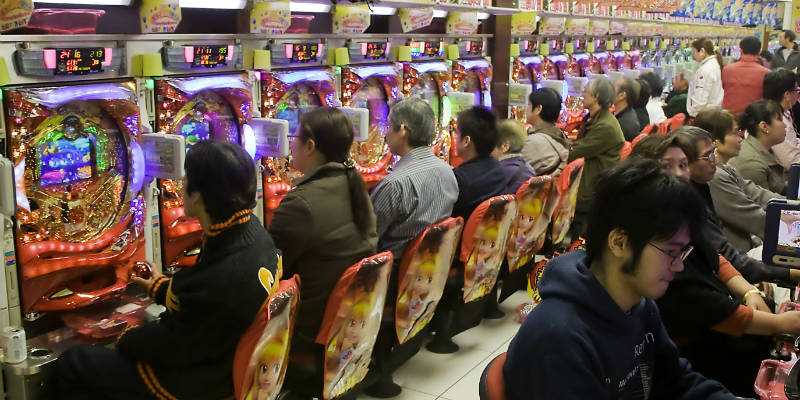
[1] https://www.japan-zone.com/modern/pix/p/pachinko-parlor.jpg
A report on a guy who specialised on repairing old aibos: https://motherboard.vice.com/en_us/article/8qxk3g/there-is-o...
Shinto priests hold Aibo funeral services from time to time, here's a recent article: http://www.asahi.com/ajw/articles/AJ201706090040.html
Flats are small, not pet-friendly and people are old and lonely, there's a good market for the new one.
People are strange.
Something about them triggers some kind of anthropomophization instinct in us.
It's as niche as the first 32MB MP3 player was niche.
That seems like a decent market to start with. (Though the ethical side of me feels slightly queasy.)
[0] http://edition.cnn.com/2016/09/11/asia/japanese-millennials-...
Edit: Apparently the new one will be selling for about the same price? Yeah, in that case they'll probably have the same problems as before.
Born to be gazed at, it is an unbelievable pupil. Unexperienced love perseverance that I can not help touching unexpectedly.
But I also got this useful info:
Scheduled to be released on January 11, 2018.
Surprisingly not an excerpt from my OkCupid profile, but it might be my opener now.
translates (approximately) to:
"Cute (eye) pupils, born to be gazed at. Moving around in a vivid manner, in a pure form. You can't grasp or can't imagine such an adorable experience."
The final sentence means: "Before you even notice, you'll find yourself playing with the pup filled with adorableness you've never experienced before."
Edit: came up with a more accurate one: "Unprecedented adorableness, that makes you want to touch it without a second thought."
Hmm. Maybe there's an emerging market for robot funerary services.
Truth is stranger than fiction. http://www.asahi.com/ajw/articles/AJ201706090040.html
It's 252,021 yen.
Well for as long as they don't shut down the service, which is going to be hell shorter than "posterity".
Pets provide important companionship. But some environmental costs of pet ownership aren't borne by the owners in a "privatize the profit, socialize the loss" situation.
http://www.nzherald.co.nz/nz/news/article.cfm?c_id=1&objecti...
He pioneered the “operation”, fabricated the metal replacement parts by hand-milling them, and successfully replaced the hip joint in an era where home 3D printing was a pipe dream and Sony couldn't hope to offer the same repair service. The “hip jitter” became a common fault, and X-Dog ended up with a waiting list of Aibos to fit new artificial hips to.
It was pretty incredible at the time, and it felt like being part of the future – like the robot pet repair clinics in Philip K. Dick's _Do Androids Dream…_.
The most impressive thing about Aibos at the time – apart from ball-tracking and kicking – was their self-righting mechanism. It became a party trick for people to knock them down and see them get up again, a precursor of sorts to viral bullying of the modern Boston Dynamics prototypes.
I sold RT, but still remember feeling sad to watch Sony wind Aibo output down. It's nice to see them coming back.
A 30 day warranty for an $1800 USD toy robot seems quite short. Is this normal for electronics in Japan? In the US I would expect at least a 1 year warranty.
But what Sony offers is a kind of a tentacle of a huge corporation.
At the end of the conference all 12 of the prototypes had broken neck servos. Because so many people had patted them on the head.
It's surprising to see its return after a long hiatus, as Aibo has had several ups and downs in the market. And despite such a long period when it could have been enhanced, it looks like it is not significantly changed from the last generation.
Makes a $1000 iPhone seem cheap.
I know several people that bought the first version of this robot dog, it had some very clever electronics for its time but it failed to find a market and became an expensive orphan. And now Sony goes back to the concept again. I wonder what is different.