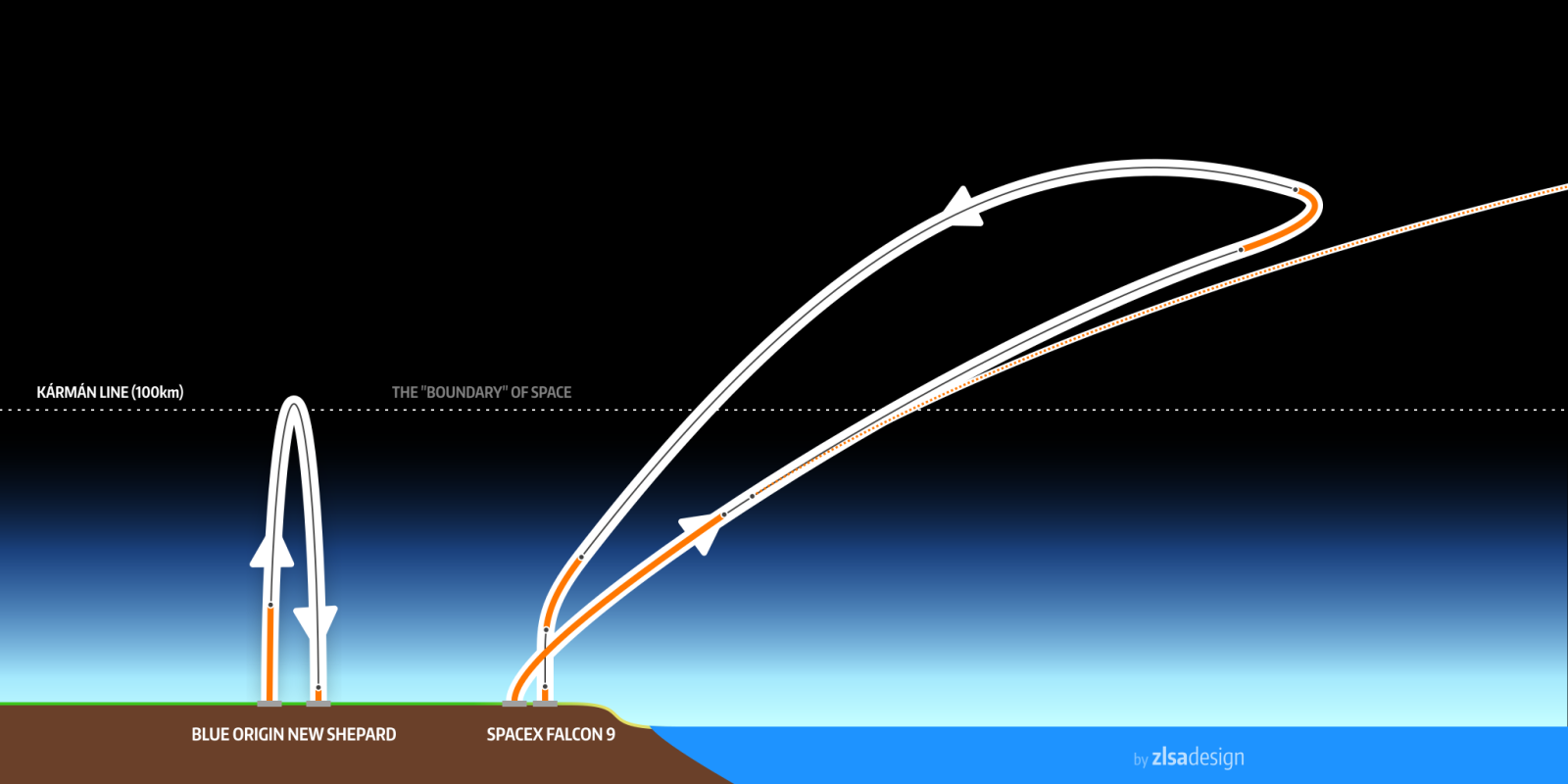
Is that line even close to true? Last I heard Blue Origin was years away from revenue and far behind SpaceX in terms of capability and manufacturing.
http://pop.h-cdn.co/assets/15/52/1600x800/landscape-14508878... http://pop.h-cdn.co/assets/15/52/1450888612-bevsx.jpg
Musk and Bezos are both people I wouldn't bet against, but they're so drastically different in their styles. Musk is flashy, but gets shit done. Bezos knows how to get shit done quietly... and suddenly he's dominated and bought everything around you.
Amazon is successful because they are fine with taking losses, only just recently making a small amount of profit compared to their scale.
Musk seems a little more down to earth (sic) here.
If SpaceX can get Falcon Heavy to work then no, so much of the oxygen will be sucked out of the launch services market that Blue Origin will be hard pressed to compete. At that point. I see them much more likely as a ULA acquisition to insure engine supply rather than a continual drain on Jeff Bezo's net worth.
If on the other hand Falcon Heavy continues to slip, or if their early attempts at launching them are unsuccessful, or they are unable to recover the three boosters (which I think is 'baked in' to the market expectations) then Blue seems to be in a position to take some of the heavy launch business, except that there isn't nearly as much of that business as there is the small/medium launch business.
Finally the dark horse here is the 'previously unexploited used for heavy things in space' which is to say some business or process that is tremendously more competitive in space than it is on Earth which grows the heavy launch business faster than SpaceX can scale up.
There are plenty of other reasons, beyond the money, I don't think it will be that long before BO really starts to compete.
They are more directly a competitor for talent. Rocket engineering is a small world.
Though ULA is buying engines from BO.
What's interesting to me is the dichotomy between Musk and Bezos vision for humanity in the Solar System. Musk is Mars focused almost exclusively. Bezos has talked about space habitats (O'neil cylinders for example [3]) as how he thinks things will play out. Certainly room for both.
Bezos isn't playing, he's going all in, selling $1 billion of shares a year to fund Blue Origin [4]. One way to look at this situation is Musk and Bezos competing to be king of transportation infrastructure for the Solar System. High stakes indeed.
[1] https://en.wikipedia.org/wiki/BE-4
[2] https://en.wikipedia.org/wiki/Rocketdyne_F-1
[3] https://en.wikipedia.org/wiki/O%27Neill_cylinder
[4] http://www.cnbc.com/2017/04/06/bezos-is-selling-amazon-stock...
https://www.reddit.com/r/spacex/comments/6b043z/tom_mueller_...
That rocket is going to be the real game-changer. I would say that the Falcon 9 is evolutionary, you know, a reusable rocket that greatly reduces the cost of access to space. Maybe we can achieve ten reduction in cost over, you know, like what ULA or the Russians or the Chinese are doing, with the Falcon. But we want like a hundred or more reduction in costs; and that’s what the Mars rocket’s gonna do. That’s going to be the revolutionary rocket.
So once we’re flying that, all other rockets will probably be obsolete. <laughs> Likely Blue Origin is working on a fully-reusable rocket <inaudible> But we’ve really changed this industry that the other guys are really scrambling. It’s pretty funny to watch this, because when we first started the company 15 years ago, my fifteen-year anniversary was Monday, May 1st. <clapping> Thank you.
We started the company on May 1st, 2002. Well, I started there; I consider—. Elon incorporated the company I think in February, but he didn’t have any employees yet. But I consider when he had his first employees when he had his company. But anyway, over the fifteen years, we’ve gotten, you know, this far; and when I was first hiring people, you know, that’s when I heard <inaudible> money to develop this rocket. And then we built the Falcon 1, which had a single Merlin engine on it, could throw about 1k lbs into LEO; and they said, you guys, you guys were able to build a small rocket. But you’ll never be able to build an EELV-class, EELV-mission class rocket. And so we built the Falcon 9 and started flying it. And they said you’d never be able to reuse it; you’ll never be able to get to the space station. And at some point, you stop listening to it. And I think it’s great, you know, if people think what you’re doing is impossible then you must be doing the right thing. You can still find the YouTube video online where people are critiquing our recovery thing as being photoshopped or CGI’d. That’s pretty high praise, when people don’t actually believe you’re doing. <laughter>
And you know, we were ridiculed by the other big companies in the launch vehicle business. At first, they ignored us; and then they fought us; and then they— we found out; they found out that they couldn’t really win in a fair fight because we were successful and we were, you know, factors of two or three or probably even five lower costs than what they can do. So then it becomes an unfair fight, where they, you know, try to destroy you politically, and use other means. And then at some point, they figure out that they’ve got to do what you’re doing. So there’s a lot of talk at these other companies about how they’ll make reusable rockets; recover the engines, recover the stages, come up with a much lower-cost rocket so that they can compete. You know, there’s no way that they ULA would have considered buying engines from Blue Origin except for the pressure that SpaceX is putting on them. There’s no way that the French would have quickly abandoned the Ariane 5 and moved to the Ariane 6 design because— except for the pressure we’re putting on. So we’re really changing the world. The Russians are saying they’re coming up with a rocket that can beat SpaceX, which is entertaining, <laughs> which is entertaining, because they’ve been working on their Angara rocket for 22 years, and launched it once. And suddenly they’re going to be coming up with a low-cost one.
It could've that BO can't attract enough talent. Bezos might not be spending enough time at BO and perhaps the prospects aren't as great there.
What about Vitol (https://en.wikipedia.org/wiki/Vitol), Saudi Aramco, Koch Industries (https://en.wikipedia.org/wiki/Koch_Industries) ... etc ?
Saudi Aramco is indeed much more valuable than the lot combined, but it's not exactly a startup.
However, in space launch it's not like Lockheed Martin and Arianne didn't do the same.
The difference with SpaceX is that for once a government got value for money on an Aerospace deal.
We're also paying for all the wars in the middle east that keep the oil flowing.
http://www.cnbc.com/video/2015/06/01/musk-article-on-subsidi...
Obviously they haven't updated for this news yet, but they still won't be at $23B.
Regardless, going from having invested all is PayPal money by 08 and in dire straits to being $20B+ 9 years later is awesome. And depending on what narrative you believe, money to this degree isn't what he cares about anyway.
Kudos to Elon, SpaceX, and everyone working there.
http://variety.com/gallery/elon-musk-buys-fifth-bel-air-home...
http://www.businessinsider.com/elon-musk-mclaren-f1-hypercar... wrecked-it-2015-6
That being said, maybe we're looking at things differently. I'm sure he prefers having money than not having it, but the macro scale choices he's made imply he values other things more than his personal fortune.
Musk doesn't project the image of being practical. He claims to have almost gone broke when investing in Tesla/SpaceX, and now makes super-optimistic predictions: fully self driving cars in a year, and AGI in 2030-2040.
To some, this sets him apart from the "money-focused" crowd. Yet, you can think of ways his actions benefit him.
By predicting things earlier than most researchers, he can appear to have some knowledge they don't, thus attracting more young (cheaper) AI talent, and a public following whose understanding of machine learning is understandably limited.
It's unfortunate because those who research machine learning remember the last AI craze of the 80s and the ensuing AI winter. The same thing happened. Over-hyped technology couldn't meet the wild expectations of the general public. These expectations had been stoked by entrepreneurs who thought (or lied) that they could create AGI. For example, Thinking Machines Corp.
Nobody is 100% altruistic. When we mistakenly afford someone that quality, we elevate them to god-like status where they can do no wrong.
It's a tough position for practical machine learning researchers. There are a lot of advances that will be made in the next few years. I hope more people will try out machine learning to get their own understanding of its power and limitations. Getting all your information on a subject from sensationalized news or recent products isn't as educational as studying/using the subject yourself.
Personally, I do believe that's true. I don't think that precludes him from still using his money for some fun stuff.
https://en.wikipedia.org/wiki/Cargill
   Revenue: US$109.6 billion (2017)[1]
   Net income: US$2.835 billion (2017)[1]
   Total assets: US$55.8 billion
   25% of all United States grain exports
22% of the US domestic meat marketWe could afford 2 fully-blown spaceX per year just by maintaining our present disproportionately large military rather than expanding it by roughly a Great Britain this year.
It's unbelievably depressing to me that we could be leading civilization into a multi planetary age but choose not to.
100% of all interplanetary travel, shipping and trade.
As someone from India, I have huge respect for Uber. The taxi unions here were looting people. They were quite arrogant. In Bangalore, most auto taxi drivers would happily stay idle for the whole day, and try to make some quick bucks during the rush hours by charging 300% or 400% extra, until Uber came and killed their arrogance.
Uber may not have had the same level of technical innovations as SpaceX. But they do have mammoth execution challenges, to the scale that no company might have had to face so far. For eg, in India, in each of the 29 states , they have to deal with the regulators of each state. In hundreds of cities, they have to deal with the respective taxi unions. Extrapolate it to a global scale , I can't even imagine.
My respects to both Elon and Travis! Both are my heroes.
More taxes and regulations are NOT good things.
Don't the people working for SpaceX deserve to have liquidity?
Isn't it fair for the general public to have the ability to profit off of his epic feats?
That's a very weird definition of fair. Why does the general public 'deserve' to profit off of his feats?
I have never ever heard of this being called fair in my life. Honestly, I would have to go with "I don't know" for this answer.
There is a robust secondary market for SpaceX stock.
If you already have a solid path to profitability, you don't need to court investors as often as a hemorrhaging company does.
Yeah it smells like an attempt to increase their valuation, which this accomplishes. If they IPO those investors from a while back can cash out, but I wouldn't sell SpaceX at this point if I was able to own it. Unless there is some potential disaster we don't know about.
They will need about 3-4 years before it is flying reliably.
(but you might still be correct!)
In 2011, Cargill was estimated to be worth $55 billion http://blogs.reuters.com/breakingviews/2011/01/20/cargill-va...
Real evaluation is the same as for any other company, however in a private company you have less data to go with, the data can't be relied upon as much (since the source is mostly the company itself), and all of these risks get increased by the company being relatively new and not profitable yet. In exchange for the risk investors hope to gain similar growth of company value after they purchased their shares. Therefore most investors mostly look for factors that show huge growth chances, instead of looking at traditional health factors.
But, only IPO all those special classes of stock convert to common stock. So in the success case, yes, valuation and market cap are eventually consistent.
Basecamp is now a $100 billion dollar company, according to a group of investors who have agreed to purchase 0.000000001% of the company in exchange for $1.
https://m.signalvnoise.com/press-release-basecamp-valuation-...
Not much is happening at the Brownsville TX site, where Space-X still hasn't done much more than pile up dirt and wait for it to settle. They're building on beach sand. They really need that site so they can have more pad time.
I'm all for more competition driving down costs.
I have nothing against Musk in particular except that every one of his companies runs off of government largesse one way or another--SpaceX is pretty cool, though, I give him that.
We shouldn't succumb to cults of personality.
https://www.axios.com/founders-fund-partner-leaves-to-launch...
Here's the top 15: https://en.wikipedia.org/wiki/List_of_largest_private_non-go...
I'm not so sure SpaceX is "one of the world's most valuable privately held companies".
Especially with Bezos pumping $1B into Blue Origin a year.