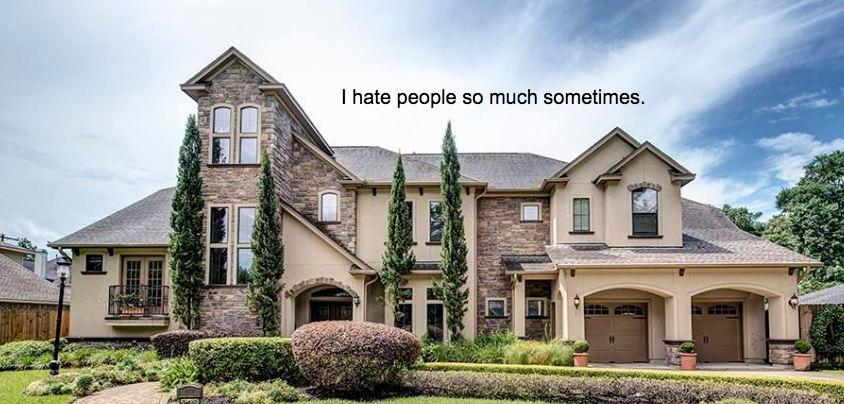
However, something about it really bothers me. There was an episode of 99% Invisible where the guest was talking about their McMansions blog and how it makes fun of these Horrid dwellings. The whole thing stank of classist elitism. The Wrong Type of people were getting the chance to design and build large houses, and of course they're applying their Bad Taste that's neither Genuine nor Authentic. They don't know about the traditions of Fine Architecture so of course they were doing it all wrong...how embarrassing for them!
Edit: It sounds like a lot of the way I interpreted this could come from my background as someone who's transitioned from lower working class to solidly middle class, and so I'm applying that defensively even though (thank God!) I don't live in an Embarassing McMansion. In fact I'm now considering the blog as more of an educational campaign where an expert in the field is railing against problematic and widespread trends in that field. It has less to do with transitions between class and more to do with the decline of an important field of engineering and design as something that people value. I think the word McMansions itself is a bit of a disservice to the purpose of the blog, with its "slobs vs snobs" / Beverly Hillbillies connotations.
If you spend any time in a McMansion, you will start to notice little things that just feel wrong. The fridge will be placed on the complete opposite side of the room from the island with the stove in it. Closets will be placed in the middle of a wall, creating a room where the bed cannot be placed against any walls. Rooms will be designed without any sense of a traffic pattern, and you'll find that it's impossible to place a couch in your den because it's basically a 30 foot wide hallway because of where the doors are. The dishwasher will block access to the sink when open.
A lot of these things are probably unnoticeable to the owners because of their lifestyle. I know friends whose parents have literally never used a single pot or pan that they own.
Around me McMansions seem to stay on the market forever compared to houses of a similar price. A ton were built where I grew up in the 2002-2007 time frame, and nobody wants to live in them. They neglect literally everything that makes a house a home for the sake of having as much space as possible. I would be surprised if the majority of them make it 50 years without being torn down.
As much as I hate looking at these McMansions, they do give me one consolation: money can't buy taste. Maybe I'll never afford that monstrosity you call a house, but at least I've got the sense to not want it in the first place.
This combined with the rapidly rising real-estate costs meant the builders threw in some of the architectural versions of Hofmeister kinks[1] to make them look more luxurious which (IMO) only made them look worse.
I don't know about the rest, but taste is definitely subjective.
Or perhaps you're against ridicule in general. Why is it your problem what sort of houses other people live in?
This is the key point in the thread. The legitimate criticism of McMansions isn't about their architecture per se, it's about the owners. I'd go so far as to say that the bad architecture is deliberate -- its senseless variation and useless ornaments call attention to the house. This is crass ostentation and nothing more. It says, "look at me, I can afford a big ugly house (and you can't)."
in Los Angeles, city government keeps on approving these extremely large homes without even requiring rooftop solar panels -- houses with not just one but TWO air conditioning condensers -- because ... uh ... wait, why?
because they save energy per capita? no.
because they will house more people than the single family homes they replaced? no.
because large homes are basically high capacity production assets which empower the city to be even more globally competitive (like a state-of-the-art rechargeable-battery factory, a digital movie production facility, a high-tech startup office, etc)? no.
AFAIK, we just have a distorted capital market. Federal government policies support home loans and the ownership society. there's also a local shortage of other viable ways for investors to make a quick $500,000 profit.
also, it's a nice boost to the property tax base.
Surely you would agree that taste is subjective...
This isn't just an American thing, but it seems particularly bad here. People spend a lot of money on homes, but try to cheap out as much as possible in expertise. No architects, no designers for the interior, no landscape architects for the yard (many greenfield McMansions are delivered with zero landscaping!) and even sometimes skipping electricians and other skilled tradesmen for upgrades and additions.
Houses are a bit like software. Builders will typically have base plans and then depending on the price point a varying number of customizations that can be applied. The more expensive the home the more customizations offered. A really great thing about people buying McMansions is that they are all experts and know far more about building a house than someone who literally owns a company that does this. So people who sell to this demographic let the customer do a lot of driving especially on the interior. Builders can also mark up these customizations to increase margins. So really I guess bottom line here is that people want these houses. The architecture (or lack there of depending on your view) is carefully researched to appeal to people with the right amount of money to spend. Having watched this process from the builder side there seems to be little to be gained from trying to for design on to the customers as they don't want it.
I think it's a bit forward for criticizing the purchasers of these homes for the aesthetics alone. They wanted these homes and there is going to be someone who will provide it. I am yet to find modern art that I can appreciate but I am happy that others can. I love classical sculpture which I am sure someone would have a bit to say about if I stuck one in my house. If someone wants a non-functioning balcony (this I just cannot understand) to each his own. One nice feature these homes have is that they are all built together in large developments where I will rarely ever venture.
Leave out the "wrong type of people" part and you got pretty much every criticism ever. Bad movies, bad books, bad food...
The thing is, I don't believe McMansion owners need our pity. They're clearly well off and not afraid to show it. Speaking of "elitism", I'm pretty sure the author of the McMansion blog is poorer than any of the reviewed houses' owners. It's not like we're making fun of homeless people for having dirty clothes. Plus those damn houses are visible, they're part of our environment and not something you do for fun in your hobby room.
I can't get myself to feel sorry, even though I can understand a general opposition against "calling out" private individuals so publicly on the internet.
Ok.
> Plus those damn houses are visible
Like the dirty homeless people? At least with homes they are on private property.
How can you "understand that mcmansions are bad architecture" and also say "the whole thing stank of classist elitism"? The blog points fun at clearly bad buildings. Fake columns, unnecessary rooms, poor placement of re-used furniture, etc. Sarcasm is funny. The blog is sarcastic in nature. What's wrong with that?
it goes: "its horrid because its trying to copy this style, here is what this style is supposed to be, and this is why it fails to look right here"
Its basically a wonderfully funny incident post mortem.
I wish my post mortems were so funny and illuminating
Is a fake column on a house any different than fins on a 1959 Cadillac?
It's punching down: the builders/purchasers didn't know/care how to make architecturally sophisticated dwellings, which is no reason to make fun of someone. The commentary applies equally-well to pre-fab apartments, shotgun shacks, suburban housing developments, etc. It's poorly-targeted.
It's also elitist a.f. "Look at these gauche bungalows, drawn up no doubt by someone who never heard of Falling Water, let alone ever showered"
(Also worth noting that McMansions are typically homes to the upper middle class and the rich, not the poor.)
You can have homes that are 1200-1800 sqft. that are very easy to live in, aesthetically pleasing and (in non-metropolitan areas) quite affordable for a middle-class family.
For me, it's about homes that are easy to sell (because they check off all the boxes on some generic list) vs. homes that are a joy to live in. My impression is that there was some wisdom regarding the latter that has been lost in the last 40 years.
I agree with practically all of its conclusions (ugly, oversized, out of place, generic, etc.), but the entire thing was a bunch of worthless value judgements: this is bad, that is bad. Not: this is bad because of function, but literally "this should never happen" -- no explanation.
Real example from way back machine, from the blog's most recent post there:
  A transom should never overwhelm the door or window it’s sitting above.
  Here’s an example of how to transom:
  And how to…not:
(Separate: Do I think zillow was right here? Of course not).
Her main points are basically unified theme and form follows function and how McMansions often break those rules (a hodgepodge of different elements, columns too large for the things they support).
Her blog also informs fundamentals of good taste in architecture. It's no different from learning what makes a classical painting good or good pacing in movies.
>... that's it. No explanation [...]
The explanation is ~'it shouldn't overwhelm it'. Of course that's a value judgement. Like saying the front bumper (aka "fender") shouldn't be too big on a car; or a persons hat shouldn't be too big for their hat (tell that to JK, https://goo.gl/images/ztdusQ).
The implicit point is that the transom is ostentatiously large, enlarged beyond the reviewer's sense of propriety.
Surely there is nothing else. It's a judgement of style?
Worse is that most of their advice is actually harmful. For instance they don't like windows, especially asymmetrical ones. But lots of scientific studies have found that windows improve mental health significantly in a number of ways. Sunlight is very good. Or they demand houses be symmetrical. But if I've learned anything from games like dwarf fortress and Minecraft, that's not true. While symmetry might look nice, it generally creates designs that are less practical than if you weren't constrained by it. And every rule they have is like that. Just purely aesthetic constraints that trade off against other more practical values.
Perhaps you could read this post as to why the author is picking on McMansions in particular, and their stance on elitism, and give your take.
Personally, I don't get the impression of the blog authors intent that you are receiving.
I look at some of the houses on the blog and think they're really pretty. Sorry I don't have the correct sort of taste in windows or whatever. Maybe it's because I'm one of those dumb idiots that grew up in a flyover state (Iowa).
This house: http://99percentinvisible.org/app/uploads/2016/10/12-hate-pe...
Looks really pretty to me. What seriously is the problem here?
In the one you pointed out, the question arises: "Which part is the actual house?" It has a feeling of "someone stuck on this extra part here, this stairwell here, ..." particularly with the mix of the stone and stucco'd/painted exterior, the multiple incoherent roof angles, and the inconsistent Z-depth of the front of the house.
With some architecture, the more you look at it, the more it grows on you. With the picture you posted, at first glance, I had the same reaction you did -- but after I really looked at it for a while, it started to bug the heck out of me. Kind of the same thing that happens after listening to too much auto-tuned music. The effect is cool the first time you hear it, but after a while, ...
It's an insult to society when somebody builds an ugly house and everybody else has to look at it.
Settled neighborhoods are more expensive than new ones because you can avoid living next to an ugly house.
I'm not sure I mind the mixed stone and stucco that another comment mentions. It seems like a valid aesthetic style, especially with the chosen colours.
However, there are a few weird things I do notice. The double roof gable on the right seems unnecessary and unbalanced. And there are also many random windows in different styles, and in strange places. The ones below the double roof seem particularly obviously mismatched, and the window on the diagonal portion above the main door really looks out of position.
Edit: the points below are all fair.
Her blog has an extremely mean-spirited tone, she's downright attacking people.
Her audience is accepting of that because it's directed at people who own large houses, and people who own large houses have money and are successful. In her world, it's acceptable to treat people poorly, as long as they're successful and have money.
If she were applying the same architectural critique to poorly-designed small crappy houses (which exist by the millions), she'd be getting a very, very different reaction.
Her Patreon might not be as successful, let's just put it that way.
I actually think that's a big part of the appeal of the content. Large houses are typically a source of envy, but if you can turn that large house into something to be embarrassed about, the envy dissipates and the viewership gets to feel built-up by the tearing down of the wealthy person.
My standard for how people should be treated doesn't change based on their income level, so to me this just seems mean, I think much less of her, and I don't want to read more of it.
On the contrary, you'd be hard pressed to find a lower class person with the financial freedom to buy whichever house they please, and because of that they kind of have to live in houses that are made in a more functional sense of "a place where humans can live."
The blog isn't about tearing down wealthy people, it's about tearing down shitty architecture. She showcases really great architecture as well that obviously isn't affordable.
I don't think your argument has any basis.
60%+ of what McMansion complained about I was oblivious to.
Sure, there are some obvious things but the majority would not be accessible to someone unless they were educated in the field and taught what 'proper' aesthetics are.
Is it still a crime in some circles to wear a blazer with denim?
Was that "classist elitism," or did Schumann just know what he was talking about?
The real problem is that the architecture is just plain bad. Space is wasted, exterior are marred by design details meant only to suggest a style of building without any of the things that make them useful, interiors waste space and destroy any efficient attempts at heating and cooling--there is no defending that.
There is a lot of space between defending bad ideas and putting up a website to mock them.
Agreed. Driving a Mercedes is a status symbol, I don't see her complaining about the unnecessary Swarovski crystals in the headlights of an S class, but oh no those columns that "serve no function and remind of me of a bank where I keep my money" they are fundamentally different and must go.
It looks like the only references to Zillow ever are citations that the photos come from their website http://www.mcmansionhell.com/search/zillow
(I ask as someones who's flickr photos ended up on the front page of a local paper... and was mildly annoyed, but it was promoting an event I work on.. had they just asked....)
News organizations and documentaries pay lots of money to clear and use old stock news photos.
I do enjoy the critique though...
http://gateway.ipfs.io/ipfs/QmeLsfKxF4dhmyX2FSGotaDPmMEqe8p3...
UPDATED HASH: http://gateway.ipfs.io/ipfs/QmUayNU49TWHMid6pSEBSKPAHsxJkTnd...
There's still a few hits going to Tumblr and fonts.gstatic.com , but all the actual content is safely inside IPFS and being served from in there. I'll let someone else rip the external calls out.
“Zillow has a legal obligation to honor the agreements we make with our listing providers about how photos can be used,” Zillow tells The Verge in a statement. “We are asking this blogger to take down the photos that are protected by copyright rules, but we did not demand she shut down her blog and hope she can find a way to continue her work.”
You hope she can continue her work....from a fucking jail cell?
So there are many ways of fighting them. Maybe not a direct "let's see who can outspend who over a lawsuit" but something along the lines of "Are you sure you want your name on Twitter as bullying a fun and popular blogger?" kinda fight.
Copyright Disclaimer: All photographs in this post are from real estate aggregate Redfin.com and are used in this post for the purposes of education, satire, and parody, consistent with 17 USC §107.
Many of the house images are taken off Zillow's site.
That said, it's a textbook case of fair use. McMansion Hell is pretty clearly educational / critical usage.
Also of note: Kate's twitter posts from this morning also indicate she has received threatening emails following the video[2], which is sadly not surprising.
1: https://www.washingtonpost.com/news/wonk/wp/2017/06/26/the-u...
2: https://twitter.com/mcmansionhell/status/879422526698532865
Makes me wonder if PR firms are complicit with large companies looking to shut down small players. They feed a story upstream to someone and then the company can pursue legal action without looking petty or like they're picking on the little guy, providing some defense against the negative PR of "punching down" while still allowing them to accomplish their goal of harassing/silencing defenseless bloggers and entrepreneurs.
May also help them if they get to the stage of assessing damages, since they can say "This was not just some obscure thing in the corner that nobody noticed; they got national press exposure."
She's knowledgeable. She knows architecture, and she's communicating her knowledge. I don't think that makes her pretentious. It's just that we don't know as much as she does. Let's face it, a blog critiquing the shitty web design/UI choices clients make would be an absolute hit on HN.
I think the bulk of the problem stems from some just being too gaudy, instead of adopting what is in the region they try to bring another region in or a tv show impression home.
if by size alone then my neighborhood would qualify but the homes here are very basic and large to support big families; 4/5/6 bedroom and square footage starting in the 3k range to 5.5k. Go a few miles and you can find some 2.5k-4k homes that fit her styling fail bill just fine and they are that too inside as well.
So I tend to lump this in gaudy on the outside and just as bad inside. the idea good architects are not involved is just an industry trying their best to redirect
Yeah screw these people living in their hard earned home! Their windows are wrong!
He would show photos from listings of excessively large, poorly made mansions (or 'McMansions'). He'd point out all the design flaws, and architectural mistakes, then laugh at the excessive price tag.
Apart from the humour, it was super interesting. If I look at a picture of a house, there's no way I can notice water damage, mis-matched windows, or just shitty door placement.
I guess Zwillo is salty as it could lead to lower valuations.
[There's still a post up on 99% if you want to take a geez](http://99percentinvisible.org/episode/mcmansion-hell-devil-d...)
http://www.mcmansionhell.com/post/162143229176/50-states-of-...
https://www.zillow.com/homedetails/19735-Chartwell-Hl-Excels...
Wow. I really expected you were exaggerating but it really is terrible. There's not much square footage why the hell didn't they put in new cabinets at least?
These images are available absolutely everywhere, on every real estate site imaginable.
https://photos.zillowstatic.com/p_c/IS66svl699b5v60000000000...
Don't ask me why I believe this or how I'd know such a thing, all I'm saying is I sense it in my gut.
That said, I think pornography is the basic aesthetic we're all resisting, when we hate on McMansions.
It's that instinctive reptile-brain hatred of doing nothing and getting everything, no matter how tasteless the getting renders the gotten.
If you were wealthy why not put in the tiny bit of extra effort build a well constructed, nice, huge house that will last for generations?
In many (not all, not most) cases, the builders locate the house in an area completely unsuited for the property. They'll find some low-cost home in an established neighborhood of 30-40 year-old ranch homes (for instance), then tear that house down (or maybe they'll buy two lots next to each other!), then build the monstrosity that towers over everything else in the neighborhood. They'll get variances and whatnot to build nearly up to every property line within fire-codes.
It becomes a nightmare for the rest of the property owners; usually their homes will decrease in value as a result, due to nobody wanting to purchase or live in their home with such a structure nearby. Of course, this may cause them to sell their property at a loss - perhaps to another developer who puts up another such McMansion...
There's such a thing, when you are building in an established neighborhood, to be a good neighbor and build something that fits in (both style and size) with the rest of the homes. Same if you modify the existing home; you don't want to go too crazy with style or structure, because this can devalue properties around you. It all comes down to whether you have any empathy for other people; whether you can place yourself in their shoes and say to yourself "if someone were doing this to a house near me, would it be a problem?"
Unfortunately, too many people that do this don't care, or can't empathise - or if they can, again - they don't care. They just want to build, and flip it for the cash. It's a grab, plain and simple. Rarely do the people who build these live in them, because that would put them at the ire of their (now ticked off) neighbors.
Math checks out to me.
(Oh, and she's not a "girl", she's in her twenties, unless we're going to play the "use the term 'girl' to minimize a woman" game and we're not, and that 99% Invisible episode strikes me as pretty good because it reveals what people don't think about, as is their stated goal.)
I know someone who sends letters repeatedly to GEICO because he hates their commercials. Why waste the effort?
They are literally building semi-permanent garbage on the face of our only inhabitable planet.
The 4 Factors of "fair use"[1]:
>1. the purpose and character of your use.
Criticism, critique.
>2. the nature of the copyrighted work.
Published photos used in website blog without ads. Also, the photos were not put into a compilation book to be sold at Amazon. However, Kate Wagner does say in twitter that "this blog is my entire livelihood" so it seems that some commercial activity is happening.
>3. the amount and substantiality of the portion taken
Kate Wagner took a tiny percentage in proportion to Zillow's entire photo database. If the proportion measurement is a particular photographer's portfolio, she may have taken most or 100%.
>4. the effect of the use upon the potential market.
Does KW's usage of the photos cause economic harm to the photographers of real estate? Do the McHell photos reduce the value of photographers' other photos in their portfolio?
Doesn't seem so but there may be some additional cause & effect that damages photographers' works.
Seems like (3) and (4) would be Zillow's strongest arguments.
Also, one can use Zillow without ever clicking "I Agree" to a ToS so I'm not sure if that's even contractually binding or has been tested in court.
[1] https://twitter.com/mcmansionhell/status/879429709251137537
They did say that. But the true nature of their actions are intimidating an under-funded adversary who actually does have fair use rights to criticize their work.
Think of the slippery slope- TOS of car, can't complain about defects, TOS of prescription drug, can't say grandpa died while using it as noted in the side effects of the drug. And that's why the courts have shot down these "TOS trumps the First Amendment" cases every time.
It's a good concept for a site. On it's surface it looks down right like community service. It's a bit snarky here and there but, man, some of those houses invite that kind of criticism. I don't see him selling anything, just a plug at the bottom about an article he wrote elsewhere.
Maybe he should switch from using Zillow's copyrighted pictures and ask readers to send in pics from their neighborhoods. Perhaps ask people to please assign copyright to him if they do. If people know he's not making money off it and just sharing info/thoughts on ugly housing I bet people would contribute.
I wonder if EFF would be capable of helping out.
We give large companies far too much lenience to bully in this country.
The legal system is fundamentally broken in this type of matchup, a small player pitted against a public company with billions of dollars floating around. Her only hope to win the fight is to be picked up by a nonprofit like the EFF, but my experience is that they're very restrained about where they'll lend assistance (that is, they're useless to most people).
Her only hope to get through the next five years without having her life substantially wrecked by a totally unnecessary lawsuit (which she will likely lose if it goes to court) is to comply with the C&D and hope that Zillow calls off the dogs.
Her brief plea for help at the end of this post could be construed as an attempt to conspire to continue to harm Zillow while avoiding legal accountability for doing so, and Zillow's attorneys will no doubt seize upon that construction to make things as bad for her as possible.
The thing to understand is that once lawyers are contacted, the time for friendly discussion or rational pleading is over. The lawyer is paid to get the court to believe that their client is being seriously harmed so that they are granted maximal damages. Conciliatory tones and forgone possibilities to highlight damage would only hurt Zillow in an eventual court case, so the lawyers must seize upon such communications aggressively. Their sole job is to make the case that Zillow is being victimized as credible as possible, which means making the defendant look as bad as possible.
We seriously need to get the legal system under control. An individual is lucky if they can afford 10 hours of time from a competent attorney. Large companies intentionally prolong their cases to try and starve less-wealthy opponents out by exhausting their legal funds. I am familiar with small companies who were forced to settle, even after spending $3M on legal services.
It takes up to a decade and millions of dollars to even have such a case seen through in the US.
IANAL.
Source: I've had a giant law firm sicked on me by a Fortune 100. I complied with their C&D (by shutting down my business) and they went away.
If she would likely lose in court, then Zillow has a legitimate case against her and is doing her a favor by sending a cease and desist instead of going straight to court and taking her money. I don't see why you would feel sorry for someone in that situation.
I feel sorry for her, but that's because I don't think she would lose in court.
>If she would likely lose in court [...] I don't see why you would feel sorry for someone in that situation.
A law's existence is not an automatic justification for its invocation. Copyright law is pretty draconian on its own, and automatically-accepted browsewrap/clickwrap Terms of Use generally constrict action even further, making almost anything a breach of contract. Fair use exists, but the standard is fairly high, and it is not really practical for a normal person to get it, especially since each use must be considered in isolation.
Other types of intellectual property would probably also be involved here, including an accusation of "trademark dilution", i.e., harming their mark's value by using it improperly. I haven't seen the C&D but it probably includes various other claims along these lines, all of which she would have to defend, which means big $$$ even if she did win (and if attorney's fees are eventually awarded, they will cover only a tiny fraction of the overall costs).
A large company with giant law firms seeking to punish individual authors for failure to unpublish unflattering blog posts should make you feel sorry, even if those giant law firms are able to contrive a case that shows the conduct was technically illegal. It's not hard to do, especially when there is such a massive resource differential.
In the real world where we're allowed to widen our perspective beyond the legal minutia, this is a blatant attempt to silence press that Zillow doesn't like. The fact that it is possible for big companies to do this to people should seriously frighten everyone.
>doing her a favor by sending a cease and desist instead of going straight to court
A C&D is part of the process. It's not mandatory, but my non-lawyer understanding is that it looks bad to file a suit in this type of case without first asking the defendant to cease and desist (that is, issuing a formal C&D).
Lawyers don't send a C&D to be nice. They do it because the court wants to see that the plaintiff a) sought non-legal remediation before filing a lawsuit and b) because plaintiffs have a responsibility to mitigate ongoing losses when they are able to do so.
The job of the lawyers is to maximize outcomes in favor of their clients, and that means crossing the ts and dotting the is. Failing to send a C&D leaves an opening for the defendant to try to soften your damage claim, pointing out that you did not attempt to mitigate the damage.
If Zillow actually had been damaged by this operation, they would continue the lawsuit after the would-be defendant ceased and desisted and try to recover the damages they suffered. Since this is just a tactic to pressure the other party into unpublishing their content via the legal strongarm, money won't be wasted on a lawsuit after the publisher has been bullied into submission.
IANAL
What I would do in this situation is to write a response letter saying, "I do not believe your accusations have merit, therefore I will not comply with your demands. I am open to further negotiations, but I will not agree to withdraw any of my own work from publication." Then they would have to make a more reasonable demand, or actually file a lawsuit.
In their complaint and summons, they would actually have to make a case, and request some form of relief that the judge could grant.
And my answer to it would essentially be this: I deny all claims made by plaintiff.
This would be followed by a request for discovery, for all computer access logs wherein Zillow believes that I bypassed their method of preventing those who have not agreed to their terms of service from accessing content via their website. Then I'd let the statutory clock run out on that and move for dismissal. There is a miniscule chance they could prove that she accessed their website at all, much less show that she violated ToS in doing so.
[0] https://en.oxforddictionaries.com/definition/corroborate
Among other things, it claims the content is not fair use material, and threatens with the CFAA.
Edit:
Putting arrows and text on an image is a modification. What if she used something to overlay the arrows and text? Would that still be considered modification?
http://www.huffingtonpost.com/ann-brenoff/olive-garden-revie...
Maybe because that's what she is knowledgable in, and she wants to point out bad practices in the industry she's involved in, or because they make expensive houses with cheap products that are only built to resell as opposed to have someone actually live there for an extended period of time?
Look, these things might not mean anything to you (or me for that matter), or ever have a real effect on you and that's fine, but you really can't imagine why such poor practices might annoy someone whose career is based around knowing not to do these things that are so prevalent?
Do you think subreddits like /r/programminghorror are mean spirited? If someone posted a snippet with 1000 cases in a switch statement, would you say "Why should anyone care what sort of sort of code people choose to write or use in production?"
I don't see how that is any different than this, or how calling out bad practices with broad strokes is a mean thing to do.
I feel like there are certain rules or techniques in say, painting, that if one follows, can contribute to the art being perceived as "good". When you combine rules or techniques and it is poorly executed, the art may be perceived as "bad". Seems to be the same with architecture.
Seems to me that Kate is an art critic of sorts. A very specific one.
Answer that question and you've come at least half way - probably much closer - to answering your own one.
http://webcache.googleusercontent.com/search?q=cache:zFONMls...
I'm also not really certain that Zillow has the copyright: those are usually property of the RETS/MLS of that specific area, if not the agent taking the pictures.
If you can get the byte-for-byte identical image from a different website, how does Zillow exercise any control here? If she just stops using Zillow, isn't she protected?
You'd have some MLS'es that required their logo to be on the bottom right, some that required them to be on the bottom left, and 95% of the time, your data feed didn't even contain the logos: you'd have to double check and make sure that you were in compliance (and they did check and would cut you off if you were not in check).
But, to answer your question: There's nothing that prevents her from going straight to the MLS or the listing agent's website to grab her source photos: zillow would have no claim at this point in time.
Lawyers exist for a reason. Don't let other lawyers bully you with threats. Get your own lawyer to look into things. Back down if it makes sense. Sometimes it does. But don't back down just because you get threatened.
Also, keep in mind that I'm not specifically talking about Zillow right now... I'm saying that you shouldn't let yourself get bullied. Running scared from a letter is just a bad practice.
Like you could stop someone using your image in a parody because you took the picture of your tie and they instead parodied your suit wearing. Doesn't work, the image stands by itself, the supposed purpose of the image is irrelevant to the copyright ... or am I wrong?
If I take a picture from Zillow's site and use it to teach a class about poor framing (ie photography technique) then the exception for educational use still stands.
Is there any open repository of house images (OpenStreetMaps, etc.) that could be used as a substitute in the interim?
OpenStreetMap doesn't store images, just map data. Mapillary and OpenStreetCam are "crowd sourced Google Street View" alternatives, which could be used for that.
At an extreme case, you can put a photo on flickr with the correct tags and geo tagging information?
Furthermore, Street View photos aren't necessarily any safer from a copyright claim. I think a creative lawyer might try to make the claim that you can't copyright data, and that Street View is so ubiquitous that it's data and thus not copyrightable, I'd be surprised if a court bought it (though IANAL).
https://www.webcitation.org/archive
Edit: the blog just disappeared for me. I managed to archive the last 13 pages of it in archive.is.
Bonus points to McMansionHell if they use only quotes from Zillow in their defence!
Some relevant info:
* https://www.scribd.com/document/339052523/VHT-v-Zillow - jury verdict
* https://www.sec.gov/Archives/edgar/data/1617640/000119312517... - notice to SEC that Zillow intends to appeal
* https://www.vedderprice.com/takeaways-from-vht-v-zillow-for-... - "Takeaways From VHT V. Zillow For Website Owners"
I really wish archive.org wouldn't honor that.
But as someone who wants to one day buy a huge McMansion in Vegas just for personal gratification, fuck all of these self-righteous snobs.
Much of their advice could actually be harmful. E.g. reducing the number of windows to make it fit into their desired style. Windows have been shown to be very beneficial to mental health. E.g. hospital patients in a room with a window recover earlier, depressed people improve a bit when they can see trees, bright sunlight is hugely important in establishing the circadian rhythm, etc.
Or the demands for the houses to be perfectly symmetrical and "balanced" is very constraining. It eliminates 99% of design space. There are otherwise more optimal designs that must be discarded because they don't meet that constraint. A room must arbitrarily become so much bigger or smaller, or eliminated entirely, to satisfy it.
And the same is true for all of the rules. They are all purely aesthetic constraints.
Is this just a case of the power of the almighty $$$ or is there something I'm missing?
A few of her architectural points are correct: a missing column here or there, perhaps some matching windows. But, most of her commentary is reaching and snarky. She might have fared much better if she put a positive spin on it and told people how to improve there architecture rather than picking apart every minor flaw, to which otherwise would be a great mcMansion.
I found most of the houses and pictures shown on there quite good looking. I would be really lucky to live in anything posted on there. I don't think she's seen bad looking architecture yet. Obviously, she's never looked at housing in CA.
And criticizing a house for having too small a lot - that's just really low. That's like criticizing a poor kid for not having any money. People don't get to chose the cost of land in their area. It's decided upon by voters and government. If she has a problem with lot sizes, she ought to blame voters not the house.
https://m.youtube.com/watch?v=XO9FKQAxWZc
Paley is in the process of creating an epic animated story, using music appropriated with out rights, as a protest piece against copyright.
She addresses the question somewhat at her blog: http://blog.ninapaley.com/?s=copyright+is+brain+damage&submi...
If you're looking for a transcript, I'm not aware of one, though Techdirt addresses some of the points raised:
https://www.techdirt.com/articles/20151022/23582332603/nina-...
[0] https://web.archive.org/web/*/http://www.mcmansionhell.com/p...
[1] https://webcache.googleusercontent.com/search?q=cache:AXKs99...
IANAL, but her case seems cut-and-dry by fair use standards. I hope that she fights it and seeks the help of her (very appreciative) readers in fighting it.
http://blog.buildllc.com/2010/04/couch-cushion-architecture-...
2) I was under the impression nearly all of the photos on Zillow come from MLS anyway.
As an architect, I take my hat to whistleblowing construction businesses that profit mostly on layman's ignorance.
    apt install dnsmasq
    echo "address=/zillow.com/0.0.0.0" >> /etc/dnsmasq.conf && /etc/init.d/dnsmasq restart