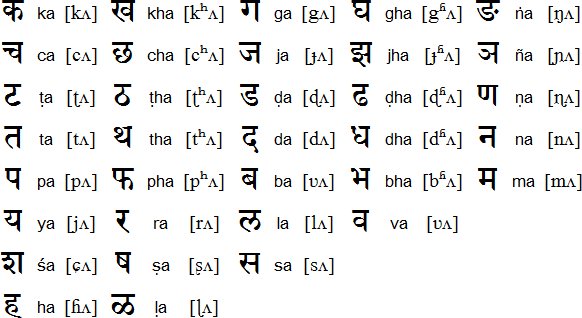
Taking a look at Sanskrit, it looks very cool. I think it's aesthetically better looking than Korean alphabet.
It's considered that by lay people, largely due to Korean patriotism, not by real linguists (can you provide a source?)
> an HN'er should be able to read and write Korean in about an hour.
So, you're talking about the alphabet used to write the language, not the language itself. At best you've proven that Korean has a highly regular writing system. But I'd argue that the average HNer could learn to read, for example, Spanish in about two minutes.
I didn't say the MOST, it's among the more scientific languages. I'm not pushing for Korean patriotism, that's just your own assumptions.
> So, you're talking about the alphabet used to write the language, not the language itself. At best you've proven that Korean has a highly regular writing system. But I'd argue that the average HNer could learn to read, for example, Spanish in about two minutes.
Hangul is the writing system that is uniquely different from a latin based system like Spanish. Your argument is moot.
Unfortunately the people in charge of the Revised Romanization decided that these rules should be applied to the Roman alphabet as well, so we have execrable constructions like "Daegu" or "bibimbab" which can't be pronounced from English spelling rules.
[0] http://www.ryanestrada.com/learntoreadkoreanin15minutes/
If you can't comprehend what you're reading, you're not reading. Learning the Korean alphabet is not learning Korean.
I don't see how that interferes with it being used as a programming language, although it doesn't seem particularly useful for the AI problems it was proposed for. There is also no need to carry over the tradition of referring to the same thing with different descriptions in a programming context.
It seems kinda neat that every name is necessarily descriptive as well.
Am I missing something, perhaps the ambiguity goes deeper than that?
The many layers of meanings is again what you would expect to emerge after a long history of entangling various fields of knowledge, such as philosophy, history, theology, etc, in a dense web with language at its core seen as a primary tool of exploration in these fields (their metaphysics postulated that words have "power" in and of themselves, so language automatically acquired very high status).
Some of these developments are also seen in Europe historically, but not to the same extent. Probably because there was no single unifying language there to play that role (Latin did play that role, but too briefly, and there was no continuity on that level between the ancient Greek tradition and the latinizing Middle Ages - while the whole eastern half of that cultural ecosystem skewed towards a Slavic lingua franca, and even then mostly for religious purposes).
One thing that is worth clarifying IMO: There is nothing inherently “scientific” about Sanskrit as a language by itself: instead what's remarkable are
1. the Sanskrit grammatical tradition, as represented especially by Pāṇini. The Sanskrit grammarians paid special attention to language, and their careful study culminated in a grammar by Pāṇini that was centuries ahead of its time, and is still throwing up new insights. The last several generations of modern linguists have read their own ideas into Pāṇini: from William Jones at the start of historical linguistics to de Saussure to Chomsky to Kiparsky. (The last of whom is an expert in both Sanskrit and modern linguistics.) Panini occupies a place in Indian thought equivalent to that of Euclid in Greek, and explicit comparisons have been drawn between the two. (E.g. all students were expected to master them respectively, these were the sciences that all others sought to emulate, ...) (I remember reading somewhere something to the effect that: among achievements of civilizations, the Egyptians have their pyramids and India has Panini's grammar.)
2. the cultural fact that, Pāṇini's grammar having been so exhaustive/complete, it became regarded as the definition of correct Sanskrit, and culturally for centuries everyone who composes in Sanskrit has just chosen to stick to this grammar. This "froze" Sanskrit and gives it a timeless quality: Sanskrit poets composing today use the same language that would have been comprehensible centuries ago; learning this one language opens up literature spanning 2500 years. With other languages that evolve naturally, this is difficult: even Shakespeare's (early) modern English is difficult for many.
- it is useful to linguists. (Modern linguistics borrows terms like sandhi and bahuvrihi for example.)
- it is acceptable to language users. Poets have continued to compose in the same language, without finding the formalization artificial.
- it is interesting even as an achievement of the human mind/culture.
A somewhat trivial example, but possibly of interest to the HN audience: the grammar needs to refer to various sets of sounds (like "nasal consonants", "short vowels", "aspirated stops" and so on). To compactly encode these sets, it adopts a curious ordering of the sounds, so that each required set can be represented as a certain substring of that sequence.
It turns out that this ordering can be shown to be optimal: see e.g.
- Economy and the Construction of the Śivasūtras by Paul Kiparsky, Stanford University http://www.stanford.edu/~kiparsky/Papers/siva-t.pdf
- A Mathematical Analysis of Pāṇini’s Śiva sūtras, by Wiebke Petersen, University of Düsseldorf http://user.phil-fak.uni-duesseldorf.de/~petersen/paper/pete...
In 1985, Rick Briggs, a NASA employee and Sanskrit (over)enthusiast, wrote an article in AI magazine [1] pointing out that for knowledge representation, one could use the Navya-Nyaya language (which in his article he called "Shastric Sanskrit"). As this (highly artificial) language (or "dialect of Sanskrit"?) had been created by the Navya Nyaya school precisely for knowledge representation (in some sense), this is not very surprising. A good description of this language is given by Ganeri ([2][3]). I think it's good to publish such articles to show "related work" across cultures (and centuries). There are no clear advantages to using this Navya-Nyaya language over some other formal language though.
In popular culture, the awareness of the existence of this paper morphed from "a particular formal dialect of Sanskrit devised by logicians for knowledge representation happens to be good at knowledge representation which we need in AI" into "Sanskrit is useful for AI" into "Sanskrit is great for computers".
[1]: https://www.aaai.org/ojs/index.php/aimagazine/article/view/4...
[2]: http://www.columbia.edu/itc/mealac/pollock/sks/papers/Ganeri...
[3]: http://www.academia.edu/download/30301777/Logic_Navya-Nyaya_...
[1] https://en.wikipedia.org/wiki/Backus%E2%80%93Naur_form#Histo...
Also, the Sanskrit course got very political, for reasons I could not relate to at all, involving the history of India. The textbook remains on my bookshelf, gathering dust.
[1] In case you're curious, what exactly I mean by Indian studies, some examples are all form of classical Indian music (and that's quite a few ..if you are to consider learning specific musical instruments by themselves as a subject, besides music theory), classical Indian dance forms, Yoga, Ayurveda ...etc
It is one of the languages in which every language, word can be copied into and pronounced to a surprising accuracy. For example, this very post can be written using Urdu syntax and still be pronounced closely to as it would sound in English!
While Sanskrit (and to an extent Hindi) may have some unique properties, I find the syntax (script/alphabet) extremely daunting to understand (for a non Hindi/Sanskrit speaker).
But ultimately, research should continue I guess to see if there is any Sanskrit-derived benefits for the mankind.
The push of such argument is inherently nationalistic than 'scientific', ironically.