1. Brush
  2. Meditate - 15 minutes
  3. Write - I usually write "3 things that I am grateful for" and "3 things to focus on that particular day"
  4. Exercise - 15 minute run
Start small. If 15 minutes of anything is too much start with 5 minutes. That's what I did.
What is good? 1) Why is it good? 2) Why did it happen?
Some of them are a result of direct or indirect action. I studied more. Some are a result of external events. The sunset was fantastic because God decided we needed a great sunset.
This has done wonders for my kids (now mostly grown) in relating their action to positive outcomes. We don't practice this much anymore but should get back to it.
My wife and I exercise for 45 to 60 minutes 5 days a week, most weeks. We rise at 4:30 AM and are done and home by 6:30. We go to bed really early.
We are 62 (myself) and 57 and the exercise is helping us a lot with health, vitality and positive outlook. Somedays it is hard to get up and go. It is always a good thing when we are done and we are grateful we went to the gym.
I strive for 7+ hours of sleep.
I mediate some, mostly at lunch time.
Wake up, immediate meditation/prayer and a gratitude list.
Only things missing is contemplating what you need to do today to be a better person at the beginning of the day and reflecting on what you did well and could've done better when you go to sleep.
An excerpt from the portion referred to as "On Awakening":
"When we retire at night, we constructively review our day. Were we resentful, selfish, dishonest or afraid? Do we owe an apology? Have we kept something to ourselves which should be discussed with another person at once? Were we kind and loving toward all? What could we have done better? Were we thinking of ourselves most of the time? Or were we thinking of what we could do for others, of what we could pack into the stream of life? But we must be careful not to drift into worry, remorse or morbid reflection, for that would diminish our usefulness to others. After making our review we ask God's forgiveness and inquire what corrective measures should be taken."
I can function on six hours, but not well. I also can't easily take 15 minutes to meditate in the morning, because I have a two month old baby I have to help care for in the mornings. This somewhat limits my ability to meditate and exercise.
If you really feel the need to disagree, you might suggest better activities or make a compelling case that focus is considered harmful.
https://www.reddit.com/r/IAmA/comments/2rgsan/i_am_elon_musk...
Got my dad to do the same. I actually made him start with just 1 minute of each. He is upto 10 minutes after a month. Plus has started weight training. He is 60.
I guess the main takeaway is do the smallest possible interval you can ( have no excuses to not do) and don't beat yourself about it. Build it up gradually
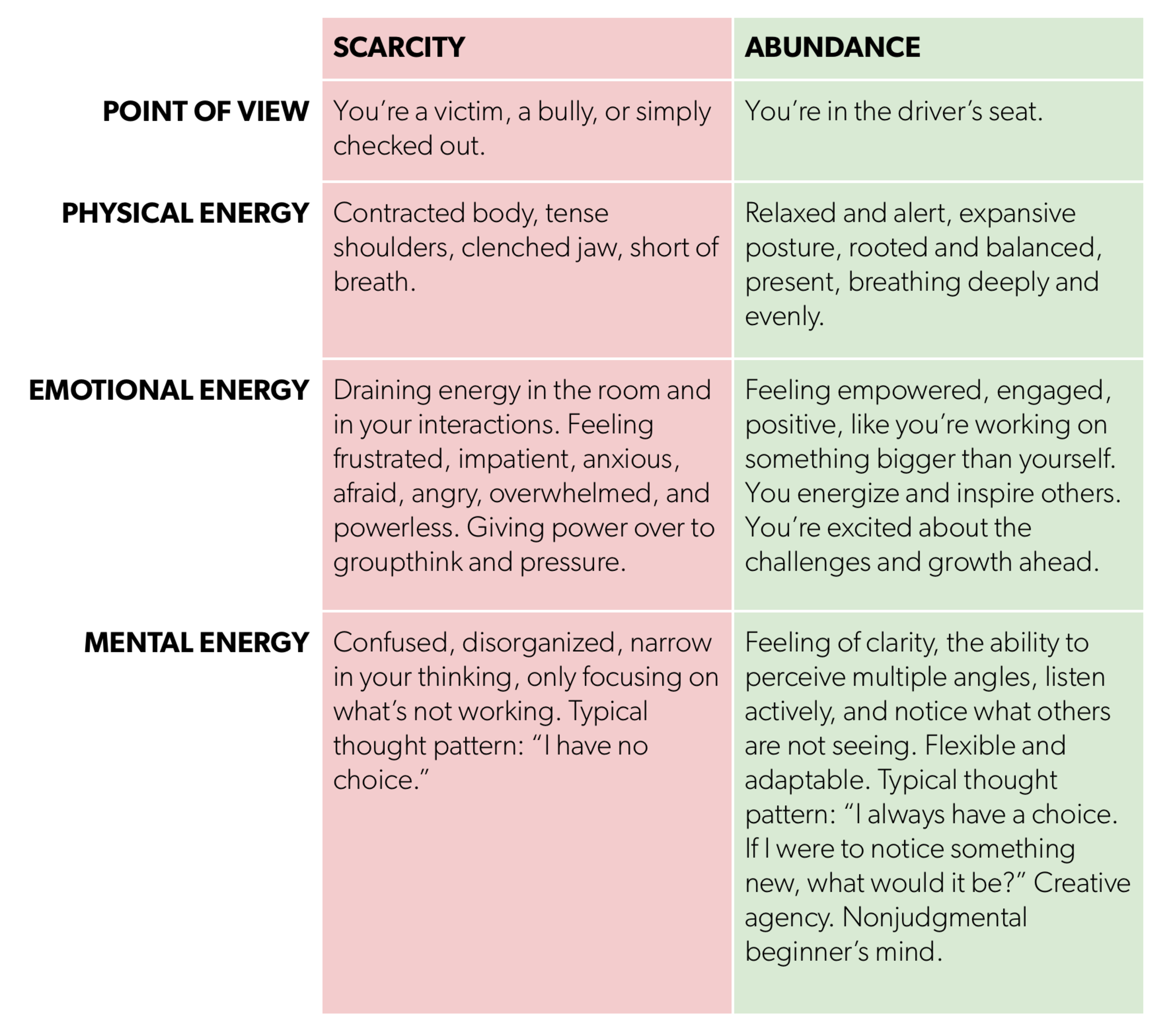
From the article: The ideal attitude is what she calls Abundant Thinking — a mindset that gives you the creative agency and grit to reach your vision — and, on a daily basis, to design your own life. When Verresen first meets most of her clients, they’re in reactive mode. It’s like they’re in a movie, acting in their job and life without knowing the script or having perspective. Her goal is to put them in the director’s chair, with more choices, perspectives and possibilities to rewrite and upgrade the script as they go.
From an evangelical site: One way of viewing abundant life is to see when people have been changed by the power of Christ; they live different lives, which affects all aspects of their experience. In missiololgy, we call that "redemption and lift." This isn’t just true individually, but can also be on a cultural level. So, spiritual change, accompanied by better decisions, does often lead to better circumstances financially. (Sometimes it get's you arrested and martyred, so don't miss the point here.)"
[1] http://www.christianitytoday.com/edstetzer/2015/march/what-d...
The New Age contrast between scarcity and abundance is compelling when applied to the question of adapting to changed circumstances. (Take for example the link posted in the last day or two about people raised in poverty finding it difficult to regulate their food intake.) The New Age arguments boil down to a simple diagnosis that we have been conditioned, by scarcity, into habits that are no longer appropriate.
There was a Wired article about 7 years ago which discussed this contrast from another angle. In that article, like the original link under discussion here, the Scarcity mindset is caricatured as mean and rigid. The Abundance mindset is healthy and open to alternatives. It's not at all about "manifesting" abundance out of nowhere, as per The Secret. I think Stephen Covey might be a major source for the Wired version of the polarity.
From the Wired article "When scarce resources become abundant, smart people treat them differently, exploiting them rather than conserving them. It feels wrong, but done right it can change the world.
The problem is that abundant resources, like computing power, are too often treated as scarce."
Hard to disagree with that.
I did read that rats run faster towards a reward than they run from a punishment etc., so yeah, scarcity vs abundance, sure, but if someone is paid to coach me when I have a deadline to meet, I'll show them some abundance.
I picked one of the more conservative sites promoting "abundance". There are much worse. See "Prosperity Theology" in Wikipedia. That, however, seems to have declined since the 2008 recession.
Practially, this is what meditation leads to. This is what therary leads to. This is what "being in the zone" really means.
Bottom line, this is a state that is good for us, and that we avoid most of the day, despite being adviced as a practice by almost all the important doctrines for a long time.
Not to be cynical about this approach, but having studied some of these concepts from a Mahayana Buddhist perspective, the idea of utilizing the perspective of Beginner's Mind to "grow your power" is a gross misappropriation and misunderstanding of the entire framework. In fact, within the traditions that originally conceived of these approaches, attachment to power, fame, and/or wealth is seen as the root cause of suffering and mental disenfranchisement and the very conceptualization that is to be let go [0].
Perhaps I need to look into this course a bit more to understand their approach but it seems that this is right in line with what many Buddhist scholars have worried - i.e., that these ancient traditions will be misunderstood and reformed in a way that may have wholly unhealthy effects on those who practice it.
[0] https://en.wikipedia.org/wiki/Four_Noble_Truths#Second_truth...
If you are truly "on the path", you will eventually be challenged to drop your ego. It matters not how you got onto the path, but how you respond to each challenge.
The very beautiful potential consequence of this kind of teaching is that it will get more and more people onto the path regardless. And once you are on the path you will recognize the suffering inherent in the pursuit of wealth, fame, and power.
On the other hand, there are parallels between the two: "noticing" and "neutrality" are mindfulness - open non judgemental attention. "Priming" is concentration meditation. "Self-compassion", "generosity" and "gratitude" are metta. They took Buddhist ideas and reused them in a corporate setting.
Without an understanding of the foundational concepts of impermanence, nonself, and nirvana (the three jewels), activities like meditation lose much of their transformative power and much of their effects on creativity and mindfulness. This is important as these effects appear to mirror the very aptitudes that "Abundance Philosophy" is attempting to target.
Judging by the chart under the Self Mastery section, it seems the author defines it as growing your physical, emotional, and mental energy.
Such a result could be argued to be in correlation with the Buddhist proposition of letting go of attachment and desire.
By letting go of preconceived notions, concepts, opinions, or the desire to have power (dominance) over others, we then have all of that energy available to us for creative means which would have otherwise been wasted in anxiety, or saṃsāra.
[0] https://www.cla.purdue.edu/english/theory/newhistoricism/mod...
There are certain things, like enlightenment, which naturally slip out of your grasp the moment you try to deliberately reach out for them.
I tend to see the problems with things. The stuff that is good enough, why spend time thinking about? Seems boring to me - it's already done, lets move on.
I actually somewhat don't like being labeled as "negative person" since the actual result in my thinking is usually very positive outcomes. I improve things and make them better. How could I do that if I didn't identify what is wrong with something? The new webapp you wrote for me might be 95% awesome, but I'm going to probably be immediately drawn to the 5% that sucks just by the nature of who I am and that's what I'll be focusing my energy on to improve.
This worked well for me in my personal life for some time. Identify bad habits, get rid of them. However it can be a grind and I think folks that think the way I do are much more prone to depression and negative feedback loops that result in isolation (largely out of perhaps a frustrated idealist point of view). That's when it get's dangerous.
As in all things in life I think it's about balance. As I get older, I absolutely see and believe in the power of positive thinking. I just think some people can take that a bit (or a lot) too far and use it as an excuse to delude themselves.
https://en.wikipedia.org/wiki/Candide
Worth a read before you start decorating your home with power crystals and fire up the incense.
If you approach girls with an abundance mentality, you're much less needy, more confident and you don't really care about the outcome. You're just there to learn about her, and if she's not interested, well, there's plenty of other girls that will be.
I mean really, I get what you are saying here, but it comes dangerous close to a guy viewing women as a "resource" and saying that he behaves better when he views that resource as unlimited.
If the usage of the word "scarcity" was what caught your eye (as an association with women being "resources"), it was simply pulled from the article, which labels the two contrasting types of thinking as "scarcity" and "abundance".
I'm usually a bit skeptical of bullet point advice like this as reading it always seem like self-evident truism; I think people have to really experience it in order to understand its proper depth. But I'm glad that self-compassion is mentioned here because it's not preached very often and prob less intuitive. When I realised about it in one eureka moment (I know!) almost immediately I could have more respect for myself and found it much easier to forgive personal flaws and mistakes. So if you ever find yourself kicking and loathing over something, do a mental "There, there" patting on your head! You'll begin to see life in a much more whimsical, Woody Allen way :)
> I have expressed my strong interest in the mass of the people; and this is founded, not on their usefulness to the community, so much as on what they are in themselves. Indeed every man, in every condition, is great. It is only our own diseased sight which makes him little. A man is great as a man, be he where or what he may. The grandeur of his nature turns to insignificance all outward distinctions.
-- William Ellery Channing
I think that can be extended to more than humans, maybe everything.
And hey, don't knock eureka moments, especially not your own! When I was 20 and late for work in the morning, I walked by a lawn with a bird on it who was looking for worms, and looked straight at me. I didn't think about it at all, but nodded and said good morning. Then I had to laugh at myself, then I thought about it, and I never quite saw animals the same way. Suddenly it seemed so obvious, of course they're persons. Not ones who speak my language or care about my salutations, but still. I feel similarly about plants, central nervous system or not. I mean, it's not like I could tell you what I mean with "person" to begin with, where the cutoff point is, but something changed and it felt and feels right.
But compassion for animals and plants is easy, compassion for humans is trickier... and compassion* for oneself, that's the trickiest part, and as you said, the most often overlooked. It's like we understand just fine that we shouldn't dehumanize others, shouldn't hold grudges, not disappoint people or break promises, and so on, but simply affording ourselves that same respect and basic goodwill often eludes us, which we then compensate with all sorts of things which are far from both compassion and real confidence.
* which is a great way to put it.. self-love just doesn't have the same ring of understanding, patience etc. to it; like "loving Justing Bieber" and "having compassion for Justin Bieber" are two completely unrelated things.
[1] https://s3.amazonaws.com/marquee-test-akiaisur2rgicbmpehea/W...
Fortunately, a quick hop into dev tools fixes the problem. For the primary paragraph content, switching from the current 22px down to 16px makes this read so much easier.
When I see a marketable name for such things, I immediately know it's some BS mix-match of hogwash to sell to people in need.
And sure enough: "sought-after executive coach Katia Verresen, who counsels leaders at Facebook, Stanford, Airbnb, Twitter, and a number of prominent startups".
Hooray for snake oil.
http://www.salon.com/2011/08/02/first_rate_madness_interview...
This guy's thesis is that in tough times, mental illness is associated with leadership effectiveness. His examples are Lincoln and WT sherman. (the stats argument here ends up being pretty weak).
Bottom line -- it's really hard to grade heuristics unless you have enough knowledge to restrict the situations which may occur in the future (and if you do, it's no longer a heuristic).
http://www.telegraph.co.uk/technology/3304496/Be-lucky-its-a...
Also: The advice given is not complete. The people who have success with this do the things the article describes, but they also do some important things the article doesn't describe.