After adding 19 separate exceptions in uMatrix for both whole domains and for types of requests/actions on domains, I still don't see any ads but I do see an ever-increasing list of third-party sites Wired is pulling requests from. Given a choice between throwing up my hands and saying "Fine, f*ckit, do whatever the hell you want" and whitelisting Wired's requests to all of (disqus, optimizely, amazon-adsystem, condenastdigital, demdex, typekit, adobetm, chartbeat, cloudfront, doubleclick, googleadservices, googlesyndication, googletagservices, mediavoice, mookie1, omtrdc, outbrain, parsely, scorecardresearch, yldbt and zqtk) plus whatever others would be pulled in were I actually to whitelist, I guess I'll have to do without Wired.
So far without ever actually loosening things up far enough to see ads that's AT LEAST 21 different top-level domains Wired is pulling from, not counting its own (and yes, I realize it's part of Conde Nast). Most of those top-level domains have at least 2 subdomains being pulled from, sometimes more. My basic reaction to this is that even if I trust Wired and Conde Nast, I don't know that I trust all those other sites like "mookie1," "yldbt," "zqtk" and whatever other obscurely-named domains.
Frankly, were I to see "yldbt" or "zqtk" as a running process or folder name on a system I was working on, I'd immediately rename them and start virus and malware scans.
So I guess my reading of Wired online will suffer much the same fate as my reading of Wired on paper, because while I like seeing occasional items from Wired it's not a daily destination for me, and I'm certainly not coughing up $50+/year for it.
Run some apps with Little Snitch turned on and you see the same thing. Tons of outbound requests to domains that I have never heard of and have no idea what they want on my machine.
I just block everything with reckless abandon. I don't give a shit if my "experience" is degraded.
Frankly, with small kids in the house who I would like to protect to the extent I am able... I am considering installing Pi Hole and whatever else I can find in addition to the spartan whitelist I've set up for them to use via parental controls.
I will say that the installation process can be somewhat painful if you deviate from the norm. I didn't want to use Google DNS and instead opted for OpenDNS, plus I wanted my own directory structure, etc...
I want people to get paid--really I do--but I'm not stepping barefoot into a cesspool of web cruft to do it. Blockers are like putting boots on so you can wade through it safely. Clean up your mess and I don't mind going barefoot.
They sound as though they're trying to accommodate 'us', but the proof will be in what the 'ad-free' experience is really like. I wonder if they're considered a paid RSS feed as an alternative - that would certainly solve much of the issue for many.
Simple static ads would render most of these concerns unnecessary, but I doubt there's any incentive to go back to that kind of "outdated" advertising.
What I object to is the cesspool of unidentifiable tracking and god-knows-what-else crud.
heck i block ads as a side effect of blocking things like Google analytics.
Never mind even getting hacked. Ad providers routinely violate the trust of content providers by activating audio, throwing up full screen overlays and who knows what else. I'm not an expert but I'm given to understand that it's hard for content providers to quality control these sort of ads. The whole delivery system is gamed to a ridiculous degree.
Publishers want ads but don't want to actually do the job of selling them; ads used to be free money, and this is coming to an end.
Ads from their own domain would be a little harder to block, especially because blocking would have to be done on a page-by-page basis (or at least, website-by-website).
I see, of course, that I'm likely not representing the majority of adblock users.
The marketers buy the hype and want all of that. "If I take this pretty chart from here, and that table that from there, and these numbers from over here, I can make a really impressive report!"
And they want to make sure that they're collecting all the data they could possibly be collecting (because they never know when they might suddenly need the last 6 months data about something they never thought of), even though they don't know what queries they want to be able to make.
So they make the developers add all of them, end up with tons of data but very little information, and start talking about 'this big data thing' that could maybe give them answers even though they still don't know what questions they want to ask. And to use it, you just have to add this little snippet of javascript...
No thanks.
when a site gets hacked, you get malicious content regardless you block ads or not.
Nit: Those aren't top-level domains. TLDs are things like com, net, org, uk, io, etc. More info here: https://en.wikipedia.org/wiki/Top-level_domain
I enjoy Wired, but the thought of adding yet another subscription to my monthly credit card statement is too great a cognitive load for me to want to make the jump. Also, if you were to subscribe to the dead tree version, you get 6 months of dead tree + digital + a physical object (battery) for $5 that comparing it to $4/mo for digital only feels cheap.
I don't mind paying a small amount for reading the occasional article, but I don't want to manage a ton of new subscriptions.
Suggested Solution:
Now micropayments have never taken off for much the same reason, but what if I funded one general "content publishers" account with the equivalent of that $3.99/mo? When I get to a paywalled/ad-block unfriendly site, I could choose to fund that particular article using a micropayment from my general fund. I would have only one subscription to manage, would feel good about contributing to content I felt was quality, and people would get paid.
Of course, this takes content publisher buy-in, but if they're already in the process of trying new things, how about it? Feels a little similar to the failed Google Contributor project, but with more direct decision making. Can someone go and build a great business out of this for me?
Maybe they were just s few years too early. As you say, now that publishers are slowly awakening from their slumber, they'll be more willing to give it a go.
If publishers work with any micro-payment system they'll be competing on a penny-per-article basis, and not be able to pressure users into paying $4/mo for what's mostly an unwanted product.
Unfortunately the obstacle is that publishers would have to give up control, and share with other publishers; and I think many would rather go out of business. The music industry only cooperate due to the threat of piracy eating the entirety of their lunch.
I think some sort of feedback would be important, at least in the beginning, so that people understand how this magic pile of money is being treated.
Who wants to give dexterdog a ton of money to go do this? :)
>Suggested Solution:
I see nothing wrong with the solution as is: view ads or pay to block. It seems like the rational middle ground here. Oh and they're committed to 'polite' ads. I don't think I've ever seen a loud ad on their site, ever. So this is a pretty easy commitment for them. I do hope that all this drama is making web publishers reconsider how loud and obnoxious most advertising is on the web, especially the mobile web.
My big fear is that publishing will move into free hosting, namely on Facebook and other walled gardens. I think there are some pretty evil unintended consequences of ubiquitous ad blocking that no one is really considering yet.
Content partnerships alone doesn't make it successful.
This is pretty much exactly what the adblocking community has wanted since the beginning. You can get content for free and have ads. You can get content for almost nothing and have no ads.
That said, here is my proposed business model. Create an app that allows users to load money into the app monthly and issues each user a unique credit card number[1] for subscriptions to other websites, giving a central location to manage subscriptions. Once you build up a number of users on a single site, go to that site and say "Hey, you can save the 1% of the subscription cost from our users that's eaten up by credit card fees[2] by going through us to manage subscriptions. Oh, and it will also increase your conversion rate among our users since it will only take two clicks to subscribe instead of having to enter a bunch of credit card information. Once you have a critical mass, you go around to companies and now create the Netflix-style subscription service. If you're clever, you probably can create article-level bundles, e.g. "every article in our network that was linked to off of Hacker News," but NOW you have the pay-to-read subscription with a critical mass of information that people want to read, instead of "we're launching with these twenty sites from these four companies and we hope to add more."
[1] Yes, there are a bunch of problems with issuing credit card numbers. Yes, I know I complained about having to enter credit card numbers in the first paragraph. This is a big picture thing.
[2] This is kind of wrong, since a credit card fee will be charged to load money into the app, as well as for disbursements. At this point, the startup would probably have to eat that fee or heavily push ACH/lower fee methods of payment (even though I hate companies that push ACH for this reason).
I've started on it, and it's coming along, but sadly my schedule doesn't have room for another ongoing project, and I can't afford to pay another programmer to build it for me, so progress comes in fits and starts. Maybe once I have a demo-worthy prototype I can seek funding and hire help.
Keep in mind that YT is more like a publisher than an actual content source. The content source is thousands of video producers from all over the world. These content sources normally rely on adverts to profit from their videos, but YT Red suppresses the adverts and instead pays the content producer from a pool of money (e.g. instead of getting 1c/view from the advertiser, they get 1c/view from YT Red).
PS - Yes, "YouTube Red" is a terrible name and sounds like a porn site.
Good luck with that, Wired.
The people-who-will-never-pay group will split into two: People who never visit your site again, and people who up the ante in the ad-blocking escalation.
While you may think that you don't care about the people-who-will-never-pay group, the latter subgroup will release their improved ad-blocker, allowing the people-who-might-have-paid group to continue blocking ads.
I don't see this ending well for any party involved.
Edit: Make that $0.01 for the page.
That might buy the publisher (a) some credibility, and (b) an incentive to publish decent quality articles and not clickbait headed by misleading summaries.
Might some people abuse it? Sure. Probably. But I think that a large majority would not. Most of us do get it that people need to get paid.
I can only see this as an act of desperation. They can't possibly think people are going to sign up for $1/mo subscriptions ... they must know that will happen fewer than 1000 times ever.
The other half - restricting their content from the exact audience that they supposedly represent ...
I feel sorry for them - they must be completely backed in a corner with no good options.
>I don't see this ending well for any party involved.
I would get used to this. Ad blockers are relatively easy to defeat and if that 20% figure starts getting higher we'll start to see more and more sites employ these countermeasures.
Blocking users that use ad blockers and will never visit their site may potentially block a significant chunk of their intended audience. That audience may then share interesting articles with others who are not running ad blockers. I would assume that the cost of serving a single article to a portion of users who will not view ads may be insignificant in comparison.
Don't view ads. Wired doesn't care about you. You contribute nothing back anyway.
So by making it a little harder, at least some of those people with morals will be pushed in the right direction to pay or white list ads for free content.
Nice.
You might take a moment to consider that some of us who block ads are more concerned about the morality (read: more or less utter lack thereof) of the a̶d̶v̶e̶r̶t̶i̶s̶e̶r̶s̶ trackers than we are the revenue some arbitrary site may or may not lose from missing our impressions before you start casting stones wildly about like that.
I'd probably be very willing to consider whitelisting sites who worked with advertisers that didn't run tracking programs most of the Three Letter Agencies in the West would kill to access — if they didn't already have behind-the-scenes arrangements with them. But that question is probably pretty moot at this point, isn't it?
As opposed to those without morals who won't white list the trackers or pay up?
As opposed to those moral upstanding citizens that run the advertising industry?
I don't think that the 'morals' bit needs to be in there, in fact it would be stronger without.
Losing 20% of their audience may have really painful effects on their reader network.
Correction: they make it up by giving third parties the ability to lift each and every bit of identifiable information available from your browser, to profile you, to sell your demographic information (lat/lon/approximate age/wealth/family situation/etc, etc) to middlemen who will then in turn sell the opportunity to advertise to you in a real time bidding process to the highest bidder, some ad agency that bought campaign inventory.
If it was just the ads I highly doubt there would be any issue at all.
When will these clueless execs realize that if they didn't abuse our eyeballs they'd have our eyeballs?
well, i will restrict my viewing of WIRED.com then. Like completely.
If they lose significant eyeballs, they can't charge a premium for the ad space. With less premium, they make less money. With less money, they can't write the articles.
At least with ad block and non-adblock eyeballs, they could say we get "XXX"k traffic per day/month/year. Less traffic overall will be bad in the long run.
One metric that is used to rank sites is the bounce rate. If ad blocking users simply go back to Google and look for another result, then they will get penalised by Google.
I do pay subscriptions for things that I use (almost) daily: Hulu no commercials version, Netflix, and Google Music.
So, good idea, but I would expect a subscription to perhaps cost $10 to $15/year. Just my opinion...
The $1/week is a ridiculous grab from people who are unaware that there is a cheaper option available.
Something squirrelly in the pricing tiers.
The problem is that this 'solution' is not really a solution. It degrades the web to a fraction of its original use case and it would indicate a drastic departure from the open standards that got us here in the first place.
In a war - if you want to end it - the idea is to de-escalate. A reasonable first step from a property such as wired would be to demand from their ad-tech providers that they get rid of any tracking code and other trickery in their ad tags and that the ads served would be simple imagery rather than flash and/or javascript ads that leak an enormous pile of sensitive data about you to the 'supply side platforms'.
But since that would go hand-in-hand with a reduction in effectiveness they would then have to de-rate their ad prices or they would have to live with less income. It appears that wired would rather self destruct or at a minimum force users to convert directly at rate card prices (a win for them if they do in signfificant numbers) rather than go down this route. Time will tell if it is the winning move.
Heck, I get annoyed when on Snopes simply because I can't select any text (which I use to keep my place in the article).
The client will always win. Browsers are user agents, not server agents.
If you feel $1 per week ($50 / year) is too much remember that display ads to a targeted audience such as Wired's are worth CPM rates that you'd probably not believe.
Tracking (oh, you thought this was about advertising?) you has value, and quite a bit of it.
This ad-blocker wall thing is an interesting development (and Wired is definitely not the first site doing this), I sincerely hope that wired will survive the transition, at the same time they don't seem to understand that to lay fundamental blame for using an adblocker with that 20% of their audience (that high?). After all, it wasn't the users that decided to substitute 'ads' with 'tracking', 'visual garbage' and 'malware' it was the properties and the advertising companies that did that and wired does not seem to want to do much to prevent the remaining 80% or so from also installing an adblocker.
But ads without profiling are so much less lucrative that wired has now made 'advertising on or else pay us at a rate that reflects our rate card' into their opening bid in an all-out confrontation with their users.
Interesting times. If this holds for a while we might have our non-commercial web back. Note that nowhere does wired say that if you do disable your adblocker that you won't be profiled or tracked by them or their advertisers or analytics providers, privacybadger spots 8 of these on that very page.
I've seen enough of the inner workings of ad tech companies to never want to disable all my ad blockers, we'll see if there is a wired article that pushes me across the line to a paying subscriber. This one would not have made the cut.
Someone please invent an actual working micropayments system that does not rely on a centralized entity.
Micropayments, however, will never work. The main problem is that the jump from no payment to $1 is the biggest hurdle. If you can get someone to pay anything at all, you can probably get the to pay more than micropayment amounts, so your optimum payment is never a small one.
I'm already using Google Contributor, and have apparently effectively paid amounts from less than a cent to $0.35 to various sites I've visited in the last month or so, and all for $5 a month. Seems like a better way to handle paying for content than signing up for subscriptions individually with dozens of sites.
Wired figures that if you read any of their content at all you owe them $50 / year and that's an 'all you can eat' figure. So if you read all the articles they have that's a bargain, if you read only one then you might as well skip that one and the next and take your s.o. out for dinner.
A micropayment system would reduce the need for such calculations, it would allow a pay-as-you-go model which is far more effective for impulse buys such as articles.
Sigh, again, these are just the incidentals of ads. I wish everyone was just completely honest about what ads are for: they are ploys to manipulate viewers into buying things that they did not need until they watched that ad. Ads are not some goodwill clever mechanism to keep magazines in business. The purpose of ads is not to keep Wired in business.
That being said, I think Wired is completely in their right to escalate in the adblocking arms race. I just wish that they were honest about the rules of engagement: either you are open to the possibility of acquiring a purchasing need that you did not have until you watched an ad, or you do not read Wired's articles.
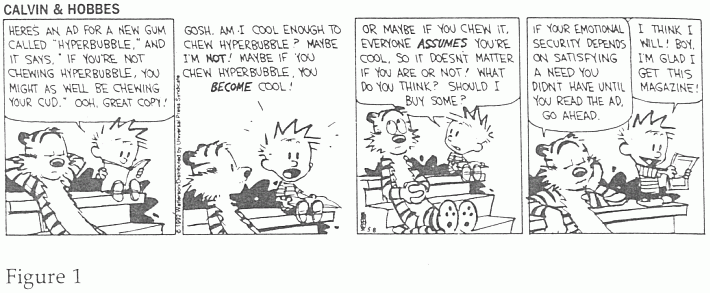
Or like Hobbes said to Calvin...
I think those ads definitely exist-- , but I think as well ads can just be a company with a thing, making sure you're aware of that thing.
I presume you enjoy at least some movies. I also presume you have missed movies that you would have enjoyed, because the trailer or whatever never made it to you. Getting that movie trailer or poster to you, and only getting those trailers or posters of movies that you'd like to you, is definitely advertising, but I don't think it's negative advertising.
So, let's talk about the ultimate purpose of ads. Do we endorse that purpose or not? That's the conversation I really want to be having.
I have to take issue with this, sorry. You may not be fully cognizant of your needs at the time you see an ad, and what if an ad tells you something about what you want rather than what you "need"? And who are you to make that call for anyone other than yourself?
Who are you to say what the grandparent is cognizant of or not?
I for one do definitely not need advertising to tell me what I need, if I need advertising to tell me then I did not need it.
> And who are you to make that call for anyone other than yourself?
The call was made on behalf of at least on other person, but in fact that suggestion was never made in the first place.
They want my money, they're going to have to either pay off the mob (Adblock Plus) or get together with all the other news outlets and give me a one stop shop option.
No way am I going to manage dozens of $1 a week subscriptions, logins, and such just to read articles linked to by Hacker News. Your content just isn't that important to me, sorry.
I like reading sites that don't require a login unless you want to leave a comment. My account was hacked at the Harvard Business Review and I used to leave comments there. They redid their website and limit what you can read now.
Sorry to say websites are moving towards a subscription model and I don't read every article on a website to make it worth the money. Just articles I have an interest in reading. I don't mind ads as long as they aren't annoying. As long as they don't take up a lot of the screen or pop up windows or a new browsing window or pop up a notice to enter my email to subscribe to their newsletter. I want to just read an article with no annoying stuff. Clickbait articles that take up several pages turn me off. Video ads that autoplay turn me off. That is why I installed an ad blocker to get rid of annoying things. I don't mind non annoying ads like Adwords or the typical banner ad.
So, you wouldn't need to share your payment details with any publisher, but with just one , that distributes it further. This is really similar with the system in place in some countries, when you wanted to get a subscription to a newspaper, a central collecting money company would take your request, invoice you, etc, and distributed the newspaper to your door.
Again, old business, "but on the internet". And if we don't like paypal, we can always build something better, right?
For now the easiest way is to use Anti-Adblock Killer[1], which so far works really well. Most likely they will add support for Wired once they enable their anti-adblock policy.
It reeks of desperation on their part - no good options left for their business or their business model.
That being said, while I will not miss wired.com at all, I will miss a site like arstechnica and would hate to think they are in the same boat ...
Presumably, given the even higher level of technical acumen among their readers, ars might be in an even worse situation.
That's kind of the point, you know.
If I worked at WIRED I'd be very concerned with increasing the quality of content.
I'd be SUPER happy to see ads that support a site that didn't track me.
The "problem" would be that current ads are SO tailored that they have a baseline click-through rate that'd be higher than one based solely on the content of the website.
To solve that problem, how about client-side ad picker? (e.g. I download a score of ads from "nottrackingyouAdCompany.com" and a client-side JS solution chooses what to show, meaning my privacy is only "broken" on my own PC.)
Given that a site's costs are fixed, but targeted ad's are worth more than untargeted.
And, if you do not want to partake, then don't. No one is making you read Wired. But, I strongly suspect that publishers that want to keep producing high quality content without running themselves into the ground, as ad blockers become more prevalent, are going to go down this road. The folks here that saying "Ad blockers or bust!" are going to be left with increasingly fringe and lower quality content in the future.
The problem is that ads on the web have become more and more obnoxious as click through rates have fallen. The ads have dramatically reduced the usability of some sites, and that's before you get into the issue of tracking and malware.
Had Wired curated their ads to ensure that no full screen popups and other annoying dreck never got onto their site, they might not have a problem. But even then, so many other sites are filled with terrible ads that users would keep using ad blockers anyway.
Maybe their plan will work, maybe it won't. Seems to me that they're going to have to be a little more clever about this than just charging people $52 a year for Wired.com. Maybe they're counting on a very small percentage of "whales" to make it worthwhile but I think the vast majority of people using ad blockers doesn't get enough value out of Wired.com to subscribe, especially considering that it is 2 to 5 times as expensive as the print/tablet subscription.
Agreed. Subscribing isn't an option for casual readers of any online publication. Nobody is spending hours on Wired every week! Whitelisting Wired isn't a great option either, so there's not really a good solution yet.
You should focus on growing sustainably, instead of selling yourselves to advertisers for quick cash. God knows there are a plethora of other places we can get our content from. There's enough information pollution in our daily lives - I won't accept you polluting my reading of your 'well-written' articles.
So, in summary... good riddance.
I have subscribed to the Wired print magazine off & on over the past decade and never paid more than $10/yr for it. I am not currently subscribing, but if presumably they'll put their best content in print, too, why in the world would anyone pay 5x the print cost for online access?
Unfortunately the post fails to address the reasons that their readers USE ad blockers. If only they had gone a LITTLE bit farther in this post and made specific promises in exchange for being whitelisted. Here are the promises that would have convinced me.
- Third party scripts will be kept to under 33% of page weight. (They're at ~50% for this article, and that's with a 1.1MB gif in the content!)
- We will respect "do not track" headers in your browser (or settings on your Wired account) by excluding you from ad- and analytics-related tracking
- If you have enabled "do not track" headers in your browser, we will only serve you anonymous ads
- We may serve you ads based on your browsing behavior at wired.com, but they will always include a short explanation. For example, "because you were interested in XXXX:"
- Our ad placement and content will follow strict limitations (link to a public page of their guidelines), based on the the Adblock "Acceptable Ads" rules (https://adblockplus.org/en/acceptable-ads#criteria).
- We will serve all content and ads over HTTPS, from within the wired.com TLD (or include a list of specific sources), so you can trust that it's really coming from us.
Since Wired doesn't offer to address any of the issues that make (technical) people enable an ad blocker, the post is reduced to an ultimatum. They're asking you to make a special exception for Wired, and offering only a stick as incentive. No carrot, no quid pro quo, and no addressing your concerns. And they're doing it on a 3.3MB page with 1.5MB worth of third party ads and tracking code attached.
Giving an ultimatum to 20% of your readership sounds like a stupid business strategy, and I doubt it's what the Wired board had in mind. Perhaps they could learn something from app designers: if something is so objectionable about your Ux that 20% of your user base uses third party alternatives to get at your content, try a little market research to improve that Ux. Just do a cursory investigation into WHAT people find so terrible, and WHY they use the alternative; consider how you might change your Ux to make that unnecessary. This is 20% of your userbase who likes your content so much, they find ways to access it despite a shitty OOTB Ux. It would be a big sacrifice to cut off such a dedicated (and large) group of fans.
You are so terribly wrong about that.
The problem though is that with today's credit card infrastructure the processing fees make this sort of thing unrealistic, and the emerging alternative (blockchain tech) is not yet widely enough accepted by consumers to be useful in this regard.
I think we'll get there eventually, and a new "culture of tipping" on the web may flourish in a way that is very healthy for the journalistic community as a whole. It could also mean that for instance a poor person in a remote part of the world could record a youtube video of some traditional folk art or dance and then upload it to multiple social platforms and receive material amounts of money from random visitors within the first few hours without first needing to "strike a deal with youtube" or anything like that.
This might reorient village life in some areas away from making trinkets to sell to western tourists and instead towards making traditional creative art to share with a global audience. This could in theory help counteract the "westernization effect" that global cultures have been experiencing.
1. support for micro transaction amounts (The PPC business already think in terms of clicks that are worth a few cents on the dollar, and I think ultimately the consumer will think like this as well). In other words I think tipping needs to feel non-material to the consumer, but a dollar.. that's almost enough to buy a domestic draft beer.
2. support for truly global payment (tipping) and global remittance with reliable, flexible, always on time payouts.
It would need to embrace blockchain as a payout method because this is the only way to offer truely global remittance capability right now. In other words there's no way to get around blockchain completely so it's better to support it.
One way this could work would be for the platform to issue it's own alt-coin which rides on the back of the platform's reputation. Bloggers in diverse foreign locales where it's difficult or time consuming to receive bank wires could exchange these alt-coins to whatever they need to arrive at local currency. The consumer in priveldged markets would be sheilded, so to speak from thinking in terms of blockchain units because the platform would make it easy for them to tip and be paid in dollar amounts using the standard payment methodologies such as bank wires, ACH, and debit/credit cards. This reduces the amount of friction experienced by the average consumer in the most developed markets while at the same time enabling participation by people in the under-developed markets. In this way the platform could be thought to support a form of "graceful degradation" from a frictionless mobile/web consumer experience at one end to the complexies of blockchain / currency exchange at the other end.
3. Privacy protection
4. Fairness. The fact that you have your brand reputation tied to the platform why it's worth hosting not because of direct revenue. In other words No Squeeze.
5. A no-hassle embeddable tipping badge that any webmaster can easily leverage
6. No demanding of identity documents or tax id numbers while witholding payout. It should be the responsibility of the webmaster who is being tipped to comply with his local laws and tax regulations.
I think that if the ball is dropped in any of these areas then some variation of blockchain will ultimately win.
You can't trust the client. Ads are displayed in the client. It would take hardware level ad serving to make ad serving and anti-ad blocking feasible.
There are ways to make it very difficult to distinguish between content and ads, that's all you need to do. At the highest level, the content is the ads, which is usually what ends up happening to trade publications anyway.
I use uBlock Origin. I went onto Wired to see how it worked. I must have viewed about 2 dozen articles, with no side effects. Either they haven't activated this yet, or it doesn't work.
Also the IP ranges of search bots are more or less well known, so it would be trivial for publishers to block this kind of hack, if they wanted.
Furthermore, with population aging, I think that for the next 10-30 this will make the adoption even stronger. So let's say that it keeps going on until most of the people use some adblock. What is the situation then? Let's explore one option:
No one sees advertising/tracking on the web. Newspapers, magazines and others have either adapted or died. So, for Wire's example, allowing for an ad-sponsored site makes no sense since most of the people use adblocking so there's not much public left. Now I don't know anything about paid online magazine, but I've read that their numbers are not so great.
So who's left?
- Websites that do it for free to scratch an itch such as codinghorror and Joel on Software.
- Corporate blogs that act like news press to improve the brand. This could include Tesla's blog, SpaceX's news, etc.
- Blogs that make it a content strategy so you buy their product such as GrooveHQ.
- Personal or professional review sites with referral links.
This is arguably a stronger change than when printed papers went online or when they went mobile, since their business model remained unchanged. It's a change of business model, so they will have to adapt somehow.
I would miss a lot of the sites that would end up disappearing, but in the end, I arguably would be better without them anyway. I hope they get to stay, and we find a solution, but if they don't.... shrug
The subsequent effect is media ranging from Wired to my local newspapers continue to lose ad dollars that are funneled to Google/FB. Just as an example, Buzzfeed smartly made an incredible Facebook video brand in order to help increase their reach, value to advertisers (via sponsored content) which helps fund real journalism (akin to the role of comics/crosswords for newspapers decades ago). Month after month, excellent journalists who used to work for national newspapers leave or are let go because of decreasing revenue, whereby they end up moving to Buzzfeed News.
It really irks me that Facebook and Google has so much clout over the advertising industry.
I don't think that is something bad. For example clickbait would slowly disappear - without ads there is no need to trick users into more page views.
Ad-blockers will win because people find ads very annoying.
A different, but equivalent, way of looking at the product is that Google Contributor lets me essentially enter a op ad in the advertising auction for any web page I visit; if my bid wins, I see a placeholder instead of the ad. One nice side effect of this scheme is that the ads that do make it through are generally of high quality, since they're the ones for which some advertiser managed to outbid me.
* If Wired would implement a solution that provides confidentiality to users, following the approach of The Intercept [1], I would have no problem with it.
* If Wired would show me ads I was interested in, I'd be happy to see them (assuming my confidentiality is preserved).
* If Wired would provide a way to pay them without having to go through another website registration and credit card payment process, I'd pay them. I don't have time to register for and pay every website I read using the current systems, and Wired isn't at the top of my list.
If users are so annoyed by part of your website that they are investing time and effort in disabling it, perhaps the problem is with your website.
[1] https://theintercept.com/2015/11/04/what-the-intercepts-new-...
1) Websites that still render and are readable after uMatrix, uBlock Origin, and a few other restrictive content filters are done with them. I continue reading and enjoying these, provided the content is worth my reading time.
2) Websites that are broken, or otherwise make the content inaccessible. For example, a "dialog" appears over the content, inviting me to join their newsletter. These sites get the ol' ^W or ⌘W, and after a few visits I learn to never visit them again.
Also, sites in category #2, are auto-censored anywhere I moderate.
That said, I appreciate how wired is handling the situation and communicating transparently and reasonably. I may consider white-listing the site simply out of support.
It's a tough spot to be in for all these companies - they need to make money and stay in business, but it's rare that any of them are important enough to the average user to turn off blocking. There are simply too many sites out there to choose from.
Wired is asking its readership to compromise, without being willing to make any compromises themselves. They're asking us to trust them on a one-to-one basis, but that's now how trust works in a network. We have to trust Wired, and trust every single one of the companies or servers they include content and scripting from, and trust every single one of the companies or servers that these companies or servers include content from. We're looking at trusting at least a hundred actors here, quite likely more.
"Trust us, and only us."
A much better compromise would be to ask us to turn off ad blocking on their site, while in turn guaranteeing that every single script and asset served on their domain will also be served from their own servers, after having undergone at least some type of inspection. Then we at least have a reasonable basis for trust.
Here is how a terminal looked like :
https://www.element14.com/community/servlet/JiveServlet/show...
I'm not suggesting to go back to that of course, it was dreadful, but it feels like current content providers always try to reinvent the Minitel somehow.
Actually, Teletel/Minitel wasn't completely centralised. A lot of services ran from their own servers on an X.25 network....
The UK's inferior Prestel service was completely centralised (well, there was more than one server, but the servers were identical).
However....
> The phone company directly handled payment so there was no friction or paywall.
That idea certainly worked well at the time. Today, you might want to subscribe to a "content server" accessed via a VPN.
It lowers their hosting costs therefore it actually makes them money. People who don't use adblock, whitelist, pay the fee for ad free all make wired money and will continue to read it.
THAT is a system I would sign up for in a heart beat.
But I guess one thing to consider is, even if I block, people who I send links to may or may not block. There's some math that probably needs to be worked through.
Only 20% is pretty low for a tech-savvy audience. I'm surprised as I assumed ad blockers were more wide spread amongst us "computer people".
BUT!
I want to KILL the free internet--that is, the internet that is paid for with slices of my attention and life. I do believe that advertisers are very good at extracting my attention and money, and I genuinely do want to destroy that internet model. What will emerge? I can only cross my fingers.
Isn't having an account a form of tracking?
And this is where wired missed the boat here, the article should not have been titled 'how wired will deal with ad blocking' but it should have been 'how wired will deal with tracking'.
http://blog.practicalethics.ox.ac.uk/2015/10/why-its-ok-to-b...
These arguments are not even acknowledged by Wired (or any other service that relies on ads)
I understand that Wired has to pay its staff but it's a uphill battle.
Still, if I could pay on demand, 1 cent per article, I'll consider it. Show me an abstract first and remember that I'll remember if your content is really worth that cent. If you think it's tiny, divide the price of a paper newpaper by the number of articles it's made of and we get to that order of magnitude.
There are scripts that foil ad block detection as well. So some people are fighting back.
It reminds me of file sharing sites like bittorrent sites that people use to get DRM free versions of products at risk of having their IP scanned by DMCA bots sending them a C&D letter.
It comes down to when you buy something you don't own it you only buy the right to use it. Now you only have the right to read articles if you get exposed to ads and tracking. If you block ads they can take away your right to read an article.
It is all about rights and how corporations control what you get access to.
Facebook, Google, and others use ads and tracking as well to earn money. Their sites are free at the cost of your privacy rights.
Then actually address those concerns, rather than just telling us to ignore them (whitelist) or pay up.
I don't care about ads, really. Yes they are a petty annoyance, but I grew up with magazines, newspapers, TV, and radio all supported by ads. However, the way they presented their ads was markedly different.
* Their ads didn't invite dozens of third parties to spy on everything I do.
* Their ads didn't break into my home, rifle through my things, and set up operations doing potentially illegal activities in my basement.
* When I wanted to read a 1-page article in their magazine, yes they showed me some ads, but I didn't have to pay the full cost of having a 20-volume encyclopedia delivered to my house just for the ads on that page.
Find a way to advertise without constantly assaulting the reader. Actually address your readers' concerns instead of downplaying them and knowingly causing harm to your readers. You have other options. Taking them, and proving that you can be successful without being evil, that would make a difference.
But, the one thing i can tell you: there is no way i will manage premium subscriptions/accounts for 20 different sites. Not only does this get costly very fast... but even if it was only $1/month each (it's not!) - handling 20 incompatible logins on 5 different devices, most likely payed via different payment methods... that is just absurd.
This is not the way to go.
Wired has been on a long stead decline ever since it was first sold in the late 90s. Now they've gotten to the point where they do so little good journalism that just blacklisting them (to save myself the bother of running into their adblock block) will be as painless as cancelling my subscription was after their part in exposing Manning.
The absolute first thing one must do before asking people to whitelist is to reduce the ad footprint.
This means since I can't view their articles, I definitely won't be upvoting them on places like HN since I can't read them, and I'm sure others are in the same boat.
They could have done this in so many other ways, but they chose the way that was openly hostile to their viewers. Good luck declaring war on your own readerbase, wired.
I genuinely read "viral stories" the first time I read that sentence, and thought to myself: that's awfully honest of them.
Speaking more seriously, I'll repeat what I've said before: I have only started blocking ads in the past 6 months or so, because while in the past I would simply not visit websites with obnoxious advertisements, there is now nowhere to go.
And I understand that you need money to pay your staff, and I understand that the public is not paying you, so someone has to, so that naturally falls to advertisers, as it has done for a hundred years. But clearly the public isn't going to let you do that, at least not traditionally.
So I don't know where this is going to end up, but no where good I imagine. More paid promotions, more "native" advertising, more catering to people who haven't worked out how to use ad block, more viral "you'll never guess who farted in the senate" style non-content-- the top two articles right now on Wired are literally reporting about advertisements. There is advertising sponsoring them writing about advertisements. My head is spinning.
I'd love to see their numbers in a few months - but I doubt that they would make them public.
Obviously making money via adverts on news websites is a shrinking business. I wonder if any companies are taking advantage of this to create a new type of revenue generation machine for publishers? I know micro-payments keep getting kicked around but they don't seem like the solution here. Any thoughts?
Suit yourself. Goodbye, Wired, and welcome to reality.
Also, I just left that article to leave a comment here, since there is no comment section on that article, something else that drives me away from Wired.
Any ethical policy with regards to ad blocking should start with the word "sorry", followed by a lengthy apology for two decades of utterly unethical business strategies.
Instead, we just get another aggressively anti-consumer move in the privacy arms race.
No tracking if you pay up amounts to blackmail. Publishers like these won't get a penny from me until they apologize and give up tracking altogether. (Of course the fact that Wired hasn't been relevant since the late 90s makes this particular decision a lot easier...)
That's why I'd love something like a "pay per like" system, which let's me support the quality content I enjoy and boost the people behind it. But I guess it wouldn't really work out as most people are cheap and lazy - you'd need to sign up for a new service etc.. :/
Suddenly, they disable their adblockers.
Now, how much weekly ad revenue does Wired earn from those 1,000 visitors? There's no way it's $1,000 worth of ad revenue.
In which case, you could be forgiven for thinking this move by Wired is not about solving the website adblock problem, but more a subscription drive.
As an occasional reader I want a better deal on the subscription. Say, 20 cents per week. Apply a quota, cap my plan, all good. But $1 per week is not happening, and whitelisting the site is not happening. That's just me.
I would've hoped there would be some acknowledgement for their magazine subscribers, both digital and print. Certainly for print, which costs significantly more, but even for magazine subscribers who've been around for a number of years.
Then the ads got sufficiently obnoxious that everybody started wiping them out.
The solution is to insource your ads again and take responsibility. Then people would quit wiping them out.
But, that will cut into somebody rich dude's profits, and they'll have to ... ewwwww ... employ somebody.
Or, they can lose completely and go out of business. Their call.
I don't link or read Forbes articles anymore. Cool by me.
Next up, the aggregators will start ripping the content that isn't strongly paywalled and republishing it. Probably without attribution. Good luck.
Title: How zevrox is going to handle Wired going to handle Ad Blocking
Body: Zevrox will never visit Wired.com and their whiny princess ass again.
On Wired, I got what? 100 folks all doing the same thing only with more taste and style?
I get the fact that Wired, on average, is better consumable content than Facebook, but hell, Facebook is free. The rest of the net is free.
I do not have an answer for the Wired guys, but I gotta admit it's sad/funny that Facebook and Google are such close partners with so many content providers. They're the guys driving the bus that's taking you over the cliff.
For the record, I own the device or app that consumes my content over the net. If I choose to own a device or app that only displays text, or only displays text from certain domains? That's my business, not yours. You can certainly turn the spigot off or on, and perhaps you'll get me to pay for you turning it on, but that's the limit of our interaction on this matter. What kind of device I use or whether or not I see certain things you want me to see is none of your freaking business.
In addition, as far as I'm concerned, any information I provide back to the server about what kind of browser I'm using is highly provisional and subject to change without notice. It is a courtesy that I provide anything.
It continues to amaze me that people who are in the business of providing entertainment somehow feel that it's a good thing to go to war with the people they are entertaining. For the life of me I just don't get how that makes any sense.
One day somebody is going to write a "meta browser", a browser that opens up other browsers in invisible windows and surfs the web, then sucks out filtered content for the user to consume. (There would be a provision for faking out credentials, spoofing the signature, resetting the cookies, signing up under assumed/real names, and so forth) Once that day comes, both the browser vendors an the content providers are going to be unhappy. But that's where we're headed if this radar vs. radar detector battle continues forward. Content consumers will win. They always do. (I imagine we're going to see a big push for legislative relief here. Prepare yourselves.)
Wired is a print mag. They have always struck deals with advertisers to show dumb ads without impression counts, in their magazine. Just put those ads on the site!
I wish more places would do this. I subscribe to several news outlets, and none of them provide this option, even for paying customers. It's ridiculous.
Unfortunately for Wired, their content just isn't good enough to warrant the $52/year price point.
I don't want to pay wired and forbes and WaPo and NYT and keep track of all these payments appearing on my credit card. We need a Netflix for web publishers.
As for the content charges, a micro transaction system really needs to take root for the web. I really don't want to be driven to the poor house with a dearth of monthlies. Its bad enough with cable, tv, netflix, etc/etc, and now every damn website. Worse are magazine based companies trying to charge print subscribers for web content that used to be free.
A dollar a week might not sound like much but if I am not using the site each week its too much. Set me up an article bank so that my one dollar gets me a set number of articles and it tracks which I read so I can reread content I paid for
That's cute. I just rolled out network-level adblocking at home to improve the security of legacy clients (e.g. old un-updateable Android phones). There is no concept of a whitelist in this approach.
Can't even finish the first paragraph before the bullshit starts flowing.
ah well, we'll see how it goes, nothing uBlock Origin can't handle :D
p/s: does anyone from Wired is here? to at least read / respond?
echo 127.0.0.1 www.wired.com >> hostsA good friend is a fashion designer and she collects oodles of high end magazines, they have a heavy cover price and advertising makes up a large proportion of the pages, but it doesn't matter because the content and advertising coalesce. The advertising editor is still an important part of the business and they make certain that their work both reinforces the business and doesn't tarnish the content. It's a slick alignment.
Something became unstuck with publishing on the web very early, and for whatever the reason, magazines and periodicals typically gave up exclusively collating and editing their own advertising material. An industry of third party providers took that job, providing the initial promise of instant revenue and later the promise that adverts could be tailored to the eyeballs of the viewer. But the third parties never came up with a way to nicely separate their ads from the content that people were attracted to, to give it the necessary space that makes reading a magazine somehow less bombarding. They adopted the messy format of banners and placement ads, which wasn't far away from the newspaper grid. But newspapers were always a different beast with less refinement, the daily coverage was enough of a compulsion to readers that it covered the incongruous layout (and the trend for a very long time was not to pollute the front page with advertising as this would cheapen the status of important stories and editorials - this came much later). Every ad technology that they have come up with only aides in their own destruction - popups, overlays, flash and animated gifs only serve in distracting the audience enough to irritate.
It's probably too late to reform the industry to make advertising consistent, relevant and non distracting. The content has already suffered, reputations are diminished and reputable journalists are becoming far more autonomous in their output. There was a renewed interest in digital magazine publishing when the ipad came out, it allowed for more traditional interaction, layout and perusal, but releasing an app based publication is more involved than publishing to the web once and there's more mind share in the latter.
It's going to be interesting to watch how the web trends for commercial media. But at the same time I doubt my fashion friend is about to stop buying magazines and judging by the content they are becoming more beautiful and textural with every new publication. Still a viable niche alternative to screen burn, the adverts look fantastic, and there's zero chance of accidental malware. No salvation for a suffering industry, but they've been embedded in the web a very long time and failed pretty badly.
Wow, a paywall. Did you come up with that idea all by yourself?
This will only create a fractured Internet and make it difficult for small startups to survive.