* Spotlight no longer finds things as easily. I used to use it for everything. Since updating to El Capitan, it has missed some exact match folders. Planning to switch to Alfred.
* iWork was gutted in '13. People used to use Pages professionally. I'm now using Pages '09, and planning to transition to Word or Latex. I tested Pages '13 intensively, and it fails for even basic publishing.
* Siri can only work with default Apple apps. And those default apps are getting worse. So Siri takes a hit with every app that declines. I used to use Mail, now I don't.
* Constant Wifi issues. I frequently have to turn off wifi, then turn on. On my home network. This never happened pre Mavericks.
* In general, all my Apple default software on my iphone is sitting in a folder titled "apple", which I never use. I don't think I use any Apple default App.
* I avoid icloud. It sends scary "do you want to delete all these files" messages if you ever unsync a device, and it's not clear which actions produce which effects. iTunes has a history of destroying files on syncs, so I can't trust iCloud. Even now, itunes will add apps to my device if they're in my library but I deleted them from my phone. It does this without asking! Any other cloud app has figured out how to handle deletions from one device.
Pages 09 hit the hardest. It was wonderful software. I used it for print publishing, and it just worked. Easy to use, incredibly powerful. Have a look at their manual for the level of care they put into their software, as recently as 2009.
Pages 13 can't do half of that. Very basic stuff like "facing pages" for books has been left out.
https://manuals.info.apple.com/MANUALS/0/MA663/en_US/Pages09...
Edit: A comment below pointed out that, I do in fact use default apps. I had taken them for granted. These ones work well and I use them:
Messages, Phone, camera, photos, clock, wallet, calendar, music (UI got worse on this one). Reminders I use occasionally because of the Siri integration.
There are some issues with some of them, but mostly they work pretty well.
On the mac, the only default apps I use frequently are textedit and Preview. Previews remains excellent. I use spotlight, but as noted above it got worse.
A nice Linux set up with minimal software (e.g. xmonad, mutt, emacs or vim) is a joy to use, but takes time to set up and learn to use. So it's not for everyone.
Interestingly, I've experienced the same issue Apple is suffering with Ubuntu. Edgy Eft (6.10) was incredibly simple and nice. Like OS X Tiger. Now there are dozens of services running and something always gives trouble. I guess the old adage applies, make things as simple as possible but no simpler...
Not just Apple, I see similar issues with Google.
Google's Youtube IOS app has issue playing video correctly. It can't even buffer the segments correctly.
Google latest Android Map crashes all the times 1-2 minutes into the navigation, extremely dangerous when I have to restart the navigate while driving. I can't depend on it at all.
I have to roll back to the default factory install older version google map to make it work. Lately I see the older stable version start crash more often, probabaly cause by the "update" on the server API side.
It will be a very scary world if this type of SW development processes are applied to tomorrow's "self driving car".
Recently I've additionally seen random network slowdowns that are impossible to debug, and they happen only on a single Macbook -- all other machines on the same Wifi are fine. Completely unreliable.
Pages is the only piece of software I have on my Mac where I need to keep the previous version safe because it was so much better!
Music once it went flat UI is now complete crap. It drives me nuts all the time and I use it often because there really isn't an alternative.
While I'm ranting one thing that's been bad from the beginning is the locked music UI. The next track button is just a few mm from the volume slider which means about once every 2 weeks I blow my ears out trying to skip to the next track. That "feature" carried over to the toolbar menu (or whatever the slide up menu is called)
iOS app 'screenshots' (in task selection mode) are often dated, even after multiple openings of the app. I get that they are meant to be just that, snapshots, but if those aren't up to date, you may as well just show the app icon.
Up to once a week, now, iCloud (in OS X settings) asks me to verify my password when "nothing has changed" (no purchases, etc). It then spins for a long time and there's no acknowledgement that it 'succeeded'.
Several more.
I had to reboot the access point in the end so perhaps it wasn't an Apple problem. Yet no other devices were having issues and I've not had a problem with it since it's been running Windows.
The difference is that everything worked.
My personal opinion, based purely on speculation is that once Jony Ive & company rolled over everyone in the company, as with any corporate struggle, their priorities are the only ones that really matter. The Apple Music nonsense, that somehow managed to break an already broken product is a similar story I'm sure.
Lots of attention was paid to the visuals in Yosemite, but "unimportant" things like broken wifi, and gratuitous changes like discoveryd were allowed to see the light of day. I think Jobs was the only person able/willing to tell anyone to go fuck off, and the company is suffering from that loss.
Typically I would be getting really slow speeds and intermittent disconnects.
Switching to a 5GHz WiFi router solved a lot of problems in the WiFi department for me on both El Capitan and Yosemite.
- calculator - camera - clock - contacts - messages - phone - photos - safari
If you literally use none of these apps, I would be really surprised.
Since we're sharing anecdotes: I've never had a problem with WiFi connectivity or Spotlight on El Capitan across multiple devices. I don't use iWork or Siri, so I can't speak to that. iCloud seems fine to me, but I don't use it extensively.
I should spend some time partitioning the disk and installing Linux.
Given how basic the concept of a playlist is to iTunes, I was surprised to find this was not fixed immediately.
My understanding is that the desktop version of Pages was brought in line with the iOS version. Simple things like paragraph styles were taken out.
FWIW updating to El Capitan fixed this for me.
  * Start by use/create a full functional regression system.
     * It is not that hard to create system level functional test coverage for wifi, Siri, search, etc.

  * Require ALL SW developers to run full tests every evening, weekend.

    Code are not allow to checkin or merge upstream if any test failed.


* The test system should submit report on all test scripts pass/fail and performance characterization to central server every night.Perhaps, the years of oversimplifying applications has created an Apple that can't handle complex applications?
Or, there's a chicken and egg question: XCode and the surrounding tools are atrociously buggy and hostile to the developer and it seems to increase with each release. Is this a symptom of what's going on inside Apple or a cause - perhaps Apple's own developers are dealing with the same hellish development experience and are just happy when something can compile without crashing Xcode.
Or, perhaps, at some point, software becomes too complex for humans to deal with.
Windows got so much flack over the years. It wasn't the prettiest but it worked and did what it said. Sure it BSODed sometimes and had some memory problems but it handles infinity more hardware/software/driver situations than OS X. Visual Studio is a dream, if you're into that ecosystem. MS dev tools are actually very nice.
You probably wasn't paying attention when Job was running things.
OS X 10.1 was a mess -- it took until several updates to become somewhat usable. The Finder was half-arsed for a decade. Mail.app had several issues. The Windows versions of iTunes was crappy. OS X releases that are now praised as "the best ever" etc, got tons of complaints for introducing bugs and instability. XCode has been historically crap (and it's much better now). And don't even get me started on the state of their Cloud offerings under Jobs.
Hardware wise the same. Every new release, from the original iPod to the iPad was met with complaints and bickering ("No wifi? Less space than a Nomad? Lame") -- even if it actually took wifi and batteries 5 more years to even start making practical sense to have on such a device for syncing. Aside from specs people complained about, there were also all kind of other HW issues, from the overheating G4 Cube, to the logic boards dying on G3 iBooks, to cooling goo spilling from G5 towers, the crappy "round" mouse, and lots of other stuff besides.
That said, I don't buy the "Apple software went downhill as of late" thing. First, because as said there were always issues. Second, because in normal use I don't see any particular decline. If anything things have got better, to the point where we complaint about trivial stuff. The thing is Apple of today puts out a heck of a lot more software and hardware products than the rosy Apple you remember.
I'd take iTunes in the back and kill it though -- as the latest redesigns are absolutely crap from a UX perspective. Then again, I wouldn't call that a programming quality issue -- more of a "idiotic focus and shoving on our faces of BS online music platform issue".
>Or, there's a chicken and egg question: XCode and the surrounding tools are atrociously buggy and hostile to the developer and it seems to increase with each release.
The opposite. XCode was "atrociously buggy" in the 3/4/5 era and before, and has gotten quite better in the 6/7 series (despite having to support a whole new language).
In fact a large list of early XCode 6 crashing bugs have been squashed months ago -- which was (as reported) around 90% of them.
Ah, you've fallen for the illusion. Those "simple" Mac apps you love are fantastically complex to implement. It's the user experience that is simple, and it takes a ton of sophisticated engineering to pull that off.
You can think of it as there being a certain fixed amount of complexity in the user attaining some goal. You can make your software simpler by foisting the complexity on to the user: just make them do all of the nit-picky tasks.
If you want to make it simple for them to achieve their goal, your app is going to have to contain that complexity itself.
I'd say rather that things need to be simplified and features removed in order to improve quality. Every new Mac or iOS release touts XXX number of new features. If you want to offer the best products, having more features isn't necessarily a prerequisite.
Maybe. I felt like the quality started going downhill shortly after iOS came out, starting with low-level APIs, then xcode, then making it into user-level applications.
My theory is that a lot of the really experienced engineers (the one who started with NEXT and OpenStep) left when they were rich after the iPhone stock jump.
So really there is nothing Steve Jobs could have done unless he had a developer education program or something.
Steve Jobs, Steve Jobs ... that's the guy with the skeuomorphic preferences, right? The one who, at the first iPhone release, told developers that they don't need native apps because using HTML + WebView is enough, right?
Just to make sure we're on the same page here.
-iTunes bloat is a choice, and bugs.
-Mail.app is mostly bugs. (non-standard .mbox was a choice)
-Final Cut X was a choice.
-Eschewing strong AppleScript support in native applications is a choice.
-The app store(s) are a choice.
-Allowing core utilities like Contacts and iCal to stagnate and be outshone by 3rd parties (BusyMac) was a choice.
-Aperture+iPhoto=Photos was a choice. (So was selling Aperture after it was EOLed)
-FFF
Says everyone who disagrees with any decision Apple makes. "Steve would have had the same opinion about this I do!" Statements like this are just you projecting your own opinion onto him.
I've been using OSX since just after Panther. I generally agree with the idea that some things started getting worse after Snow Leopard, but I still don't think it's come close to a point where I'd actually move back to Windows or try out desktop Linux.
And I'd say Windows had far more issues that BSODs and memory problems. I've used Window for music production for years (by the time I switched everyday stuff to OSX, I was locked into my music workflow and haven't cared to spend the time learning a new package like Logic, even after all these years). The way I survive Windows problems is pretty simple: never plug in an ethernet cable. I'm sure things are far better now, but for a large part of the past 15 years, doing so opened you up to a lot of problems and required utilizing software you simply should not have to install in order to have a functional system.
Also, a high percentage of OSX users have no idea what XCode is, let alone care if it's not as nice as VisualStudio.
No. Just No. Windows loves to "forget" things. Things like Bluetooth devices. Or wifi devices. Windows likes to update your laptop for you when you're trying to close it ("Don't turn off your computer..." Wait, what? I have a plane to catch!). Windows scatters files all over the place! And that registry. UGH!
Remember Antennagate? The iPhone 4 had a serious hardware fault that significantly degraded it's signal. Jobs himself was the one who said to a customer "You're holding it wrong"
The problem now is none of the SVPs seem to have that attention to detail, or they are too stretched doing numerous things.
When I got my first Mac back in the PowerPC days it was definitely a step up. In the past I feel that Apple was targeting power users. Today I think they are going after casual users. Probably capitalizing on the general popularity of iOS.
I've still got a couple of old Macs but they're all running Windows now. Visual Studio still has the occasional lock-up whatever hardware it's on. At least you don't have to sign in to an app store to update it though.
Visual Studio is nice, if you're not writing in Rust, Perl 6, Ruby, Objective C, D, Scala, Smalltalk...
Most likely because dogfooding
Apple has the resources to approach software like aerospace. Formal interface specs, heavy Q/A, tough regression tests, formal methods. It's expensive, but Apple ships so many copies that the cost per unit is insignificant.
Microsoft did that, starting with Windows 7. Two things made Windows 7 stable. The first was the Static Driver Verifier, which examines driver source code to check if there's any way it can crash the rest of the OS. This includes buffer overflows. The driver may not work, but it won't take the rest of the kernel down with it. All signed drivers have passed the Static Driver Verifier, which anyone can run. Driver-caused crashes stopped being a big problem.
With the driver problem out of the way, any remaining kernel crashes were clearly Microsoft's fault. (This has the nice problem that kernel bugs could no longer be blamed on third party drivers.) Microsoft had a classifier system developed which tries to group similar crash reports together and send the group to the same developer. It's hard to ignore a bug when a thousand reports of crashes from the same bug have been grouped together.
That's part of how Microsoft finally got a handle on their software products. Is Apple doing anything like this?
As someone whose starry-eyed Mac obsession predated Windows 95 - Apple's software has always been buggy. It was buggy under Sculley, it was buggy under Amelio, and it was buggy under Jobs. I remember getting plenty of sad Macs under System 6 and 7, and early versions of OS X weren't any better.
We just didn't care because Steve Jobs was really good at distracting us with promises about how great things were going to be, really soon now.
The comparison with Microsoft is instructive. Microsoft software was even buggier than Apple's during their period of greatest dominance. Win95/Win98/WinME would crash all the time, and was an open barn door for security. Early versions of IE were pieces of shit. Even later versions of IE (6-9) were pieces of shit. Microsoft finally got a handle on security & software quality just as the world ceased to care about them.
Apple's been driving change in the computer industry since the iPhone was introduced in 2007. New products are always buggy - the amount of work involved in building up a product category from scratch is massive, and you don't know how they'll be received by the market, so there're frantic changes and dirty hacks needed to adapt on the fly, and they often invalidate whole architectural assumptions. It's just that most of the time, this work goes on when nobody's paying attention, and so by the time people notice you, you've had a chance to iron out a lot of the kinks. Apple is in the unenviable position of trying to introduce new product categories while the whole world is looking.
The Apple Watch is buggy as hell, but I still find it useful, and pretty cool.
iOS is also in pretty good shape, but almost every time Apple releases a new version its buggy. By now, iOS 9 it's a very stable and robust OS, but it needed work up front.
The biggest places were Apple is having trouble are with new products. Watch OS was slow, buggy and limited at release. It's pretty much at a 1.0 state right now. The new Apple TV is by far the best version of the Apple TV, but the OS is buggy and still needs refinement.
My take on this is two-fold:
1) Apple is doing more and more products, causing there to be issues with newer products. They haven't been putting in the QA work on newer software. OS X is old and mature software, so it's pretty stable, but something like Watch OS is very new.
2) Apple's insistence on yearly OS upgrades is causing there to be a lot of 1.0 roughness each year. Just slowing down to a two-year cycle would allow for a lot more time to refine and more time where the OS has been patched and is the latest OS. iOS 10 will be announced in a few months, but iOS 9 still has at least one major point update to go.
Microsoft invests a massive amount of money into MSR, and creates tools out of the most useful results. The Static Driver Verifier depends on Z3, an SMT solver developed at MSR. Other verification tooling like SAL (C/C++ annotations to assert contracts for functions) has a similar history.
But that is not nearly as bad compared to having to rely on software developed the way they do in the aerospace business! From http://blogs.law.harvard.edu/philg/2010/02/09/public-tv-figu...:
> Who crashed Colgan 3407? Actually the autopilot did. … The airplane had all of the information necessary to prevent this crash. The airspeed was available in digital form. The power setting was available in digital form. The status of the landing gear was available in digital form. …
> How come the autopilot software on this $27 million airplane wasn’t smart enough to fly basically sensible attitudes and airspeeds? Partly because FAA certification requirements make it prohibitively expensive to develop software or electronics that go into certified aircraft. It can literally cost $1 million to make a minor change. Sometimes the government protecting us from small risks exposes us to much bigger ones.
(I agree that Apple's cash hoard does not make $1M sound like a lot, however, they also have much more software to tend to.) Overall, it seems that today you have to trade correctness for features and development time, and the cost in features and development time cannot be borne by a market participant unless the market is regulated so that all competitors have to do it, in which case the user is going to get way, way less functionality. I believe that the cost of bulletproof correctness might drop significantly enough at some point to change the game - and I really, really hope formal methods will take off big time, without being sure they can - but it doesn't seem like we're there yet. (This is my opinion, not data, of course; the one thing that I think $millions buy that works very well without costing too much time or features is automated testing.)
They don't have the time, however.
Nothing. And that is the problem. When you are generally speaking doing everything well there is little room for massive improvement. The days of perpetually exponential improvement, and resulting growth, are over. Apple is not a startup. Like Ford, Sony and GE, they now have to settle into the grind of incremental improvements for reasonable returns.
Or they can put their markers down on ever more grandiose schemes. They could branch into transportation by starting an airline, or a robot taxi service, but I doubt shareholders will tolerate such outflows for long. If doing so causes the neglect of the core business (iPhone) shareholders will revolt.
1) Apple still develops the OS using waterfall over the year. Entire sweeping changes are made only at x.0 releases that trickle down to teams that have to work around the instability all year long and there's no other approved way to get in significant changes.
2) They keep adding more apps to the core OS image that can only be updated with a full software update now. This makes delivery of quick fix updates near impossible since they have to go through the OS release management teams.
It certainly sells better to have a huge list of changes at WWDC that then become reasons to upgrade, but software delivery has moved on from waterfall, so in that respect Apple's OS teams are behind.
It could be entropy, as some have suggested, or simply the difficulty of maintaining a level of quality one has become associated with producing...
Maintaining the (high) level of quality one has reached is difficult enough...
Incremental gains on a level attained become much more difficult...opportunities become infinitesimally smaller...
I would think that what you stated, while true that they currently have these resources, would directly go against their product roadmap schedule, the consumption of said devices in that schedule and thus their bottom line ($203B in cash)
Whenever I read articles like these, I wondered if the software quality has actually declined, or if it's received too many features to be properly maintained, or if now it has so many more users that the flaws have become more apparent.
From my own experience, and the experience of other Mac users that I know, I think that the quality of their software has had a marked decline in the last decade or so. The exact reasons aren't totally apparent, but it seems like there's too much rush to add new 'features' without fixing and refining existing ones, and that annual releases aren't giving them sufficient time to polish what's already there. It's no accident that Tiger was incredibly stable and 'complete' after having nearly three years of work done on it.
I'm not advocating they work for three years on each version of OS X, but even 18 months, and fewer new 'features' per release, would give them more time to improve the quality of what they're releasing.
Actually I have to restart the Finder every few days because the network drives either disappear or are no longer reachable. Sometimes the shortcuts disappear as well especially the ones that are located on a network drive (I tried both smb and afp).
I've also noticed a lot of slowness throughout the OS. The spinning colored wheel shows up very often compared to previous OS versions and on all kind of actions.
So yes, for me Apple's software quality truly has declined sind Snow Leopard.
I'm not really sure, it's hard to point to something that's just plain broken. I noticed that some small UI features that I don't like in El Capitan, it seems slower, but nothing's crashing or preventing me from working.
Part of it might be that Apple is moving in direction that many professionals/developers don't like.
iTunes is different story though, that piece of junk needs to get replaced. Half the time it would even find my iPod and I doubt Apple cares because "get an iPhone".
I've actually had more problems with the hardware. My late 2011 Macbook Pro was just returned from the offsite Apple Repair with it's 3rd logic board (that being said, it's still under an extended warranty from Apple, which is at least a consolation prize).
That means that it's not properly maintained, which means declined.
> or if now it has so many more users that the flaws have become more apparent
More eyes do find rarer bugs, and hundreds of millions of eyes is a LOT.
But I can tell you from personal experience that all sorts of little simple things that used to work don't and it gets very obnoxious. I've been using Apple stuff since ~2004 (ignoring the iPod I had earlier) and I do think things are worse.
It creates a push towards constant acceleration in all things- shorter release cycles, more product categories, etc. This supplies the continuous growth that shareholders demand right up until the point where it kills the host.
Also, "success hides failure". If you're a titanically successful corporation, any internal argument along the lines of "we shouldn't do X anymore, we should do Y instead" can be shot down with "well, look at how successful we were while we were doing X! X must not be so bad after all." It degrades an organization's ability to be reflective and self-critical.
These are problems for all successful companies, which become bigger and bigger problems with increasing success.
See: Kodak.
If you're pre IPO, fund your company through debt, which is extremely cheap at the moment with interest rates at historical lows, or sane, sustainable equity rounds through investors who you know and trust and are in it for the long haul.
If you're post IPO, pull a Dell and exit the public markets so you can refocus on core business ideas and long-term growth rather than spending time bickering with Carl Icahn and fighting market sentiment.
This is because almost everyone's retirement fund/401k/IRA is now directly tied to the stock market in one form or another. There are no more pensions, so people need growth in order to retire and live a reasonable life in your last years.
Every capitalist mechanism insists on growth. That's literally what capital is.
My suspicion is that it's the proliferation of new ways of doing things - new languages, no-sql/key-value db's, new hosting platforms such as AWS, docker, big data stuff like hadoop, storm and spark, all kinds of embedded software (tv's, cars), etc - we've got a lot of new stuff lately, a lot of us don't understand what we're doing and we've introduced a ton of bugs.
Though I cannot justify it with numbers I will add the theory that, with the advent of a weak US economy combined with outsourcing to less expensive, global programming labor pools, domestic software management has become kind of spoiled and lower in quality.
Software managers are now, more than ever before, empowered to say "We need to add XYZ feature" and they quickly hear back from someone somewhere in the US or the whole wide world who says "No problem. I'll get on that right away!"
And then the manager thinks they've done their job. Like that's all there is to software management.
A lot of domestic software managers don't seem to have more sophistication than that, or more insight than that. Because, in this marketplace, they don't have to.
You can't be fast moving and have high quality. Software is like any other trade: polish takes time and you need to stop to polish things. This thread has a lot of people praising Snow Leopard. Frankly, the difference between Leopard and SL aren't the high, but that's two years of development at Apple to polish things up. Apple had a rare slow moving period to clean things up.
I suspect the mobile/cloud/whatever revolution is only recently slowing down and we'll be entering a polish period again soon. Then we'll be entering a complexity building period sometime after. Its a cycle that keeps repeating itself.
Even putting aside the iOS-style elements being added, my experience has been that each version of OS X has been slightly worse than the last, and tends to introduce strange little anomalies and instabilities on hardware that was otherwise working just fine. Sometimes these issues are fixed in the next major version, but sometimes they aren't; and even when they are fixed, there are an equal number of new issues introduced.
My perspective is perhaps coloured by having switched to the Mac during the Tiger era, which was about equal with Snow Leopard in terms of stability and 'completeness'. Since then, with the exception of Snow Leopard, it's been downhill. (I realise, of course, that Tiger benefitted from 11 point updates and thus more polish than any version before or since, but the point stands.)
For a long time it was effectively on a two year clock; they had releases in 2003, 2005, 2007, 2009, and 2011. Now it's half that.
People deride the "iOS style" features of El Capitan but first, what specifically are you referring to besides Launcher? Do you think adding Notifications to OS X is bad? I find them extremely useful, and like the integration better than the spotty support Growler had among third party software.
I never use Launcher but it's not there for me. It's no skin off my nose that it exists for other people. And it's not like Finder or Spotlight have lost functionality, if anything I feel Spotlight in El Capitan is much better than it was in Snow Leopard or any prior OS X.
Mission Control works great and I think is much more elegant in El Capitan than in previous OS X releases. Granted in older OS X you could arrange your desktops in grids instead of just left to right but I only use about 3-4 desktops anyway, so I don't mind.
OS X has also improved for power users since Snow Leopard as well. Lion introduced FileVault 2 which I find to be a fantastically easy to use encryption system, that I have had no problems with. I enjoy my Retina screen and the Retina support that later versions introduced as well. Air Drop is also handy since my wife and coworkers have Macs as well.
In my mind, each new release of OS X, like each new release of iOS or anything really, has good things and less good things in it. But on the whole I'm glad to be running El Capitan today rather than Snow Leopard. I don't pine for those days.
Just generalized instability and "weirdness" for lack of a better term. The problems always seem to go away after a fresh load.
It sucks that this is required, but between Time Machine bringing my apps and settings back, and launching the upgrade at night before bed, it's not really that much of an annoyance.
I'd still rather use OSX than any other OS at this point. But I think we need a Snow Leopard 2, a release that only tightens up the backend stuff with no new shiny features.
When I got my first Mac, it had Mac OS X Tiger on it, and everything about it really felt like it had the user in mind. These days everything about using it feels like it has shareholders in mind. The features being added seem like the kind of things you'd have executives brainstorming up in a committee, and then demanding that engineers implement.
It's a shame. It no longer does The Right Thing™ by default, and there are more hardware and software bugs than I can ever remember in an Apple product. I've listed them before but here's a short list again:
- This mid-2013 Mac Pro wakes up every few hours at night, even though I have disabled every "wake from sleep" setting that exists in OS X
- My mid-2013 MBP has, several times this week, turned on while closed, and continued as if it was opened (playing YouTube videos or whatever else it be doing), only shutting back off after about 120 seconds or so
- Every time I turn this Mac Pro on, it doesn't recognize the wired Apple keyboard that's plugged into the Apple Cinema Display, and says it's looking for a bluetooth keyboard, until I unplug and replug the keyboard in at least 3 or 4 times
- My MBP once emitted a (very) loud buzzing sound from its speakers, for absolutely no reason, that lasted about 3 or 4 seconds, startling everyone nearby, when no sound-based programs were running
- Yesterday I tried syncing my iPhone to remove about 200 songs, and iTunes said it would remove them, and then "did" remove them, but they were still there on the device, and iTunes once again showed them being present; it took a full iPhone reset to clear them off.
My last solid OS X machine was a 17" MBPro with a G4. I forget the OS - Cheetah maybe? That year I also had a developer Intel box. It seems like it was that transition that I could really feel things were going awry.
I'm not talking about the dev box, it was what came after. I had a MBPro 15" Intel machine that was really buggy hardware-wise. yOu could no longer apply updates without rebooting (something we all disapprovingly looked down on at Windows). The software just didn't work anymore either, or at least it felt like it didn't.
I think a lot of this was tied to more and more embedding of Apple apps, just like Microsft did. That and gaining some sort of complacency because they were not the scrappy underdog.
I've been waiting for another Snow Leopard where Apple just says "no more 'features', just bug fixes and stability" (for iOS as well). bUt I think that's just a pipe dream at this point and the train of more is better had already left the station.
And the design as way harder to master than it should be. For instance, to search for a track in Apple Music, you have to be in any tab except iTunes Store. OK, there's some logic to it, but it simply is not intuitive. Why can't there be something that specifically says "Apple Music" that makes it obvious that that's where you go to find tracks? I'm an experienced computer user, and in fact a software developer, and when I first purchased Apple Music I was mystified about how to search for a track in Apple Music. I had to Google it. My wife, who isn't used to Googling for these kinds of answers and isn't a technologist, has no choice but to ask me or the kids how to do things like that.
In the Music app iOS, to make it show only the tracks you've downloaded, you have to click on the pulldown where you select Artists/Albums/Songs/etc. It's a switch on the bottom of that pulldown. When you're thinking "What tracks do I have downloaded?" this is just not obvious. When you get used to it, it's fine. But if you're a naive user, you really have to have a friend who's an experienced user just in order to figure out how to do such basic things. Naive users may not even understand that the Artists/Albums/Songs/etc. pulldown is a menu. And even if they know it is a menu, it's not intuitive to think that there's an on-off switch for showing all songs at the bottom of it, which relates a fundamentally different concept.
It all just seems like really poor design. I don't know what their problem is. But my son, who has always been an Apple user because I've been one, and who is applying to colleges like MIT to do engineering, is seriously considering switching to Android so that he doesn't have to deal with so many bugs. (Not that I know that Android is better.)
I find Photos.app to be the best Apple app I've ever used. It's simple, modern, works amazingly well between iOS and OS X, transparently manages 100GB of data between iCloud and local storage.
This entire piece is surfing on Mossberg's take and goes way too far.
From what we know, Apple does seem to be sorting out big challenges on software side:
- transition to Swift on 2 platforms, which won't happen until they decide to only support 64-bits OS X and iOS at some point in 2017 or 2018 or later
- OS X and iOS foundations are actually super solid. Accidents happen, both codebases are now much more mature and stable. Probably the best they had for decades
- manage the largest updates in history yearly. You hear of bugs because everybody gets to experience them at the same time. Windows never got that many million devices updated overnight
On top of that, they do seem to have conflicting marketing priorities. They don't know what to do with iTunes - as a brand, as an app, as an experience. They're obviously conflicted whether a user should depend on the AppStore to do stuff (feature creep in Notes.app).
IMO this "apple software sucks" is more a consequence of a stalled marketing than an engineering problem.
I don't know when I can use the back arrow or not.
Flagging no longer shows up on the pictures, so I have to look up to the menu bar to see if a photo is flagged.
I've got a few shared galleries with family. Does anyone know which photos are going to show up in Photos vs Albums (All Photos) vs Shared (Activity and your named shared galleries) and the My Photo Stream under Albums?
Virtually every time I recreate a photo library or get a new device, I need to turn off all the icloud syncing crap and photostream crap about 3 times before it finally starts syncing photos. And sometimes when it does, I click on a photo thumbnail and the wrong photo pops up.
Photos is effing TERRIBLE from a UI/UX, features, and functionality standpoint.
Personally, i don't feel that apple's software quality is getting worse, but then it has always been a mixed bag for me. I found the apple quality halo to be a bit of a myth across the half dozen apple devices i own. Seems comparable to windows' quality.
The problem with Apple, and I've said this for ages, is that Apple is fashion. It's a status symbol, Sony used to be that same way, and look at it now. It had similar business verticals, pushed the same proprietary nonsense instead of adopting what the rest of the industry is doing and they were drowned as they began to expand their portfolio of devices.
Apple makes great quality devices, but Apple also enjoys massive hardware margins. Hardware margins diminish with time, no company has successfully escaped it. So the question is, at what point does Apple go out of style?
A huge factor in Apple's sliding software quality is lock-in: once you're on iOS using an iPhone, it's so much easier to simply stay on iOS than it is to move platform. Most people, myself included, will look at the effort required to move and decide that, really, the grass probably isn't greener enough to make climbing the fence worth it. Once you add in some other Apple devices --- say a laptop or an iPad --- staying becomes even easier.
From the user and developer point of view, the only major drawback would be applications. Devs porting over apps to linux and users not having some of their favourite apps available.
It's becoming clear that Apple is not paying enough attention to the under the hood details of an OS and the security situation. And maintaining the OS is a huge investment from Apple. So it only feels natural to base Mac OS on linux and, as I said earlier, focus on the distinguishing features.
Technically though, it would still be a huge challenge as there are lots of factors to consider,but in the long term everyone wins Apple,linux though maybe not Microsoft.
I have been thinking about this idea of Apple using linux instead of its proprietary Mac OS for a long time, and have considered the transition only at a very high level. I would like to hear what the HN community thinks of this idea.
Edit: So instead of forking a version of linux and developing it independantly like what Apple did previously, a better model might be where Apple periodically forks from upstream projects and makes its modifications. Something like what Linux mint does with Ubuntu. So this way, they continue to get the latest and greatest developments from upstream projects without investing additional resources into maintaining their forked OS(this is currently what is happening with Mac OS).
This is the kind of revolutionary thinking Jobs had when he went OS 9 -> OS X... could Linux set them free on the desktop by open sourcing the desktop OS X?
I know, I know, it sounds ridiculous, but there's bits of OS X I like...and bits of Linux I like, as far as technology, architecture, speed, GUI frameworks... like some combo of the two would be a killer OS for the ages and open source too.
And really, I don't think it's very ridiculous. As you've said, it's more or less exactly what Apple did with BSD/Mach and the OS 9 -> OS X transition.
On OS X this is especially true: OpenGL implementation has fallen behind the competition, the filesystem desperately needs updating, the SDK has needed modernizing for years, networking and cryptography have seen major gaffes. And that’s with regards to the under-the-hood details, the applications are easier targets: it’s tragic that Aperture and iPhoto were axed in favor of the horrifically bad Photos app (that looks like some Frankenstein “iOS X” app), the entire industry have left Final Cut Pro X, I dare not plug my iPhone in to my laptop for fear of what it might do, the Mac App Store is the antitheses of native application development (again being some Frankenstein of a web/native app), and iCloud nee MobileMe nee iTools has been an unreliable and slow mess since day one.
I've found myself thinking along similar lines. The two biggest offenders in my opinion are (1) feature bloat and (2) poor UX/UI decisions. iTunes is a prime example of how the confluence of both can turn a relatively simple and popular app into a quasi-unusable nightmare.
I've also noticed a lot more freezing and kernel panics on my iPhone, to the point where I've stopped updating the OS for fear of what might be introduced in the next version.
Time and time again a startup comes along with "-foo- simplified", gets people to switch with it's ease, bloats up the product over time, and then loses to the next guy.
1. Forgetting how truly crap things used to be
MacOS is better now than ever. Systems 7-9 fell over about every 10 minutes, 10.3 was the first version of OS X to be good enough for work and 10.5 'Leper'- nuff said.
2. Ostalgie [0]
Maybe Windows wasn't that bad after all...
3. 'Steve Jobs wouldn't have allowed it'
Good grief – Apple have had a long history of stinkers even when Jobs was around. Remember Ping, brushed metal UI, Apple Maps v1, Mobile Me, the iCloud launch...
4. Civilisation is crumbling
Things were always better than they are now. And the sky is always falling.
That's not to say there aren't problems, there are. Point them out for sure, but I don't think that these 'things are getting worse' conversations are very helpful. Just seems like negative opportunism.
I think xCode e.g. which I use every day could easily be made into 3 different programs. 1) Project management and configuration. One program where you define which pieces go into your project. How they are compiled, deployed etc. 2) An Editor component which does syntax highlighting, refactoring, code navigation etc. 3) A GUI designer.
Sure integration has its benefits. But it also has many big disadvantages. Many people like to use different editor components, e.g. AppCode does refactoring and code navigation better in many people's view than xCode. Yet it becomes an incomplete solution as they do not have as sophisticated GUI design and project management tools. But it these were separate tools which could just as well be used with AppCode one could inspire much more diversity.
Likewise the monolithic iTunes locks out any kind of alternative third party solutions. There should be one synching applications which can sync content like pictures, books, music etc. But that is all it should do. Movies, Music, Apps etc should be separate apps and we should allow alternative third party alternatives to these. People might want other ways to display and organize their iTunes music e.g.
We used to have that. The GUI designer being separate was never a good situation, considering how one would connect the IBOutlets and IBActions.
At one point both my MacBook and my iPhone were suffering from regular graphical glitches. It's still an occasional problem, but at least Apple have got on top of it for the most part. I just wish they'd do something to stop my iPhone from kernel panicking and automatically restarting itself every so often.
Sadly, this doesn't seem to be specific to Apple either. It has become almost the norm in many parts of the software industry, to the extent that I don't voluntarily update any software that is installed and working any more, other than essential security updates. These days, even that is only done after a search to see which supposedly essential Windows updates are actually important for security, because I no longer trust Microsoft to be honest about what their updates are for either.
My default assumption otherwise is that running any sort of updater on application software, or heaven forbid on drivers or the whole OS, has a better than even chance of breaking something I care about, and that every time a browser auto-updates there is a close to 100% chance it will break something I care about or change something in a way I don't want or need. But since almost everyone is now producing similar levels of unreliable and unstable products, there's little you can do to get away from it.
Combined with the version ratcheting problem we were discussing a week or so ago here on HN, also in connection with Apple but also a much wider problem within the industry, it's becoming almost impossible to simply choose and use software you actually want, and to upgrade if and when a better version for your needs is available. This is not a good thing.
If we could just have a rule that said "don't get Apple's first version of a product", but they continue to be terrible. I recently lost my entire music collection because my Apple Music subscription ended, and now I have to download them all one by one via iTunes - even though I only want to stream them to save the disk space.
This happened across both Windows and OS X, of course.
So by default, to do even the most basic of operations, you have to install homebrew and Chrome. I'm not sure how things got this bad. When OSX came out it was kind of forgivable for the first few years, but now that I've been using it for 16 years it's unforgivable.
I seriously use Safari everyday. Works fine for me. In my experience it's noticeably faster, more stable, and more battery friendly than Chrome.
On such large apps that need large teams of engineers, without good product management and also project management, even great engineers can do a terrible job despite all their efforts or heroics "on the ground".
Windows 10 on the same MBP, has none of these issues. OS X crashes significantly more often than any Windows machine I've used in the last 5 years (Windows 7-10). Apple used to brag about how OS X was more stable than Windows, but I think that Microsoft's need to make Windows compatible with so much hardware and software has actually resulted in a more robust and harder to crash OS.
- iphone screen turning black with siri enabled and repeating that she couldn't hear what I said or something like that
- closing lid on macbook, re-opening -> no more wifi until you reboot
- itunes download progress disappearing after a few seconds, changing tab and coming back would show it again for a few seconds
- randomly losing wifi
I might be cursed when it comes to Apple software but that also means I won't go near an Apple car, even though I hope they have very different standards from the OS/phone teams.
Meanwhile, last time I was on an airplane (December), every single older woman over the age of 60 had an iPhone. This means that it's not only reached critical mass (the late majority on the technology adoption curve has been achieved), but now it's no longer hip.
I'm not sure what will be next, but I'm guessing it won't be Apple's.
Were I gambling man, I'd have shorted Apple's stock right there after that airplane ride.
Apple haters seem to often have the misconception that people like Apple products for their style appeal. It's easy to think that, and not wonder if there are possibly some more important reasons.
https://discussions.apple.com/thread/7257238?tstart=0
It's because of things like this that I usually wait until the .4 release to upgrade. El Cap is at .3 and I'm feeling stupid for breaking my rule.
And disappearing scroll bars - why?!
Didn't this company write the HIG book?
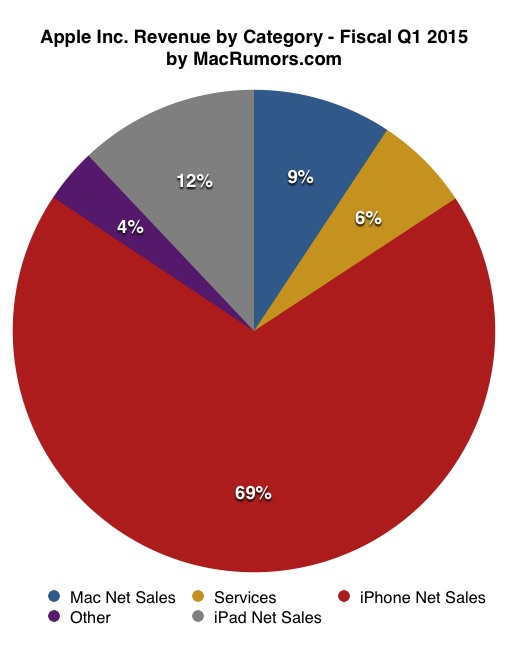
http://cdn.macrumors.com/article-new/2015/01/piechart115.jpg
  iOS          Logitech      VPN

  9.1          OK            OK
  9.2          Fail [1]      OK
  9.3 Beta 2   OK            Fail [2]
- They at least offer updates, many other vendors offer few to none. Is that how you achieve quality? My wife's iPhone4S is still receiving updates and she's been happy with the device since 2011 to today. I've always used competitor's products and never achieved this. As a result, we will continue and increase our scope of purchases from Apple.
- Software is hard, many pieces of software that I've dug into I'm left amazed it even works.
I'm not outright dismissing this blog, but I wish it included who is the leader of software quality- since the statement is that it's not Apple.
My experience leads me to think that if they're an example of failing software, wow... what about the rest?
But yeah, the software situation from most phone vendors is atrocious.
And OS X -- it's hardy bad by any stretch. Mostly it's fantastic. There are the rare glitches, but as other commenters have said, there are several factors at work, what with increasing complexity, efforts to get platforms to work more closely together, proliferation of multicore CPUs, 64-bit, evolution of security and networking technologies, bringing Swift and modern programming language patterns into the technology stack, dealing with changes in unstable third party platforms, and preparing for whatever unknown things Apple has in the oven.
Apple is trying to bring the future to us. Doing this kind of work, over multiple versions with plans spanning years or even decades, is not simple. This kind of work has been likened to rebuilding a 747 aircraft while it's flying. IMHO it's probably even harder than that, and Apple is doing a damn good job so far.
Admittedly there's a lot of assertion here, from my own experience of things working just fine, and not much (even anecdotal) evidence, but I just wanted to say one needs to view the small bugs in the perspective of all the significant work that is being undertaken.
To be honest, with the Retina MacBooks, the memory consumption has only increased with the 2x graphics and images becoming more common on the web. But the RAM on a MacBook Pro is seriously lacking. 16GB is simply not enough even without running a VM. All it takes is around 100 browser tabs and an IDE for the ram to exhaust.
I wish they had a 32GB version that's not a desktop. And no, their hardware isn't necessarily perfect - despite what the fans like to believe. I have seen 4/15 MacBooks with pretty uneven display backlight that normal users don't notice. The best thing about MacBooks in 2016 is still the trackpad and a pretty design - everything else is outdated now. You can find equivalent or much better in all other aspects of hardware.
Browsers are notorious memory leakers. I find my rMBP 16 GB is fine even with an IDE and VMs, but I do have to restart Chrome or Safari at least once a day.
> I wish they had a 32GB version that's not a desktop.
There have been limitations with Intel chipsets there until the latter half of 2015. I'd expect to see a 32 GB and maybe even a 64 GB MBP this year.
Yosemite was the biggest disgrace of all. My mouse or keyboard would not wake the iMac after it went to sleep. And the beach ball was seen so frequently that my 1500 CHF iMac was useless after just 2 years. El Capitan finally fixed the sleep issue and the beach ball is seen much less, but I'd expect much more for the price I paid. The profiteering of Apple with regard to having an SSD with the iMac also severely annoys me.
My iPhone seems to have numberous glitches and software issues too. And for a fine example of just "what the hell are apple thinking" - the original incarnation of the battery monitor in iOS was it. What's the use of seeing the percentage of the battery an app has used - a completely useless statistic unless it included the time too. I still don't find it a particularly useful feature, as I am sure my battery is draining too fast, but the battery monitor gives me no simple way to prove this.
[1] http://www.zdnet.com/article/apple-google-microsoft-where-do...
I consume all the walled garden media stuff through Android and iOS - they're devices like my fridge. My desktop is the centre of my creative world, I don't want someone telling me how to do it there. And yes, I'm willing to trade-off my own time to obtain that control.
Regarding the specifics pointed out by the author: OpenGL support does and always had lagged behind (sucks) and there have been security gaffes (sucks). I don't agree that the SDK needs 'modernizing', whatever that means, however.
Apple has problems with software quality, granted. But is it realistically any worse than any other provider, or is it getting worse? That's not my experience, at least.
The author's limited experience is mentioned in a few sentences without a lot of details. The whole article could've been trimmed down to just two paragraphs including the links to the other articles, considering that the linked articles are not "recent news" to have additional commentary and considering that other people have already written about it with commentary.
Apple seems much more concerned with adding new features than fixing bugs, even if that means a significant portion of their users have a bad experience.
On a small sidenote, Apple's ticker symbol is actually AAPL, not APPL. I hope you did not invest into the wrong company's stock!
[1] http://arstechnica.com/apple/2015/01/why-dns-in-os-x-10-10-i...
Apple computers in 2005-2006 became awesome when they went Intel and OSX was solid, everyone loves to code on a pretty front end backed by *nix. Then iOS in 2007+ was solid for many versions. Slowly, it has been getting worse.
I honestly dread Apple software updates because I know they're not going to fix anything I care about, and they're going to break stuff or arbitrarily replace perfectly fine, working features with new half-assed implementations that are buggy and don't work as well.
The latest example came just a couple days ago when I finally updated to the latest iOs, hoping maybe they've made it possible to remove the "radio" feature from Music. They haven't, and as bonus they replaced the "app close" screen with an ugly, broken one for no good f'ing reason; and the top info display with service/time/battery level now covers the top 20 pixels of several apps, obscuring the view in those programs. And they've added a few new crappy apps I have no interest in using, but can't remove.
I still think their hardware is awesome, but their software is going down the drain.
I used OSX for the first time in a few months yesterday, having installed Windows 10 on my Macbook a few months back.
For about 5 minutes I started to think that I missed it, it looks so nice, but within 10 minutes I'd had two fundamental networking issues crop up that slowed and then stopped me from doing my work without a reboot.
I own a fully pimped out top of the line 2014 15" Retina Pro ($4k to buy at the time). For at least a year it had a WiFi bug that required me to enter a command at the terminal in order to disable some aspect of networking so that I get full WiFi speed. If I don't my WiFI is limited to 10Mbps, once the command is run I get nearly triple that (i.e same as when I plugin ethernet). Why was I having to manually type commands at the command line in order to get my $4k laptop to connect properly to WiFi? 229 pages of people's issues here in just one thread:
https://discussions.apple.com/message/29742198?tstart=0#2974...
Also google "slow wifi MacBook pro"
It's possible this has been resolved in more recent updates and/or El Capitan.
Final issues yesterday was network access to my NAS, just random connectivity. Sometimes I can get access sometimes I can't. If I try to connect with an incorrect account password then access hangs and I'm not prompted to login again, so I have to reboot to get a network login window. It's just so frustrating, because I would love to stick with Apple. I've had none of these issues with Windows 10, or even Manjaro when I tried it again recently. But I do really miss lots of 3rd party software that I can only get on OSX.
I bought a Mac this summer to do some OS X-specific development, and I was truly shocked by how bad things had become on the desktop. Performance is generally poor, UI has apparently gone out the window, and the UNIX features that Apple once heralded have been hidden below new toolkits and proprietary replacements of old systems (discoveryd anybody?).
In many ways, I was reminded of how things were both on System 9 and during the early releases of OS X. It's not nearly as bad now as it was then, but Apple also doesn't have nearly as many reasonable excuses to for such a regression in quality.
I run Parallels and Windows 10 on my MacBook Pro and Windows runs smoother in there than it does on my Windows laptop...Maybe that points to superior hardware and integration, but I think it's also because OS X is more efficient than Windows and it's 500 lb sack of goiter it drags around in the form of legacy support for everything in the last 30 years.
I used to be a Windows computer, Android phone user. Now I'm an iPhone and MacBook Pro user. Every ecosystem has issues. I find that iOS and OS X still give you the smoothest ride though.
Multiple password prompts, having to login twice after a restore, terrible multi-monitor support, lack of window management, unclear system prefs (or things have moved again since the last update), hidden options (holding the option key is so unintuitive) and shortcuts, networking tools are poor, weird update process, notifications blocking the UI of apps, strange finder UI.
There are a lot of UX issues that make it a frustrating experience.
I was a fairly late converter to OS X having used Windows and Linux before. I used to hear people berate Windows similar issues to those above, and I'm surprised on switching to OS X that things aren't all that different/better.
This is an incredibly stupid bug and it's eating up my disk space (until I clean it up of course). I am literally talking about 10 entire albums at a time every time I make a purchase. It's been going on for the last year. I'm not sure why I still use iTunes anymore to be quite honest. I buy my songs through iTunes and then they get uploaded to google music, and I think I've just been going about it as a matter of habit all this time.
However, I generally avoid most of the default software that comes with both OS's with one exception: Windows Explorer is lightyears ahead of finder. Finder is really quite terrible and behind in usability and UI from Explorer. So while I avoid Finder, I still use Explorer for many tasks...so many that I don't bother with most "organizer" apps.
There's some things on Windows networks that are really nice, like WDP (which is much nicer than VNC).
Both OS's are pretty rock solid in my experience and across multiple machines. It's actually the Linux machines I come in contact with that are super flaky.
However, I've found that software on my work Mac is pretty crashy/flaky compared to Windows. I also notice that app developers seem to play more monetization games in OS X-land compared to Windows e.g. I just had a free app I've used for a year auto-update and disable itself because the author decided he wanted to turn it into a paid app. To be fair, the crashy flakiness seems to coincide much more often with some combination of opening-closing the lid and losing VPN connection to some servers.
Either way, both OSs seem to be about even to me for 90% of what I do, and the parts where they are better than one another don't really overlap.
[1] https://marco.org/2015/01/04/apple-lost-functional-high-grou...
Keeping customers happy is important. Keeping "Wall Street" happy is the root of most problems.
http://www.forbes.com/sites/bruceupbin/2013/06/30/the-six-ha...
Cloud services is the one area where newer companies like Google and Facebook have a distinct advantage over Apple and is really the only threat (Android can never be as stable as iOS because of the vertical integration). Cloud services are amazing because they add so much value in the mobile era where you can easily operate from multiple devices without syncing nightmares. Google's cloud services are the thing which makes Android better than iOS in the areas its superior.
Up until now Apple's offerings were so ridiculously terrible than no one even used them, whether it was iDisk or MobileMe or whatever other branded services they churned through—they were utterly unusable. In the iCloud era it's actually become usable which exposes all the warts in new features which would have been hitherto impossible, whether it's iCloud app developer woes, message syncing issues, or Photos complaints, these things have all become usable now and at least arguably competitive with Google's offerings in the same spaces.
Sure there are warts, and sure it's annoying OS X doesn't get the love it deserves as iOS drives the company, and sure they're struggling with the scope of maintenance they're now saddled with, but that's not really the sky-is-falling narrative that tech bloggers have been pining to snap onto the Tim Cook era.
That said I'm not too upset with 10.12 or whatever the heck we are running right now. What bugs me is iOS 9. Long pauses, freezing up, graphical glitches, first-party apps crashing, sound lagging...it's just terrible.
I guess I'm happy that I haven't had the old problems of not syncing up, the phone getting hot and eating battery life, apps not refreshing, etc. But the current iPhone experience reminds me of amateur hour shit I'd expect form a low-end, no-name smartphone.
Notes sync was broken between 10.7 Lion and 10.8 Mountain Lion. Now it won't sync without iCloud.
To downgrade iTunes 11 to 10 on Mavericks 10.9, I had to replace some system libraries. That broke the Mac App Store. I use a friend's laptop to get binaries of apps that they download that are only on the App Store (e.g. Shazam, LINE).
If Apple fixes USB sync, I might force myself to get over the new GUI (which is awful - no track name & artist on the iTunes MiniPlayer?).
If Linux developers get USB sync to work reliably, and make some UI scripting tool similar to AppleScript, then I would consider switching.
"The best thing for Apple to do is to re-take their position as a leader of software quality before it's too late: consumers know that Apple's hardware is the very best, but more and more their using apps made by Google and Microsoft and Facebook."
*they're
However, the major thing that bugs me is Apple's services. iCloud, iMessage and Apple Music have had some terrible issues. Especially when they launched Music, it was not only buggy, it was SLOOOOW. I can't believe that the giant Apple can't even compete with little Spotify in terms of ease of use, speed and stability.
It shouldn't take 10 seconds to search for a track, and not take a few seconds to start playing a track. Spotify is, and have (the past 4 years when I've used it) been INSTANTLY on when playing tracks.
However, now Apple is essentially the iPhone company. The iPhone has a new version, with new hardware and new capabilities, every year. This basically means a new iOS, new apps, and often, new capabilities in OS X (Hand-off, whatever is happening with photo sharing this year, etc), and new features in XCode. (Plus all the watch stuff last year.)
I'm all for being agile and moving fast, but there's just not enough time to do this right. Sure, it might help to have more focus, and they have plenty of people and money. They just don't have enough time.
If you want me to bother to help you find bugs in your system, you have to make it easy to file bugs and you have to make me feel like part of the team when I do that. Apple does not.
Before I even get into interface issues, let's just say that Apple's bug reports are like a ginormous black hole. I've filed plenty of bugs that have never been properly closed or even updated, and it makes no sense. In any other system I've seen, you would at least be able to see that your issue had been assigned to someone, and given a priority, etc. Apple has none of that.
The only thing worse than filing a bug that no one responds to is having to spend 20-30 minutes writing it in the first place, and Apple excels there, too.
Their reporting system is too complex (too many fields that should not be necessary, especially the ones that seem to ask the same question twice). It's not automated in any way. It is not integrated with the OS; e.g. why can't I turn on a "developer mode" on my Mac or i-device that lets me instantly do things like "compose new bug report for this OS version" or "compose new bug report for this version of this application", etc.?
Also, despite Apple's attempt to redo the web interface a few years back (because developers had complained endlessly about the even-worse previous bug reporting page), today's web interface is still mostly a repaint to look iPhone-like. It doesn't really address core usability problems. It has created new ones though; for instance, right at the bottom, right where you'd expect to say "submit" and send in your last 20 minutes of writing, is the DELETE BUG AND OBLITERATE FOREVER button!! I once destroyed a bug report that I'd spent a long time writing and I was extremely frustrated. It made me instantly decide that Apple didn't really need to see my bug report after all. And that is a broken system.
I don't think there is, in fact, a "problem" that can be "solved" to return Apple to the glorious design thought leader status we all know and love. The "problem" is that Steve Jobs is dead, and his unique talent was coordinating a huge number of talented designers/programmers/businesspeople to passionately care about meticulous levels of detail in product design.
At this point, the board-meeting-and-shareholder conversation will continue listing the problems with Apple's "management" or "perception" or "process" or whatever. Their efforts are entirely futile.
While this is all happening, Linux's software quality continues to rise. KDE Plasma 5.5 is beautiful and stable. GNOME 3.18 is Stable and very useable. XFCE, Mate, and Enlightenment are rock stable.
This isn't new; During KDE 4.x, Microsoft directly ripped off KDE's first plasma interface for Windows 7. Before Vista was released, They were showing off wobbly windows in demos, weeks after it was first accomplished in the Compiz window manager for GNOME (now part of Unity).
> position as a leader of software quality before it’s too
> late: consumers know that Apple’s hardware is the very
> best, but more and more they’re using apps made by Google
> and Microsoft and Facebook.
I'm not sure whether it's not too late already. I switched last fall to an Android phone using only iPhones before that. (I just didn't see the point anymore in paying 2x for an iPhone, which can't do anything better). I started using Google apps like Inbox, Google Calendar, Google Keep, Google Now, Google Fit and now, even I would go back to an iPhone today, there is no way, I'll use Apple Apps again (not as they are today).
Now that this combination is gone their software is slowly but surely going bad.
But another bigger issue is that Apple is still focusing too much on user interaction rather than system interaction.
The real advantages which we are gaining from technology is not a better input format or navigation scheme, but rather the use of weaker or stronger algorithms to remove the need for the user to interact with their machines.
This.
I would never buy a car from Apple, EVER. You make computers, not cars. It would be like Ford suddenly making a PC, how stupid does that sound? Ford would be the laughing stock of the tech industry. But for some reason since a decent computer hardware company thinks they need to get into cars, they think people are going to buy it?
This is the sort of delusional thinking that makes companies go bankrupt.
EDIT: Looks okay now 10 minutes later.
Such a tiny thing, yet so infuriating.
It doesn't help all the review channels (magazines, newspapers, blogs, vblogs, videos, etc.) focus their attention exclusively upon new features in a new release. You need someone as persuasive as Jobs to pull off convincing those channels to review refinements to add stability as new features. The people Apple has put forward to hopefully capture that role hasn't resonated with the public yet.
But software QA should never be an episodic, herculean, release-bound effort. There are ways to market it positively, but I'd always rather use the finite PR time surrounding a release marketing and selling the quantum leaps that set me apart from the competition, not the incremental steps.
In the age of Big Data, instrumented apps and online-inline updates delivery, a possible initial pass at identifying problem areas to shore up that is actually hitting people in their daily workflows is to simply track on the search engines the popularity of complaints about major bundled applications, subsystems and components. An OS X release should not, for example, let the first-page results for Contacts be about entries disappearing [1], three updates into its lifecycle.
There is still plenty of space for innovation here, I think. There are auto crash reports, but no systematic, automated means for a publisher like Apple to send targeted offers to users sending crash reports that pass a specified threshhold (number of crashes, kind of hardware, stack trace pattern, etc.) to update their app to an instrumented one that give developers not just the results of instrumenting the one or a handful of users who happen to persist enough through the now-familiar troubleshooting dance, but hundreds or even thousands of users at the same time, opening up opportunities to automatically search for commonalities and assist with the manual troubleshooting.
[1] https://www.google.com/search?q=mac+contacts+%22el+capitan%2...
http://macperformanceguide.com/topics/topic-AppleCoreRot.htm...
I find the core iOS and OS X operating systems to be just fine, thank you: frequent security and other updates that I get on a timely basis (compare to my Android Note 4, which I really like, but getting updates is infrequent).
On the other hand, I think that the web services like iCloud and Siri have a lot of catching up to do.
Then i went back developping on android for a small project, and found that image file names couldn't have space, or uppercase letters.
Steve Jobs was that guy. He did not care about anything but 'is this a great product and would I use it?'. Stock price or someone's feelings be damned.
I've felt this way for many times of the last few years but the one that hit me hardest (even though this is more esoteric rather than design or technical faults - which imo there have been many) when I walked in the Apple store and saw the center piece of the store - Watch Bands - not the Watch. No, man, that aint right. I like to think Jobs would have fired that person on the spot.
And there's the biggest issue right there. Even more so for other companies.
What has changed is the importance of the Apple's software. When it was a minority player that offered advantages over the status quo, we overlooked the issues.
Now that it is the status quo, we are no longer comparing it to anything else, but to an ideal - as we should be.
I think the idea that there is a decline is false, but the increasing criticism and demand for quality is absolutely appropriate, since it is absolutely Apple's responsibility to improve our experience of their products.
* There are many more integration points between their products now. Shipping only the Mac or only the Mac and an iPod or even a first gen iPhone that can only get data into system apps via a USB cable is very simple compared to what they're making today. For Apple's best-cast customer, who owns a Mac, an iPhone, an iPad, an Apple TV, an Apple Watch, and who uses iCloud, how many integration points are involved now? Integration points are like the exponent on software complexity. It's where software goes to die.
* They are still essentially a fat client company that's trying to build more cloud-oriented applications. This leads to additional complexity in the product that other companies just don't have to deal with. An obvious example that jumps to mind is iTunes vs. Spotify. If iTunes was just Apple's version of Spotify, how much better would it be?
* Brain drain. Apple's stock made a lot of people a lot of money, and if you work there, you can't participate in the mobile revolution they started. Steve Jobs's passing could also be a natural book end for people in their careers to try something new, or find a job where they're not working 80 hours regularly, or to just take some time off.
I guess the last one isn't really "concrete", and is more just me speculating, but I threw it out there because of a decent amount of anecdotal evidence I've seen. Here are some other things that are also just speculative but interesting to consider:
* Apple is a product company that succeeds or fails on innovation. As capable of an executive as Tim Cook clearly is, he's not a product person. How does this trickle down into the product development process?
* Product development was micromanaged by Steve Jobs basically until he died. That leaves a HUGE vacuum in an organization and executive team he built to amplify his personal strengths and weaknesses. Who is filling that vacuum now? Is it Jony Ive? Does his new role of "Chief Design Officer" mean he's kind of the new Steve Jobs, in charge of product design, retail stores, office space, etc.?
* If Jony Ive has the final say of all software still (not clear to me in this new role), how good is he at software? How interested is he in it personally? He clearly loves the physical design of things. Steve clearly loved software. If Jony is in charge, does he have that love as well? Does he devote the time and attention into the software as he does with the hardware? Or, to take the iTunes example again, is Eddy Cue basically in charge of that product?
* How good are the people there at software design without Steve? There's a great story about Steve Jobs coming into an iDVD design meeting where he ignored what the team came up with and drew a window on a whiteboard with one area to drag files and one button that says "burn".[1] Is that just one story? How important was that to the day-to-day of the products they shipped? Who does that now?
The key point to me is that, according to Steve himself, Apple is a software company.[2] They make hardware so they can make really great software. Software is what's most important, and I hope stories like this are a bit of a wake up call to re-center their focus on what's truly important.
[1] http://dandemeyere.com/blog/5-most-inspiring-steve-jobs-stor...
Shotwell, Music, Nautilus, and Gedit are brilliant and simple to use applications.
Spotlight: This has become extremely unreliable (and ridiculously slow) for me. More often than not, it won;t return results, except for an icon for the topmost result which flashes in the search bar for an instant after I hit a key. If I hit enter while that icon is visible, spotlight will open the app/document.
Data Detectors: What happened to these? I used to love them, but they never seem to work correctly for me anymore.
Safari Autofill: Why can't Safari simply autofill my email address like it used to? Why does it have to show me the opaque contact box, where I'm not sure which email it will autofill for me.
Time Machine: Hasn't worked for me in years.
Calendar: I was a ridiculously heavy user of iCal in the mid to late 2000s. Can't use it anymore. I'm not sure what specifically went wrong with it (just seems a lot more clunky). It used to be far more keyboard friendly (I liked Apple Mac apps when every app had a default layout with the side bar, that showed my organization hierarchy at a glance.)
Contacts: To be fair, this (and Address Book) has always been an unholy skeumorphic mess.
Expose: After years of making Expose unusable, starting with Lion, it's actually back to being pretty good now (now that it works closer to what it did in Tiger).
Dashboard: I was one of the few that actually used dashboard. I wish Apple would just kill it instead of what they are doing to it right now.
Dock: I think the Dock has gotten much better over the years, but I think the Windows start bar is superior at the moment.
Force Quit: Why don't my apps force quit like they used to? Force quit used to be extremely reliable, but now it doesn't seem to actually do a force quit at all.
iWork: Haven't dared to go back to iWork since the refresh. Pre-refresh I loved Pages and Keynote. I happened to use Keynote to present a ppt a year ago, and while the conversion was pretty good, the presenter mode was extremely gimped and uncustomizable. I may be misremembering, but I think it used to be far more customizable in terms of being able to pick the info to display on the presenter screen, etc. Numbers was always terrible, so I'm not even considering that.
iTunes: Do I really need to say anything?
QT Player: I think it's improved, but I'd switched to VLC way back.
Quick Look: The switch in the QT engine means the vast majority of my videos don't quick look any more (I think it was Perian that made them work). Maybe I need to search the net again, to see if there are more plugins for this.
Finder: Still as clumsy as ever for file management, but seems to be better at parallelizing tasks. However, file/folder metadata takes way too long to load. It used to be a lot better (I remember I used to have the inspector window in always open mode. I wouldn't dare to do that anymore).
Bah, that was way too long...once I started, couldn't stop, and I can probably go on for much longer. (I'm one of those guys whose 2nd favorite part about an OSX release, after the Siracusa review, would be the Macrumors "Little things" thread).
FTFY
----
Software quality is a nebulous and divisive topic. There are many parameters to software quality – reliability, speed, user experience, design, discoverability, and more – and a move towards any of these virtues leads to sacrifices in others, especially on a limited time schedule. Additionally, a number of forces influence software quality over time, like accommodating for different use cases, changes in platform, changes in hardware, changes in design preferences, changes in market, changes in expectations, and more. Finally, software is not like digging a hole, say, where more people really can dig a hole faster than fewer people: in fact, more people can often slow down a software project.
Nobody knows this better than the technology titans of today: Apple, Google, Facebook, Amazon, Microsoft, IBM, Oracle have all experience unanticipated software problems and regressions and high profile bugs. These are organizations with thousands of programmers writing and maintaining millions of lines of code for billions of devices. And these devices are machines which require perfection: one slight ambiguity of intent, any minor breach of contract, any single unexpected 0 where there should be 1 or vice versa … has the capability the bring down the whole system. In fact, it often does. Countless kernel panics, stack overflow errors, null pointer exceptions, and memory leaks are plaguing poor users and tired system administrators and overworked programmers right now. Machines are fast, but they can be awfully dumb.
And no company is feeling the pain of software’s nebulous nature and hardware’s mindless computing more than Apple right now. The underdog that many loyal fans rooted for is now the world’s (perhaps previous) most valuable company. With that, comes insanely high expectations: they need to grow the world’s biggest company every quarter to keep Wall Street happy, and even harder, they have to keep those nerds that kept them alive through the hard times happy too. And with release after release of the most revolutionary operating system ever, it’s tempting to picture Apple like an actual Titan, in particular Atlas, holding the world upon his shoulders. But it seems more and more every day that another Greek tale is more fitting: it’s time to admit that Apple have flown too close to the sun.
Walt Mossberg, technology journalism’s elder statesman, has this to say about Apple’s software quality:
In the last couple of years, however, I’ve noticed a gradual degradation in the quality and reliability of Apple’s core apps, on both the mobile iOS operating system and its Mac OS X platform. It’s almost as if the tech giant has taken its eye off the ball when it comes to these core software products, while it pursues big new dreams, like smartwatches and cars.
This isn’t the first time that a prominent member of the Apple community has criticized Apple’s software quality. Here’s Marco Arment from January of 2015:
Apple’s hardware today is amazing — it has never been better. But the software quality has fallen so much in the last few years that I’m deeply concerned for its future. I’m typing this on a computer whose existence I didn’t even think would be possible yet, but it runs an OS with embarrassing bugs and fundamental regressions. Just a few years ago, we would have relentlessly made fun of Windows users for these same bugs on their inferior OS, but we can’t talk anymore.
    In Fortune’s story, Lashinsky says Steve Jobs summoned the entire MobileMe team for a meeting at the company’s on-campus Town Hall, accusing everyone of “tarnishing Apple’s reputation.” He told the members of the team they “should hate each other for having let each other down”, and went on to name new executives on the spot to run the MobileMe team. A few excerpts from the article.

    “Can anyone tell me what MobileMe is supposed to do?” Having received a satisfactory answer, he continues, “So why the fuck doesn’t it do that?”

    Jobs was also particularly angry about the Wall Street Journal’s Walt Mossberg not liking MobileMe:

    “Mossberg, our friend, is no longer writing good things about us.”
Jim Dalrymple, in response to Mossberg, writes:
I understand that Apple has a lot of balls in the air, but they have clearly taken their eye off some of them. There is absolutely no doubt that Apple Music is getting better with each update to the app, but what we have now is more of a 1.0 version than what we received last year.
Maybe we expect too much from Apple’s software. But Apple’s hardware doesn’t have little problems like this.
About 2 days ago, I discovered from my closet, my very first old and abandoned HTC Desire (The OEM version of the very first Nexus One). Powered it on, updated to Android 2.3 (Last official update) and I thought heck, I wonder if this thing is still usable.
So, I carried it along with my iPhone for the next few days. Remember, this phone was purchased sometime in 2010. So, I was assuming the battery was probably dead. But, to my pleasant surprise. It wasn't. But,even if it was, no biggie, I realized it was replaceable. Then, I had the phone throw a bunch of insufficient space errors on me. I was so used to the Apple eco-system that I just thought I should delete some existing apps to make some space on my phone. And in this process, I discovered that I could actually expand my storage by purchasing a new memory card for just ~$5 because the desire has a provision for adding a memory card and transferring all my apps and their data to the SD card. Cool!
Now, to the most interesting part. The software. In my experience, when I turned it on, I had to re-auth some of my previous Google accounts and from there, pretty much everything just worked. I didn't notice even a single crash in my entire 1 week heavy usage with this phone. What a pleasant surprise. What was even more relaxing was that, when I opened the music app and played a song, the music just played! I was so invested into Apple's ecosystem of iTunes Match and Apple Music and deluded by them that I didn't realize that I was being shoved with a poor user experience under the guise of subscribing to a premium music service.
For example, on my android, I have a playlist X. I click on track A. In just under a second the song starts playing. I can do this while my phone is still in my pocket just using the remote on the headset. On my iPhone, I click on a track A under playlist X (also using remote) and in my mind, I'm actually quite anxious if this thing will start playing immediately or if it will get stuck waiting to download the track from the cloud forcing me to take my phone out and close the music app, open it, evade the Apple music interface I want to avoid, select my playlist from the playlist tab and find the track I want to play again. What a nightmare. What's worse is my whole phone freezes when using certain apps and sometimes I'm forced to restart it. On the HTC I had to do this absolutely 0 times in the same time period.
When we buy a smartphone, we buy it assuming certain basic use cases - Make calls, listen to music, take pictures. If your smartphone can't even fulfil these basic needs, especially when you charge a premium, then something is seriously wrong with you.
Despite being a 6 year old discarded device, my android phone is far more stable than my current iPhone. It actually came as quite a shock to me. I have some devices still on iOS7 and they're definitely quite not stable enough. This made me realize my original point - Apple's focus has been too much on just pushing updates rather than on stability. This gives you the illusion that you're innovating faster than the others when in reality it isn't.
The reason I took time to explain my experience is not because I want to start some kind of iPhone vs Android flame war, nor suggest that Apple is dying, etc. etc. nor that we all should be buying Androids (I still find iPhone has an edge for my use case, infact).
I just simply want to demonstrate how a company whose selling point is "Everything just works" has consistently failed to deliver and yet how we (atleast me) still been thinking they're the superior ones.
1a) The title bar colour changing feature occasionally bugs out. It will show white over white, or some other non-contrasting colour. This happens with no particular reason as far as I can tell
1b) The title bar sometimes stays on top of a 'fullscreen' app, meaning that for example you have the top title bar icons and text sitting over the camera display view. This happens with no partiuclar reason as far as I can tell.
2a) I have noticed that in the portrait/landscape rotation, sometimes the app veiw gets bugged to sticking one way when the screen display itself rotates. For example, All of the content of the app rotates back around to a portrait orientation but is still trapped in a landscape layout on a portrait display. This is rare but seems to have no particular cause that I can recreate.
2b) The above can sometimes happen in the camera app. When you rotate the camera the icons (flash, hdr, etc) rotate for you. Sometimes rotating it causes them to 'stack up' on one another as if they adjust in one axis but not the other. I most noticably found this when I rotated having had the flash options open (force flash, auto, no flash) and they all collapsed to being on top of one another rather than closing that selection pane.
3) The 'zoom back to home screen' animation sometimes interacts strangely with folders. In that the icons of the folder will do the 'fly out' animation but only confined to the final size of the folder GUI box on the screen. It looks buggy and seems to be a corner case situation. I can't recreate it when I intentionally open a folder > lock my phone > unlock my phone but I've noticed it many times so I should try to pay more attention to its causes.
4) Since iOS9, I can press my 5S's home button to get the screen to light up and recognise my thumb print, but sometimes it will activate siri even if I press it very rapidly. This is a 5S that I purchased in November so I don't believe the home button is faulty. My suspicion is the screen initiation routines on the 5S are a little laggy and sometimes the button registers as a press-and-hold for Siri.
5) Right now I have 2 'unread' emails in one email account, despite there not being any as verified by Outlook on my home PC and the 'unread emails' folder which I added to the mailboxes screen of Mail. I suspect if I remove and re-add the account it'll clean this up but Mail is the only place reporting 2 unread emails.
6) Some apps can have their text input boxes bug out, whereby I can't tap the input cursor part-way back in the window and as I delete text it highlights words and goes wierd. I suspect this may be a buggy implementation in the app itself but I'd have expected that to be a pretty robust UI object, so I figured I'd include it.
Anyway, the above are just examples of the sort of lack of polish I'm noticing build up over time. As said, the biggest increase in it came when they switched to the flat UX design, because I suspect they created so many new UI changes that there were inevitably fresh bugs that had been stamped out in the old design. Nevertheless, a number have stuck around and it's frustrating because I noticed more polish and less of these little rough edges back in the 3GS and even my 4S days on iOS5.
The biggest bugbear is that I don't really know of an easy way to submit these bug reports. I guess I have to jump on the apple dev boards or something but there's no nice way of going 'here's a bug, please consider looking at it or asking me for more information if needed!'.
There are going to be upgrades -- that is GOOD. But we need to -feel- like there's something new and better and worth the inevitable bugs that -change- is guaranteed to introduce. Those who react to this problem of 'change produces bugs' by saying 'nothing should change' or "don't change what isn't broken" are inevitably in the wrong. Change needs to happen, but more importantly the right changes need to happen.
iCloud is really confusing -- there is just no simple way to understand what it does, what its for, how to use it, how it can go wrong, what happens when it goes wrong ... and on and on. It needs to be turned into something more modular with better boundaries between its unrelated aspects.
- iCloud needs to change faster. In my opinion we've been on on a slow path towards an iCloud account being _required_ for OS X usage -- the slowness of this progression has drastically complicated the introduction of iCloud features. In my opinion, doing iCloud right _requires_ iCloud to be present and configured. Just pull off the bandaid -- require an iCloud identity for each user account and redesign the rest of the setting system to assume its presence ... Re-implement the process by which all the system provided apps query for settings to use the new model designed to keep up with modern users expectations.
In my mind iCloud needs a new statement of purpose. I'd propose this: iCloud is about:
- establishing identity of person for usage of apple services - establishing the ability to mutate configurations associated with that person on any device that person uses. The other _services from apple should not_be called 'iCloud'. I'd like to see iCloud become:
- a screen which is ONLY about configuring 'the iCloud account associated with this user'. This should be about proving who you are to apple so that you can synchronize your other system settings to/from cloud and other devices. Nothing else.
- The rest of iCloud should be folded into a generic interface to all 'system integrated internet services'. I imagine a screen designed to manipulate a data model that looks something like: Service Provider -> User Identities -> Devices -> Services
From one place I can configure my authentication credentials for various service providers, and then decide which services from each provider I want to enable on each of my devices.
The associated settings are synced to iCloud and onward to each device. iCloud is one place to define all the system<->internet integrations for all your devices. The implementation of those services is _not_ part of iCloud. I should be able sit on my mac and configure which mail accounts I want my phone to check -- this is iCloud -- actually downloading the mail on my phone, not iCloud. I think iCloud should implement a user-facing synchronized management console for describing the set of network service integrations to enable for each of my devices -- it should also expose an api by which applications can gain access to these service configurations. That's what iCloud should be in my opinion. Its a lot of _change needed_ to get there, but no change here is worse I think by far...
I'd like to see apple change more about OSX -- change something low-level, long-lived ... Do something controversial that forces the most ossified of unix curmudgeons to learn new tricks. How about a new default shell (fish! ... something homegrown)!
My advice for apple: Keep moving the world forward, don't go into maintenance mode, improve things that need improving, embrace the fact that not all change is churn. Someone at apple needs to stand up for that mantra in the face of all this criticism and prove to the world that can still improve things by changing them. That's the only way this perception of 'declining quality' is going to change.
And I don't even attempt to trust big things, like backing up my data with iCloud or using Apple music. Hell no.
It seems clear they've stretched their talent too thin over the years, and the yearly release cycle probably also has something to do with it. On the other hand, their hardware comes out roughly yearly and does not exhibit these kind of problems. Their hardware is still very good.
OS X Yosemite was a travesty, made worse by the fact that as an iOS developer I HAD to run it, I couldn't stay on Mavericks like I would've greatly preferred. Yosemite had a lot of good things to add, but at the same time it was plagued with tons of bugs and horrifically un-optimized graphics code (full screen blur with no caching brought my Macbook Pro Retina to it's knees many times). El Capitan has been a huge step in the right direction but I can't help but notice so much of the OS's new features weren't so much optimized or fixed as simply regressed.
Additionally, speaking as a developer, many of Apple's API's and SDK's are outright terrible. iCloud implementation for any iOS app is a nightmare, as is using the shared keychain. Then there's the constant obfuscation of the file system on both iOS and OS X which just drives me insane, and the tendency of all Apple apps to operate as if they are the only app you'll ever use for any given purpose, which seems obnoxious at it's best and outright nefarious at it's worst.
Looking at Apple laptops, the newest Intel processor I can get is a 5th gen Broadwell, and it's only in the 13" retina. The 15" retina has 4th gen Haswell. And the 13" pro? Some old processor from 2012. 6th gen Skylake is shipping everywhere from every other laptop manufacturer.
The 13" Macbook Air still has a sub-HD display. (1440x900) Yet, I can now get a 4K display on a Razer Blade Stealth with 100% Adobe RGB at a competitive price. Even their 'retina' laptops are low res by comparison.
The only hardware they have that looks reasonably impressive at the moment is the iMac 5K, but that's a desktop.
Nope. See Brooks' Law.
They're getting better at software, distributed systems, etc. But everyone else is getting better faster, and catching up on design.
And you hear how Apple employees are forced to work, using codebooks to talk over lunch and without a lot of cross communication for fear of project leaks and you go, "Oh. That's why they're struggling to keep moving forward."
They're basically buying a lot of their core tech and repackaging it these days to keep velocity. But that too isn't a silver bullet, as it fragments the tech space.
Mac OS as lot of Apps which need update, Photos -- was more of an attempt to catch up with Picasa Similarly notes and icloud as well need updates. It feels like Apple just wants to through sometime out since they are trying to catch up with others in the market and once that is done, you have to wait another year just to get an update. Software development and updates should be iterative and not based on media events.