As I understand it, the original academic paper introducing the concept of planned obsolescence, described it as an economic boon -- essentially a form of stimulus. At the time, the intent was not to sabotage the lifetime of products, but to keep introducing desirable new features.
Now, anecdotally, I think that I've witnessed planned obsolescence of a sort, in some kinds of products. I remember the home appliances in my house when I was a kid, being much more reliable than those sold today. I've had to repair literally every appliance in my house over the past decade, in some cases two or even three times. We're already on our second fridge. The cause may simply be due to relentlessly driving the cost out of those products while keeping an eye on the one-year warranty.
Fridges used to be made out of metal (plumbing, freezer etc). Now they are made out of plastic that cracks after ~2 years, perfect time for warranty to run out and force you to buy new one.
Solid washing machines used good quality stainless metal for the Drum Support/Spider. Nowadays they use specially designed alloy that DISSOLVES in washing powder:
https://www.google.com/search?tbm=isch&q=corroded+spider+was...
Drum spider corrodes and falls apart, incidentally it is often the ONLY internal part not covered with anti corrosion paint :).
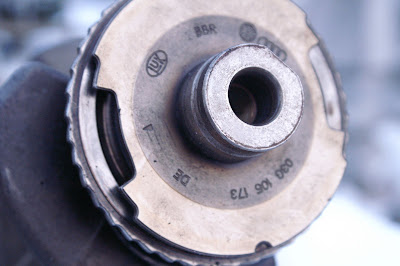
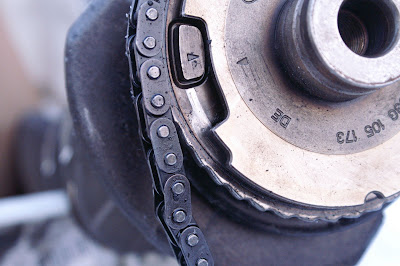
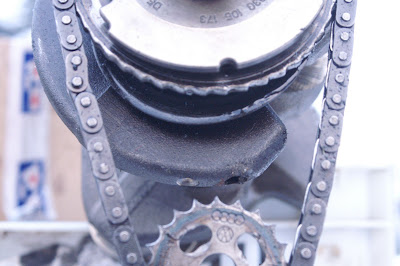
Car manufacturers also jumped on this bandwagon. VW group 2.0 TDI BLB Engine is made to fail at ~200K no matter what you do, from oil pump to head micro fractures. crankshaft sprocket after 200K http://lh6.ggpht.com/_m_33vQTtsxM/SyuSlFIeSXI/AAAAAAAAG9o/rt... http://lh3.ggpht.com/_m_33vQTtsxM/SyuSn5YALLI/AAAAAAAAG9s/ul... http://lh3.ggpht.com/_m_33vQTtsxM/SyuSp1yUs4I/AAAAAAAAG9w/mO...
VW answer: this part is non serviceable, whole crankshaft needs to be replaced :D Why is it made out of putty while smaller sprocket (the one taking more force) is still 'working'? Why is it designed not to be replaceable? Good 'old timer/not by the book' mechanic is still able to replace it (heat whole crankshaft, use big hammer).
Apple is the perfect example, from using glue everywhere (have fun replacing screens/batteries/keyboards #1) to actively sabotaging servicing by booby-trapping products (screw holes over critical pcb section + carefully selected screw lenght to destroy said pcd section). https://news.ycombinator.com/item?id=9833205
#1 replacing non splash/liquid proof apple keyboard means ripping out about 70 alu rivets! And we all know nobody ever spilled any liquid on a keyboard, right? Its not like it was designed to make you go out and pay $750 directly to Apple for replacement. Its not like its a solved problem and you could go out and but IBM/Lenovo T410 lapto .. oh wait.
Is that a result of appliances becoming more reliable, or just cheaper to replace (disposable)?
Show me a spreadsheet or a something.
It's like, the last time I bought a DVD player, it cost $26. They tried to sell me an extended warranty on it, and I laughed, because I didn't expect to actually need a DVD player longer than a year or two. I was right. It lasted a bit over a year, and then I got a bluray player. That's all I needed or wanted for my $26, and I'm glad that there was a cheap little DVD player that could provide it.
If the manufacturer comes out with version +1 and +2 of their OS that still do run on your device, but coincidentally run only badly enough to make it really annoying to use, how can you protect against that? Even if you mandate that any future version of the OS released during the warranty of your device must run on it, you can't mandate that it runs as well as the original.
When new releases come out the manufacturer will just say that "due to all these new features we can't keep the same level of performance on the older devices" and the software ecosystem being incentivized towards moving to these +1 and +2 versions makes holding onto them even more difficult.
An iPhone 4S is a great phone compared to everything except newer phones.
All computers?
You might in theory be able to run it on an iPad of the same generation as well, but ask a few people who upgraded their iPad to iOS7 or above how well it worked afterwards and you'll hear plenty of complaints, particularly about performance being much worse on the older hardware.
Perhaps we should call obsolescence over time as the market changes as natural obsolescence?
Is this just a theoretical consideration or is there good reason to believe legislation is moving in this direction?
[1] https://en.wikipedia.org/wiki/Digital_Millennium_Copyright_A...
"When I was a kid, there were radio and TV servicers in many neighborhoods. If something broke, you dropped it off at your local electronics repair shop, which was as much a part of ordinary life as the corner automotive service garage. These days, those shops have all but disappeared as rising labor costs and device complexity have driven consumer electronics into the age of the disposable machine. When it stops working, you toss it out and get a new one."
He makes some other points too from a deep technician perspective citing how companies began to view and deal with complexity and liability of having their products be user servicable...
"..."No user-serviceable parts inside. Refer service to qualified personnel," replaced the [repair/service] diagrams. Is it any wonder they call today's gadgetry "consumer electronics"? Service manuals were cheap and plentiful, and shops kept huge rows of filing cabinets bursting with them. In addition to manuals generated by the products' makers, the Howard W Sams company produced its own comprehensive line of Photofact schematics for just about everything out there. If you couldn't get a schematic from Zenith, you could get a Sams easily enough for a buck or two. As products got still more complex, manuals grew from a few pages to a few hundred, with large, fold-out schematics and very detailed, color pictorials. Producing these big books became quite expensive, so their prices skyrocketed. Shops continue to buy them--they had little choice--but no consumer would spend more for a manual than the product cost in the first place! Companies gradually reduced and finally abandoned the infrastructure for selling manuals to the public, and today's age of "use it, wear it out and toss it" was in full swing. Many manufacturers will no longer sell schematics or service manuals to consumers, thanks in part to fear of potential lawsuits by injured tinkerers. Some companies won't even sell manuals to service shops unless they're factory-authorized warranty service providers. And, believe it or not, some even refuse to provide diagrams to those facilities! Secretive computer makers, in particular, only let authorized servicers swap boards; the techs work on their machines for years without ever seeing a schematic of one."
Give it a read, you'll come to realize that for any failure something has to break, some component, otherwise for a failure to occur every single component has to go at once simultaneously. I realized this concretely when I had repaired our garage door opener. I could see the designer using substandard material on the teeth of this horizontal slider cog that allowed it to fail first, and it happened to be an easy part to replace, rather than say having the corkscrew fail, which would be much more complicated to replace. I remember reading about the part in amazon reviews where people criticized it, but I felt it was a good choice and had a reasonable lifetime to it. If something has to break, let it be the more serviceable part!
http://www.theguardian.com/global-development/2013/dec/14/to...
But besides the 800 lb gorilla in the room, what worries me more than planned obsolescence is an entire ecosystem primarily composed of glorified MVPs rather than refined products. And that is doing more to disenchant me with technology and applications than any other force, one crash to the desktop at a time.