The former just has a sexy title. The latter we've known all along because these schools openly state that they embrace affirmative action.
The matter of fact is that the school is incredibly strategic in how it makes its admissions decision, taking into account not only race, but geography, and a whole host of other factors. The complaint is utterly silly, because it fails to realize that nowhere is the claim made that the admissions process seeks to select the best students according to the SAT -- it seeks to select the students who best add something novel to that year's entering class.
A VERY STRONG argument could be made that race ought to be something which can't enter into that calculus. And I agree with that. But, from the moment a school adopts Affirmative Action (and the US supreme court upholds it), then this is just the sort of thing we can expect to see.
The magnet school where I went to high school has median SAT scores comparable to one of the mid-level Ivies. They got rid of affirmative action. It is now 70% Asian. And that's without accepting any foreign or out of state students. Asians didn't take seats from other minorities, because there weren't all that many to begin with. They took seats from white kids.
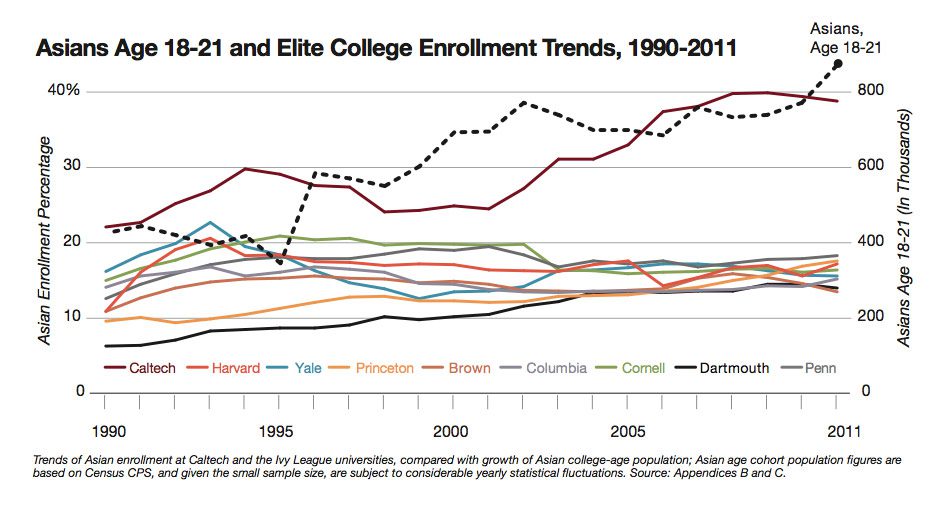
CalTech, which is race blind, has 40% Asians, more than the number of whites. That's the end result schools like Harvard are trying to avoid.
Why? That is the worst kind of discrimination in my book. How is it my fault that I was born smart, worked hard to capitalize on my innate abities and then competed on a standardized test to perform better than folks who just happened to pop out of a different vagina or uterus? Nice way to fuck me for no fault of mine.
For those saying not getting into Harvard or MIT is no big deal, are either in the sour grapes camp or have never had to face opportunity costs arising from picking a non-exclusive-low-visibility-(but-great)-school.
I don't know what la-la-land they live in, but that Veritas stamp will open doors that no amount of effort, intelligence or other factors ever can.
"White applicants would benefit very little by removing racial and ethnic preferences; the white acceptance rate would increase by roughly 0.5 percentage points."
Back to the real world though - what a shitty thing to do to someone - to care so little about them as an individual, but to only give them a place because they meet this week's PC hiring criteria. For shame all of those who promote or continue with positive discrimination.
  > Discrimination is a bad thing that should be rooted out and
  > stopped. The most insidious is of course the very PC "positive
  > or affirmative discrimiation" - where a group of people decide
  > discrimination is now ok, just because.
Next, your use of the word "insidious." This means something that appears innocuous but is actually a creeping evil. There is nothing "innocuous" about affirmative action. It's not banal. Nobody thinks it makes no difference.
Insidious is something like claiming to strengthen democracy by eliminating voter fraud, but actually attempting to suppress the votes of African-Americans. THAT is insidious.
Openly favouring applications of one group while openly claiming that you believe this will right a systemic wrong is not insidious. You may feel it is wrong-headeded, but there is no deceit involved.
Finally, you may not intend it this way, but your phrasing is misleading. It makes it seem as if affirmative action, by being "the most insidious discrimination," is somehow more dangerous and damaging than the everyday discrimination minorities face every day in North America and have for more than a century.
Affirmative action may be misguided, but under no circumstances is it the same level of threat to our stated principles of equality as the existing systemic and cultural discrimination minorities face. To use words so carelessly as to equate the two is irresponsible argumentation.
or by, say, observing the life of Barack Obama.
The stated mission of Harvard college is to "educate the citizens and citizen-leaders for our society"
In neither case is their any value is filling up the school with people with highest test scores. The primary use of the test scores is to select from the cream from a broad cross section of society, because the entirety of society is whom the graduates of are expected to lead (serve or exploit). A secondary use is to extort larger sums of money from the elite whose children score exceptionally low.
Working class whites complain that lower scoring african americans get jobs as police or firemen over higher scoring whites. They ignore that purpose of the tests is simply to weed out people who can't do the job.
Scholastic test scores serve a similar purpose. Harvard has an exceptionally high graduation rate. There is no reason to believe that Harvard is admitting students who can't benefit from what is offered. Even if it was, the children of tiger moms pursuing meaningless vanity metrics have no standing to complain about it.
A better solution would be to stop negative discrimination in the first place, but sometimes that's too hard. When you pile hacks on hacks, you end up with crazy edge cases.
People of colour & women who are perfectly competent at their jobs fall under more suspicion, have to prove themselves more, and are assumed to be less competent than white men doing the same work. There are so many studies affirming this.
It's pretty ugly behaviour to hold onto the idea that a single PoC might be an incompetent "diversity token" rather than just ... someone doing their job.
Why should childless adults pay taxes that go toward a school system that educates children, despite the fact that they don't have children?
Whatever your answer to that is, it is probably closely related to the answer to the question you posed. My own interpretation is that the whole point of paying taxes and building services is to cover the larger society's needs, not simply my own needs.
When it comes to companies, diversity is far better than having whatever the equivalent of "everyone looks the same and has the same SAT scores" so presumably it'd probably work to Harvard's benefit as well to encourage diversity whether mandated by law or not.
There's been plenty of studies pointing to the positives of diversity. In order to foster an environment which will be diverse you're probably going to have to skip over some of the kids from the populations that are large and generally well off even if they have better SAT scores.
I personally, have no problem with this. The kid who just missed getting into Harvard because of their race is probably going to an awesome school and statistically is more likely to come from a pretty good place in the world. They'll be fine.
The other kids who do get in though, get to go to a school that is better precisely because of the advantages diversity offers.
Here's some reading:
http://images.forbes.com/forbesinsights/StudyPDFs/Innovation...
Or they kill themselves because their life goal is over or become bitter and hateful of others. Really hard to tell when you shatter someones dreams arbitrarily.
Have you considered getting the Blackberry Passport which features a physical keyboard which is also touch sensitive for swiping. I find the Passport quite interesting and it can also run Android apps.
On that point, it's very hard for me to see how Asian-Americans have a societal advantage that needs redressing in the USA.
As I see it, Asian-Americans are being punished - not to admit more Afrian-Americans - but to keep European-American admissions higher.
If we say that African-Americans are benefiting from positive discrimination, we must be consistent and say that European-Americans are benefiting from positive discrimination.
I would expand your use of 'etc':
Harvard Accused of Bias Against Asian-Americans === Harvard Accused of Favoritism Towards European-Americans
Where it does bother me is med school. I've seen several of my Asian friends who were just ridiculously obviously great applicants either fail to get into med school or struggle to get into med school over several years. I'm not talking about someone who you see and think "yeah he could be a doctor", I'm talking about someone who you see and think "wow this person has it all - smart, charismatic, hard working, intellectual curiosity, top notch GPA, tons of extracurriculars - this is a no brainer, he'd be a great doctor".
All my friends of other races who seemed similarly qualified to me had no trouble getting in on their first try. And getting into med school or not is a big fucking deal. In some cases, we're turning away people who would be incredible doctors and making them pursue other careers, which is a huge waste.
Those are just anecdotes of course, but I wonder if anyone else has noticed the same thing.
https://web.archive.org/web/20080801022539/http://www.aamc.o...
All those don't make a great doctor. I have couple of friends who are currently in med school and are there because they wanted social prestige of being a doctor and not particularly because they have some sort of passion for medicine.
All of them did "volunteering" in school just so they can brag about it in their med school applications, not because they wanted to better the community they live in.
Being a type A prestige seeker doesn't make someone a good doctor.
The one I'd most label a "prestige seeker" wasn't Asian and got accepted into a great school right after undergrad, but that's an anecdote within an anecdote. Besides that, I wouldn't come close to calling any of them prestige seekers.
But if you accept it here, why not accept it everywhere?
Either race-based discrimination is bad and should never be done or acceptable in some cases. If it's bad, Harvard (and others) should stop immediately. End of story.
If it's acceptable in "some cases" the next question is: Who determines those cases? And then: Are there a set of fixed criteria or is it a case by case basis? If it's case by case, who empowers and chooses the group making the decisions? What oversight and rules are on this group?
The "some cases" scenario is ripe for malfeasance and influence peddling.. which is just another "good old boys club."
The broader problem with med school is that we should have more med schools accepting more students, and then there wouldn't be such a stark "med school vs. no med school" scenario. So the root cause of that problem isn't racial discrimination, it's just that racial discrimintation in that context might have a much bigger impact due to some other unrelated factors.
Beyond the med school issue, racial discrimination in college admissions is pretty far down the list of issues in society that I'm worried about, because it just doesn't have that big of an impact.
Of course my anecdotes could just be flukes or I could be misinterpreting the quality of various candidates. But given what we know about undergrad admissions, it's not a stretch to imagine the same thing in med school. It's just that med school acceptance is much more impactful than undergrad.
Interestingly, Ron Unz did a lengthy expose on this issue in 2012, and arrived at similar conclusions: http://www.theamericanconservative.com/articles/the-myth-of-...
He found ample evidence of anti-Asian quotas at Harvard, Yale, and other elite institutions, and perhaps more controversial, evidence of what appears to be a form of affirmative action in favor of Jews:
In fact, Harvard reported that 45.0 percent of its undergraduates in 2011 were white Americans, but since Jews were 25 percent of the student body, the enrollment of non-Jewish whites might have been as low as 20 percent, though the true figure was probably somewhat higher.51 The Jewish levels for Yale and Columbia were also around 25 percent, while white Gentiles were 22 percent at the former and just 15 percent at the latter. The remainder of the Ivy League followed this same general pattern.
Jews comprise a mere 2% of the population yet a massive 25% of the student body at Harvard, Yale, and Columbia. The contrast with Caltech and UC schools with more merit-based admissions processes is quite stark:
But Caltech’s current undergraduates are just 5.5 percent Jewish, and the figure seems to have been around this level for some years; meanwhile, Asian enrollment is 39 percent, or seven times larger. It is intriguing that the school which admits students based on the strictest, most objective academic standards has by a very wide margin the lowest Jewish enrollment for any elite university.
Let us next turn to the five most selective campuses of the University of California system, whose admissions standards shifted substantially toward objective meritocracy following the 1996 passage of Prop. 209. The average Jewish enrollment is just over 8 percent, or roughly one-third that of the 25 percent found at Harvard and most of the Ivy League, whose admissions standards are supposedly far tougher. Meanwhile, some 40 percent of the students on these UC campuses are Asian, a figure almost five times as high. Once again, almost no elite university in the country has a Jewish enrollment as low as the average for these highly selective UC campuses
(Unz himself is Jewish, in case you're wondering.)
Andrew Gelman has the details:
http://andrewgelman.com/2013/02/12/that-claim-that-harvard-a...
Is Harvard really 25% Jewish? Or is that the fraction of domestic students who have some (possibly small) Jewish ancestry?
And what's the source that Caltech is 5.5% Jewish? Could that mean 5.5% are actually practicing?
Did Hillel actually perform a serious survey/study in these schools, or are these numbers based on some student's guess?
Admittedly, I haven't looked through his citations and supporting material, which looks pretty extensive.
Asians have the highest GPAs and SAT scores, followed by whites, followed by Hispanics, followed by blacks. As such, blacks are given the benefit of the doubt, where as Asians are judged more harshly.
Statistically, these groups have differing average IQs in the same order that I just described, with Asians at the top (actually Ashkenazi Jews at the top, followed by Asians) and blacks, sadly, at the bottom. This isn't to say a black individual can't have a high IQ or an Asian individual can't have a low IQ, just that on average they cluster around certain numbers, so a black with genius-level IQ is rarer than an Asian one.
Whether or not you believe IQ measures intelligence accurately or comprehensively, the fact is that it correlates strongly with academic performance and SAT scores. I also will concede that "race" has questionable biological validity, and it gets really fuzzy when one is the offspring of one or more "mixed-race" parents". Still, race/IQ statistics in all of their generalities are a source of existential depression for me. Most of the data is touted boldly by people I despise and used to bolster viewpoints that I find deplorable, but there seems to be at least some truth to it.
The idea of discriminating based on one's race seems unfair if we lived in a world where literally everyone has the same capacity to succeed but merely chooses not to. But what if that's not the case? If Asians generally can attain high test scores and high GPAs due to an innate advantage, could that mean the admissions standards should be stricter for them and more lax for other groups? The alternative is that certain groups completely dominate academia with ease, while other groups are barely represented at all -- which is probably already the case to a large extent.
I don't think there are any easy answers. Trouble arises with an Asian individual with a relatively "average" IQ faces the admissions process, and trouble arises because the black individuals who manage to get in have above-average IQs. Still, I support the idea of affirmative action for the reasons that I previously described.
Asians might have a harder time while other groups get a bit of a head start, but if you have a high IQ you will ultimately have the capacity to carve out a high-paying career in ways that someone with a relatively lower IQ never will.
1: http://scholar.harvard.edu/files/fryer/files/testing_for_rac...
Moreover, many blacks admitted to Ivy League schools aren't black Americans at all--they are Africans, and their scores are on par with Asian students. People like the "Tiger Mom" acknowledge this openly. But educational institutions lump all blacks into the same statistical category--in part because as soon as it becomes evident that some black Americans are getting left behind in favor of Africans, the institutions will have to deal with various groups on that issue.
Ultimately, you fail to differentiate between black students, assuming they are all of one type--and yet you tout your intelligence! Besides, it's hardly surprising that African students fare better in education than Black Americans. Most African students are from an environment where they are viewed as leaders, as equals, and not as inferiors. They see themselves reflected positively for most of their lives. Contrast that with how Black Americans are treated, and it's no surprise that Africans fare better.
Not to mention that among black Americans at Ivy League schools, many get their admission boost from legacy admissions and their family's wealth--they don't even need to benefit affirmative action. Grades just okay but Dad gives enough money to the school? Take a trip to Europe for a year, write about it and come back next year--that's for wealthy kids, regardless of race.
And, finally, just because any racial group has an "average" GPA or LSAT score, doesn't mean that every student in the group does. Drop the pretense: some Asians and whites with lower test scores benefit from affirmative action just like other minorities.
https://en.wikipedia.org/wiki/Race_and_intelligence
https://en.wikipedia.org/wiki/Sex_differences_in_intelligenc...
More simply, if the SAT is the perfect determinate for intelligence and energy, and success in life directly relates to intelligence and hard work then the SAT alone should be the prefect predictor of success after graduation regardless of which university you graduate from. Particularly if, as alleged, employers don't care about your school after you've been in the work force for a number of years.
If Ivy League's continue to generate the most successful people then their holistic approach is better at choosing the best candidate than the SAT or...
Or the ivy league diploma works like a tile of nobility to a great degree nearly guaranteeing success in life to all its holders regardless of wit. In this case the argument really is what proportion of races should get these titles, each person looking to advantage their own.
Nobody, including the College Board, has ever made a claim remotely close to this.
Either the current process in its entirety used by Ivy Leagues produce the most successful candidate or it does not. If it does then either it is already selecting the smartest hardest working candidates whatever the race statistics or success from going to an Ivy League has less to do with brains and effort. If so, we're just arguing about who get's a non-merit based boost in life.
It's hard to form a full opinion without the type of information you'd only have access to as a member of the admissions comittee.
Use all the rationalizations and euphemisms you want, but the truth is this: Ivy League schools are rejecting many of their most-qualified applicants solely because of their race[2]. These policies need to end.
1. http://en.wikipedia.org/wiki/Numerus_clausus#Numerus_clausus...
2. http://www.theamericanconservative.com/wp-content/uploads/20...
I knew this would be unpopular when I posted it, and I am personally biased, but I don't think one can make the argument that Asian's lack socioeconomic mobility in the same way as some of the other races.
In any case, it would be great if Harvard could provide some stats showing exactly how Asians are deficient. Will be interesting.
So Asian's are 5% of the US population [1] but make up 20% of the admitted applicants [2]. While African American's, representing 13% of the country [1] and a shameful legacy of mistreatment make up 12% of admitted applicants [2].
The problem is that admissions isn't based solely on your capabilities as a student at the time of application, but also on your potential to grow. Asian's tend to be fairly successful in the US (especially 2nd and 3rd generations) [wish I could find stats for this right now], if you start in a good environment with two intelligent well-meaning parents a 780 in math is impressive, if you're the son of a single mother with a father in jail and 3 younger siblings you share responsibilities for that 520 in math looks spectacular.
If I ever see Asian's in this being denied social mobility I'll raise torches and pitchforks, but in this scenario Harvard is a limited resource that provides immense social mobility for students from the lower echelons of society, if admissions were rooted solely in test scores and grades then these students with potential, but not the resources from birth, will be denied a chance to benefit from a prestigious education.
[1] http://quickfacts.census.gov/qfd/states/00000.html
[2] https://college.harvard.edu/admissions/admissions-statistics
edit: I appreciate people's rights to disagree, but I find it frustrating that the preference has been to downvote this rather than engage in meaningful dialogue.
It's odd that affirmative action is basically basing everything on color of your skin and not the content of your character. I was under the impression that it was supposed to prevent this.
I only have one life. Being told it's ok that I was denied an opportunity because I'm white and I'll be ok is easier to abstract into a broad formula, but harder to take when, on merit alone, I'd be given that opportunity and my life as a human being would be better for it.
Affirmative action was arguably a way to accelerate towards true unbiased judgement, but any purpose it served has run its course and now it's rather harmful, IMHO.
There are better solutions. For instance: free lifelong quality education to all. But naturally, elites would rather waste society's wealth on wars (international killing) and prisons (the most jailings in the world)... than silly things like knowledge and healthcare.
Affirmative action is a modest, successful effort to chip away at the self-destructive inequalities of society. Naturally, many try to attack it to claw back more unearned white privilege for themselves.
Depends on what variety of English you speak whether the term Asian normally includes Indians or not.
For Brits, Asian primarily means "From the Indian Subcontinent" which includes Pakistan for them, IIRC.
For Americans, Asian primarily means "From East Asia" which is China, Japan, Korea, and Southeast Asia.
Of course, in an academic context, Asian means "Anyone from the Asian Continent" which includes some but not all Russians, all South Asians, all East Asians, all Central Asians, all Middle Easterners (except Egyptians), and whoever else depending on how certain lines get drawn.
I had extremely strong credentials overall - generally strong standardized testing scores (1250 on the SAT in 7th grade with a 740 Math/510 Verbal split, 800 on the SAT II Math 2C in 8th grade, 780 SAT II Biology, 780 SAT II Physics, 750 SAT II Chemistry, 750 SAT II Writing, 1450 on the regular SAT with a 750 Math/700 Verbal split), college math & physics credits while in high school (Calculus III/Multivariable Calculus, Linear Algebra, Differential Equations, etc.), lots of extracurriculars & achievements, and a recommendation from an Ivy League physics professor. However, I slipped up on my essay since I wasn't a good writer then (which clicked for me the summer before college strangely enough) - that slip up was all it took to get deferred rejection from schools like Harvard in a year where a lot of the private colleges were weakened by the Enron scandal & consequently took 3/4th of the normal enrollment.
On the flip side, in just the class before mine, there was a girl who had nowhere near my scores or achievements (in fact, I heard her SAT score was a 1320) who was accepted to Harvard - the kicker was that she was half latino.
At the time this happened, I was extremely angry/bitter - I ended up attending a public university, which ended up being a blessing in many ways. I ended up learning a lot in non-academic aspects, but a lot of that was from force of character as someone who pushes himself to break barriers and challenge himself to succeed on difficult situations. I still believe those schools made a bad mistake, but I've accepted that admission is not necessarily a merit based decision for these schools, and to concern myself with what I can control.
- Asians are getting higher scores than others, so they're required to get higher scores to be admitted.
- Parents of the next generation know that their children need even higher scores, so they force their children to work continuously harder.
It's misplaced attention on what "minorities" are (or should be) getting, while overlooking the benefits that the wealthy receive. Also, many people's understanding of the minority groups at Ivy League institutions seems flawed.*
The reason affirmative action exists is only partially as a benefit to minorities. Sure, they benefit (as do some whites and Asians), but affirmative action also acts as cover for legacy benefits in the admissions process.
You see, the day affirmative action falls, lawsuits will be filed to remove legacy preferences. If you're going to get rid of preferences, the argument will say, then get rid of them all! Do you think that wealthy donors will have the incentive to lay heavy money on the endowment if they don't receive some benefit for their children in the form of legacy admissions?
Or, as Sandra Day O'Connor said in the oral arguments in one of the affirmative action cases related to a state school: "I want my sons to go to Stanford" (paraphrased), her alma mater. Did I mention that the Supreme Court justices attended Columbia, Harvard, Yale, Stanford, and Northwestern?
If you think this is primarily about minorities, think again. Wealthy people will protect themselves, but in this case, people are so focused on race that nothing need be done--legacy clauses continue to fly under the radar.
You can expect to see Affirmative Action end when the wealthy are prepared to give up the benefits their children receive.
How long do you think that will take?
*In terms of African-Americans/Latinos, consider the following:
1 - Many of black students admitted to Harvard aren't black Americans, they are Africans, with test scores and grades on par with Asian-American students.
2 - The first black student graduated from Harvard in 1869. Over the past ~150 years, there have been enough black graduates such that a fair number of black applicants now have the legacy boost to their admissions.
3 - Affirmative Action was meant to rectify the disadvantages minorities received. Such as denying black soldiers access to the GI bill, while white soldiers used it to receive an education. Was that fair? And how much does education impact the future of a family? Multiply that by a few generations and you see why Affirmative Action still exists.
i've heard of african immigrants doing better, economically. but never students, any sort of supporting link to this point?
What happens when you have limited resources (housing, dorms, teachers) and a group of people who are superior in some way end up wanting to use all your resources (buy all housing, be smartest and get admitted everywhere)?
With money, we end up with capitalism doofus blindness and say "you got money, you EARNED that money, clearly, so do whatever you want" even though in modern "foreigners buying real property" practices, it's corrupt/graft money breaking SF/London/NYC/LA/Seattle/Vancouver housing markets in a worldwide government sanctioned oligarch money laundering scheme.
With intelligence/capability, it's trickier. The popular belief is every human brain starts as a blank slate with unlimited capability. By that logic, if you don't get accepted somewhere, it's your own damn fault. But, that's so obviously wrong. I know plenty of people who are physically smarter than me. In certain problem-solving capacities, they think faster, better, and in more immediately creative ways than I do (what I lack in immediate ability I make up for in long-term effort). And so do their siblings and their parents and their grandparents going back many many years. But, just because I'm lesser, should I be thrown to the gutter while _only_ high quality education goes to the "truly smart" people?
Then that's where race rears its ugly head. If you only select people with a certain strand of hereditary smarts, you end up with a campus with a majority of people from background X where X feel "at home" there and welcome, but then your minorities C, D, E, F, G, H feel, well, minority. A popular solution to the "too many high achieving people from the same background" bugaboo is to try and make the minorities less minority by boosting their numbers though allowing sub-perfect acceptance (not sub-par, just sub-not-the-absolute-best-ever). But, you have a fixed resource to allocate (class sizes, dorm rooms), so that kicks out some of the (glut) of perfect achievers you would have otherwise accepted.
Then it comes down to politics. Conservative = "me me me, i'm perfect me me me, kill the lessers." Liberal = "we're all in the together, so maybe you should step aside from this opportunity to let others advance too."
You end up with a spectrum from top-down solutions ("no more than 20% of people from X background") to a bottom-up solutions ("only compare people of Y background from other Y background, then start acceptance from non-majority application piles first"). Neither is "fair" to the other, but if you don't pick a society-optimal fairness system (which is inherently unfair to those rejected), you get a completely unfair system of privilege boosting privilege (inherent privilege obtained by upbringing or genetic lottery). (Completely ignoring the other soft acceptance categories of "will this student eventually give us (or will their children eventually give us) lots of money in donations or bring us fame as a legacy.")
There's no actual solution to preventing the over-allocation of fixed resources in the presence of superior consumers; all we're left with is compromises on the spectrum of "superiors only" versus "helping everybody in society."
Thought experiment: if space aliens (superior consumers) landed and offered to sell us antigravity fabric and replicators for $9 trillion USD ('fixed' resources), would we just give them all the money? (Extension: what if they wanted $1 trillion USD worth of bitcoin and you can't even generate that much? Fiat wins again!)
The next thing is this. You say, well people of other races might feel uncomfortable if it's too much asian on that campus. So the white or black will feel out of place. But you're being a sort of coddling racist with that kind of thinking. You know what will make somebody out of place in an elite school? Somebody who didn't actually measure up to the standard and got in anyway. Somebody who starts to suspect they don't really deserve to be there and realizes they don't fit and they will take a lot more personal and school resources and probably won't fit much better and so are really a drain on others rather than a contributor.
Because a person who achieves something honestly will have the confidence that they belong and even if the first few days feel weird to them, their work and intelligence will quickly bring them into the fold with their academic peers and teachers. The current biased admission methods will inevitably create tensions too and a bad long term result. If harvard is now confirming a bias, then they leave an elephant in the room. The asians at harvard will look around and notice, say on of their latino classmates is clearly not capable. And that asian will think "my cousin is WAY better than him / her" and she couldn't get in with me. Who is this clown? And so it breaks down their own belief in the school they got into and a tension with their classmates. A non-biased academic admission would mean that conflict or tension like this would be dissolved, the asian would give the latino the benefit of the doubt
It also breaks down the reputation and brand of harvard and so people of minority races with harvard might be suspected as lucking their way in due to color.
95% of why a college degree is valuable is for the signal "hey I went to uni of X degree of prestige [and therefore am probably of Y degree of intelligence/ambition]".
Why do young Americans need to spend $100k just to signal their iq level to employers?
Why do young Americans need to compete with each other to do so?
Maybe to get into Harvard you need iq > 130. As the population grows, there are more kids with iq > 130, but # of Harvard seats does not increase.
There needs to be a low cost and widely accepted way to signal iq that does not create unnecessary competition and cost for people starting out.
Also with AI coming along the corporate obsession with iq will be obviated as well. Nobody gives a shit how well you did on the SAT when goddamn Skynet can diagnose 5000 medical conditions per second with quadruple human accuracy.
The best solution is to set up a few Asia-American self-funded private schools across the country, where academics becomes the major admission criteria and your race does not matter, of course this has to be stated carefully otherwise you still could be sued for "discrimination" becomes some group of people will be least represented as expected.
Affirmative Action will not make those who can take advantage strong, as strong comes from serious competition only, they will make that group stay weak for good. It's simply unfair to those kids who spent most of their time learning, what a shame to Harvard and the Supreme Court.