During the 20 years I lived there, I cycled everywhere, and I had an almost weekly accident, always at the same three intersections -- cars running into stationary bikes, half the time openly on purpose (there is a bolo for a taxi driver for attempted manslaughter under my name: his plaque was unlegible on the camera, but him accelerating twice into my bike was clear).
The local police knows those intersections, there are camera monitoring those. Those are on large axis, and have the largest concentration of tourists (about 50 people waiting at the light at any time of the day).
If you want to make Paris a biking city, no need to spend millions; all the protected lanes become useless ever 50 m when an intersection shows up and dozens of car just want to run you over no matter what.
Just ask Police to enforce laws on attempting to kill people and make clear that a car can be used as a weapon. You do not even need to budget their presence: they are already there, watching and helpless.
> You might not get “Paris-level results,” or the world’s best city for biking, [omissis]
The best city for biking? Paris is a mess and a dangerous place for cyclists.
I am very pleased to hear they are investing more to fix the situation. That is the news to me.
Personnally I ride a motorcycle; it was stolen last year and so I used bikes for about a month. Here are my observations, that I think are difficult to fix with money alone:
- pedaling makes you hot and sweaty; you arrive at the office being a mess
- when it rains you get super wet, much more than on a motorbike, because you have less protection and you don't carry special rain trousers with you at all times (whereas they're permanently stored on my motorbike)
- also, when it rains, if you cover yourself up to avoid the rain, you get even hotter and sweatier
- Paris isn't flat! (contrary to Amsterdam...) and some hills are very steep
- some distances are irrealistic for bikes: I have two clients who are 15km apart and (to me) 15km on a bike is a fairly long ride
All in all it seems bikes are mostly for tourists (who don't have to show up in an office at the end of their ride), during the summer (well, the part of the summer when it's not too hot) and for relatively short distances.
But in the absence of bikes, tourists don't take a car, they mostly use public transports (or maybe an occasional cab), so I very much doubt more bikes mean less car traffic.
There is another program in Paris that seems much more promising: Autolib, cheap electric cars that you can rent for a very short amout of time. Doubling that with electric scooters would be really great, IMHO.
The problem with Paris would be more that it's full of parisians.
It's very cliche, but sadly true. People are smart and educated but undisciplined, behave unresponsibly, and think about rules as mere guidelines. Being "human" and super lenient is mostly a quality, even when it comes to street rules.
Drivers are really bad, bikes don't care about road rules nor surrounding trafic, and pedestrians can strike conversations in the middle of the street if they get to stop the cars around them. There is an intersection in front of a subway station in the town I live, there is a trafic light, mirrors and road marking, and still every two months someone runs through it and gets hit by a car.
I think the best system would be close the streets that already effectively dominated by pedestrians, reserve the most busy streets for professional vehicles (buses, taxi, delivery vans etc.). This would tip the balance to use private cars for very specific reasons only, and switch to public transport for the more casual trips.
Road mortality would be down, people currently wildly circulating on the street would have full areas reserved for them, public transport would have a boost in use justifying more investment in the infrastructure and modernisation, and pro drivers would also have dedicated lanes and streets.
It feels like a clear win for basically everybody.
I can cycle hard and sweat, or I can cycle gently and sweat very little. We don't have a shower in the office, but I don't cycle too hard to work, and change shirt when I get in. It's not a problem. On the way home, I cycle hard and have a shower.
I can stay completely dry when cycling by simply carrying waterproofs. I just make it routine to always have these. It's true that these make it a little sweatier, but a change of clothes solves this problem.
Cycling isn't going to be suitable for every journey. However, 15% is quite a small target when you think about all the little trips people need. Things like cheap electric cars can be useful for the remaining 85%.
- when it rains you get super wet, much more than on a motorbike, because you have less protection and you don't carry special rain trousers with you at all times (whereas they're permanently stored on my motorbike)
- also, when it rains, if you cover yourself up to avoid the rain, you get even hotter and sweatier
I liked your point about people cheering for the cars, but those three are a bit disingenuous. I come from a country where "everyone" bikes "all the time". Perhaps we smell (I jest only slightly). But in the face of at least two countries where people cycle a lot, including for their commute, those three things somehow don't add up.
The distances: yes. The hills: yes, good point. It's not suitable for every journey. But sweat? Come on. And not just once, but three times.
It weakens the rest of your post, which is a shame because I think it's a good one.
P.S.: I'm not going to individually address the points to avoid turning this into some cycling pissing contest. Suffice to say: people cycle. It's real. Nothing inherently wrong with it. Correction: yes, inherent problems, but clearly nothing insurmountable.
EDIT: Can't reply to the guy below, just want to say you make a great point about showers! Showers at work are not just good for biking; also for running. And just for showering :P I'd love showers at my office.
Of course not! I did; and that landed me in the hospital twice. It is far safer for bikes to go through an intersection after of before the wave of cars, not when the light turns green and the cars turning right are rushing into you. The other issue is that you and most others ignore the actual rules: a bicycle is perfectly allowed to drive in the middle of the road. Try doing that once in Paris, and I'll be happy to bring you flowers after your recovery. Most streets in Paris are single-way for cars, but clearly marked as both ways for bicycle: same thing, try it once, dare to point at the signs, and you'll get honked at and ran into just to teach you how to “respect road signs”.
Has anyone ever apologised for making up rules like those? Come on; be serious: you and so many others are far too busy telling us that we are wrong to actually check the facts.
The rest of your comment proves that you do not know what you are talking about.
> Personnally I ride a motorcycle;
Now we are talking… Running red lights; parking illegally; running up one-way street… you never heard of those; have you? And my favourite: kicking bikes at the red light to stand just in front and have the biker enjoy your noxious fumes, unfiltered. You are polluting Paris dozen times more than a car does, and nothing would help both bicycles and Paris in general that you realise what a selfish prick you are.
* Stealing:
You need a secure location to drop your bike, or you're under the risk of losing it[1]. I knew it was risky, but I never knew how easy, cheap and fast it is to steal a bike[2].
* Speed:
I used to ride above average speed on dedicated and isolated channel lanes (Ourcq), but you can't always keep that pace. Kids, families, slower users... It's risky for everyone. In town lanes are thinner and more crowded, thus I guess slower.
About sweat, how many Offices have showers ? Or maybe some water and a towel would do.
[1] or a piece of it. I had my wheel guards stolen in front of Police station.
[2] cable locks under 2cm diameter are pure fluff, guys can rip or cut them in 10 seconds. Even heavy chains won't resist some tools. Surprisingly people assume that someone cutting metal in the street must be the owner, and if they suspect he's not, why bother being harmed.
https://www.youtube.com/watch?v=mVJAeQbInYg https://www.youtube.com/watch?v=InaqGRYq1z8
A 15km ride might be 13km of RER and 2km of biking, on some trips it's pretty damn fast even compared with a car that has to contend with traffic.
It doesn't solve the rain issue on the other hand. Especially as folding bikes generally have smaller wheels that tend to skid on wet pavement.
As a cyclist, I always carry waterproof clothes at all time (I still haven't found a way to protect my shoes though...).
This may be the case for some people but if you cycle gently enough and are moderately fit, there's no reason you should be particularly sweaty after arriving.
I cycle to work in a cycling/change of top. After I arrive, I wait around 10 minutes to cool down (not always needed, but it's a habit) while checking emails, making a coffee etc. and then I change into my work top and all is good.
If you are really hot and unable to shower at work, perhaps consider baby wipes or similar for a quick freshen up.
Money can help here, as it's usually easier to cycle casually if you're on segregated cycle tracks not "holding up" the traffic and feeling like you need to cycle fast to fit in.
> - when it rains you get super wet, much more than on a motorbike, because you have less protection and you don't carry special rain trousers with you at all times (whereas they're permanently stored on my motorbike)
A set of mudguards is a necessity for pleasant commuting (in the UK, at least), as is carrying a packable waterproof jacket.
I don't personally worry about my trousers so much, I wear jeans with a slight waterproof treating, and if it's particularly wet before I leave, I will wear cycling specific clothing or take a change of clothes.
> - also, when it rains, if you cover yourself up to avoid the rain, you get even hotter and sweatier
Can't really argue with this but there is a saying that there's no such thing as bad weather, just bad clothing. Just because something is waterproof, it doesn't mean it will be pleasant to wear on a bike. Typically, the more you spend, the better balance the clothing will provide between waterproofness and breathability.
I don't know how much it rains in Paris, you could only ride on dry days? It's remarkable how little it rains in London.
> - Paris isn't flat! (contrary to Amsterdam...) and some hills are very steep
Hills can usually be conquered fairly easily with the correct set of gears but I can see how it would be off-putting.
> - some distances are irrealistic for bikes: I have two clients who are 15km apart and (to me) 15km on a bike is a fairly long ride
You wouldn't run a marathon straight out if you were starting to run, so if you're starting to ride your bike, begin with short distances and slowly build up the distance if you want to.
On the other hand, I still crap my pants when going through Bastille...
You are essentially right, though, have an efficient network requires good nodes and good paths, right now the paths are pretty good but some nodes are painful and to get around them, you need to leave the network.
For reference, here is a map of the existing and planned bike paths: http://i.imgur.com/PigJifZ.jpg
The golden rule is to segregate. Give cars, bicycles, and feet their own space. DO NOT mix. If somebody can make a choice to put their 6 year old child on a bike and cycle around a city, you've got it right.
My city of birth and upbringing (Warsaw, Poland) has a huge problem of people not respecting each others' space. Unfortunately a lot of bike lines are just painted on sidewalks. This (and the fact there's not enough bike lanes) encourages cyclist to just drive around pedestrians, who sometimes also tend to drift onto dedicated bike lanes.
It's terribly annoying to travel on foot during summer/autumn. You can easily get hit or at least shouted/honked at by a 'deranged' biker. Pedestrian/car and Cyclist/car relations are even more complicated.
Now living in Berlin I have to say this city has mostly solved the issue. Majority of bike lanes are a (separated) part of the car lane and cyclist are encouraged to just mix with cars on low-speed streets (<30 zones). Annoyingly enough some (not many though, mostly deliveries etc.) cyclists completely disregard the signage and still ride on the sidewalks.
Still, the roads seem to be really safe, hence most cyclists don't even wear helmets. I noticed drivers in here also pay more attention to what's happening around them. You rarely read about serious accidents involving bikes. Last one I remember it was a case of road rage where car driver beat a cyclist with a bat.
But also, Seville has one of those easily under-estimated features that engenders a great cycling experience, and consequently good chance of success with such a plan - it's relatively flat. Amsterdam enjoys a similar benefit, though I can't speak for Copenhagen on this aspect (those were the two extant 'cycling capitals' mentioned in the article).
Thinking about it, there is some truth to this. I have kids and would NEVER dream of cycling with them in Paris; we put the bikes in the trunk of the car and go to a big park if we want to ride.
If there were actual segregated bike lanes where there is zero chance of crossing a car (at any speed: I mean NO car) I might cycle with them in the city, and I admit it would be nice.
Also "mix everything" is a viable option, too, if people behave themselves. The "woonerf" (http://en.m.wikipedia.org/wiki/Woonerf) is a very good solution for densely built neighborhoods (even in the USA, it seems: http://ithacavoice.com/2015/04/ithaca-housing-project-includ....
In a similar fashion, I see little wrong with cyclists driving on sidewalks. Problems only start when they drive faster than pedestrians in a busy street. In other words: if they do not acknowledge that they are guests on the sidewalk.
That is fairly typical behaviour in the Netherlands. People will cycle through almost empty pedestrian-only zones at 10-15 km/hour, slow down to walking speed when coming close to pedestrians, and start walking, bike in hand, if things get really busy. Legal? Not everywhere, but this rarely gets you a fine.
This seems too emphatic, given the counter-example of Japanese cities, which have few dedicated bicycle lanes, yet remarkably high rates of cycle usage.
The Japanese shifted liability onto larger vehicles. Just as most places will always treat a rear-shunt as being the fault of the car behind, hitting a cyclist is always the fault of the larger/motorised vehicle.
Of course this could have nothing do to with Germany phasing out its nuclear power plants and having to reopen coal power plants instead.
They massively increased the share of solar and wind in their energy production, but still need more traditional methods of power generation to cover when those 2 are not providing energy, hence more coal [1].
And coal is incredibly polluting. See [2] for example for CO2 emissions :
> In July 2014, a group of NGOs published a study on the EU’s 30 worst CO2-emitting thermal power plants. German power stations featured six times among the 10 dirtiest.
CO2 is not the problem for city pollution of course, it's the rest of the small particulate matter that is.
[1] https://www.greentechmedia.com/articles/read/germanys-energy...
[2] http://www.desmogblog.com/2015/01/24/coal-casts-cloud-over-g...
Usage of coal stayed roughly the same in the last 10 years [1]. If you directly compare it with the amount 10 years ago it's a slight decrease.
The real issue for pollution lies in different sectors. For instance around half of the PM pollution in Germany is caused by people using wood for heating. Cars are one of the biggest polluters in cities.
[1] https://www.energy-charts.de/energy.htm click on year: all, annual, all sources
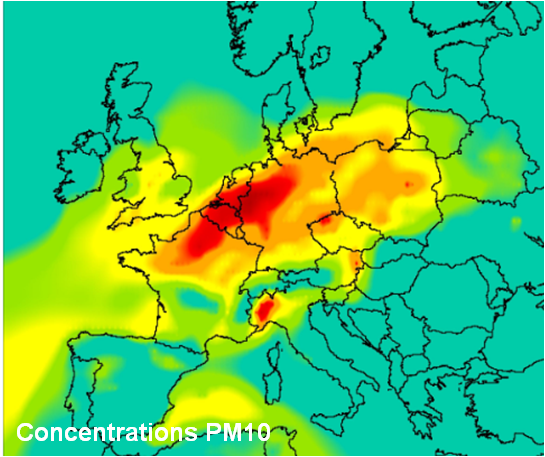
In my experience the big pollution episodes in Paris are when there's no wind to wash the smog away. It's definitely localized over the city (not that the air is not polluted elsewhere, it's just generally much worse in Paris).
Another example of a recent particulate matter concentration map : http://www2.prevair.org/sites/prevair.org/files/styles/scald...
I have no idea what the reality is of smog in Europe, but your off-hand dismissal of this based on the perceived distance between the source and recipient of the pollution is entirely wrong.
Have a look at this recent map of particulate matter concentration during a recent pollution peak for example : https://pbs.twimg.com/media/CAr9obuWkAAQgjq.jpg:large
The cost of public biking in Paris (3$/month) is very very very small when you consider the cost of having a car (at least 200$/month) or taking the subway (around 70$ / month).
One problem though, Paris has some hills and people tend to avoid these areas. Using your legs is great yes, healthy etc... but hey, we'd like electric bikes :)
(I cycle round the year in Finland)
In Helsinki, the share of trips made by bike is 11 % and the goal is to reach 17 % by 2025, in ten years time. I think even that is ambitious but not entirely unfeasible.
(However, it must be said that there seem to be vary many different ways to calculate the share of trips done on bike vs. other ways, and if you change the way you make statistics, you can of course indicate huge progress...)
Bikes on local trains is huge.
http://www.citylab.com/commute/2014/07/if-an-electric-bike-i...
How much of electronics is recycled, how much can be recycled?