Figure at a bitrate of 128 kbps, and a sample rate of 44.1 Khz, an MP3 1 million bytes in size usually clocks in at close to 1 minute of playback. With those statistics in mind, a ballpark figure of 2 years of noise is a reasonable estimate, and that's pretty close to the 711.5 days they cite.
FLAC compression, by comparison, is closer to 10MB per minute, so maybe you'd only get 71 days in the same space, or require 10TB of storage. You could probably fit the lossless version on roughly 400 blu-rays, and opposed to some 233 DVDs?
Even cooler though, is what seems to be some java source for the original noise?
http://www.jliat.com/HNW/HNW.java
Who needs a compressed static copy, when you have the original source?
EDIT: There's also a lossless version in 16 bit WAV audio...
(No shit - someone actually sells those)
What effect would the MP3 compression have on the signal's entropy? He says, "MP3 format was chosen not only for its length..." which implies that he managed to compress it at least a bit - if so, there goes his entropy! I can't see how an MP3 compressor could make any headway against a really noisy signal using psycho-acoustic masking, so I'm guessing that any compression he realized came purely from coefficient quantization, which in the case of a really high-entropy signal should actually lower the entropy.
If anyone knows more about this, please feel free to correct me.
Or to put it more succinctly: Oftentimes art's biggest enemy is people making it out to be a bigger deal than it really is.
I mean, FLAC proves that people for some reason cherish wasted storage space, especially when that storage space is used for meaningless content that they can't actually hear.
My scheme does that, only bigger.
  // basically no wimpy numbers - only fat ones
  if (s > 0 & s < 30000) {s = (short) (s + 30000);}
  if (s < 0 & s > -30000) {s = (short) (s - 30000);}
Damn I would hate to have to re-burn 233 DVDs, or this set of 510(!) he produced later: http://www.jliat.com/HNW510/index.html
This type of bug, an integer overflow, is one of the many types of bugs I look for when I review source code as part of my job in info sec.
[1] http://jliat.com/HNW/HNW.java
Burning 233 DVDs is easy if you have the right equipment. At my workplace we used to use units from rimage.com and now use units from microboards.com. The units have built-in inkjet printers so that each disc can have its own label. The software that will let you queue up lots of jobs at once.
(You don't want a disk duplicator, those will typically burn you 10-at-once of the same image.)
"Oops indeed! but not me! :-)
they have confused THREE! works. The 1 TB set of disks was not made using the Java code! but made from samples of Harsh noise.... as MP3 files = 1 TB - Harsh Noise not HNW! Each MP3 being made of random chunks of MP3s spliced together using a VBnet program. The other piece 510 disks is HNW but again not made using the JAVA code he refers to, and this uses .WAV files.... not .AU !!! (it layers randomly HNW noise to create a .WAV)
Now as to the JAVA code - I wrote this must be 6 - 7 years ago as an exercise- but i've just run the program which creates the .AU file of HNW... max value in the file is +32729 minimum -32720... were found in a small chunk of the .AU file.... so?
here is a sample of the .AU file actually produced by the code to which he refers...
-12248 -30299 5627 -12218 6453 6684 6991 6832 6059 -30395 -30301 -30188 -30270 -12141 -30911 -32020 -32664 32208
Now i'm ready to admit i'm no JAVA expert...!!! which is why i use .Net! But this was an exercise in seeing how to make HNW using Java. It was never released as a piece. I used some code I found for making sine waves and plugged in my random algorithm... nothing smart. But it did work! Why it seems IDK.
As a rule of thumb i tend to look at the output of any programs...
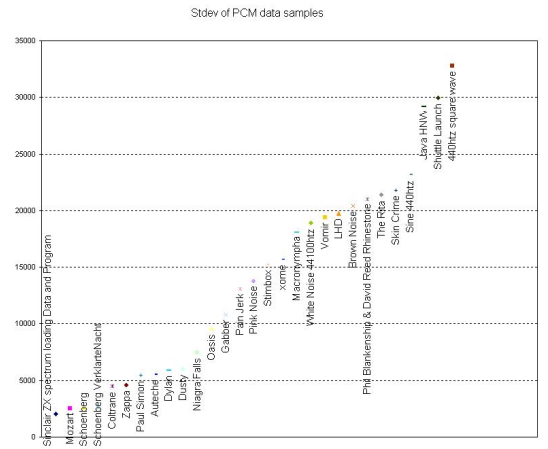
Feel free to post this response as i'm not a member of the group, but would think as the code and program is there a simple test run would show its harsh. That my attempt to not use wimpy numbers doesnt seem to work as it should is besides the point. From memory i probably just tweaked these numbers until the results were harsh - that in the above data set (only a small number of samples above) gives a standard deviation of 29101.09796...
http://www.jliat.com/pics/graph.JPG
If you look at this you can see a plot for the output of the JAVA HNW.... its high! I gave the source so anyone into JAVA could play with this... as i say its not a piece but a by-product on seeing how HNW / Noise has large Standard Deviation and low SNR and as one might expect produces HNW. The harshness being a product of sudden and large changes in values...
In fact i like the fact that in spite of the (MY) mistake it still works - can you fail in noise? :-)
best
James
P.S. The JAVA HNW is way too slow to make these big terrabyte files... it would take much longer to write them than they sound when played!!!"
Wouldn't it result in something like `if (true & true) {...}` being evaluated, which seems weird?
Other than that, I can't really say that creating a project of 700 days of generated noise is very interesting from an art perspective, but I'll save the art critiques beyond that.
I wasn't sure if the 4 GB limit "discovered" FAT32's limit or if it was a MP3 format issue
Although, there's MPEG/DVD mastering software in use, which would (probably) be smart enough to fragment assets, and chain them together for continuous playback (considering the availability of dual-layer 8GB recordable DVD's).
The images also note a Thinkpad is in the mix, which might imply Windows XP (or newer), and possible access to NTFS partitions, which permits files of 2^64 bytes.
The lossy compression (and apparent algorithmic errors) make this a fairly poor choice of random noise input.
_______
reminds me: need to read Vertical Color of Sound: http://www.amazon.com/Brian-Eno-Music-Vertical-Color/dp/0306...
also reminds me: someday I'm going to listen to Lou Reed's Metal Machine Music
Adults just have more money and skill to put into activities like that.
Reading the thread is interesting! My motivation for the 1 Terabyte work was nothing to do with conceptual art, I wont go into detail but originally conceptual art was the idea that art was essentially a practice of examination of the nature of art, see
http://tallervi.pbworks.com/f/Art%20After%20Philosophy.pdf
This is an incredibly important document (though I don’t subscribe to it now) as it poses the severing of art from aesthetics! (which I do subscribe to)
Unfortunately the media then took the term ‘conceptual art’ to mean any art using any ‘idea’ about anything! Which was usually linked with challenging the viewers idea of art etc. or being ‘interesting’ or smart or ‘pushing the boundaries’… And was based on the misunderstanding of the lack of symmetry in this kind of thing..
1. New art is shocking. 2. Something shocking is new art.
1. might be true in some cases, but 2 does not follow anymore than…
1. New theories in science are often thought crazy. 2. If this is thought crazy its new science.
So my motivation for 1TB– simple
“A man climbs a mountain because it's there. A man makes a work of art because it isn't there.” Carl Andre.
So not a conceptrual work but an OBJECT.
I just thought - could I make a terabyte of noise? I like the discussion about why mp3? The project began many years ago 1990s… using a lap top and VB to write the files. This was so slow that after about 2 days the program would crash… the problem seems not FAT32 but the old VB couldn’t handle files larger than 4gb. Well after several attempts the lap top gave up! Latter of course you see the header of a .WAV file allows for a max of 4gb. (“WAV files are usually stored uncompressed, which means that they can get quite large, but they cannot exceed 4 gigabytes due to the fact that the file size header field is a 32-bit unsigned integer”) So I had two problems, size, and the time taken to write! such a long file. The answer was when I found you can join mp3s and they will play… even using a DOS copy command… copy *.mp3 /B big.mp3 would copy all the mp3s in a folder to one big mp3 – which would then play! (unlike mp4!)
So I created a .vb program (called MUZILLA....) to randomly splice chunks of .mp3s to create large mp3s. The random selection giving different sound files of very large lengths. This would make very big mp3s in minutes not days…. So the project looked possible!
Moreover I found though one can count up to a billion, a trillion is impossible, I am very interested in ‘objects’ which exceed the human. http://www.jliat.com/tg/index.html
http://www.jliat.com/APCDS/index.html
This is bound up with such ideas as infinity, multiverses and a time before and after humans as being the nature of reality. (Speculative Realism) If reality is essentially inhuman – and if art is about our relationship to reality… then I think my work could be considered as being art. Or if not then I’m just messing with what I find in the world…