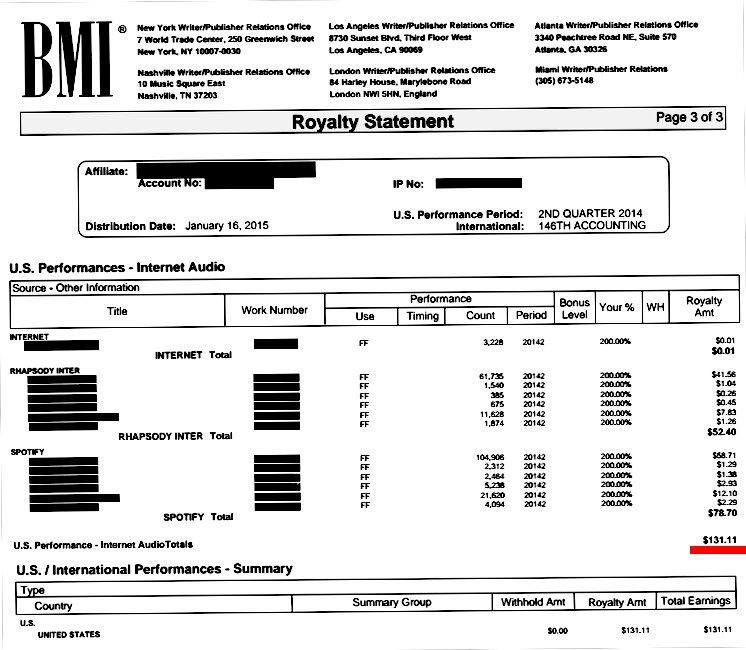
Realistically, it would be both hard to change structurally and a hard sell for major labels to give up what is effectively a subsidy of popular music by indie fans. Let’s take the author’s thought experiment to its logical extreme:
Imagine “Terry” listened to just one obscure band for the entire month of February. $7 of his $10 subscription fee is going to artists, but let’s say he’s also the only fan of that band on Spotify. So that band has effectively zero percent of Spotify’s plays for the month, meaning that the band gets effectively zero percent of Spotify’s monthly revenue.
Terry thinks $7 went to his favorite band, but it actually got divided up among February’s top 40, with only a fraction of a fraction of a cent going to the band!
That's an interesting problem — this is only true if indie fans listen to less music than pop fans.
Imagine there are 10 users, 9 of whom only listen to pop, one only listens to indy, all of whom pay 10$. Now consider two scenarios: A. everybody listens to 100 tracks per month, or B. pop listeners stream 110 tracks per month, and the indy listener streams 10 track per month
Scenario A:
    9 pop *  100 tracks =  900 tracks streamed
    1 indy * 100 tracks =  100 tracks streamed
    total                 1000 tracks streamed

    total to pop artists  = 900/1000 * 100$ = 90$
    total to indy artists = 100/1000 * 100$ = 10$
    9 pop *  110 tracks =  990 tracks streamed
    1 indy *  10 tracks =   10 tracks streamed
    total                 1000 tracks streamed

    total to pop artists  = 990/1000 * 100$ = 99$
    total to indy artists =  10/1000 * 100$ =  1$
EDIT: Now that I think of it, it probably benefits pop music over metal and progressive rock (or, worse still, classical music), because pop tends towards short songs, so more tracks played over the same period of time.
That point is explicitly addressed in the post. Mainstream users listen more because mainstream users are gyms etc. that just let the top 40 run in shuffle 24/7.
One could also mentioned some sort of tiered payout scheme or a non-linear minimum after a certain amount of plays plus a percentage above that. Likely something that Spotify will experiment with over the years.
About your point with indie artists vs top 40- it seems to me to be a problem with fragmentation. Top 40 has much more overlap between listeners and casual music fans vs a much more curated play list for the indie music lover. So out of 100 casual music/top 40 fans the playlist is more or less the same. However two indie rock fans have a higher probability of having fewer tracks overlap in their playlist.
It becomes clear that the scheme suggested in the post doesn't make sense either... so I accidentally left "Everything is Awesome" on repeat all night and now this month indie band X gets 1c from me instead of $5, even though I still listened to their album 20 times like usual?
This is a bit like being a vegetarian at a buffet and complaining about your admission fee paying for steak which all those other people are eating. It's true, but you came to the buffet because it was much cheaper than a la carte with better service.
Every time somebody listens to a song on Spotify it generates payments, but Spotify does not calculate royalties based upon a fixed “per play” rate.
Your buffet analogy isn’t really apt here because streams aren’t limited resources, and they all have the same effective wholesale cost to Spotify (again, assuming no secret deals).
I listen to Spotify and Pandora almost exclusively. Mainly Spotify. I probably listened to 300 tracks of Emancipator a month on Spotify. At 0.00786 per play, that works out to 2.85. For the last 2 years: 2.85 * 24. That's $56.59. I seriously doubt I would have spent that much on iTunes. In fact, from their site, I can only spend $46 on their music.
http://emancipator.shop.redstarmerch.com/Dept.aspx?cp=69283_...
In the long run, it seems to me that Emancipator is winning on Spotify, even if I overestimated by a factor of 3 and only listen to 100 tracks a month. Presumably, I will be listening to Emancipator for a long time.
Or split Terry's money between the artists they actually listen to.
This scheme is similar to the proposal to calculate artist pay independently for each user, but I think it's a little simpler, since you still only calculate the artist pay out of the global pot, you're just weighing each play by the user's total monthly plays. And you can put a minimum on it too, so the per-play weighting doesn't take effect until the user listens to more than a given number of tracks per month (this way the user who has a subscription but just occasionally listens to a song here and there isn't paying the artist $1 per play, which is to say, until you reach a certain point, listening to other songs won't "devalue" your previous tracks).
The reason Spotify specifically works this way is because any other reimbursement model is untenable in the streaming world. Rev share works "off the top" because the overhead of managing reimbursement (specifically the audit overhead) at the subscriber level would wipe away too much margin. Pandora had an overly complicated revenue sharing scheme and it nearly bankrupted the company until they moved to a model closer to Spotify's.
But more specifically, revenue share works this way because that's how it's defined in the contracts that both the major label and the indie label signed. If the indie labels thought it was a terrible idea, they wouldn't have signed it. Most indie artists anymore simply expect to make next to nothing on distribution and playback of their music: they make their money on the live shows.
There is also the idea that some "users" are businesses playing background music all day, and that they are more likely to all choose the same pop songs (which the most people are familiar with) and to play them all day everyday. Unlike a normal user who typically listens to a wider variety and for fewer hours a day.
The article explained this - because heavy users are playing music 24/7 at gyms, etc., and never play the smaller groups or genres that only some individuals like (and would like to support).
So basically, my dad, who listens to 60s and 70s music all day on Spotify is mostly compensating top-40 stuff. In the olden days of FM, his listening habits were paid for by the sponsors of the oldies station.
Later the funds are being distributed after "market share", which means most of it will be sent to Taylor Swift or the Michael Jackson estate, even if the restaurant played nothing but epic fusion mathcore.
I'm guessing that the "big five" asked for a model similar to this when Spotify started, because it was a model they understood.
Perhaps there is a simpler solution. Here's one idea: for accounting purposes, only count a limited number of plays per month, per user. It can be the first 100 plays, or if you want to prevent any biasing, it can be a random sample of 100 of each user's plays.
A random sampling can even be audited to prove that it was fair.
My source is the following article over at Complete Music Update, which elaborates on the tactics employed by YouTube in their goal of competing with Spotify:
http://www.completemusicupdate.com/article/independent-label...
As it currently stands, Terry's band also gets a small amount of money from people who aren't listening to it, which is something you didn't include in your argument. There's really not going to be much difference for the tiny artists, however you carve it up. $7 is 'effectively zero percent of Spotify's monthly revenue' as well.
http://help.grooveshark.com/customer/portal/articles/669416-...
It becomes very hard to ensure you are being paid properly in his proposed scenario, I would personally expect it would create even more controversy, or extremely long payment records every month for artists.
For instance say we have 500 paid users. Lets call them user1 through user500. Each user listens to the same number of songs a month as the value following the word user in their name. Then we have 500 different rates at which artists are paid for their song playing ranging from the entire monthly fee to 1/500th the monthly fee. Therefore providing a full accounting of each of those rates would be necessary for an artist to understand why they got paid more the month they had a single play than the month they had 400 plays.
To be fair assuming the minimum song length on Spotify is 30 seconds this record provided to artists would have a max length of (31 * 24 * 60 * 2)+1 = 89281 items for premium users plus items for add supported users if they did not overlap exactly in rate. Assuming all Premium users paid the same rate, which is not the case.
Edit: I ignored the 0 listen use case, as well as spotify's 30% cut to simplify an already complicated 'simple proposal'. I also forgot to account for daylight savings time in which a day can have 25 hours.
Having said that, the accounting doesn't have to be that complex:
1. When paying out an artist, list out the (anonymous) users who listened to their music on Spotify.
2. For each user:
a) Show the what percent of the user's total listening was spent listening to that artist. (e.g. 40%)
b) Multiply the amount the user paid by the percentage from (a). (e.g. $10/month * 40% = $4)
3. Sum all of the amounts from #2. (e.g. $4 + $3 + ... = $total)
Also, accounting would only be a problem for Spotify. 99% of artists would prefer this model, even if it meant more complex accounting.
> 99% of artists would prefer this model, even if it meant more complex accounting.
What are you basing that on?
Artists paid more might not complain, and those paid less (likely the more popular artists) would complain. Then there are new artists, growing artists, and people who would just be annoyed by the complexity.
The theory is simple, but the implementation is a complete nightmare.
Keep in mind things would still need to be split per song also, as rights holders vary per song.
Do you really think giving every artist that many potential lines of accounting every month can be called simple?
But is it Spotify that pays the artists unfairly? AFAIK, Spotify pays to the record labels, and then it is up to the record label, how they distribute the money to the artists? (Also some of the money, the labels keep them selves, and do not distribute to artists.)
That wasn't ever mentioned or implied. The point was, the author doesn't understand how complex his simple solution is.
There are already a bunch of assumptions in the payment model, do you pay per track? (In which case, the artists could game it by sticking in 30 second intro tracks and things like that). Do you pay per minute? (In which case, artists can increase their revenue by putting in dead time in "bonus tracks").
It would be an interesting experiment for Spotify to calculate what the payouts would be given the proposed scheme, and compare the differences.
Anecdotally, the people I have met that work at Spotify are a lot more sympathetic to the indie artist and non-Top 40 music than the average person listening to Spotify. There is a reason they keep building ways to discover non-Top 40 music. I'm sure they are interested in making things better for these types of artists.
So the per play rate should be determined by taking 70% of the user's subscription, dividing that by the number of seconds of streaming that user streamed that month and then multiplying that by the number of seconds that user streamed the artist's song (since songs can be stopped mid-song).
Regardless of how they bill, it's likely that artists will have to, for the most part, just trust Spotify. There can, and should, be independent audits of the billing code. It seems an analogous situation to what the NGC does around computerized gaming systems. Users have to trust that the system is fair, but the NGC is very thorough about checking that code complies with applicable laws.
If the proposal were followed, all transparency is lost.
"Extremely long payment records" is quite an under-statement. Imagine sending a popular artist a 27-million line breakdown (you'd need a LINE PER LISTEN, and what % of a listeners listens that was). That's absurd, and STILL less transparent.
I understand the problem, but this is actually a pretty terrible solution. Future complexities build on existing complexity. I can't even imagine the monstrous data, business, and programming nightmares that would arise from breaking payment down in the proposed manner.
I am not saying the Spotify method should not be changed just showing that the proposal at hand should not be called 'simple'.
I realize this the amount they are paying now per song is not too far above the $0.005 amount which rounds to 0, and therefore given changes in the market could potentially drop to an amount which would round to 0 for single play also. I also get that a single penny isn't what anyone is going to be upset about. Also that few artists will have a single play. I just find the low number of plays (1400 in a month isn't really that many) required by a person for an artist to potentially not get paid interesting.
Fortunately, the 25-hour day is in November, which is only a 30-day month. So you're okay on that front.
Here is a link to one such example I have seen which has each song paid at the same amount per play. This has made the number of items on the payment record to simply be the number of different songs which were played by that artist. http://www.digitalmusicnews.com/wp-content/uploads/2015/02/B...
That said, has there EVER been a business model in the US that was profitable for artists? I don't think there was ever money in music for artists from album sales.
The cost of distributing and promoting music is just more expensive than making an album.
But ya, that sure seems like that should be fair enough and profitable enough for the artists I listen to, so if Spotify isn't doing a good job of making sure that is the case then I hope someone else arrives on the scene who does. After all, switching costs are now incredibly low for us as consumers and that is where I want my money going.
I think it's important to remember that I'm speaking as an "unsigned" and independent artist. My income is not noteworthy from digital sales, and frankly does not even recoup the amount that I spend on distribution. However, unlike the majority of "signed" artists, I have extensive rights management avenues, very little overhead, and if I ever do make a lot of money through digital channels, it will not subsidize a system that I utterly dislike on practical and ethical grounds (ex: no health insurance for signed artists). YMMV.
However they also have some pretty giant omissions and even for the top tier track they are very hostile to their users, which means I am looking for something better.
Or the pro-piracy crowd...
As far as I know, the various music purchasing services (as opposed to radio or rental services) directly pay the artists a fraction of each purchase of their music.
And if you're sufficiently popular, you can also sell directly to decrease the overhead.
In a completely different direction, there's also Patreon and other patronage-model sites.
Here's a good post:
The Eagles made $100 million last year; Springsteen $81 million; Bon Jovi $81 million; Calvin Harris $66 million; Toby Keith $65m; Taylor Swift $64m; Bruno Mars $60m; Pink $52m; Roger Waters $46m; ... Muse $34m, Gaga $30m, this list just keeps going.
Michael Buble made $1+ million per tour date in 2014 (making $51 million overall).
From the info I can find, there are at least 100 individual artists making over $5 million per year.
https://medium.com/@jackconte/pomplamoose-2014-tour-profits-...
May as well ask people to play some more normal 30s songs and turn off their speakers, avoid being delisted as a non-album.
Thanks for the suggestion.
Jack Stratton's proposition is wagered on the proposition that the users who listen to his tracks are ones who don't listen to very much other stuff. His listeners pay $9.99 per months, but don't stream very much, and a big chunk of what they do stream is Stratton's material. He doesn't want most of that $9.99 going to those other damn artists, who are just random junk whose material isn't sought out by anyone, but streamed randomly in Yoga classes, elevators, supermarkets or wherever.
If there is some user who paid $9.99, 70% of which is $7 going to the artists, and half of what that user listened to was Stratton's tracks, Stratton wants $3.50 for that month, for that user alone. Add to that other similar users, and extrapolate to twelve months and you have some non-negligible cash at the end of the year: better than a fraction of a cent.
Problem is, no matter how you slice the pie, it is a zero-sum game. There is so much revenue and so many artists. Most artists, likely including Stratton, will lose this zero-sum game no matter how the pie is carved.
There is little difference between 99% of the artists getting peanuts, and 100% of the artists getting peanuts. The proposed rule would just create a tiny group which gets quite a lot more revenue than the rest, at the cost of slightly impoverishing every member of the remaining group, who then gets a slightly smaller fraction of a cent.
It's actually a good rule from Spotify's POV because this tiny group would represent "success stories" which Spotify could use for promotion.
On a different topic, this kind of reminds me of the whiners who complain about online dating sites. "I'm obviously a more qualified bachelor than most of the losers who make profiles on this site, so if only the implementation of the site were based on somewhat different rules, then I would easily get replies from the women I'm interested in. I might have found a girlfriend long ago if it weren't for this damn dating site. Waaaah ... sniff!"
Nope, this rule would do the opposite. Currently, only a very small fraction are getting any "real" money at all. This would cut out some chunk of their revenue and distribute it slightly more evenly across all the artists. This is a more "fair for everyone" approach, in the sense that socialism is more "fair for everyone".
(Personally I like the idea a lot, but it sucks for the artists currently making a killing on Spotify. Perhaps for big labels as well, though since they have a ton of small artists typically it might be near neutral for them)
It is also more correct, your subscription is distributed to artists whose music you actually listened to. It repeat listens are accounted for, then it would be even more fair, since you usually listen more to your favorite artists.
Currently the distribution just isn't correct. This is probably because of technical reasons.
How on earth is it a "zero sum game" that they are paid their fair share of the cut?
> There is little difference between 99% of the artists getting peanuts, and 100% of the artists getting peanuts.
You just pulled those numbers out of your ass.
In the sense that it is a fixed income situation, where the question of how the income is divided does not make everyone richer as a group. If you change the rules for dividing the spoils, those who get more income do so because someone else is getting less. This is consistent with the definition of "zero-sum game".
> that they are paid their fair share of the cut?
There is no unique definition of "fair share" here. It is not inherently "fair" that if some subscriber paid $10 for a month, and forgot all about the service and ended up listening to only one song that month, that some artist should get $7 for that. It's not "unfair", either.
> You just pulled those numbers out of your ass.
That is true, and if you would prefer the numbers out of your ass, then you do the pulling; I'm not going there, sorry. Ass numbers for the sake of example is all we are going to get here, though.
And do total stream divisions take into account only premium accounts? Or do they also include free ones? Because ya, as a premium user, I really do want (and perhaps naively expected) my $9/mo split between the artists I listen to, which certainly seems the fairest.
* A stream from a free user pays the same as a stream from a paid user, and
* Paid users bring in more than free users
I don't think Vulf's idea works.
Following this suggested model, free users listening wouldn't help the artists at all - is that really desirable?
>Following this suggested model, free users listening wouldn't help the artists at all - is that really desirable? I doubt it. Paid users are usually free users first. No free users means fewer paid users down the line.
That said, I don't like the model that's currently in use for online-only music stations... it's tough all around.
For instance, it is probably true that to some people $5 dollars a month is nothing compared to the torture of listening to a single ad ever.
However, he then makes the leap that that means that less popular artists are subsidising the popular ones, which has yet to be proved.
That being said, there's no proof of this without data to back it up.
And yes, I'd would expect the tail to be fragmented. Lots of people listening to but a small and mutual exclusive set of bands. Next to the odd main stream one.
So perhaps it is not really a question of light users sponsoring heavy ones, but more the banality of average taste.
Would love to see some stats.
My guess is that great albums got listened to a lot -- driving down the revenue "per play" but generating great word of mouth and lots of net record/cd sales. How much of that applies to Spotify?
Assuming 12 songs on a CD, and that each CD costs $2 to print, distribute, and account for merchant margins, that gives us effectively $0.66666 per song. At the rate of $0.00786 per play on spotify, you'd have to play each song on your physical CD 84 times (or 1018 plays across varied tracks) before it produced less revenue for the artist than a play on spotify.
I'm guestimating here, but I'd say that in general artists/record companies benefit more from CD sales based on those numbers.
Maybe this is obvious to others? But not to me.
+ Huge catalogue on-demand
- Lower quality
- Latency, dropped streams
- Monthly subscription
- Artists get next to nothing
- Player lock-in
Hard disk:
+ Zero latency
+ Highest quality
+ Artists get everything
+ Any player
- Device storage limitations
- Heavy file transfers
I never understood why streaming caught on to begin with.
+ Easy discovery (find an artist and play instantly without any download)
+ Your saved albums are available on any device instantly
+ No catalog/file management (important for mobile listening, as transferring new music was always a hassle)
+ Professional curation, social playlists
Two more possible trade-offs:
- Does the average person know how to transfer their music collection to a new computer?
- Paying for songs a la carte requires thinking about what to buy and deciding if it's worth your money. Streaming reduces that friction.
Having moved to streaming, I can't really imagine going back to storing songs. If I had a really great stereo or headphones, maybe then I'd reconsider. But streaming is just so much more convenient.
> Instead it was $0.00786.
This sounds like a much better way to do it. The artists should ask Spotify to change it. However I guess the big players don't really want it changed.
Would the users follow?
I would imagine Taylor Swift with Blank Space might have cleaned up. Is there a source of public data on this?
1) as in all the people who get paid off the artist's music including, hopefully, the artist
Major studios are bringing brands to Spotify, indies are draws but aren't big draws. They will put their stuff on Soundcloud and stream it for free to get ears to get concerts.
I love Google Music, and don't understand why everyone's so hopped up on Spotify, just because they were "first" to market (and they weren't).
""" (a) “Subscription Fees” shall be the greater of:
(A): Monthly Subscription Minimum * number of Google Play music subscription service subscribers on the last day of such month * Your Subscription Activity Ratio
-- OR --
(B): Subscription Revenue Share * Music Subscription Revenue * Your Subscription Activity Ratio """
B is exactly what is laid out in the parent article, A is a subtle twist on it. Both of them are still [Google's revenue] * Your Subscription Activity Ratio, where "Your Subscription Activity Ratio" == "the fraction: (i) the numerator of which shall be the total number of streams and plays of Your Tracks from the Google Play music subscription service; and (ii) the denominator of which will be the total number of streams and plays of all tracks from the Google Play music subscription service."
... this makes me sad.
1) I think Ek is right - there isn't much money in the consumption of music. I do believe music is extremely effective at getting people's attention, but outside of that, it's value is much lower than we currently give it credit for.
2) I'm reminded of the TED Talk by Clay Shirky on institutions vs collaboration[0] where he explains power law distribution (watch from 6:01 onward specifically) with regard to photos of Iraq on Flickr. He says (paraphrased) "that figure at the bottom at 10 photos per photographer is a lie. it doesn't matter...the top 10% of the most prolific photographers account for almost 75% of the photos. 80% of the contributors are below the average amount of contributions" This is Spotify in a nutshell. People wan't access to all of the rap music in the world even if they are only going to actually consume 20% of it, so that in the rare chance they listen to one song of the other 80% that it's still made available. In other words, the overall utility of Spotify's system is only valid when it's whole, but the individuals who are necessary for it to be whole are unevenly distributed (in this case number of plays). So the argument then becomes who needs who more?
Depends how you consume it. I had to pay nearly £100 to see the Stones live. Online of course you can download it for nothing.
The indie music industry as a whole is already selling more than the 3 major record labels together in the US. Once that 20th century model is 100% over, we will see technology doing really cool things in collaboration with music.
* dance/electronic
* elevator music
* toddler songs (audience loves hearing that same song for 1,000th time)
On the other end of the spectrum you have audio content that is intended to be listened to once, with extremes being audio books and radio news.
An artist optimizing for endless replays would do well on Spotify: "E.D.M. artists like Avicii and David Guetta are seeing payouts in the millions. Avicii’s “Wake Me Up,” the most streamed song on Spotify, has more than three hundred million spins, which, using Spotify’s benchmark per-stream rate, would be worth about two million dollars to the rights holders." http://www.newyorker.com/magazine/2014/11/24/revenue-streams
But it's not perfect model for every artist out there.
No, it's completely irrelevant. This is a discussion about a pricing model, not about an artists' lifestyle. Unless you want to think of the choices of artists whether to distribute on Spotify or not, depending on the pricing model, to be a 'lifestyle'.
As for what pjc50 wrote, no, he didn't quite get the point of the article.
Yes, perhaps the most equitable way to charge is for artists to set a price for 1 stream, or 1 permanent download (iTunes).
But the Copyright holders are NOT being paid 'per-play'. Sure, they're paid more when the plays go up, but that's not necessarily indicative or a 'per play' model. Just like your gas station doesn't sell gas 'per mile' you drive, yet if you drive an extra mile you obviously pay more at the gas station than if you didn't drive that mile.
Spotify is not a pay per play model for copyright holders. It's a pay-by-share model. This means that if 10 people are subscribed, and they all play two songs 10 times, the copyright holder gets as much money as when these 10 people played both songs 100 times each.
Both songs get 50% of the artist revenue each, in both cases, which is 70% of 10x $10 subscriptions worth, which is $35 each per song, whether both are played once, or 10 times, or 100 times, no difference.
Obviously NOT pay-per-play but pay-by-share.
If it was pay-per-play then there'd be an actual difference in the songs' revenue if both songs were played 10 times or 100 times. Not the case with Spotify.
Now, this is what the article is about:
There are multiple (here just 2) ways to implement pay-by-share.
1) You total up ALL plays on Spotify, and ALL revenue. So say you have $1m of subscription revenue, and 1 million song plays in total. You then pay out artists the fraction of their plays. Got 10 plays? 10 plays / 10m total plays * 1m revenue = $1, that's your revenue.
2) PER USER, you total all the user plays, and take the $10 subscription, and then pay out the artists as a fraction of how much the artist listened to that particular user. Artist got 30 plays, user played songs 100 times? You take 30 user-plays / 100 user-plays * $10 = $3, that's the artist's revenue.
Is there a difference? The assumption is yes.
The assumption is that some music, like classical music, gets fewer average plays by classical music lovers, than an average pop song. i.e. a classic music lover might listen intently to a 15 minute song, and then another, and have 30 minutes of music, and generate 2 plays.
And a pop song that's 3 minutes long, will get played 5x in that 15 minute period. And instead of 30 minutes of conscious listening, it'll be on in the background for hours and hours as it's made for radio. So you get 4 hours of 3 minute songs, that's 80 plays.
Now say there's 1 pop lover, and 1 classic music lover. And say both categories have 2 artists that get listened equally.
In model 1, you'd have 1 classic music lover listening to 2 classic artists and generate 2x 2 plays per day = 4 plays. And the pop lover generates 2x 80 plays is 160 plays, for a total of 164 plays. The two music lovers both pay $10, so you get $20, and the two pop artists both take home their 80 play share out of a total of 164 plays on $20, or: $9.75. The classic music artists take home 2 plays / 164 total plays * $20 each = 24c.
In this model 1, we see that the classic music lover that pay $10, is subsidizing the pop artists with a huge fraction of his $10, despite the fact he only listens to classical music.
But in pricing model 2, the two classic artists would each get 50% of the share of the classic music lover: $5. And the pop artists would both get $5, too. Only there'd still be more pop song lovers, so they'd still make a ton more money because which is fine, as again there are more pop song lovers. But then there'd also be more pop artists, so there'd be more competition.
Neither models are pay-per-play. They're both pay-per-share. But in model two, the classic music lover who plays 0 pop music, is paying 0% of his money to pop songs. While in model 1, over 90% of his money goes to pop songs which is being called a subsidy for songs that are shorter, more culturally fit to play as background music/noise.
In model 2, obscure, less popular, longer songs, songs with fewer average plays etc, get a decent bit of revenue, because they compete for revenue shares of users who listen to other like minded music, and thus they compete against other obscure, less popular (in absolute numbers), longer songs, songs with fewer average plays etc.
I think it's clearly a more fair approach. And I think it's clear it has nothing to do with 'preferred lifestyle', and the argument is certainly no straw hat.
Either way if a formula change, distributing earnings based on an individual user instead of the whole pool, means the popular songs would earn far less.
It also means if someone listens to one song that would earn more than someone who loves music and pays the same thing!
I would argue the formula isn't wrong its difficult comparing an total Audio CD sales vs a lifetime NPV of music played on Spotify for an author.
Taylor Swift did just that recently and pulled her music from Spotify because she didn't feel she was fairly compensated.
Or is it "for each user, divide their $10 by the number of streams they played and pay that to the copyright holder of the streams played?" So the more streams you listen to the less artists get paid for that?
I think his solution works like this:
Lets say you listen to Beck for 50 times, Beyonce 50 times, and Drake 100 times. That gives you 200 total streams, which a respective stream distribution of 25%, 25% and 50%. We can assume you enjoyed Drake more since you listened to him more so he should get more money obviously. So Beck and Beyonce each get $7 * (0.25) = $1.75 and Drake gets $3.50 for the month.
I think that's because buying a digital album has so far been really unrewarding.
Artists need to come up with a package for their music that people actually want to buy.
I always felt kinda stupid paying 10 Euros for an album, then spending 10 minutes fixing metadata and downloading a halfway decent cover image from discogs.
You'd get better data quality from filesharing sources, since fans obviously care more about releases than labels. Same goes for movie releases btw.
Artists who don’t like it or aren’t getting enough value — either through payouts or marketing - should simply opt out of the system (if they can; in many cases control might rest with their record label or another rights holder). Some artists never opted in (the last time I checked, this included AC/DC) or withdrew part or all of their collections (Taylor Swift).
I’ve watched the Spotify model appear in the ebooks marketplace, through services such as Oyster and Scribd. They target readers, and ultimately seek to ensure large payouts to investors, platform owners, and large publishing partners. Authors have largely been treated as an afterthought. Kindle Unlimited is even worse, demanding exclusivity and lowering sales of many authors.(1)
I believe the time has come for recording artists, filmmakers, authors, and other media producers to band together to fight unfair or predatory platform practices. Subscription services may be great for consumers, but they don’t pay enough to the people who are creating the products that draw audiences in the first place.
Why not keep the existing royalty structure, but split the royalty pie based on user initiated streams and computer generated streams. If someone buys premium and only listens to Yoga Radio:
  30% Spotify
  70% Existing Yoga Radio Big Pool Royalty Structure
  30% Spotify
  35% Existing Yoga Radio Big Pool
  35% Direct cut determined by per-listener chart
  30% Spotify
  0% Yoga Radio
  70% Direct cut determined by per-listener chart (all to one with love from Mom)
Best of both worlds, no?
I guess not.
It does seem more fair for the artist this way, though it probably means they need to do more crunching with map reduce or something.
Could be worse. They could have their own musicians record popular songs and classics, and just pay the statutory royalty to the composer. Seeburg did that in the 1950s.[1] They sold the Seeburg 1000 background music system, and rented out phonograph records of background music, all recorded by Seeburg musicians. Stores rented and serviced the simple record changer, which endlessly played a stack of 25 records (both sides), about 50 hours of music. It's not a jukebox; it's much simpler.
Instead of copyrighting the disks (back then you had to register a copyright and pay for renewals), they used a primitive form of DRM - the records are 16 2/3 RPM, 9 inch diameter, 2 inch center hole, 0.005" stylus width, mono. This is incompatible with everything except a Seeburg 1000, though it's not hard to adapt a turntable to play them.
Someone has digitized the available Seeburg 1000 records, and you can listen to about 6000 songs of '50s - 70s background music.
The end result is that rich and well known artists will end up getting more money, and lesser known artists less.
The reason this change would very likely not benefit indie artists is simple:
People who listen to more music are more likely to have a high proportion of their music listening being "indie" than those people listening to less.
Pdpi's example explains very nicely how this would benefit pop artists over indie.
Does this system have other benefits?
Yes, a wonderful inadvertent thing you get for free is eliminating fraud listening. People would be unable to create accounts to listen to one artist on repeat all month long and laugh six months later when the checks come in (see the Vulfpeck story for those unfamiliar)
Would some indie artists benefit from the change?
Yes, of course some artists wouldbenefit, that's pretty much inevitable under any calculation methodology change.
None of this addresses the issue of time spent listening. Classical and Jazz payouts will consistently under-index people's time spent listening simply because the track recordings are so much longer than the average recording length. A time spent listening payout system would be a huge improvement, but then you can imagine people trying to manipulate this (throwing 25 minutes of silence on the last track of the album anyone?). Smoke and mirrors...
Also think about the talent pool. The only longer line at the job fair is probably for playboy photographer.
Tons of people wanting to make music + low barrier to entry = Cheap music
The only thing attempting to hold this dinosaur market afloat is monolithic record companies, and their stranglehold on the popular genre seems to give them enough leverage to arrange a deal in their favor. Hence what we observe here.
What will likely end up happening is the next cost of music will become zero to the end user and bands and artists will find new revenue streams. Such as live performances, or perhaps product placement. Or does economics not apply to art?*
*I'm the weird guy who doesn't like music so I may be entirely wrong.
For example, in a hypothetical world let's say Spotify could capture a high amount of market share and still be profitable at $0.10/month. If they had the same revenue split they could say that they are giving artists 70% (0.07/month). I think the artists would rightfully complain that Spotify is devaluing their product.
Artists like Taylor Swift are starting to catch on but people act like she's greedy and out of touch when she pulls her catalog.
Services like Spotify don't support independent, awesome musicians that you love enough to give them even a bad living. If someone creates art that touches you and improves your life, figure out a way to support them in a way that actually makes a difference.
How does Terry's subsidization of yoga studios make any difference for Terry's listening experience?
Unless it's a very deep point in that Terry's subsidization, if it didn't happen, would cause more small artists to pop up onto the scene thus increasing the diversity of the catalog.
https://www.change.org/p/spotify-ltd-pay-artists-from-the-pe...
Suggestions for improvements welcome.
Here's how it could work. Every month, I'd get an email with the top 20 artists I listened to that month (stats! fun!). By default, my contribution goes to my most listened artist. I don't need to do a thing.
If I want, I can manually go in and change the contribution to another artist – say I listened to the new Kanye album a ton, but would rather give my extra dollars to my second-most-listened, way-less-famous artist.
I believe a lot of people get real personal value out of supporting artists they believe in. Right now, the best way to do this is to go to shows and buy merch.
Optional donations as describe above are an opportunity for Spotify to increase the amount of money spent on music, while generating lots of goodwill from users and artists alike.
I didn't go thorugh Spotify's TOS, but is it allowed for commercial settings such as stores, studios, etc? I'd think the price would be for personal use only.
I can imagine this licensing fee differs largely and contributes heavily to Vulfpeck's anecdote.
I really do have sympathy that there isn't much money in recorded music, but I do struggle to find a justification for why artists seem to think Spotify should be paying them more other than the fact that they just 'want' it and need to make a living. I understand that completely - and honestly I'd probably pay a higher price for Spotify if they demanded it and the extra money went to artists.
I think the problem is this: the music industry in general has exploited artists for years. It is not a business that works in the artist's favour, unless those artists are extremely popular (and even then, labels can seriously fuck artists over if they want to). Outside of the superstars, musicians may (not always, but often) fare better when they organise their own affairs - live performances, commissions for work, appearances, media, collaborations etc. They probably won't get super-rich doing this, but it could be a decent income for the right artists. What we have instead is a situation where artists create music for a (more or less) one time cost (recording, mastering, equipment, studio time etc) and then hope to make the money back through physical sales, royalties, and performances. The problem, I feel, is that the initial costs of production are still high, but the distribution costs are now incredibly low, which means end-consumers are reluctant to pay higher prices. I don't see any way around this other than altering the nature of the business itself. If production is always going to be a costly affair in the music world, then income from royalties through services like Spotify are destined to be considered low.
I honestly think there's no real hope for any significant increase in income through digital services. Why should there be? There's no technical reason to increase fees - distribution gets cheaper all the time. The only way to increase royalty payments generally is to either cut into profits, or pass the increase on to the customer - neither of which are sensible business decisions unless Spotify's hand is forced.
We don't really have a profitable relationship with music - the value we attach to a single track on iTunes or Spotify doesn't reflect at all the costs to the artist - but unless artists can convince consumers to start paying a lot more, I just don't think they'll see significant returns from recorded music any time in the forseeable future. It's just not an industry that pays particularly well. Production costs are high, distribution costs are low. Unless we alter the way music is produced, performed, and experienced, people won't feel like paying more gives them any extra value. It's an uphill battle.
I wish things were better for artists, but I just don't see a way out of this is that doesn't involve massively increasing price at the point of consumption.
I guess the "artists are being ripped off when it comes to record sales" blew over several decades ago.