A) whatsapp improves the daily lives of hundreds of millions of people. You don't necessarily need an absurd customer lifetime value to get a $19b valuation with that many people using your product.
B) SpaceX provides almost no current value to anybody. And the people it does provide value to are "free riders" in the sense that they love watching space travel and get to watch SpaceX regardless of whether or not they pay for it.
Just an inexact thought experiment. Let's say we poll the roughly 1b people living in first world, and ask them each to pay $10 to see SpaceX do whatever SpaceX does. How many people even think it's worth $10?
I just wan't to add that the problem is not that SpaceX provides less to humanity than WhatsApp.
The problem is that most people are not really far-sighted, but only see things which benefit themselves in a predictable amount of time.
Why companies like SpaceX (or NASA) are important has already been answered with Why Explore Space? A 1970 Letter to a Nun in Africa
https://launiusr.wordpress.com/2012/02/08/why-explore-space-...
Well, someone payed SpaceX for a delivery flight to the ISS the other day, they're certainly providing value in that context
WhatsApp is big outside of the US because (at least in Panama, were I was born) text messages are not included in the mobile phone plan; however, you can get a data plan for a monthly fee and keep in contact without additional charges. In the US most people use text messages to communicate.
I am not saying Whatsapp has anywhere near the potential value of SpaceX but it is important to factor the amount of risk given the stage a project is at.
WhatsApp is a consumer product. It lives as it breathes. As long as people/consumer keeps pumping in money & time to it, its value will stay or rise from its current value. Once that stops and people/consumer stop using it, its value will eventually fall.
SpaceX on the other hand is not a consumer product yet, but is aiming to become one. Consider it just like Boeing or AirBus, nobody would have valued them as a multi-billionaire company ( back in 1900s when they were founded). Their technological advancements and the development phase would have been same as SpaceX right now.
But eventually it became a very integral part of human life. They have become a consumer product, their value is now because of people using it daily. And unlike WhatsApp people won't stop using air-travel.
Everyday people do not invest directly into it like they do(?) for WhatsApp, but indirectly by using airline services they are paying for it. Similarly for SpaceX everyday people aren't investing in it right now but eventually ( as per SpaceX's ambition ) people would just like they are doing for air-travel.
I think comparison is ok, but people are missing an important distinction - yes, the system works exactly as one would expect it to. There are good reasons for the system to value WhatsApp higher than SpaceX. The algorithm's implementation is correct. The problem is, we're using a wrong algorithm - a system that begins to increasingly value wrong things.
There is also some level of tragedy of the commons problem going on, in which SpaceX benefits all of us every time they successfully test a new design, but it only benefits their investors when they manage to get mining rights to the moon or set up martian tourism or the like. Goals which are possible - which is the impressive thing - but still very risky bets.
I always wonder if people actually seriously believe this.
We are many, many decades away from this being even close to a reality.
SpaceX is in an industry with better financed/politically connected companies and an unpredictable revenue stream. It's a risky business by every definition. WhatsApp by comparison is a stable, very popular, growing and strategically important messaging platform.
And if you think that human-human communication is less valuable than putting a few satellites in space (NASA/ESA/ISRO/etc are the real keys to future space exploration) then I would argue your priorities are a bit warped.
I'd rather phrase that as "WhatsApp by comparison is a currently stable, currently popular and growing generic platform implementable and implemented by thousands of companies and hobbyyists worldwide with nothing unique about the company except the current user-base, a (mostly free-loading) user-base which has shown great willingness to flock to the next great thing should this service ever do the wrong moves".
You know... The sort of statement you don't make about 20 billion dollar companies. They should have a more solid footing than being trendy right now. To put it in the dryset terms possible: They have no unique value-proposition.
SpaceX is doing real shit which might make an impact on the future of mankind. To me just comparing them in the same context seems offensive.
With SpaceX, there is enormous value in the company as it is, even if it went bankrupt tomorrow.
Now are they? NASA itself now outsourcing its LEO capacity to SpaceX. And SpaceX is much more focused than government agencies thanks to virtue of having a single leader with an idea, as opposed to bureaucracy and CYA-ism. Of course, space exploration is not a one-man endeavour, but I wouldn't dismiss the impact SpaceX already has and likely will have in the future - they're empowering those big space agencies.
that is exactly bifurcation point each technological civilization faces (be it whole human race today or China 600 years ago) - to "go in", i.e. collapse into something like ant-colony or to "go out", i.e. explore and expand.
Hell, for a simple analogy, it's like with solid rocket boosters - you should appreciate how far they got you, but you definitely don't want to keep being attached to them when they burn out and decide to not go to space.
Who do you think designed and built the Saturn V? Redstone? Atlas? Ariane?
Commercial companies making a profit.
That is to say: WhatsApp is much further along its individual trajectory than SpaceX is. In decades, the value of SpaceX is likely to eclipse WhatsApp, which in all likelihood won't even exist any longer.
A lot can happen over time. 10 years ago MySpace was by far the dominant social network and Blackberry was the mobile powerhouse. Seemed like neither would fall with so much momentum behind them but we see how that played out.
Market capitalization does not indicate importance to the human race, though it's easy to lose sight of that.
I think one of the reasons people lose sight of that is because they look back and see all those products, all that improvement in quality of life that capitalism brought us. Those things are undeniable. But one can't infer from this that the system will forever be awesome. It was aligned with human goals initially, but as time goes by, it's less and less aligned.
With science based startups the partner at a VC can't easily make an independent assessment. They have to rely on specialists to do tech D&D and they rarely trust them completely. So they shy away from those deals, or they factor the risk into their valuations.
This behavior somewhat ironically can make these investments higher risk. There is a degree to which fund raising at a lower level makes a company a higher risk, because they have less money to work with and can't afford to make mistakes. (the converse is also somewhat true).
Post?
Right now Tesla Model S vehicles connect via AT&T (at least in the US, don't know what the carriers are in other countries). It's a tiny number of "devices" connected to the network so it is probably expensive for Tesla. At some point it gets really expensive. One assumes the Model 3 will have the same always-on connection that the Model S/X has. Millions of Models S/X/3 around the world mean a lot of communications costs. And then there are the SuperChargers, that will in time no doubt be communicating with cars too, to improve the user experience.
I suspect a few million "devices" connected to the SpaceX version of global wifi would be way cheaper than connecting to a dozen or two carriers in countries around the world.
Just a theory.
With that said, telsa promised 3g free with the model s for another 4 years. Maybe timing with the satellites?
that would be the ultimate end game move by Musk.
A company like SpaceX can raise all the money they need from a small number of like minded investors. It saves them the hassle of dealing with thousands of shareholders with their own risk tolerances, investment goals, etc.
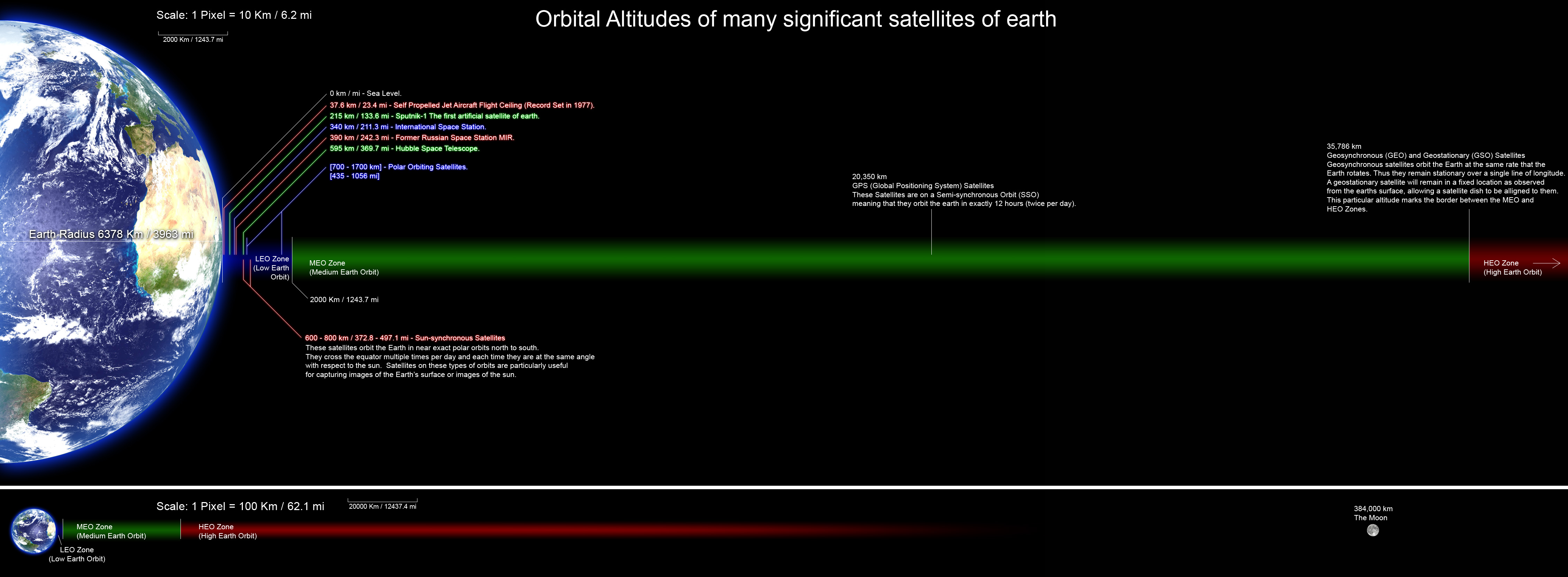
http://upload.wikimedia.org/wikipedia/commons/8/82/Orbitalal...
How much data could these push in theory?
ViaSat-1 is (as far as I'm aware) the most capable satellite currently in orbit, with a rate of 140 Gbit/s. Its bandwidth capacity when launched larger than all of the other North American satellites combined.
I would be VERY surprised to learn that the fundamental issue with this would be spectrum capacity, as the K band satellites operate in is very wide.
The way current satellite technologies typically deal with concurrent data streams is to split up into 'beams' that cover a specific region. Currently VS1 uses 72 bands but they're spread all over Canada and the US. With more satellites and tighter beam placement it's certainly feasible to have millions of simultaneous connections.
I feel like I kind of rambled on there - if there's anything in particular you'd like me to expand upon I'd be happy to (and if someone notices I'm wrong about anything please let me know!).
Since you asked :)
How much of this is relying on phased array antennae on the satellite and does that mean you won't have to aim a dish or will the downlink for residential require a tracking antenna or do those also work using phased arrays these days?
The industry wasn't regulated very much until a situation in which some installers aiming dishes for EDJ (Edward Jones Financials) were knock things off line by aiming dishes at wrong satellites. I don't know much about how the technology works but it became apparent that aiming a dish at the wrong "bird" as we call them could interfere with others.
The EDJ thing was big news back in the day although a google search turns up nothing. It reportedly knocked Edward Jones off line for something close to a week while many were deployed to go and re-aim satellite dishes.
After this incident, the FCC got more involved and now to install a two way satellite dish, you have to take a course and pass it. My whole team was required to go through this training.
We also installed 2 way satellite internet for a company out of Canada that had a PCI card you plugged into your PC. The PCI card would then connect to the dish transmitter and LNB. The down speed was around 4-5Mb/s while the up speed was very slow at around 128Kb/s. I forget the name of the company but they had a proprietary driver for the PCI card that compressed the TCP packets in order to deal with the huge latency of traveling up to space and back down. They also had patents on a modified TCP/IP stack whereby they could locally ACK outbound TCP packets to improve throughput (as it was explained to me at the time).
Even if he wanted to, Cook doesn't have enough power at Apple, practically, to be actually in a position to do that yet.
I mean clout. He literally can't personally decide to do that (yet) and just do it.
The Apple watch is the first category or undertaking of a similar size and novelty, and has yet to be accepted or succeed. (It will.)
My comment is being misinterpreted so I've clarified above. My comment isn't about what Apple can 'afford to do' it's about what Tim Cook can 'afford to do' (politically and in terms of consequences.)
Apple could step in at $1.5 or $2 billion, at twice the valuation, and the deal would be theirs most likely.
If not, then for the same price tag, they could just launch their own network.
That said he isn't stupid enough to invest in something like this. Apple doesn't benefit all that much from having more people on the internet. Google does.
If the site wants to change their paywall to block Google users, they should go ahead and do that.
There's no subscription account involved and being shared, a requirement.
Something tells me this might be a little problematic in the future.
For example, there are literally thousands of airplanes flying in the US airspace at any time. Now look up and see if you can spot one.
There's a lot of empty space up there. Even more so 200 miles up.
Legitimate question.
I think this is a great move by Google.
Source: http://www.ted.com/talks/larry_page_where_s_google_going_nex...
[1]http://www.history.com/shows/men-who-built-america (available on Netflix)
Just pointing out some people have a VERY different opinion of those rich men.
The term robber baron derives from the medieval German lords who charged nominally illegal tolls (tolls unauthorized by the Holy Roman Emperor) on the primitive roads crossing their lands or the larger tolls on ships traversing the Rhine—all such actions without adding anything of value,(see robber baron) but instead lining one's pockets to the detriment (added costs) of the common good.
`javascript:document.location.href='https://paywallbypass.org/?q='+document.location.href;`
Google Inc. is close to investing roughly $1 billion in Space Exploration Technologies Corp. to support its nascent efforts to deliver Internet access via satellites, according to a person familiar with the matter. The investment would value SpaceX, backed by Tesla Motors Inc. Chief Executive Elon Musk , at more than $10 billion, according to this person. It isn’t clear what exact stake Google could end up with in the fast-growing space company. If Google completes the deal, it would be the Internet company’s latest effort to use futuristic technology to spread Internet access to remote regions of the world, alongside high-altitude balloons and solar-powered drones. By extending Web access, Google increases the number of people who can use its services. Spokesmen for Google and SpaceX declined to comment. News of Google’s potential investment was reported by tech blog The Information. Google has been considering satellite-based Internet service for more than a year. In late 2013, it hired satellite-industry veteran Greg Wyler, who at one point last year had more than 10 people working for him. Mr. Wyler left Google last summer and is now developing his own satellite-Internet venture. SpaceX builds and launches rockets and spacecraft. Mr. Musk last week described a general concept for SpaceX to launch hundreds of satellites into relatively low orbit to deliver Internet access across the globe. Mr. Musk told BusinessWeek the project could cost $10 billion to build and take at least five years, but gave no details about funding or manufacturing plans. For several months Mr. Musk has been mulling ways to expand SpaceX’s rocket-and-spacecraft manufacturing operations to designing and building satellites, according to aerospace-industry officials who have talked with him. Though short on specifics, his latest comments were the clearest sign yet of a long-term commitment to such expansion plans. It is likely to take years to establish designs and potentially set up a specialized satellite-making facility. But SpaceX already has some important building blocks. Industry officials said the company builds its own navigation and flight-control systems for spacecraft, which could provide some elements for satellites. There also are synergies between parts SpaceX makes today for solar arrays on spacecraft and such devices intended for satellites. One big technical and financial challenge facing the proposed venture is the cost installing ground-based antennas and computer terminals to receive the satellite signals. That issue has bedeviled some earlier Internet-via-satellite projects and threatens to complicate Google’s efforts, satellite industry officials and consultants say. Another unanswered question is how SpaceX plans to transmit Internet signals to Earth. The company isn’t believed to control rights to radio spectrum. Mr. Musk has discussed using optical-laser technology in his satellites, according to a person familiar with the matter. That technology works by beaming information from satellites in space. But lasers wouldn’t be a reliable way to deliver Internet service to Earth because, unlike radio waves, they don’t easily pass through clouds. The talks are somewhat unusual for Mr. Musk, who has resisted most outside investments that could reduce even slightly his control over SpaceX. Industry officials said if problems arise, SpaceX might need additional capital in the next few years to fund new rocket development and more launches. It isn’t clear what terms are under discussion. The Wall Street Journal reported Mr. Musk’s interest in satellite-Internet service in November, saying he was talking with Mr. Wyler. Mr. Wyler last week said his new venture, OneWeb Ltd., had secured funding from Richard Branson ’s Virgin Group and chip company Qualcomm Inc. Mr. Wyler said he hopes to provide Internet service from a constellation of 648 satellites in low-Earth orbit, using a large block of radio spectrum he controls. Mr. Wyler estimated the plan would cost as much as $2 billion. Messrs. Musk and Wyler stopped working together because of disagreements over control of any joint project, according to a person familiar with their discussions.
fwiw, in case of Quora, add `?share=1` at the end of the URL.
And when you're on the move that doesn't matter. One way to make it work untethered indoors is to simply bridge the satellite downlink box to a wifi repeater. That would get you coverage indoors and outdoors from regular devices around your house, and if they sell enough of these downlink boxes they could conceivably pool the bandwidth by creating a mesh of them.
All kinds of interesting options, even if it doesn't work directly indoors.
Edit: Never mind. So many posts of the confirmed news are popping up that there needs to be a new thread. https://news.ycombinator.com/item?id=8919901 is a reasonable article and not behind a paywall, so it may as well be the one.
Musk said the Internet access would be "unfettered certainly and at very low cost". https://twitter.com/elonmusk/status/531996243904716800
Hopefully there's a way around needing a satellite dish, aside from dishes that share their connection over wi-fi.