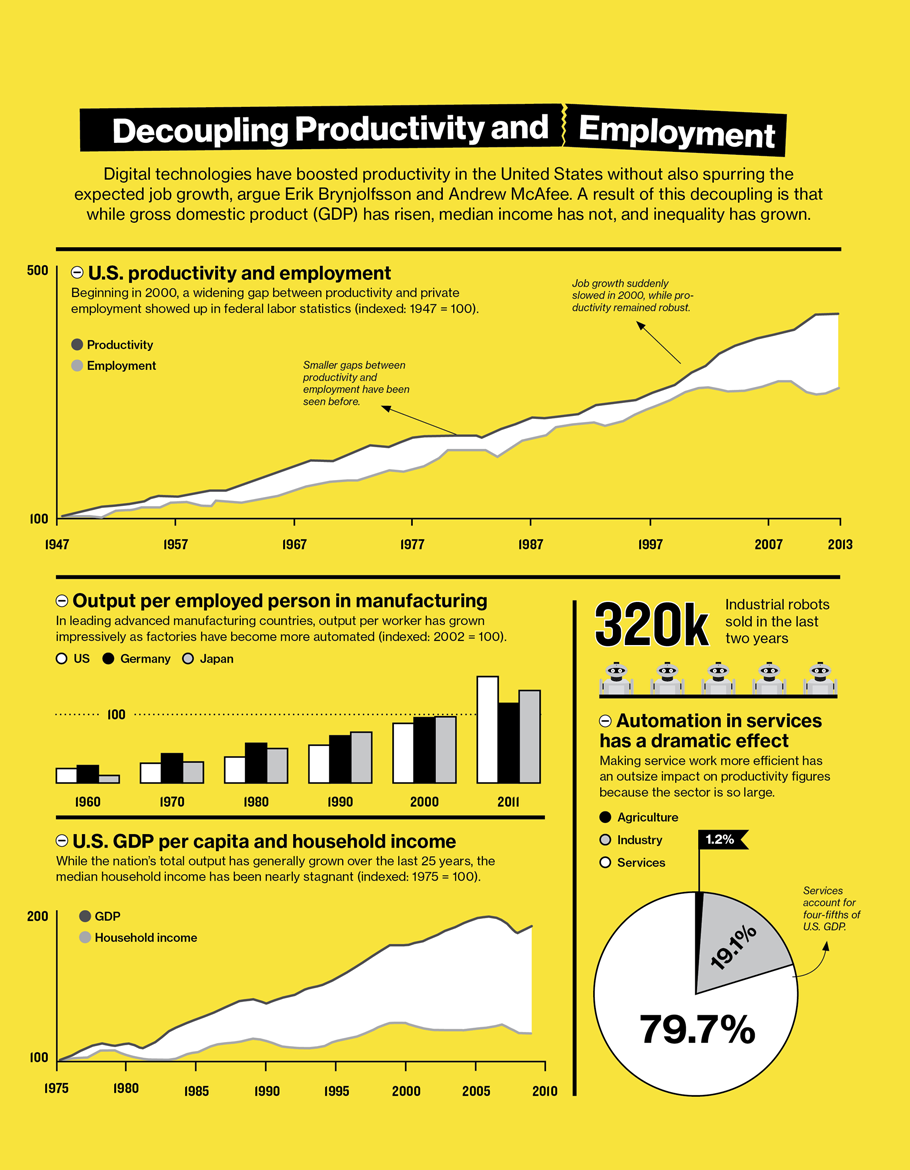
The thing is we are not all actual beneficiaries from technology. In fact a lot are victims who loose their jobs, get smaller paychecks and basically lost the ability to offer their skills to the workforce.
Technology gives and technology takes. What it takes is increasingly important to have a critical view on because something more fundamental is going on I think that is going to be increasingly clear.
These days though it might be different. An interesting extension to your point, and using your terminology, is that the rate of what technology 'takes' is possibly beginning to exceed the rate at which it 'gives'. Things might be changing too quickly for the market to adapt and ensure gainful employment to people.
Look at these two graphs
https://plot.ly/~BethS/8/job-growth-by-decade-in-the-united-...
http://www.technologyreview.com/sites/default/files/images/d...
The more jobs created have been because of globalization not because technology creates more jobs. (My claim)
Furthermore the less money is being made even though production goes up (because of technology)
This is the problem we are facing and so I am simply not buying the luddite fallacy argument it is in itself a fallacy.
Another way to look at this is that technology replaces higher and higher levels of abstract thinking.
The horses that where replaced by cars didn't find new jobs.
Software development is probably a decent model of what's coming for the rest of the population. Rapid technological change is already reducing the career expectancy of programmers to about 10 years before moves into management or consulting are considered necessary. The cost is that a lot of expertise is lost and the results are often inefficient with many wheels getting re-invented.
You say: "technology isn't just programs, [it is] also change... a lot [of people] are victims who lose their jobs..."
When in fact, the "victims" of this process aren't subject to the technology, qua technology (technology is simply a tool - derivative of the Greek "tekhne" for "art" or "craft"), which is to say, one doesn't create a technology which then has a mind of its own (yet), but rather, they create tools that other individuals then have a choice to either use, or not.
And so when you say "technology gives[,] and technology takes," what you really mean is "people chose how to spend their [time/money], and [those choices have consequences]."
Which is to say that you are implicitly saying "We ought to decide how people chose to spend their [time/money]".
Would your reaction be the same to the ironworker who made a living on horseshoes two hundred years ago?
Of what do you wish to be "Critical"? Of choice? Of giving people the ability to spend less of their time and energy on certain tasks?
Five hundred years ago human beings spend most of their time producing life-sustaining staples -- growing what for bread, chickens and cows and hogs for protein, vegetables for vitamins and nutrients. Now we can buy a week's worth of sustenance (which used to quite literally consume 12 hours of labor per day), grown to higher standards, in greater quantity for less than $50 -- the equivalent of a single day's labor at minimum wage.
Do you wish to be "critical" of this tekhne as well?
You are proving my point by applying the very flawed logic of the luddite fallacy that I am really critiquing.
Language is also technology. It is probably the most important technology we have. But you can hardly argue that people make a choice to use language. Sure, you could choose to learn a new language, but that only handicaps you unless you're moving somewhere. And even then, that might be a massive waste of effort.
As long as a service requires my submission into an database which will be sold off and used to strengthen marketing and other forms of persuasion, I have no choice but to assume the worst case usage. With that assumption I feel it is most ethical to mostly not participate.
I hope that I'll be able to sit back and hop on when popular tech services have given me an alternative form of payment other than my person as an information commodity. I have no idea as to whether that day will ever come.