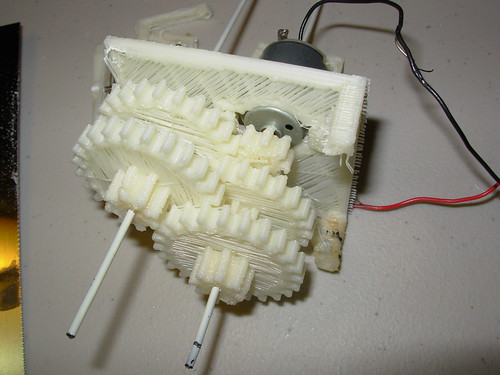
With that said, I don’t think you looked at the resource I linked, which has some great advice for using a CNC mill to make high-precision parts via resin casting. Nothing in its advised method involves milling metal. The design involved might be slightly more difficult than designing parts for 3d-printing, but it’s not inordinately more difficult.
I personally find home-3d-printed parts to be very slow to print, expensive to print, ugly, brittle, and entirely ineffective for many things I’d want to do with them (art projects, mechanisms, housings for electronics projects, small pieces of furniture, etc. etc.). Everyone I know who has tried to do 3D printing at home spent much more time fixing and babysitting their machine than actually making stuff (and most were ultimately unsatisfied with the quality of their prints). The process is by no means “simple”.
- For a one-off part, it’s often possible to directly CNC mill something out of plastic, wood, or some other material that is vastly superior in quality and can be made just as fast or faster than a 3d-printed part.
- For trickier shapes or stuff you’re making multiple copies of, the resin casting process in the link above should often be pretty effective. Compare https://farm5.staticflickr.com/4049/4501639683_37351127de_o.... to http://farm4.static.flickr.com/3487/3703543046_b9588e64b6.jp... or for a detailed point-by-point comparison see http://lcamtuf.coredump.cx/gcnc/ch1/
- Sometimes a few flat pieces of wood, sheet metal, or acrylic cut on a laser cutter or waterjet, or using manually operated tools is a better option than CNC milling something.
- For certain other parts, I’ve seen reasonable results ordering from Shapeways or some similar place.
There might well be particular cases where home 3d printing is the best answer, but nothing that I’ve personally run into.
In any event, do whatever works for you!