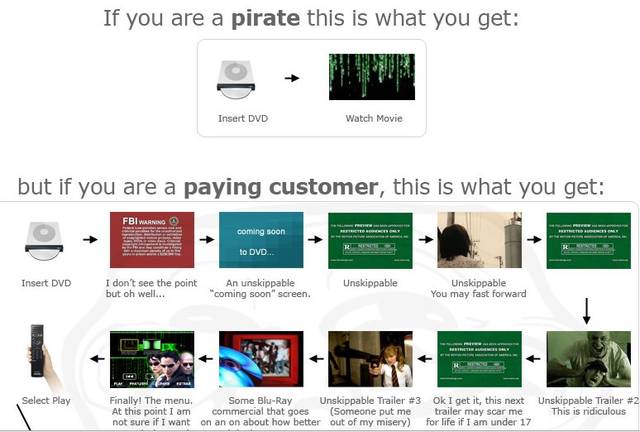
Do people still legitimately wonder why so many people flock to torrents? Hollywood (and by extension, other large content producers) have the most sincere form of Ostrich Syndrome[0] that I know of.
[0] http://www.urbandictionary.com/define.php?term=The%20Ostrich...
That was about stuffing promo's and ads in before the movie but this feels very similar. You can get a better experience by getting a torrent over streaming legally. I pay for Amazon and Netflix but I will still download content from time to time that I can get on them (for no additional cost) because I can get a better experience: no buffering, no quality yo-yo-ing as network speeds fluctuate, no ads, reliable watched status (Using Plex, this is more an issue with Amazon which keeps track of your position in a video but doesn't have watched/unwatched status so it's sometimes hard to pick up in a series where you left off).
Spotify (IMHO) is a great example of a level of service/features (even at a price) beating piracy. I'm still waiting on the "Spotify of TV" (Or movies) and no I don't think it exists out there yet. I would be all over Hulu expect I refuse to pay for a service AND see ads. I would rather pay $20/mo and not see ads then pay the $10/mo and see them. Almost as bad as having to see ads in the first place the ads on Hulu are painfully repetitive at times.
You are going to have to make a better offer to the studios that are currently charging customers $80/mo AND forcing them to see ads.
Hollywood would have to slim down significantly if it was going to go Netflix-model primary on all its content.
They charge $80/mo (sometimes much more) and show ads because they can get away with it And we let them. There are also other old economics (like paying for channels you'll never watch) at play that are no longer applicable with the internet.
The netflix model is tricky. On the one hand, it's a constant stream of income. On the other, there is ever increasing licensing fees and questionable return on investment when they produce a new show. I don't know that it's an ideal model, in those regards.
I think (or hope) that what will win out is the ability to vote with your wallet. I watch some shows, and I want the shows I watch to do well and stay on the air. Equally, i don't give a crap about the shows I don't watch. But I think a barrier to that will be the price tag they attach, which will likely not be anything reasonable.
And this circles back to the topic of hollywood: a few companies in control of the majority of the market, inflating prices to line their pockets. But the internet levels some of the playing field, so an independent could come along with little more than a youtube channel and compelling content and bypass all their nonsense. And I think that will be the best thing: competition.
Similar to the contraction the music industry is going through because music isn't as valuable when there is so much more of it to listen to (ie Taylor Swift vs Spotify)?
There was a long ad on hulu for some drug that had nothing to do with me. At first I said "swap ad" but then that option magically disappeared the next time I saw it, so I said "no" to the "is this ad relevant to you?" question... about 5 times. Still kept appearing during every. single. commercial. Downright infuriating. But clearly there's some logic behind the scenes where no matter if they swap it, or say its not relevant, or even pay for hulu plus; that ad should play because the company paid a lot of money for it to be played; and it doesn't matter how many times a user has had to sit through it.
And that's the thing. They don't give a shit about you. They don't even try. We're just a product for them.
Personally, I don't feel right grabbing torrents, but I also don't want the hassle. I think that legit digital delivery for music and video has, for the most part, crossed the threshold where it's just easier than the alternatives.
I know quite a few people who use torrents (or usenet) as their primary source of TV. Combining Plex + Sabnzbd + Sickbeard you get a internet DVR with little to no maintenance once setup (other than adding more capacity as/if needed). They all have a hulu-like (next day) experience, they get it in HD, and there are no ads.
Legit delivery for music has crossed the threshold but video has not. You still have to use multiple services to watch everything you want.
Selection bias.
You and the people you know still represent a vanishingly small fragment of the population.
"People" don't flock to torrents, only tech savvy pirates do.
Who do you know? I estimate 80-90% of the people I know who are technical download "pirated" movies via torrents or usenet. Most also use paid services like Netflix and Amazon Prime but the content on those networks sucks.
All of these people also use netflix, amazon, itunes, etc., but it's hardly a catch all.
Which is ironic considering how much better of an experience piracy is 9 times out of ten.
It's quite possible these TVs or STBs are shipping with a special hardware decoder that supports this format that they're using.
They are technologically fully capable of providing the desired service (4K video) to the customer but as soon as HDCP 2.2 Blu-ray players and 4K content come out they are fully obsoleted.
"As of this update, among the major manufacturers of AV receivers only Onkyo/Integra offers such AV Receivers that support both HDMI 2.0 and HDCP 2.2 as will be needed to support certain of the high quality 4K/UHD video sources, such as the upcoming Blu-ray 4K/UHD players." [1]
1 http://en.wikipedia.org/wiki/HDMI#Blu-ray_Disc_and_HD_DVD_pl...
You're assuming that's a bug. It means that users will have to buy a new box to access all that content, which means the manufacturers may see it instead as a feature.
Of course you can just distribute the decoder, and of course the decoder is much faster (Divx is 28fps ont he same Core i7 IIRC). But the # of people with 4k displays right now is really tiny compared to the install base for HD, like I'd guess <<1%.
Admittedly, I feel a little bad about paying providers of DRMed content, it sends the wrong market signal. But if I didn't pay these content providers, I wouldn't have a mechanism of signalling that I enjoy watching certain TV shows and movies.
However, if you don't actually stream the content from Prime / Netflix / et. al., my guess is that they probably aren't paying out accordingly on the back end.
What if content is removed from Netflix?
Piracy is mostly a matter of market. The more DRM BS you try to force upon me, the more I'm going to do to not give you any of my money at all.
Even if most people pay for content, any level of piracy is "unacceptable" to these companies. It's not enough that they make a buck, or make quite a few. They have to crap all over the experience in an attempt to stop piracy, which is a fools errand and hurts the people who DO pay for content.
I'll start being reasonable when they stop being unreasonable.
Amazon even has a whole page that explains the difference. http://www.amazon.com/Digital-Copy-DVD/b?ie=UTF8&node=721726...
Wow, maybe if there's a country full of people so eager to watch your content that they'll steal it you should, I don't know, sell them the rights to watch it? Of course, I'm just a simple nobody. I guess you have to be a fancy movie studio executive to understand how you make more money by preventing people from accessing your content.
If someone else wanted to show this content in their jurisdiction, they'd just create a one-off agreement for it and be on their way. They honestly don't know how to sell to the entire world at the same time.
Piracy is the Alexandrian solution to this. Untying the relationships and legal contracts would take decades, but the threat of piracy forces them to offer solutions today to compete.
Obviously they still need translations and such, but can't that be done concurrently while they're preparing for release anyway?
Why is this the case in this time and age?
I'm in my country. You're serving me bits just now in order to tell me this. WTF?
It's like sitting down in restaurant, see a wonderful meal being served at the table right next to you, seeing the meal on the fucking menu, but when you order being told "no sir, not at your table".
In what industry do people come back after being treated like that?
There are also groups who focus purely on release time and quality is at most a secondary concern. What I'm getting at is that using torrents (or rather piracy) allows to obtain content that matches your needs (in this case quality vs release time). You can get music/movies/tv shows etc in higher quality than any commercially available streaming source allows for.
" The open source HEVC software decoder requires a four-core Intel Core i7 running at 2.3 Ghz to play 30p 4k video, and I'd guess it'd be running so hot you could fry an egg on it. The Retina iMac only has an i7 chip in the maxed-out upgrade configuration. So maybe it is about the hardware performance.
If Amazon paid for it they could license a commercial software decoder with lower CPU requirements, but that'd cost them a lot of money and still likely run with fans blazing.
Those new embedded TV chips you deem to be weak compared to desktop CPUs have dedicated hardware designed specifically for decoding this new video format, and dedicated chips beat software performance any day. When most desktop PCs ship with hardware 4k HEVC decoders too, then I'd expect Amazon and Netflix to come on board."
(I think he would be fine with my copying it with the same attribution he posted with - it's just a story comment.)
If I was Netflix I wouldn't want to release 4K if it meant only a small segment of customers would get a good experience. Releasing a disclaimer that the user requires adequate hardware won't satisfy the majority of computer users who don't know or care about the specs required. Most people just want it to work.
I also take issue with the line, "Anyone who knows technology knows the computational and image-processing capabilities of even an average PC or Mac far outstrip those of a streaming box." Dedicated hardware can outperform a general computer while requiring less "processing power" (measured in FLOPS or GHz or whatever). The Chromecast has a dual-core CPU and 512 MB of RAM and it runs HD video perfectly.
* technically level3 doesn't name them by name, but i wouldn't really consider it reading between the lines...
http://arstechnica.com/information-technology/2014/05/see-wh...
To the people talking about torrenting it instead, that's again the entire point. It limits access to those able to torrent, but still enables studios to control a significant part of the market that can't or won't torrent. It really is all a control game.
I suspect it won't be long before the DRM being used for the Amazon and Netflix 4K TV streams are well and truly broken like they were for HDMI and other "secure" measures before it.
Movies and music are more than simply products, they are part of our culture. Nobody would argue that they shouldn't make money from it, because we want them to succeed and do it again. But what we don't like is getting fucked over, and thats basically their business.
There was some disney show a friend of mine wanted to watch with his kids, which was classically available via amazon prime. But then it became the holidays, and disney pulled it from prime so now he had to pay to watch it. It's the same song and dance with netflix, who is at the mercy of the licensing of media companies who decide how much to charge for the license, and if they want to license it at all to them.
It's an exploration of bullshit and greed.
ETA:
From Netflix' FAQ it looks like it's via the TV apps on select "Smart" TV's.
Why Netflix or Amazon would tolerate that is another question. I'm not convinced they need to.
But, I'm not the right one to ask anyway because I can't get that kind of internet access from my cable company, and therefore not going to watch any 4k anything for a few years, I'd bet.