Q: Who can use Visual Studio Community? A: Here’s how individual developers can use Visual Studio Community: Any individual developer can use Visual Studio Community to create their own free or paid apps.
Here’s how Visual Studio Community can be used in organizations: An unlimited number of users within an organization can use Visual Studio Community for the following scenarios: in a classroom learning environment, for academic research, or for contributing to open source projects. For all other usage scenarios: In non-enterprise organizations, up to 5 users can use Visual Studio Community. In enterprise organizations (meaning those with >250 PCs or > $1 Million US Dollars in annual revenue), no use is permitted beyond the open source, academic research, and classroom learning environment scenarios described above.
(Disclaimer: Microsoft employee.)
That's very sloppily worded. Is it 5 concurrent users? May 5 people create a product and 4 others (after delivery) maintain it?
Anyone knows if there's a way to avoid that? I'd like to have "just an IDE", for node and web development.
Sorry to reply on a tangent, but for that sort of development I feel compelled to chip in and recommend WebStorm. It's not free, but ships with a boatload of features that are perfect for NodeJS/WebDev. Like a reverse-debugger that you can use on your serverside as well as front-end code. A real time-saver.
http://blog.jetbrains.com/webstorm/2014/04/spy-js-webstorm-s...
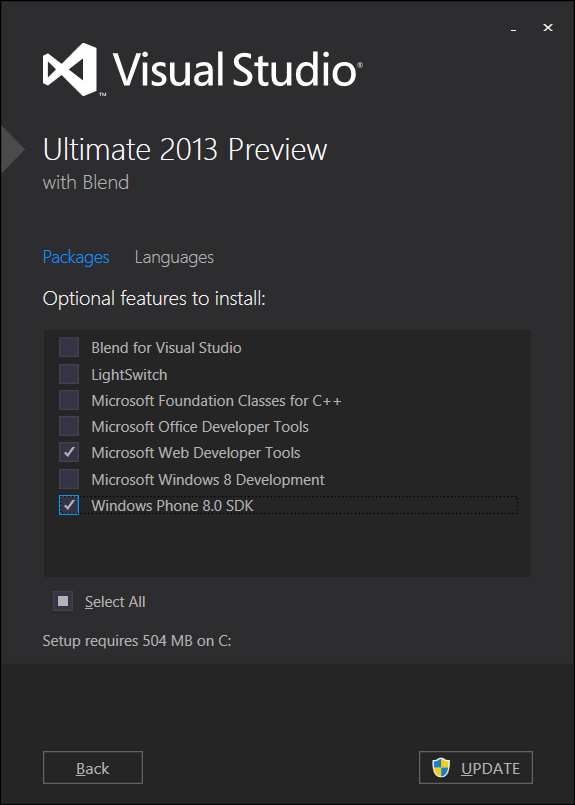
What that out of the way, within five seconds of clicking the link here it computed 7GB of disk space. It did not provide options to ignore subcomponents like the full VS 2013/4.
My experience is that the MS tools stuff installs and uninstalls cleanly -- and what little it leaves behind are some system components that I'd prefer to have updated and left around anyway. If this freaks you out then that's what VMs are for.
This is not just about "style" or "personal preference", it is a serious problem: it eats too much energy and therefore destroys the planet, millions of old but perfectly usable devices are transformed into highly dangerous toxic waste because Windows 8x is too slow for them and - most important - we loose a whole generation of brains as too many young developers grow up in the perception that this kind of bloat is acceptable, what is a real catastrophe for the whole industry - it is so hard to find people that can program without crutches and really know what they are doing.
We should more actively avoid this bloat and support better alternatives.
Yes, Mickysoft jobs pay the bills for many, but this happened because we tolerated this too long and alternatives were too weak. Nowadays it is possible to replace all the legacy MS waste that still exists in many companies with better solutions.
I run windows on a 4 year old thinkpad. It's 8.1 on an i5. It goes like lightning and the battery lasts twice as long as Ubuntu does on the same kit even after powertop has been frigged with.
Also my wife's android handset has 25% more battery capacity than my Lumia 630 and lasts half as long.
YMMV but what you state is not factual and merely a slashdot-esque troll.
Wait, Open Source is magically free of bloatware? OpenOffice, Firefox, KDE?
Try running a modern Linux desktop distro like Ubuntu on a 10 year old machine or a 5 year old netbook. Open ten tabs with sites like Gmail, YouTube etc. in Firefox on that machine and then get back to us.
And since Windows 7, the minimum requirements have been steady and boot time has been pretty fast.
I think what we're looking at is a CEO that gets it and is trying to move as fast as possible to turn the monolithic company around. That's no mean feat, considering how long Microsoft has gone with everything being behind closed doors in a licensing maze.
I for one approve of this trend.
I've heard this from MSFT employees and I believe Ballmer made a post-retirement comment in an interview about the same: that this all started after he left.
Satya Nadella has been a Microsoft exec since 2007, so events in 2009 are not before his arrival, and he was credited for being instrumental in driving this kind of transition in focus before becoming CEO.
> actually I see Staya Nadella taking reins as another step Microsoft took to be more open.
Sure, it was a vote to double down on the things Nadella was driving as a key leader before becoming CEO.
When they stop pulling crap like that, maybe I'll believe in the "new Microsoft".
It’s basically a full version of Visual Studio with no restrictions, except that you can’t use it in an enterprise setting and for teams with more than five people (you can, however, use it for any other kind of commercial and non-commercial project).
- DirectX debugging tools, including GPGPU
- Parallel code debugging
- MFC and ATL for those that still need to support such type of applications
- 64 bit compilers
- DDK integration
- Sharepoint integration
That was true of most of them through 2010 (though the 2008/2010 Web Developer Express supported, IIRC, at least C# and VB.NET as backend languages.), but not the 2012/2013 versions.
The VS2012/2013 Express Editions are not language specific, but project type specific -- the 2012 editions were "for Web", "for Windows 8" (i.e., Metro/Modern UI), "for Windows Desktop", and "for Windows Phone". 2013 merged "for Windows 8" and "for Windows Phone" into "for Windows".
http://www.microsoft.com/en-us/evalcenter/evaluate-windows-8...
I may be wrong here, but as far as I can tell, the only reason to maintain an MSDN subscription for the purposes of Visual Studio (assuming you're eligible to use Visual Studio Community 2013) is if you want the features in editions beyond Professional, you want to be on the bleeding edge, or you want the peripheral perks of subscribing.
Personally I think it's a fantastic decision, I'm just surprised Microsoft is actually doing it. Hopefully they will be timely in releasing a Community edition for future versions of Visual Studio.
Also, this move is pretty great for startups. I think it also puts BizSpark in a better position. Most early stage startups will no longer have to jump through hoops trying to get into BizSpark, nor prematurely start the clock ticking on that until they're ready.
One of my major peeves with BizSpark has been the requirement that your company's public-facing site be more than just a "Coming Soon" page. While I can see the reasoning, it's kind of annoying when you haven't launched yet, you'd prefer to focus on your product, and you want to make said site using Visual Studio anyways.
Want to try out or develop against any piece of MS software, just download it from the MSDN portal and off you go. Want to test out provisioning with Azure or fire up a server to test or dev against, just use your Azure credits. You can happily run a couple of small servers with the Azure credits.
If you just want Visual Studio you could always buy it on its own for much less than a subscription.
If I grab MAPS sub and VS community I'm well up on cash.
One of my major peeves with BizSpark has been the requirement that your company's public-facing site be more than just a "Coming Soon" page.
"I found BizSpark's barrier to entry, practically zero. I applied online and got accepted within hours. I just graduated last month. I never got bothered by Microsoft during the whole membership and exiting was pain free. My experience with the program has been wholly different than yours.
My point was how Visual Studio Community 2013 enhances BizSpark by rendering that particular complaint moot.
So if they lost us to the community edition they'd lose $0. (And probably end up saving money, since no Azure developer credits.)
Seems to me that from a precompiled binary and build management perspective it's just the easiest way to use whatever is best supported on each platform. Which seems to be clang on MacOS, gcc/clang on Linux and msvc on Windows.
I had to use chromiumembeddedframework in one project and compiling it with gcc or clang on Windows isn't even a choice. Even if there is a way to get it to work, it's a huge project that takes quite a lot of resources to build. Even if it was easy, prebuild is still a lot faster.
With the newest version always beeing free and tools like CMake beeing able to generate projects the only downside I can see is that msvc would dictate the features I'm able to use.