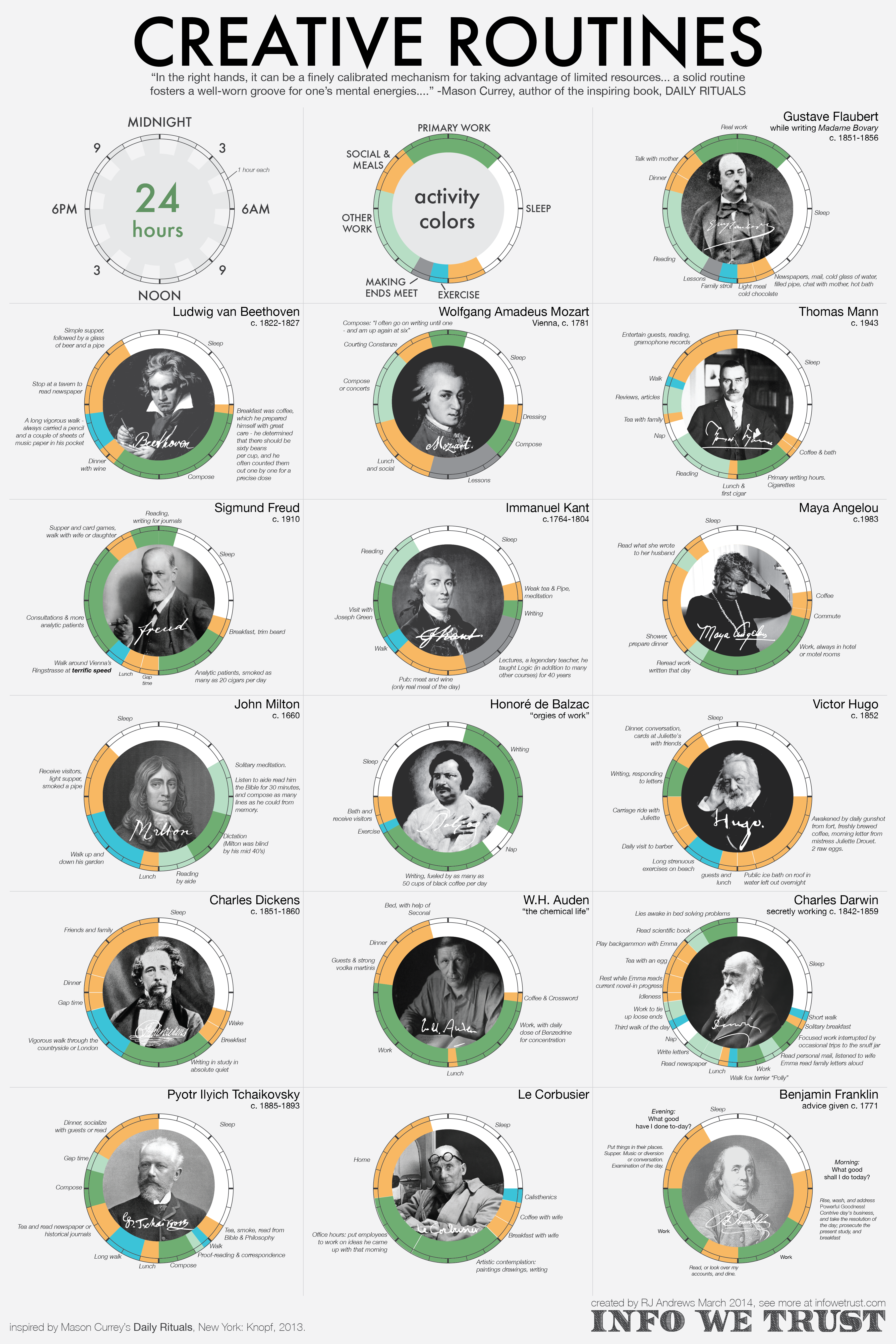
Creative people by and large don't have "day jobs".
“We should do away with the absolutely specious notion that everybody has to earn a living. It is a fact today that one in ten thousand of us can make a technological breakthrough capable of supporting all the rest. The youth of today are absolutely right in recognizing this nonsense of earning a living. We keep inventing jobs because of this false idea that everybody has to be employed at some kind of drudgery because, according to Malthusian Darwinian theory he must justify his right to exist. So we have inspectors of inspectors and people making instruments for inspectors to inspect inspectors. The true business of people should be to go back to school and think about whatever it was they were thinking about before somebody came along and told them they had to earn a living.”
Meanwhile, culture modifies itself to reward consumption ("buy the expensive [read:right] things!") and ambition ("become powerful so you can buy the shiny things!"). I do believe we need to be productive, of course.
An excellent argument for the Universal Basic Income:
It's interesting how few hours of sleep they get and they're all early-risers.
I'm sure that we could go through the list of "creatives" here and enumerate the progeny for each one. In the way that the viz breaks down various other categories around "creative work", I jokingly suggested that a parenting vector is also warranted (though obviously impossible to produce) given that many of these figures had kids and in significant numbers.
I divided the people in the book "Daily Rituals" into eminent and not-so-eminent based on whether I could recall much about what they did.
I found that eminent people almost all had a strong daily routine. Eg Hemingway would start writing at 6:30am regardless of how hung-over he was (possibly the reason for his view that "all first drafts are rubbish").
Also they were very inclined to let nothing get in the way of their work. See below for some examples.
Quite a few took stimulants including tea coffee nicotine and even amphetamines in several cases. Eminent people were also more likely to take regular walks. Both the eminent and less eminent people had a pretty strong tendency to get working in the morning. The eminent people were also more likely to have regular systematic social relaxation activities.
Proust took caffeine tablets and then took strong sleeping tablets to get to sleep. Perhaps he could have saved himself some money and put himself to sleep by reading his books.
I only had 13 non-eminent people as I got bored reading about people I had not heard of so the results for them are probably rather rubbery.
At the end I have extracts of the agreement of Einstein with his wife, and a report of Richard Feynman's (Nobel physicist) divorce case as illustrations of "hard core" commitment/obsession to their work.
Einstein Agreement with wife (relevant extracts)
A. You will make sure…
... especially that my desk is left for my use only.
B. ... you will forego…
my sitting at home with you;my going out or traveling with you.
C. You will obey the following points in your relations with me…
you will stop talking to me if I request it;*you will leave my bedroom or study immediately without protest if I request it.
Feynman Divorce Testimony
>...the appointee’s wife was granted a divorce from him because of appointee’s constantly working calculus problems in his head as soon as awake, while driving car, sitting in living room, and so forth, and that his one hobby was playing his African drums. His ex-wife reportedly testified that on several occasions when she unwittingly disturbed either his calculus or his drums he flew into a violent rage, during which time he attacked her, threw pieces of bric-a-brac about and smashed the furniture.
For better or worse: http://i.imgur.com/TxYanPX.png
Source: http://infowetrust.com/2014/03/26/creative-routines/
Everyone in the book sleeps, eats, drinks wine, and finally works for a couple hours when they can be alone. Later a little bit of opium.