Assuming the correctness of quantum mechanics, a quantum computer WILL be faster than classical computers for specific classes of problems, exponentially faster in some cases. This has been mathematically proven. (EDIT: No it hasn't apparently. See Michael Nielsen's response below.)
I think there's a few people (t'Hooft if I remember correctly?) that believe a quantum computer will never be able to experimentally demonstrate this speed-up because some aspect of quantum mechanics is incomplete/incorrect.
Edit: Here's the thread I was thinking of where t'Hooft and Shor discuss this http://physics.stackexchange.com/questions/34217/why-do-peop...
ex.: "Man bites dog" doesn't mean "all of mankind bit a dog", it means "this man bit a dog".
P.S. why did you go with "man bites dog"?
But it's pretty easy to quickly read the headline and interpret it as "the performance of ideal quantum computers is no better than the performance of ordinary PCs."
> Assuming the correctness of quantum mechanics, a quantum computer WILL be faster than classical computers for specific classes of problems, exponentially faster in some cases.
I'm not sure about this part either. Some smart CS guys apparently think that quantum computing isn't even possible. Leonid Levin (yes, of the Cook-Levin theorem seems to be one of them: http://www.cs.bu.edu/fac/lnd/expo/qc.htm.
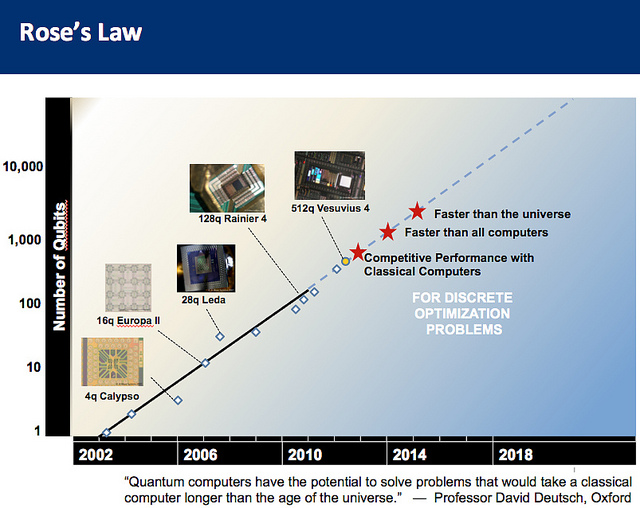
These machines are testing a completely new computing concept. We're trying to learn how they work so that we can apply that to building machines that can actually outperform traditional computers, and once that's achieved then the potential benefit will be enormous.
According to http://www.dwavesys.com/d-wave-two-system as you scale up qubits the power demands do not increase. That alone has huge potential.
Maybe new materials need to be developed to see the full potential of these computers, lots of research needs to be done. Why are all of these articles so pessimistic?
NASA, Lockheed, and Google purchasing these multi-million dollar machines should indicate that there is at-least some potential and value in the D-Wave computers, even if in the end they just learn what D-Wave did wrong.
https://www.youtube.com/watch?v=CMdHDHEuOUE
"We don't know the best questions to ask the quantum computers, that's what we're trying to find out now."
Is the operation of the D-Wave an unknown? I don't know much about it.
The qubit processor is like an intermediate step, instead of a traditional processor, the grunt of the work of special problems is handled by the qubit chip.
The data is put in and the results are as expected, but they are not as fast as modern computers, so now the challenge is figuring out if different types of calculations can increase that performance or what can be done to improve the chip or other methods.
https://www.youtube.com/watch?v=HKUZ6IuJyHw
The machine itself seems so simple though from a visible hardware perspective, most of the D-Wave Two is just to keep the main chip cool and shielded.
It's just experimenting right now. The internet was probably dismissed by many because of it's enormous expense to implement, but the value could be envisioned by many and it paid off.
There is potential for future versions of these quantum computers to be able to solve problems that massive amounts of supercomputers would have trouble solving, and the energy usage is enormously less (same for a small calculation as a huge calculation).
Encryption is one thing that could be hurt by this technology. Instead of millions of years to crack encryption it might be solvable instantly. That's all just what I remember reading about the subject, there's plenty of information out there that's probably more reliable that my babble.
It's far too early to worry about a non-zero probability of it not working, just like fusion power. All it takes is one breakthrough and a revolution in computing will begin. Doing research on quantum computers is a low-risk and high-reward situation. None of these companies are betting everything on quantum computers.
Even though I don't even believe this thing is really a quantum computer, there are much more specific and defined ways to poke holes in D-Wave than just by running some tests and comparing speed. D-Wave has, very specifically, targeted this machine at one function: http://en.wikipedia.org/wiki/Quantum_annealing
Unless you're doing quantum annealing on the D-Wave, it might as well be a toaster, an Android phone, or a Windows PC. It's made to do only quantum annealing.
Did D-Wave 2 somehow expand its capabilities? I'm basing this on D-Wave 1 knowledge, but I cannot imagine anything really changed except the number of Qbits inside the thing.
All this having been said, the D-Wave has yet to prove that it is even doing Quantum Annealing, let alone that it's faster than a traditional computer at this problem set. No one has shown it to be faster than traditional outside of D-Wave.
The D-Wave executive's claim that the problems used in the study are "not at all the right choice for probing a quantum speedup" is in reference to the specific subtypes of quantum annealing problems that this study looked at, not whether they were doing quantum annealing at all.
Which appears (I can't tell, paywalled) to be an update or this one: http://arxiv.org/abs/1401.2910
I don't have to time to read the article properly right now, but doesn't look like they did anything ridiculous in their choice of testing algorithm.