Any "help" from "Myanmar" would have come in the form of a conquering Japanese army. Would they have brought some truckloads of rice with them from Burma? Sure. Would they have shared it with the Indians? Probably not. And despite the "censors", I think the Japanese were pretty open about their willingness to conquer and enslave (er, "help") the suffering Indians. I would invite our Indian friends to ask the Chinese if that would have been a good deal.
The Wikipedia article on the 1943 famine is a much more serious read.
Link to actual wikipedia article: https://en.wikipedia.org/wiki/Bengal_famine_of_1943#Governme... (the article has NPOV problems for more than a year now).
For the British apologists, here is the quote to give you some acquaintance with the subject of Britain induced famines:
"During the first eighty years of the nineteenth century, 18,000,000 of people perished of famine. In one year alone—the year when her late Majesty assumed the title of Empress—5,000,000 of the people in Southern India were starved to death. In the District of Bellary, with which I am personally acquainted,—a region twice the size of Wales,—one-fourth of the population perished in the famine of 1816-77."
"Suppose we divide the past century into quarters, or periods of twenty-five years each. In the first quarter there were five famines, with an estimated loss of life of 1,000,000. During the second quarter of the century there were two famines, with an estimated mortality of 500,000. During the third quarter there were six famines, with a recorded loss of life of 5,000,000. During the last quarter of the century, what? Eighteen famines, with an estimated mortality reaching the awful totals of from 15,000,000 to 26,000,000. And this does not include the many more millions (over 6,000,000 in a single year) barely kept alive by government doles."
- From an article printed back in 1908 (http://www.theatlantic.com/magazine/archive/1908/10/the-new-...). The actual article is much more detailed and better written. And it has less reason to view history from distorted mirrors than we have 110 years later.
The reason Churchill was different from Hitler was because Hitler had an effect in Europe, while Churchill was conservatively continuing the thats-how-people-used-to-think-then policy towards his 'lesser subjects'.
One can still make unfavorable comparisons to other "evil" figures, where the analogy is imo closer. If indeed Churchill is responsible for an essentially deliberate famine, one could compare him to Stalin, and the probably-deliberate famine in the Ukraine. Or, if he's merely responsible for a large famine via negligence, one could compare him to Mao, and the probably-not-deliberate famine in China.
"Churchill’s excuse — currently being peddled by his family and supporters — was Britain could not spare the ships to transport emergency supplies, but Mukerjee has unearthed documents that challenge his claim. She cites official records that reveal ships carrying grain from Australia bypassed India on their way to the Mediterranean"
&
"Churchill’s hostility toward Indians has long been documented. At a War Cabinet meeting, he blamed the Indians themselves for the famine, saying they “breed like rabbits”. His attitude toward Indians may be summed up in his words to Amery: “I hate Indians. They are a beastly people with a beastly religion.” On another occasion, he insisted they were “the beastliest people in the world next to the Germans”.
History is full of injustices. I don't see why the present generation of Indians should hold onto what happened to their grandparents generation. We don't need to suffer history now, we get to live in the present - that is the attitude I see in most people in India. That is why India is as peaceful as it is (we have to normalize whatever good or bad is happening to the population - "India" is not an aggregate in the same sense that, say, "Sweden" is an aggregate - so whatever happens in Sweden once a year would happen almost once a day in India, simply based on the relative population sizes).
But if the neighboring provinces had food surpluses, why didn't the authorities manage a transfer?
How else do you get the argument that Churchill was intentionally killing Indians because he "had a bad attitude" toward them and because he didn't risk enough merchant shipping during a world war to ship food there?
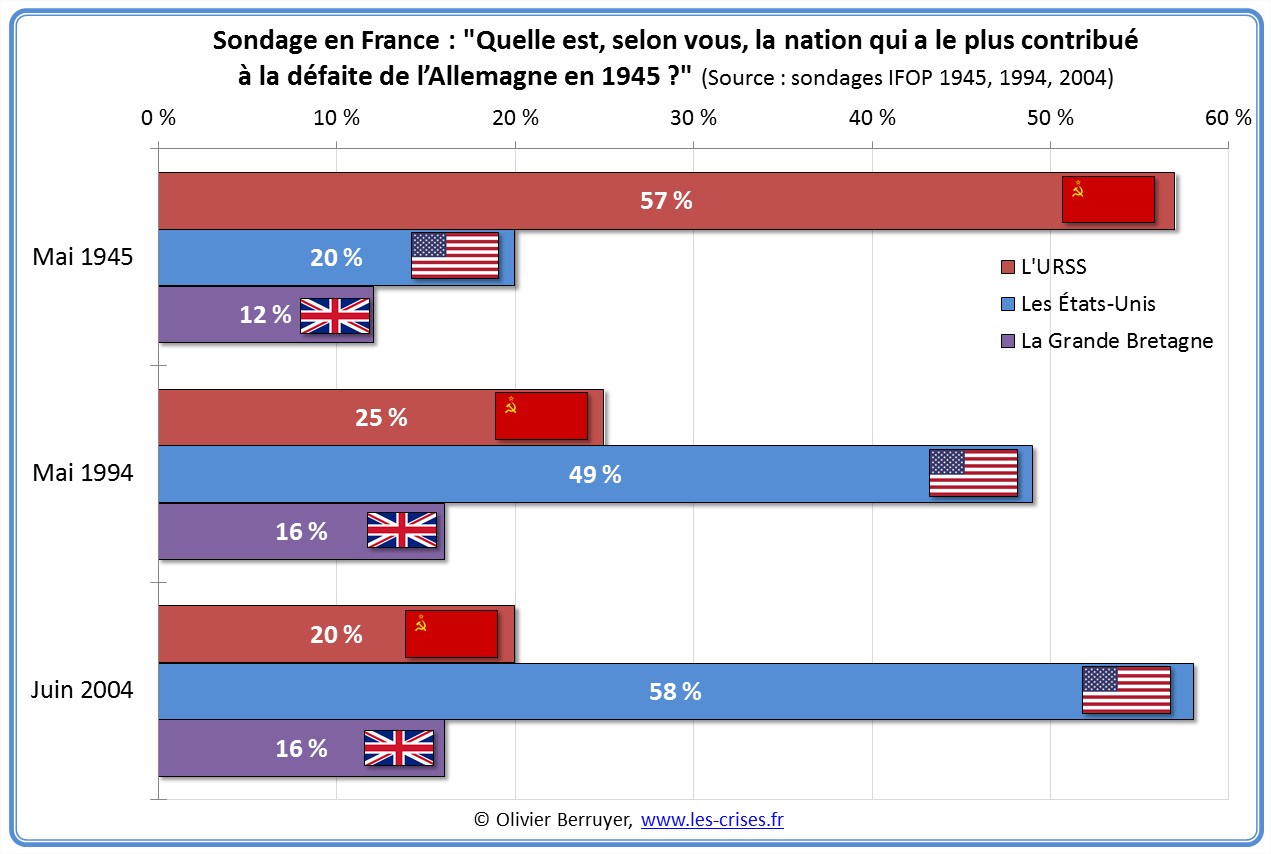
For example, here are the answers of French people to the survey question "Which was, in your view, the nation that most contributed to the defeat of Germany in WW2?":
   1945: USSR 57%, USA 20%, UK 12%
   1994: USSR 25%, USA 49%, UK 16%
   2004: USSR 20%, USA 58%, UK 16%