One is of course free to debate when that point will come, or when the inevitable decline toward that point begins, but the simple fact remains that a finite resource is, well, finite. And given the difficulty of predicting exactly when its finitude will catch up to us (i.e., the theme of this op-ed piece), it seems only prudent to have contingencies and alternatives in place well in advance.
Meh, the market works. As the supply of oil at a given degree of extraction difficulty decreases, the price of oil increases, which brings additional oil at the next higher level of difficulty into the profitable-to-extract region. Repeat ad nauseum. Eventually, there will be disruptive innovation and we won't need oil anymore. Disruptive innovation is similarly triggered by the increasing price of oil: the lower the economically viable supply, the higher the price, the higher the price, the greater the return to R&D to replace it with substitutes.
All of this has happened before, and all of this has happened again. We used to use prodigious quantities of lamp oil, which was made from whale blubber. Kerosene happened. Then electricity happened to kerosene. We no longer have to worry about Peak Whale Oil.
Sure. But that's like saying "gravity works". As I jump off of a ledge, I do so with perfect faith in gravity: There is almost certainly a time T after which I will be on the ground! [1] But whether I will be happy at time t > T depends crucially on the actual shape of the terrain in front of me. A 1% slope would be good. A ski slope, perhaps tolerable. El Capitan, not so much.
It will always be possible to buy some quantity of oil at some price. For example, although it turns out to be far more difficult than you would think, we can almost certainly synthesize oil from carbon and hydrogen. In theory. But you wouldn't necessarily want to burn the result: It depends on how much effort it took to build the stuff.
The important question is: What does the demand curve for oil look like? How much oil is available at each price point? And how long will it take to come online?
And even if technology will someday make it possible to run a society of 7 billion people on oil shale, or nuclear fusion, that won't necessarily be any consolation to us. Transition can be a bear. And real-world technology research doesn't work like Sid Meier's Civilization: It doesn't arrive on schedule, and it might not arrive when it is most needed. If a genius tech commentator of the 19th century had gone to famine-stricken Ireland and told the starving farmers that their problems were solvable, that there were technologies that could produce orders of magnitude more food than their current technology, he or she would have been correct. But it wouldn't have come as much consolation, because the agricultural revolution was a century in the future and their kids were starving right then.
---
[1] Unless I jump into a hole drilled completely through the earth. Or I manage to put myself into orbit.
The issues with a hydrogen economy have been detailed in the past on HN: http://news.ycombinator.com/item?id=688909
In a case like this that involves a massive lag time and an insanely complex upgrade procedure, I'd argue that planning ahead is way better than waiting for the onset of a slow-moving disaster. Not to mention we should probably be phasing out oil anyway for all the usual reasons (global warming, pollution, empowering dictatorships, etc.)
For an example of how this has happened with other resources, look at metals. Aluminum and iron used to be much more expensive and scarce. Now they're pretty cheap, and to find out why, just total the savings of lots of tiny improvements like thinner soda cans, better sorting of recycling, lower-energy production methods, etc.
If 50 people come up with cumulative improvements of 2% to a process, you end up with a 269% improvement.
This is one of the reasons why software is so appealing - it's low-capital to distribute, and there are an unending number of tasks to automate, making it easy to come up with new approaches to improve productivity.
What concerns me is the combination of long-run rise and short-term volatility. When the price of crude goes up, small fuel-efficient cars become more effective and energy startups attract investment. When it goes back down, gas guzzlers come back into fashion and alternative energy is a hippie obsession that of course can't make money.
I fear that at some point in the future, the price of oil will shoot up and stay up and the infrastructure that can maintain a First World standard of living in spite of $500/barrel oil will simply not be in place yet. The market will sort everything out in the long run, but "in the long run we are all dead" and I would prefer to die in an air-conditioned room.
I think the market works well in this case, including the part called speculation. $147 oil and the quick rebound from $30 something to $75 in the middle of the deepest recession since the 1930s should tell us something.
He claims that the oil price will go back to $30 and stay there. That's mad. The new discoveries, like the big one in Brasil, are not viable at that price level. Prices may go back to $30 but we will see new spikes as billions of people in Asia start to consume more and more oil.
We already saw proof of this, $4+ US gasoline prices last summer resulted in a reduction in demand. There is some cost point where it just becomes too expensive to use. We also saw that a relatively small number of speculators and the limited oil reserves on hand make it possible for the demand side prices to spike in fairly short amounts of time which makes it nearly impossible to predict when "peak oil" will happen for good. There are just too many variables, not the least of which is the continual increases in extraction technology. Oil does get more expensive though and at some point it will be "too expensive" and that's peak oil.
We're well beyond peak $10/barrel oil, we're probably moving up on peak $40/b oil, but we're no where near peak $100/b and we're not even thinking about $200/b oil.
As patio11 said, the more expensive oil gets, the more expensive alternatives become viable.
So, yes, the author concedes that the supply of oil is finite. But he is arguing that "Peak Oil" is much less imminent than many claim. Specifically, that there is an extra 1.5 trillion barrels of recoverable oil that "peak-oil advocates" do not account for. I would like to see a peak-oil advocate's take on these numbers.
http://www.google.com.au/search?hl=en&q=peak+oil+10+year...
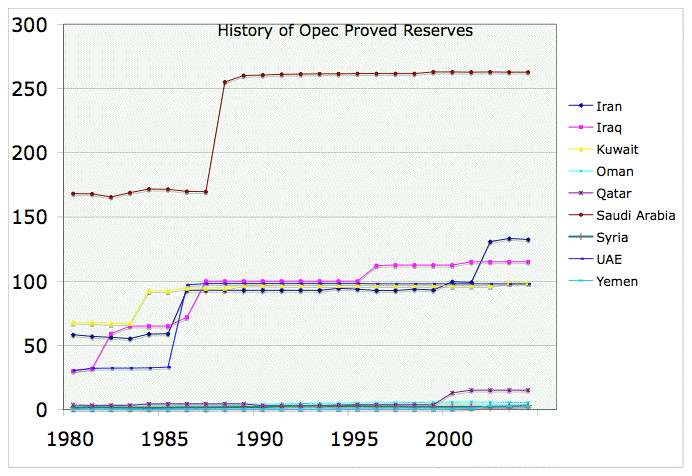
All you need to know about peak oil is "Are the reserves growing or shrinking over time?"
http://www.theoildrum.com/uploads/12/opec_reserve_growth.gif
http://www.nrcan.gc.ca/eneene/sources/petpet/images/refstrar...
(Anyone remember the total obsession with garbage we had for a few years in the late eighties early nineties? Like how we were going to cover the entire world with it if we didn't recycle everything? Turns out, um... global warming and peak oil!)
Personally, living in Japan, I'm more concerned with "peak people" than any of the above.
The truth of the matter is peak oil will be very hard to predict because oil companies' reserve estimates are not very reliable, neither are the rates of future discoveries and future improvements of technology.
In any event, the rational choice for the USA, as another poster pointed out, is to find alternatives now. Peak oil may or may not happen soon but it will happen eventually so that it will be very irresponsible not to have an alternative ready.
The run-up and collapse in oil prices is exactly what peak oil theory predicted, as any honest reading of the literature will confirm.
1. Mexico production has been on a steep decline, and production from the Cantarell facility is steeply falling off.
2. We had an economic collapse and oil held at 33/bbl.
3. The infrastructure that needs to be built in Saudi to extract new oil is getting very complicated and expensive, because you can no longer throw a straw in the ground to pull oil out there.
4. There's a huge difference between the marginal value of a gallon of oil for an American vs. an Indian. A liter of oil is life changing for a Bangladeshi, but won't get me further than the next piggly wiggly in town.
Anyways, that's a couple. As a disclaimer, this isn't my specialty so consider me to be a crock of shit as well. Here's some better sources with real data:
gregor.us
getrealist.com
theoildrum.com
They have actual numbers.
His attempt at argumentation about the amount of oil that's available is far beyond my ability to discredit and as a result, I'm completely agnostic on the issue. But I know to ignore any conclusion presented by this author when he applies such obvious slander and misrepresentation of his opponents. An obvious straw-man argument.
Oh, NYT? Carry on.