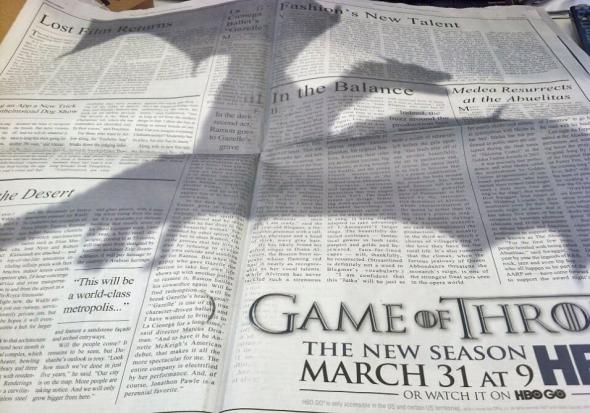
HBO's reason for staying with cable doesn't seem to have all that much to do with its corporate overlords. It seems to be more closely related to the fact that HBO has evolved symbiotically with cable over many decades, and striking out on its own would require HBO to make use of a lot of muscles it just never needed before (for example, advertising). So until their business model starts actually causing problems, they're OK with being pirated left and right because sticking with the tried and true still makes them money hand over fist.
Yes, and that might even be an understatement. To the extent HBO moves into direct-subscription or advertising-driven models, it'll need to find a way to do those in addition to its existing, cable-licensing business -- not as an alternative.
The problem is that HBO makes a lot more money licensing to cable providers than it realistically could by selling episodes a la carte, by selling advertising, or by selling HBO subscriptions individually. Any president or C-level exec at HBO (regardless of its corporate parent) is going to have a hell of a time initiating that process, politically, organizationally, or economically. It would basically amount to telling shareholders, stakeholders, and peers that one is going to jeopardize X to pursue a very uncertain X/4.
HBO will go a la carte, or ad-driven, if and when it can figure out how to make the economics of doing so more attractive than the economics of B2B licensing fees. That's easier said than done. It will probably require one of two things: 1) a platform-agnostic licensing strategy, i.e., to diversify away from cable; or 2) a complete rethinking of content forms, types, and salability.
It bears mentioning that even ad-driven broadcast networks make more money off of cable licensing than they do from advertising. (The revenue split is about 48% advertising and 52% cable/distribution fees, trending toward 40/60.)
As for the article's fundamental mistake--conflating Time Warner with Time Warner Cable--that's a pretty big one. TWC spun out from TW back in 2009.
Many people speak of Australia, but take Germany as another extreme example. HBO doesn't offer its services here so there are only two options if you want to watch Game of Thrones:
1: Get a subscription of Sky, which is mostly sports and has a minimum subscription time of 2 years. So if you're not into sports, that's about 800$ for two seasons of Game of Thrones.
2: Wait one year and then buy the DVD, because it will be available exactly one year later.
The thing about culture, though, is that you can't participate in the phenomenon that is happening _now_ if you have to wait a year.
So everybody here is pirating it like crazy. Curiously enough, Germany never appears in the piracy statistics because due to some weird legal specialties here, your chance of getting caught when using Bittorrent are 100%.
All the non-tech people I talk to watch it using sketchy streaming sites, thus generating advertising revenue for criminals and infecting their Windows boxen with malware.
I don't know what the long-run consequences are, but they can't be good.
http://www.adweek.com/files/imagecache/node-blog/blogs/got_d...
That's not exactly true. Japanese anime companies have found a way to embrace piracy in an interesting way that benefits their businesses.
There are all these piracy groups called 'fansubs', which are groups of fans that take the Japanese comic or cartoon and make their own translations and subtitles. Most of the time these groups are just excited about the show/comic and translate it because it's not available in their language.
The companies used to treat them like any other piracy group, but some of them started changing so that they treat them more or less like market research groups. They can find out, with little or no investment, where a certain comic or cartoon is successful. Then they can invest in doing their own translations if it passes a certain threshold.
Once the creators begin releasing their own official versions of the show/comic, the fansubs usually shut down. Their goal wasn't really piracy, their goal was just to get the show released in their region.
Subscription fee's go to the cable providers, who are the ones that are potentially losing out by piracy, though many cable providers are also internet providers, so they do get some money.
HBO would be worried if cable companies decided it wasn't worth it to carry HBO, but they know currently HBO is an anchor on many lucrative tv packages, which make cable companies lots of money.