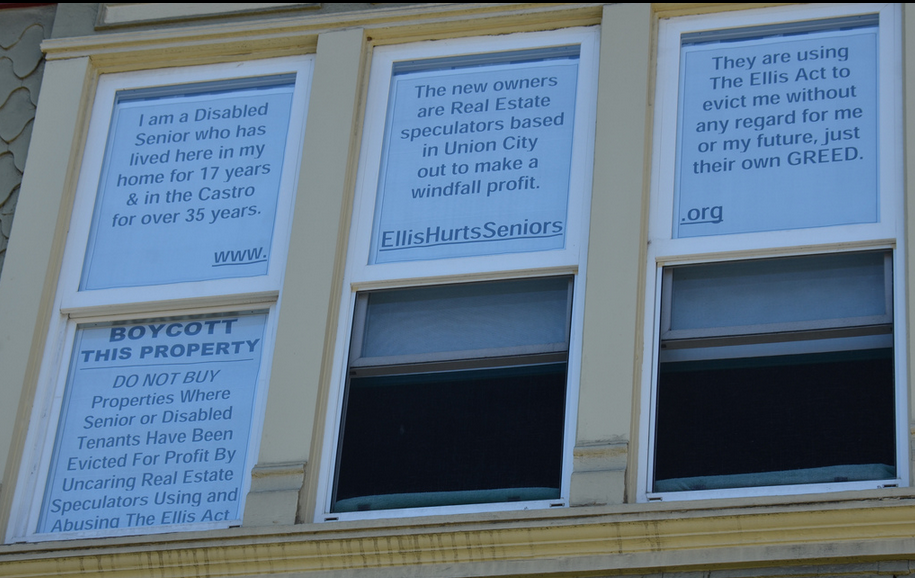
The result? Essentially innocent people, like the property owner, get "stuck" with "it's your problem now" where various agencies give contradictory mandates, backed with fines. How was property owner supposed to respond when told he must get rid of the illegal dwelling, but also told he can't evict the tenant?
I mostly sympathize with the property owner here. As a tenant, especially a tenant in an illegal or undocumented dwelling, you have to expect that a day of reckoning will come. Even property owners can be "evicted" (eminent domain), much less a property renter.
This is all-too-familiar to me, after having helped a couple older relatives through serious late-life changes like this.
Further, the general lack of safety net doesn't really apply when you're talking about a person with $1300/mo in disability/SSI, 'free' medical and some savings (/settlement payments). She could live, certainly not lavishly, but at least as well as she did before, just not where she did before or how she did before.
Which is the crux of this entire story.
not interested? or not being able to? it starts to look like a diagnosis (as an extreme illustration Rain Man comes to mind). It is not a big stretch of imagination to allow that after 20 years of being in the same situation an elderly person may lose ability for "changes", just like many lose ability to bend and reach the floor or make a split. Brain is just a biological organ and there is a lot of information around about it losing its "flexibility" with time.
Basically the society is very cruel to its members who lose the ability to function above specific level, be it physical or mental abilities.
$1300 a month isn't a lot, but I would be really surprised if there's not somewhere in the SF bay area or a nearby city (Sacramento, etc) where it couldn't cover a small apartment or studio, utilities, and normal monthly costs like groceries.
As noted in other comments, it makes the focus of the article feel disingenuous as compared to people who are being priced out of their homes and don't have any safety net at all.
http://factfinder2.census.gov/faces/tableservices/jsf/pages/...
I lived through troubled times a few years back, but I always knew in the back of my mind that no matter what, I'll never be homeless -- a nice big paycheck from daddy was only an asking away - at the cost of only a little momentary humiliation that I was the only person not 'made' in my family. It's tough to even imagine what happens to families who're not well-networked or financially secure to begin with. There is a problem right now, as much as this particular story may hint otherwise.
I'm not saying we shouldn't help these people, but if you are complaining about not being able to get by in the most expensive city in the country, I really don't have any sympathy for you.
Here's where I'm coming from - SF is small, old, and largely built. It's in the middle of a very large metropolitan area, but it includes many of the old parts that have had high population densities for a long time. Contrast that with the population densities of most American cities, and the general land area. With the exception of New York, SF much smaller and more densely populated than almost all of the regions used in these comparisons.
Now, when someone builds a large housing development far from the urban center of, say, Houston, that counts as development for Houston. When this happens in Walnut Creek, it goes down as not developing in SF.
So the way I'd answer this question - and I haven't yet - is to look at subregions in major met regions in the US that have had a population density of above 17,000/sq mi for more than 50 years, and try to measure how much development has occurred within those areas in the last 20 years, or what kind of opposition to new development happens in those regions now.
My refutable hypothesis is that SF will no longer show a dramatically different pattern of NIMBYism from those sub-regions outside San Francisco. That doesn't mean it won't show NIMBYism, or that it won't show more NIMBYism than other old, relatively dense regions - I just think that it may reveal that "population density over 17000/sq mi for more than several decades" correlates with general opposition to new construction regardless of whether it happens in SF.
Like I said, I haven't checked, it's just an idea. This would actually take some work to investigate.
Property owners sell off places they would otherwise have rented out or just leave them empty because it just isn't worth the risk. That is what constrains the supply. You'd be crazy to go into the rental business unless you had a lot of units to balance out the Inges of the world, particularly since once you finally evict someone like that you have to tear out the walls to get rid of the stench.
This read to me more like story about a squatter in an illegal dwelling, trying to cause as much pain to the owners as she could on her way out.
A property owner wants to, god forbid, sell their property, and they have to suffer through this: http://pix-media.s3.amazonaws.com/blog/632/ScreenShot2014-03...
I'd feel bad for the soon-to-be-prior owners, but the $40k in costs barely dented their 120% return ($723k) over 12 years. It's not like they didn't know she lived there when they bought the place. But it still doesn't mean they are/should be legally obligated to rent to her for the rest of her life.
Honestly if there were not so many social programs in SF the homeless population would be much lower as they would relocate to other less expensive areas and maybe actually be able to afford a place to live. The current social system in SF mixed with the crazy rent prices actually encourages homelessness.
Even I can't afford to live in SF on "developer" pay, so guess what? I don't I live in SF, I moved south where I could find an apartment at a semi-sane price (still extreme, I could make payments on two Teslas for what I pay in rent).
Clearly he should have moved out of the house and let her live there.
Come on. It's sad that she got evicted, but to imply in any way that the tenant is blameless seems ridiculous. You don't get a free pass to be an asshole just because you're old; you're still obligated to try and work with the system.
Social welfare weakens incentives for individuals to plan and live for the future. People should pay for their own lives with their own dollars, and if they are too foolish and imprudent to account for their old age, they should suffer the consequences of their own actions. They have no one to blame but themselves for not analysing the dangers.
Once people become aware that there are no second chances, behaviour will improve. It's a short-term pain for a major long-term benefit.
In my world, though, there are layoffs, long periods of unemployment, expensive catastrophic events, and generally a whole heapin' helpin' of reasons why people may need financial assistance for reasons that have nothing to do with their life choices. There are people who have done everything "right" and go into bankruptcy because a family member with insufficient health insurance gets sick. Do these things not happen in your world?
I'm just speculating, though; perhaps you would be crowned King of All There Is and paid the fealty you are so surely due, as you have responsibly planned whilst the impoverished clearly have not. All hail Nirnira, may the bones of the weak be used to grow his giant throne!
[apologies for feeding the troll, he's just so cute but ideologically dangerous]
The obvious solution to rapidly rising prices is to increase supply, as described here (http://www.amazon.com/dp/B0078XGJXO) or here (http://www.theatlanticcities.com/housing/2013/10/san-francis...). I've posted both links before but we keep seeing stories like these and the solutions remain the same.
The technology necessary to increase housing supply (steel frames, elevators) is a century old (http://www.slate.com/blogs/moneybox/2013/05/03/silicon_valle...) and well-understood. The problem is almost entirely political.
More than two decades after the USSR collapsed, and people are still clinging to socialist ideologies.
That's a lie: http://infogr.am/ellis-act-evictions
While I don't know if I disagree with the law, it is hard to see it being used outside of sale opportunities.
News Flash: people in those other communities have similar worries, transit should have been expanded/extended at least ten years ago - it would have been a lot easier when the bay wasn't in a boom - but that still wouldn't solve everything. The entire bay area doesn't want SF to sprawl all over it. Part of the beauty of the bay has always been the diverse types of areas to live in, and their distinct personalities.
People are worried that SF's personality is changing, and though this story has been told before, they're right to be.
On the one hand, noone should expect a rental arrangement to last forever, but the bay area has spent decades developing a culture that is renter-heavy, and whatever the laws say, our hearts need to understand that these buildings largely owned by speculators who benefit from our infighting have been occupied by lots of people who made them homes, who opened businesses and threw street festivals and painted murals that made us all feel like more of who we are from the first minute we stepped into SF.
And we should be careful not to leave it an empty husk if our industry faces a downturn again, if nothing else.
Broadband, people .. it works[1]
[1] Outside the US, in the US monopolies may apply.
FTFY. Seriously, there's two parts of a fraction. Why are we subsidizing immigration and children?
But this lady could live perfectly fine on her social security if she would move to somewhere she could afford. Living in San Francisco is something a whole lot of people want to do. That's why it's so damn expensive. I want to do it too, but I don't want to pay that price. That's ok, you shouldn't get everything you want. It's a privilege to live there, not a right.
Reminds me of panel 3 in http://dilbert.com/strips/comic/1992-03-01/
YES! Absolutely reasonable. There is no right to live exactly where you want for the rest of your life (especially when where you want to live is an illegal residence). Nor should there be.
When they retired they moved. Would it have been preferable to keep the house the whole family grew up in? Probably. But they couldn't afford the overhead of utilities, maintenance, etc. They moved to a smaller house in a state with lower property taxes.
They too left their friends, contacts, etc. Built up over living there for 35 years. But it was the responsible decision to do it. Why should it be everyone else's burden if they make a stupid decision to stay put in a place they can't afford? Is that a right?
Especially when seniors have the dual safety net of Social Security and Medicaid - they are generally in a better shape than many working class people. The landlord paid her $14k just to move out. That with social security would absolutely cover living expenses in most of the country.
Besides, I moved away from my family, friends, and contacts that I'd built up over the first 18 years of my life in order to attend college. People uproot themselves frequently because they realize that not doing so is just too impractical.
It is like any government handout, except here in the case of money they merely take your rights away to your property.
So she voluntarily did not use resources designed to help her out. That lands credibility to landlords story.
If I lived on fixed income, I would definitely move out of Bay Area somewhere cheaper.
She has a golden ticket to a vast array of social services, but she's tied to a community in one of the most expensive cities in the USA.
I guess you say "Sorry poor trash, but you gotta be this rich to live here. If you can't cut it, kindly leave the city you've known your whole life, abandon your friends, and get a new job." But that seems cold, doesn't it?
"I could send you transcripts of a phone message where she said she will burn the house down if we didn't fix the leaking roof. Or show you the rent increase letter that was returned to me unopened and defaced with 'Fuck You' written on it. We tried to help her."
Basically, you purchase a property from someone else and it comes with a tenant. You try to co-exist with that tenant and she behaves in a manner that is unreasonably hostile. Are we really supposed to be sympathetic? Is this really supposed to make us feel for the plight of people being evicted in San Francisco?
I lost my job in Canada, and it was prohibitively difficult to find a software job I could sustain myself on in my home city, so I packed up and moved. I moved out of the city I had lived in my whole life. I left my friends and family and landed, alone, in SF. Because the economic landscape forced me to move.
I understand what you are trying to say, but I'm having trouble sympathizing. And, given how many H1Bs get given out every year, I suspect I'm not the only one here who feels that way
I've done many things I didn't want to. It's part of being an adult. Then again, nobody makes me eat my vegetables.
It's a simple thing: she and her prior landlord were breaking the law. Either SF has to change their zoning laws or she had to comply. Hard to see the property owner as the bad guy. After years of legal action and dealing with someone who honestly sounds like an exceedingly difficult personality, I'd want to sell the house too.
You're right. But that's life. For example, I had to pack up and move 8 times in the last 14 years, and it sucked every time. But I dealt with it.
Having to move merely once every several decades is a comparative luxury.
They could have chosen between any of the Ellis Act evictions in the dabrownstein figure (~4000 of them), and yet the person they chose to interview
* has health care retirement benefits
* has the ability to go back to Germany and use their social programs
* has personal attention from social workers and relatives finding her options
* has a car
* has a shelter offering a place to stay for the night
* is a member of a social group (female, white, older) that is not the bottom of the charity priority list
* hoards, smokes, intentionally antagonizes her landlord
All of this raises questions about how representative Inge is of the evictee population. I suspect the answer is "not very."
My main take-away from all of this is that being evicted in SF is quite the feat, right up there with climbing Mount Everest or swimming the English channel. We should commend her for accomplishing something so difficult, despite all the people who told her it could not be done (read: tried to help her).
SF's land use policies are horrendous, but anecdotes (in any direction) are not evidence for specific changes.
That might have been good advice 30 years ago, but it certainly isn't now. Modern insulin preparations should be kept at room temperature while in use for up to 30 days -- keeping it refrigerated while in use is contraindicated due to the potential for thermal cycling to result in inaccurate dosing -- and keeping insulin "on ice" is never recommended due to the risk of the insulin being damaged by freezing.
Do you have a citation for this? I'd be interested in researching more on this subject. My girlfriend tells me she needs to keep her insulin pens in the fridge. We've also noticed that her blood glucose will fluctuate for strange and mysterious reasons. Your comment wrt thermal cycling rings true, and I'm wondering if the temperature change from constantly going from fridge (~5C) to her purse (~20C) and back, several times a day, might be causing this
Every insulin pen "user guide" I've seen says "store unopened cartridges in a refrigerator; keep your pen at room temperature".
My girlfriend tells me she needs to keep her insulin pens in the fridge. We've also noticed that her blood glucose will fluctuate for strange and mysterious reasons. Your comment wrt thermal cycling rings true, and I'm wondering if the temperature change from constantly going from fridge (~5C) to her purse (~20C) and back, several times a day, might be causing this
The biggest problem with thermal cycling is that insulin pen cartridges, unlike insulin vials, aren't perfectly sealed -- the rubber stopper needs to be able to slide. As a result, when a cartridge is cooled and the liquid contracts, it will tend to draw a small amount of air into the cartridge. This will result in bubbles forming, and obviously injecting a bubble of air will be less effective than injecting insulin.
In young adults this is a nuisance more than anything else, since we're likely to notice bubbles, but in children (who don't understand the implications) or the elderly (who are less likely to notice this due to visual impairment) it can be a serious problem.
Assuming your girlfriend falls into the "young adult" age range, it's unlikely that her blood glucose fluctuations are caused by this; assuming you've ruled out monthly and diurnal patterns from endocrine causes, I'd look at diet -- protein in particular, since amino acid catabolism can dump glucose into your bloodstream at unexpected times.
"...$1.4 million; it’s a good time to sell, considering he bought the place for $627,000 in 2002."
Wow! Sounds huge right? Well, 12 years to double? That means it's a ~6% yearly increase. That's LOWER than medial bills, college education, & almost exactly what you'd get from any stock index (S&P 500) for that time period.
You need to calculate the return based on the equity invested. Assuming they paid 20% down that's $125K. The house appreciated $773K over the initial purchase price. That's a 6x return on equity, not a 2x.
But thanks for the lecture about how other people don't understand inflation / math.
My point was more about how journalists too often spout "PRICES DOUBLED!" to get attention like blood in the water, including here. And, in too many cases, it's over a time period that's 10+ years, so it's not really doubling, but 6%/year.
And, yes, leverage can profit, but it can bite hard too. Plenty of people bought at $500k with $100k down, then saw the value drop to $300k, meaning they lost 200+100 = $300k if they had to sell.
All fun math, with, yes, GROSS simplifications here.
But, more fun math:
Stocks don't have maintenance costs like houses/rental units. The property tax alone per year on a ~$500k place is ~$8k. (You'd need to get $700/month in rent JUST to cover property tax.) (The next buyer, at 1.4M valuation, would need to charge ~$2k/month JUST to cover the prop tax, nothing else!)
Add in ~$2k/year in regular maintenance, + ~$30k of maintenance every ~5-10 years (roofs, flooring, bathroom fixtures, appliances all die someday), and renting not so profitable. Reliable capital appreciation is the bigger, pure profit here.
HN is a place devoted to people interested in technology, slanted towards startups. Startups absolutely require the concept of private property and the ability to determine the use of that property. The makeup of the majority of visitors determines the point of view taken on stories like this.
The thing at fault here is rent-control laws. They are insanity and lead to perverse outcomes, including housing shortages, high prices, sub-standard housing and cases like this one where someone is allowed to make other peoples lives a misery because they somehow became part of a protected class - a privelege denied to just about everyone commenting here.
This entire situation is quite a shame for all involved - it's a dreadful problem without a good resolution.
If there is any reason why poor can not afford housing in SF then it is not the fault of the landlord who is trying to make maximum money but the government regulations which prevent him from doing so. It is beyond me why In-Law unit is illegal in SF. The city is expensive, poor people are clearly willing to stay in these illegal units which is a better option than staying in a car. What exactly is government's problem ?
My making the in-law unit illegal government has actually deprived the poor people of any legitimate consumer rights they could have. Government has reduced competition between the in-law unit owners and as a result increased prices and left the poor people susceptible to all sort of oppression.
The problem with poor people is most often they are able to see the first order causes but not beyond that. Igne was not stupid to blame the Landlord for her situation, but she was merely ignorant of the fact that it is government that forced him to take such steps. Her sense of entitlement though it totally misplaced.
I am pretty anti-regulation as such things go, but one plausible reason:
Such "close quarters" tenancy is bound in the aggregate of a big city to lead to a large number of he-said, she-said disputes of the sort that are nearly impossible for the city to resolve or regulate in a just way. I say you're using more than the agreed share of electricity, so I'm evicting you immediately. You say my car is blocking your access to the unit through the garage and want to sue me for breach of contract. Yes, the tenant and landlord could, in a regulation-free Utopia, negotiate a specific binding agreement that could cover all contingencies, but again, those will be very expensive and time consuming to litigate.
The city agrees to enforce rental agreements that fall within certain parameters, and one way those parameters are set is by looking at what kinds of disputes they're likely to produce and which the city is actually capable of adjudicating.
Also there is an opportunity cost involved here. How much resources are spent directly or indirectly by both city administration and other citizens for homeless people and any problems they create ? How much potential revenue in taxes is City losing because such units are not legal ?
> Over the years, Inge’s rent had gradually increased from $480 to $560 per month; in late 2012, in the midst of the permit debacle, she decided to stop paying rent altogether. Withrington says he “couldn’t do a damn thing about it,” since he was renting an illegal unit.
Sounds pretty smart to me.
Sure. Sometimes it's pretty smart to screw other people over. I guess it just depends on what kind of person you are.
I live in San Francisco, and own a 2-unit building in the heart of the tech shuttle stops near Dolores Park. I had rented in the city for years before that. I couldn't have bought my place (almost unlivably dilapidated in the 2009 downturn) without a job at Google and help from my college friend who agreed to rent one of the apartments, despite the hot tub installed in the living room by the previous owner. Sadly, she's moving out this summer.
Almost all of my friends rent, and very few of them work in tech. My partner is an artist, and his contribution to SF culture is an irreplaceable part of what makes SF great, but it's not remotely competitive financially with tech. I've personally benefitted from the city and its business and social cultures. I have a duty to pay it back.
But I won't rent the vacant apartment, because renting to someone is a commitment more permanent than marriage. My house - not accounting for the insane appreciation - is more than 50% of my net assets. It'd be irresponsible.
There has to be some protection for the cultural core of San Francisco, given its status as a boom-bust town. Rent stabilization, a la NYC. A maximum-allowable rent increase, tied to inflation. But there also needs to be a lot more housing. Rent control is a populist disaster that sounds great - remember "The rent is too damn high!"? - but actually accomplishes the reverse of its stated intent.
The current political paralysis is a nightmare, and a fascinating window onto the class politics that our modern scaled economy is creating.
In other words, this is "soft" rent control as opposed to "hard" rent control where prices are fixed, essentially forever.
It's true that landlords can set the price of a vacant unit arbitrarily, unlike say NYC's rent stabilization, which limits increases even between tenants.
However, I'd argue SF rent control isn't very "soft" by the article's definition - there's no hardship or rate of return provisions for the landlord, and during a tenant's stay, the allowable increases are negligible (less than CPI/inflation and certainly much less than market rate you'd expect on an investment with similar risk). Because a landlord has to evaluate a potential tenant for a lifetime lease, a lot of the same negative dynamics apply during the rental transaction. The landlord is trying to reduce their uncertainty - finding a tenant who will not only pay the greatest possible rent, but also stay for the shortest possible time.
As market prices rise, tenants of rent-controlled units are highly incentivized to stay in their current home, because a new lease would be so much more expensive. This further reduces the available supply.
It gets even worse when you consider the variety of protected classes SF rental law has created. Elderly and disabled tenants cannot be evicted without special cause, even if they've stopped paying rent years ago. The intent of the law is good: to protect vulnerable populations who would suffer greatly if they were evicted. But in effect, it only protects vulnerable tenants who already have a lease. Every other member of that class will find it much harder to find housing, because their tenancy comes with strings attached. There are anti-discrimination provisions in housing law, but in a competitive market, those are incredibly difficult to enforce.
Excerpt:
A look inside her Volvo is enough to curdle a stomach of steel: trash bags are piled high in the back seat, open packages of food topple into a litter box full of cat feces, door-sides are crammed full of half-smoked Pall Malls and prescription painkillers.
I am homeless. I do not live that way. Not everyone who is homeless chooses to live in filth. Plus, earlier in the article, it talks about how she did "odd jobs" to support herself in Europe and lists "delivered flowers to prostitutes" as one of the odd jobs. Seriously? They could have just said "delivered flowers." Whom she delivered them to seems like gratuitous "color" for this story, just something salacious to say that has nothing to do with this issue at all.
I was evicted. I lived in fear of eviction for 18 months. I have a serious medical issue and I did stuff like remove carpeting without my landlord's permission. I knew it was coming. I was willing to accept the consequences as the lesser evil compared to what my medical condition is supposed to do to me.
The real issue common to both my situation and Inge's is that America has some real issues with housing stock, not just illegal in-law units in San Francisco, but all kinds of issues. This article is highly unlikely to get people to talk about that issue and highly unlikely to get anything done about that issue. That is not something either landlords or tenants control. I was not impressed the lame management of my apartment whose incompetence promoted mold growth in my apartment but, honestly, I would have evicted me too for the things I did. But I also had compelling reasons for what I did. Blaming landlords and tenants and pitting them against each other does absolutely nothing to improve a situation like this. If anything, it makes the problem more intractable.
We need to figure out what does work to foster an environment where affordable, decent housing can exist without it being artificially rent controlled and nonsense like that. The need for rent control tells you there is something very wrong with the policies, laws, and so forth. There is a climate we are trying to fight against. And rather than change that climate, we just vilify people who have no real control over it.
Sigh.
Also, I don't know if the author's detailed description (probably of artistic intent) of one homeless person's life impugns on the reputation of all people who are down on their luck and temporarily homeless.
I feel like you are conflating your personal experience with hers. You may very well be morally justified in actions you have taken in your life but it is not clear to me how an article on her is an attack on you or any action you took (say remove carpets) is roughly equivalent to hers (make threats to burn down a building).
b) There is no similarity between me ripping out carpets and her threats to burn the building down. The similarity in my mind is that the housing itself was problematic for reasons that are largely out of the hands of both tenant and landlord. In her case, she was in an illegal rental, without proper egress, it's own electric bill, etc. According to the article, such places may account for 10% of the rental stock in SF. To me, that indicates a systemic problem, not specifically about this woman or her landlord.
I was training at one time to be an urban planner. I think this is an issue of local laws and policies as well as federal laws and policies.
1. You live in a building constructed after June of 1979.
2. You live in subsidized housing, such as HUD housing projects.
3. You live in a dormitory, monastery, nunnery, etc.
4. You live in a residential hotel and have less than 28 days of continuous tenancy.
So most of the new developments in the last 30 years aren't covered by RC.
> In San Francisco, a landlord can’t evict a current tenant just because they are selling or buying the property; by the time the unit was purchased, Inge had already been living there for ten years, and she had no intention to go anywhere. Since Inge's unit was illegal, her landlord had even fewer options in the way of legal recourse.
If the new owners were willing to come clean to the city about the illegal unit, then I don't see what the issue would have been. Being the new owners, surely they could not be held responsible for the crime that was committed by the old owner, right?
It seems to me that the only reason why their hands were bound is because they decided to not notify the city immediately after the property became theirs.
Why would they? They'd immediately throw themselves into the situation where they can't legally evict her, and are fined for failing to evict her. It's not too crazy (or abnormal, given that 10% of SF's housing is illegal) that they'd decide to kick that can down the road for a while.
Should a retired taxi driver be able to afford such a location? Should we be upset that she cannot?
I've seen a few evictions where the occupants seem to completely deny what's happening, refuse to help themselves, and refuse outside assistance. On top of the denial, this woman was actively antagonistic, which made things all that much harder.
Yes, the current housing situation in SF is bad, but this is a failure of the social services we provide. The article seems to take issue with the landlord, but what would any of us do in a similar situation, with an illegal and toxic tenant in our house?
IMO, the intelligent reader will see the story for what it is. A tragedy... and a realization on what happens when tenants don't like being evicted.
While convenient and emotionally satisfying to fingerpoint and blame SV higher incomes for the increased cost of housing, the real cause is the zoning ordinances which help wealthy landowners increase their income not through creativity and wealth creation but through politics.
Remove the "rent seeking" political constraints on an efficient housing market and you will go along way towards fixing the problem of people getting displaced by higher rents.
Yet she refused to do so and is now homeless, with a fraction of $14k to her name. It sounds like the landlords went above and beyond, I would kill to have landlords like that, and yet because this woman was her own worst enemy[0] she ends up on the street. Barring mental illness (which is quite possible) I can't see this being anything else but a conscious choice on her part to end up on the street. Furthermore, it seems like this woman was actively taking away resources from those who are in more dire situations[1]. Maybe we should be more concerned that the multiple social workers (and the post author) didn't consider that the woman might have needed mental help?
[0] “I personally went out and found stuff -- my own mother personally went out and found stuff. We put Inge in touch with multiple social workers and housing agencies. The problem is that a lot of these places come and check where you’re living and only take you in if you meet their standards. Inge is a hoarder, a smoker, and has a cat. The smell in her unit was absolutely…just...unbelievable. That didn’t work out well for her.”
[1]“It took three truck loads to get her stuff out,” recalls Withrington. “And the help of a whole team of social workers.”
Or three of them packed in a walkup one-bedroom and paying double the rent of their downstairs neighbor who's of much greater means but had the good fortune of being born a few years earlier?
Or the young artist who had to leave SF altogether because they couldn't afford to pay market rate and didn't have enough San Francisco seniority to qualify for a hefty rent-control subsidy?
In the name of protecting tenant rights government has made regulations that deeply hurt the land owners and reduce their incentives to create housing opportunities for poor.
"In San Francisco, a landlord can’t evict a current tenant just because they are selling or buying the property; by the time the unit was purchased. "
Burning down the house in that case sounds like a lucrative offer.
What the hell? She has to threaten and insult people around her and was living in an illegal building, yet has the perfect option open to her.
EDIT: And before anybody says anything about her giving up her life - by the sound of the article, her life consisted of insulting and fighting with all her neighbors. Logically if she had friends, she wouldn't be living in her car - her friends would have helped her out.
Note that both Ellis Act and other kinds of evictions seem to be disproportionately lower than what the median house prices would lead one to expect.
I'm not making an argument in favor of the evictions. But articles like these and recent activism imply that this is a worrying new trend rather than a slow return to previous levels.
This story tells the tale of a capitalist's hassles.
It doesn't go any deeper, into the real issues.
Is this so crazy and outrageous? Someone buys a property, and 12 years later they want to sell it? Yes, it's appreciated. Has it appreciated that much more than the S&P 500, given the liquidity issues and upkeep?
I feel bad for the tenant, and our safety net is imperfect, but "I'm renting here now" shouldn't mean "I'm renting here forever at below market rates."
One reason housing rates are so high is that people don't want to invest in housing infrastructure if they can't get their money back.
You mean, like an illegal in-law unit?
As a renter, I would never presume to be able to stay in a unit past the end of the lease without the landlord's permission. How was this basic right of property ownership was ever subverted? It sounds a bit like 'involuntary servitude' (13th amendment) to be forced to rent your property to someone after the lawful terms of your agreement to rent it have expired.