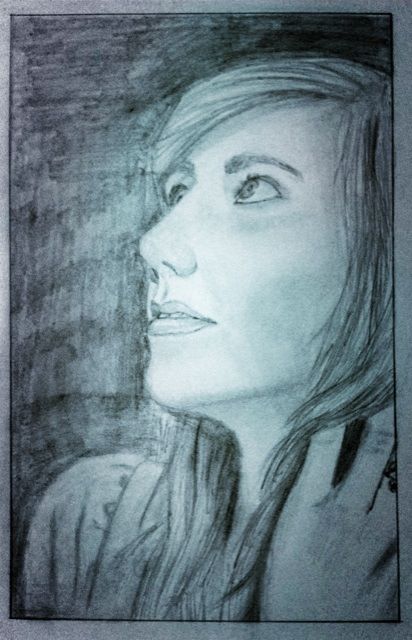
Don't get me wrong, basic skills are valuable, but reading the book and practising for a couple of months will not make you a skilled artist any more than learning to touch-type and adding an existing Javascript menu to a web page will make you an expert programmer. It can be a first step, but if you want to be really good at drawing, you probably want to to spend years practising composition, perspective, anatomy, the emotional effects of lines and shapes, color theory, storytelling, creating variation/contrast/depth/movement, etc. There's much, much more to drawing than just being able to copy what you see in front of you.
(I'm not writing this to discourage anyone, I just want to put the book into perspective.)
People who cannot draw at all seem to get a lot out of the book however...
I think it comes down to a being a human photocopier is an immensely important part of drawing, but its also a phase that you pass out of on your way to becoming a good artist. I remember me and my friends used to spend hours doing line for line copies of comic book drawings when we were 10-12 years old, its a natural part of the process i think...
Dunno. I strongly believe it really depends. I never did that, for exactly the reasons other people lay out in this thread, "but what if I want to draw something else?" (actually "but I want to draw something else, this drawing already exists anyway, why copy it").
Some of my friends did like to copy drawings. A lot of them never progressed past that, and some did. It really depends.
The book taught me that the things that we "see" in our minds are really very incomplete. You think you can imagine an elephant vividly in your imagination, but what is the ratio of their ears to their head, or their trunk to their head. Where are their eyes? How does their mouth open?
When you draw from what you see, or draw from what you imagine, it's easy to think you know exactly what you're going to draw, but unless you really pay attention you are probably glossing over it in your mind.
To draw things that you imagine well you need the same skill as you need to draw things that you see. You just need practice to memorize a form, or components of a form, or the principles behind a form before you can compose them into your own idea.
If you think that the book is just about copying what you see in front of you, you either haven't read it or really didn't pay attention to it. On the other hand, if you can't reproduce something you see right in front of you, you're going to have an impossible task in reproducing something that is vaguely held in your mind.
You see, there is some maxima repeatedly imposed by that book, like "draw what you see" or something like that — you could formulate it by yourself just fine as you've read it I guess. That is an important thing that you should hear once, that's right, because relying too much on technical methods (like perspective) is often impractical and you must learn to draw not relying on it too much. The problem is, that it's just one thing you need to hear after you'll learn perspective and other basic techniques just once, but not a lesson itself.
Because, you see, there are infinite forms in the universe and our imaginary worlds as well, and drawing an elephant isn't about memorizing it, it's about understanding. If you want to understand what I'm talking about, I'd recommend you to read Gottfried Bammes "The Artist's Guide to Animal Anatomy".
Actually, if you'll go to the art school or similar place you'll be strongly discouraged from that "line tracing" thing (however, as I said, remembering that you can draw like that as well is important), which can seem surprising at first (because, really, it's so easy and so natural to just trace it!), but you'll understand why really soon.
By the way, if you are interested, maybe you should check some sketches for famous pictures of famous artists (like Dali) who were professionally drawing for years. That actually impressed me when I first saw that, that really, really good artists who I might have thought would just draw anything from the top of their heads actually do sketches with all these support lines and stuff. Then you understand that drawing isn't just line tracing after all.
So in the end of the day drawing tons of cubes and spheres is way more useful and important than line-tracing your face. Really.
Right now I'm trying to finish an illustration where I've already sketched out everything in detail; the composition is good, the perspective is correct, one of the elements in the drawing is a running person, drawn from imagination, with a good likeness, anatomy, and sense of motion. Still, I struggle A LOT with choosing and simplifying the color scheme and rendering the final drawing in lines that feel spontaneous and alive.
I've been drawing since I was a kid and I had a good handle on the things DotRSotB teaches when I was twelve years old. But there's so much more to learn. A good step after DotRSotB might be learning about shape design, gesture drawing and movement from cartoonists, e.g.:
http://theartcenter.blogspot.se/2010/02/what-is-drawing.html
It's like, you know, that sushi-making stuff in Japan (as well as many other things): it's considered very difficult and you need many years to learn how to make sushi and there are some 86 years old master that'll tell you how he even now dreams about sushi and improves his skills and whatever. Yet you can take 3-hours long lesson somewhere in Europe or USA and start making pretty decent sushi for yourself.
Or programming, or everything else. Anyway, making some real work of art is more about your personal qualities like imagination than about "life-long learning". But there's always something more to learn nevertheless.
Don't discourage people. Enthusiasm is what brings them to interesting places. Who knows what a "skilled artist" is anyway?
- Drawing a lot of boxes, spheres cut in half, cones, other simple 3D objects in various views
- 30-second poses using Posemaniacs, and quick poses from imagination
- Head structure from imagination, like in Loomis "Drawing the head and hands" (available online for free)
The next problem is going to be color, I can already tell that I'm OK with structure but will need a new set of exercises for color and value, no idea yet what they will be. Can anyone who's further along help me out?
I don't know how I learned colour. I worked in black and white for a long, long time, and only started using colour when I started using the computer/scanner.
(If you like maths and physics, check this out: http://www.scratchapixel.com/lessons/3d-basic-lessons/lesson... esp. lessons 1 and 2 it won't help you one bit about choosing the "right" colours for artistic purposes, but it's super interesting and useful for knowing about how colours are made in print and on the screen)
If you want to move on to the next step of drawing whatever the hell you want to out of your head, in any angle, I strongly recommend you go to http://johnkcurriculum.blogspot.com/2009/12/preston-blair-le..., get the Preston Blair book, and start doing these exercises. You will get a lot better, a lot faster.
You can build on the simple cartoon characters in these lessons and do super realistic stuff, or you can keep on being a cartoonist. Whatever works for you.
I strongly disagree with the suggestion of starting with cartoons first. Start with real anatomy first.
Books that show step-by-step guides to drawing a comic character are only good for one thing: Learning how to draw that comic character, in that position, in that style, in that medium. I hate them. One may look at these books and think that's how all cartoonists (or other artists) learned to draw, and they'd be wrong.
To be a good cartoonist, in my view, you need a foundational understanding, not just technique (which is what these books teach, in a very limited way). Once you understand anatomy, how bodies move, forms, perspective, composition, visual weight, ... Then turning your ideas into a cartoon (or any other form) becomes simply a matter of technique. (And even at that point, learning techniques from step-by-step instruction books is a lousy method.)
These lessons are aimed at getting someone up and running with a solid knowledge of constructing a figure in three dimensions as quickly as possible. You can quite easily stack anatomy on top of this foundation and draw in more complicated styles than "1940s cartoon character"; it's useful to learn construction with those kinds of characters because they're basically little but their construction.
I do not by any means discount the value of anatomy lessons and text, life drawing, sitting out in public doing quick observational sketches, frame-by-frame analysis of video, going to the zoo to draw, or any of the other myriad activities that make up part of a serious art education. I did that, and so did everyone else I knew during my time in animation, no matter how stylized most of their final work was.
But I think these lessons are a great hand up over the huge gap between "I can copy what I see onto paper OK" and "I can draw any damn thing I please in any pose I like, with no reference beyond a few design drawings".
(tangential edit: I'm surprised to find another cartoonist here on HN and curious to see your work, but your website doesn't mention that at all, and Google turns up nothing. Any links? My website[1] is full of my stuff.)
I think it's a good idea for people to learn to construct simple 3d shapes before they tackle the complexities of human anatomy; it creates a framework for thinking about the drawing. I'd agree that there are better ways to learn drawing than from books, but still, a good book is much better than nothing.
Reading the description and comments ITT, I was a bit confused and kept thinking, "but I had this other book, and it was mainly about cartooning, not anatomy, and it explained things really well". Then someone here mentioned "lines of action" and I thought "wait a minute ..", clicked the link and it was that book :) :)
Well, I am glad that I had the opportunity to learn from such a classic when I was young. I have to agree, a lot of the ideas, techniques and really fundamentals stuck with me and shaped my cartooning style over the years.
See, anatomy is IMO not the end-all of cartooning. When I hear the word, I think about super realistic sketches of human figures where you can see all the muscles, figuring out how the clothes would wrap and fold around the body, etc. This is important if you want to draw the Silver Surfer or US super hero style comics, but that's never really been my thing.
The importance of "anatomy" in cartooning, for me, is limited to the way human body parts are connected to eachother, how they can move w/respect to eachother, and their relative sizes. As opposed to the almost biological/physiological detail I have in mind when I hear "anatomy" with respect to illustrations ...
For instance, and this is something that is treated in the Preston Blair book very well, which for me immediately sprang to mind as an example why "anatomy" really is not the end-all of cartooning: facial expressions.
Facial expressions in cartoons are nothing like how a human face actually moves. They are caricatured far beyond physical possibility (but not "beyond recognition", as I shall explain). They are NOT based on careful observation of what a human face actually looks like when it experiences a particular emotion. Look at a real crying face, a real hysterical-laughter face, that's not how cartoon characters emote at all[0]. And you can't learn how to do cartoon-emotions by studying actual human faces. Instead, they are based on the biological concept of the "supernormal stimulus"[1]. These don't exist in real life (except where someone else has already drawn/modelled them, advertisements are a good source). You have to figure them out by experimentation, not observation, because you can't know which attributes can be exaggerated for the psychological/biological supernormal stimulus effect (which can be weird and unexpected). Instead, you just draw hundreds or thousands of quick-sketch cartoon faces, with the eyes and the mouth and the ears and whatnot, just-so, randomly trying out weird configurations, anything, and figure out how it affects the perceived mood/emotion of these faces. Or body language. The other option is to copy and try out styles or ideas you like, or happen to notice (same as when learning typography, you start getting an eye for it). Or perhaps like Robert Crumb, do supernormal stimuli by just drawing whatever's your fetish.
The Preston Blair book only half-covers this, btw (if I remember correctly, it's been 10-15 years or so...), they talk about baby and toddler like configurations of the face and body proportions. Maybe also the sexual "Jessica Rabbit" type of supernormal stimuli, I forget. These are powerful, but not the only ones that exist. In particular for facial expressions, like chords and scales in music, some very powerful and useful tricks are very weird and unorthodox (or maybe I've just not figured out the reason behind the quirky sequency that is the minor Blues scale, which works so well no matter what you play with it).
Either way, my point is these exaggerations are not based on real-life observable phenomena, but on how the human psychology reacts to superstimuli (which you need to create before you can observe the reaction--which, fortunately, is quite easy to do).
Also the lines of action. are these based on anatomy? The Preston Blair book has that beautiful example of an animated character throwing a baseball, frame by frame[2]. That's not at all how a human moves IRL :) It is, however, an exaggeration/caricature of what our brains expect of rubbery bouncy physics. You can't observe that in real-life, because it never really happens like that.
Another example is the famous Pixar desk-lamp animation. It's not even got anatomy. But it moves according to some weird exaggerated physics model, and it has emotions, what, how? Because it plays to our minds, not real-life.
Another note, I'm not a native English speaker, I must have had only a very basic understanding of English when I was 11 or 12. Still, the Preston-Blair book was quite easy to follow, because most of it was explained as illustrations. Just a hint, if any non-English HNer is considering a present for their kids (they have to love drawing first, though) :)
There is one "step by step" part of that book which I didn't really like very much, and felt to me (then) it was imposing a certain style too much. This is the bit where it explains how to build a character made from spheres/ellipsoids and cylinders. I never liked first sketching shapes that you were going to draw over and erase later on anyhow. But then, this is probably exactly a type of technique that you'd learn if you'd start with anatomy as well :) I probably learned from that as well, but at the time it felt a bit restricting.
[0] which is brilliantly subverted by Ren & Stimpy, with their hyper realistic cut-scenes and close-ups, going one step beyond the fictional cartoon world into the surreal, for dramatic emphasis.
[1] https://en.wikipedia.org/wiki/Superstimulus
[2] thanks to the Internet, you can click and view the cartoon here: http://www.dailymotion.com/video/x3vhl1_mgm-batty-baseball-1... the jokes are corny, the cartoon-animation is beautiful. take note how almost none of it is realistic.
Either way, thanks!
It teaches all the underlying mechanics of visual communication without costing you a dime.
I've always envied people who are actually gifted draftspeople -- people who lay down the exact right line on the first try, and whose drawings are paragons of minimalism. R. Crumb, for example -- there's a video showing him drawing with a pen and never laying down a bad line. Whenever I watch that video, I have an envy meltdown.
My point? With a tablet and stencil, by being able to delete things, I could pretend to have actual drawing talent. :)
One of my old drawings: http://i.imgur.com/hRQY84G.jpg
There's this program for rapid sketching called alchemy http://al.chemy.org/features/ it specifically has no undo button, for that reason.
It's pretty fun to screw around with.
heh. partially that. but there's also:
    - tricks how to cover up an accident
    - recognizing an accident early so it's less to cover up
    - and finally of course, can't deny skill and control
While I probably did learn skill and control that way, I also very much learned about "happy accidents", cover-ups and recognizing an accident early or before it happens :)
Mind you, this was me as a stubborn teen, drawing during boring school classes. Maybe learning techniques for adults are different.
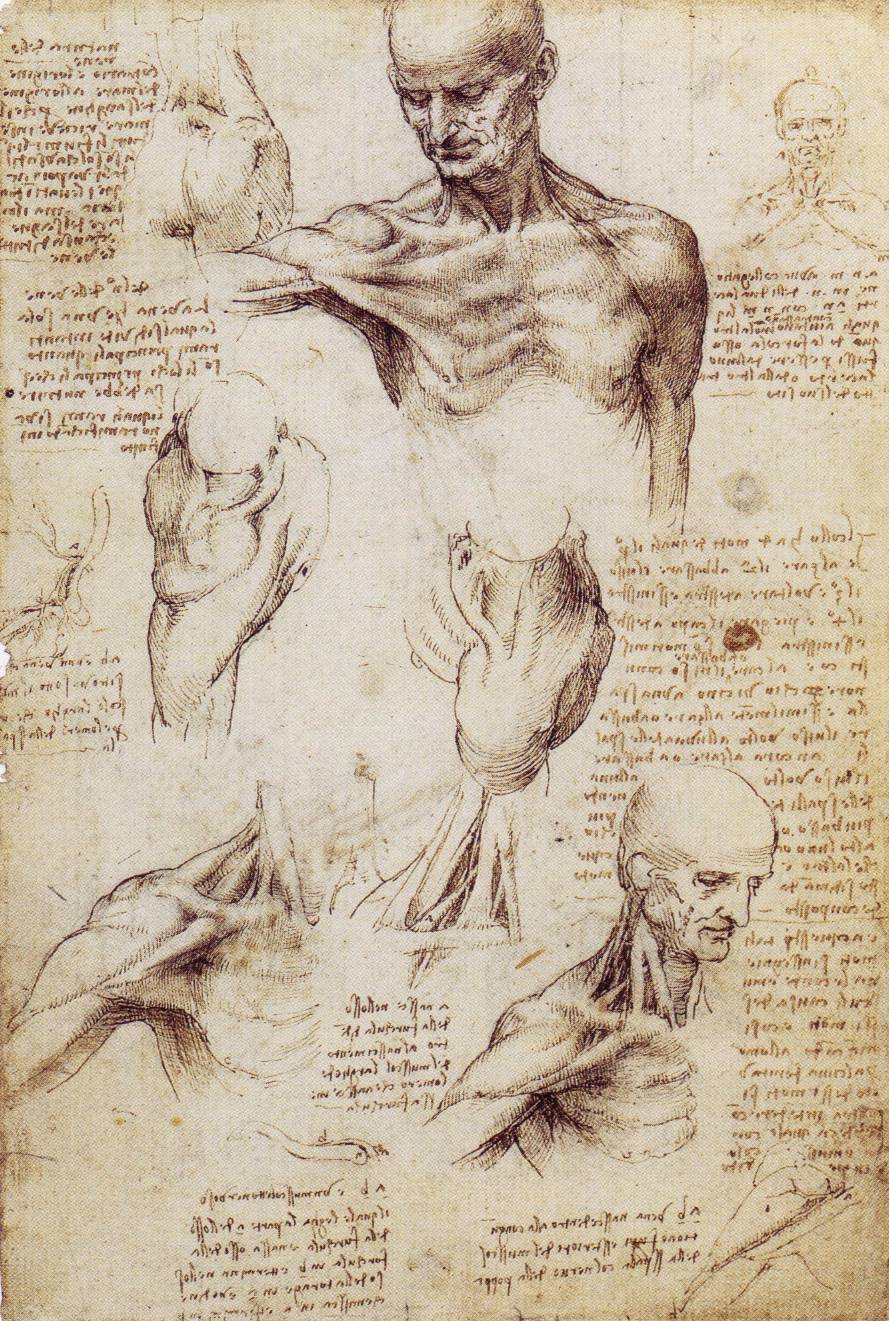
http://www.drawingsofleonardo.org/images/shoulderandneck3.jp...
So my main questions would be: - Can I still be good at drawing despite my trembling? - How do I cure my trembling?
I don't know the full cause of your tremor, but I know that if you have a death grip on a drawing tool it will be a lot less steady in your hand. A light grip may or may not help.
Also of course learning to whip out lines quickly can help. If you tremble about once a second on average, and get enough control to whip out roughly the line you want in .5s, I can imagine easily finding a rhythm that avoids a lot of the tremors.
Alternatively you could just embrace the trembling and groove on a lot of Edward Koren.
I can still draw. But I do it explicitly with my wrist+hand, not with my arm. I never have. Always rest my hand on the paper and draw with my fingers. Then I don't tremble, I only tremble when I gotta keep my hand still in free space. But on paper my hand's 100% relaxed and only moves as I want it to. Maybe it's because I've drawn things all my life and there's a trust in my hand that allows it to relax in that way.
There's two consequences to this drawing style: I draw best when it's really small, because of the range of motion of my hand and wrist (although there's a few ways I can use a marker and draw nice curves and cartoon faces on larger paper as well). I can't paint :) Because if you rest your hand on the paper you'll smear out all the paint :) This was already a problem in highschool, before I burnt out, it's just not how I want to interact with the medium. It's gotta be up close and personal.
Either way if my movements had to come out of my arm, my fingers would tremble, and it would suck.
BTW I have a similar fear for starting to learn electronics, I really doubt if I can handle a soldering iron and those tiny elements accurately enough to make things without it becoming a hugely frustrating exercise in "accepting one's limitations".
To the GP I say, try it, and really, try to relax about it (if relaxing helps with the tremors--it doesn't for me, 100%, which is why I also need to calmly rest my hand on a surface. but then it's pretty steady).
So, well, not to discourage you from medical help if you actually need some, but you shouldn't wait for getting better to start. Just find some tutorial (as I said already, I don't recommend Edwards, better start with Dodson or Loomis or anything else somewhat serious) and do something. Even if you'll be disturbed by your illness your practice lets you sublime anyway, which is good by itself.
As it's been said: nothing's impossible for a willing mind.
http://www.livescience.com/39373-left-brain-right-brain-myth...
http://eightweeksproject.wordpress.com/2008/03/25/projectone...
Then in 2010 my new years resolution was to do a sketch a day. Hard going but very enjoyable:
http://www.youtube.com/watch?v=NFWNlK2H29U
http://www.youtube.com/watch?v=lYtXlhVLYYE
http://martinadams.files.wordpress.com/2010/04/l_640_480_937...
http://martinadams.files.wordpress.com/2010/04/p_640_412_cb0...
I didn't dedicate enough time to each sketch so only got a handful of good drawings. I've fallen out of it again so would have to get right back to basics, but it shouldn't take too long before you start to feel fluid again.
Being able to draw is like a muscle.
What I am hoping to see is someone starting at a later age.
Personally, I don't believe age slows you down but maturity does. I rarely have the time to focus on non-essential tasks and priorities change. It might take me longer to learn something than if I was younger, but I'm okay with that. The thing to watch out for is jumping ahead because you think you know something and never really learn what's going on.
What I'm saying it's very populistic, but explains many thing the wrong way, which may cause some problems if you'll want to improve your techniques later. If you are learning to draw I'd better recommend you start with Andrew Loomis: "Fun with a Pencil" or even Vilppu Studio tutorials if you have serious mindset.
Who cares what book they used. If it gets them interested in drawing, then that's all that matters. It's like bitching because someone got interested in music when they listened to the latest <insert top pop album of the time> and it sparked creativity in them.
Those impressive benefits to a complete beginner are what a complete beginner needs. That they can see there actually has been progress is what will allow them to move on and continue to improve via the needed work.
Those improvements are not superficial to someone who has been told or convinced themselves that they can not draw.
I'm getting the impression that by analogy, DotRSB lets you play music that someone else has written; but to be good at drawing, you need to be able to play music that you've written yourself. And that's a valid criticism, but playing someone else's music is still fun, while writing music isn't going to be much fun if I can't play it well. So it seems reasonable to quickly get good at playing, and then later I can learn to write.
Does this seem like a fair assessment?
While this can be a revelation for some and improve drawing skills a bit, it is simply the first step. There is absolutely no way around learning how to draw but putting many hours into it. And drawing can be very exhausting. At first, you won't have the patience to sit through a drawing for more than an hour or so. It gets better though.
The drawing of the OP is okay, but not particularly good, but then he never claimed that it was good but just a way to relax a little bit. I will try this. Drawing as a mental break from coding. But you could probably achieve the same result with music, taking a walk, doing some physical activity, meditation etc.
http://nabeelqu.com/blog/surprisingly-undervalued-books/
Old HN post now refers to dead link.
I haven't posted much lately, been in a kind of slump and not producing much.
Except that I hope you do try. A few stick figures. Take a look at xkcd's earliest stick figures: https://xkcd.com/6/ and compare them to the way he manages to put actual emotion into those few lines with his current cartoons.
Okay yes his other drawings of that time are actually pretty good, but my point is, even when drawing stick figures, you can get better at it with practice :) But not if you get disheartened.
Drawing has the potential to suck me in just like playing an instrument failed. I think drawing is to playing an instrument like solving nonograms to solving sudoku. Sudoku is inherently repetitive to solve, you need to check for all numbers in a square, one by one, then all numbers in a line, line by line... In contrast, nonograms usually have non-linear solutions - there is no single way to get to the final result. This makes the process of solving a nonogram vastly more enjoyable for me.
I have no illusion that learning to draw won't require days, months, years of practice. But you can - should - try new things, and you improve in the process. No endless repetition of one piece until you can play it perfectly.
Sounds a lot like Starcraft, doesn't it ? :> I think Starcraft players who like to invoke comparisons to Chess have an inferiority complex and can't enjoy Starcraft for what it is. And it is a lot more like playing guitar than Chess. It's just that Chess much more accumulated prestige.
One of things putting me off Starcraft is that learning to play it violates the DRY (Don't Repeat Yourself) principle. A few years from now you may be vastly better at Starcraft, and I'll be able to draw many /different/ things.
I think it's a wider problem with most games. I know very few that really reward creative thinking rather than memorization of strategies and their counters, and practicing to execute them perfectly. Board games have it easier, in absence of computers they can afford to be less strict about rules, and the focus in boardgame industry is still on developing interesting mechanics rather than building on a few established genres.
lol, once more I see that nobody escapes the tentacles of post-modernism :)
I totally get the DRY principle regarding music btw. Every time I try to play an instrument (especially percussion), and I get it right, I find myself wishing for a "repeat" button.
Somehow with drawing this is very different for me. I love zoning out on penning tiny details, cross-hatchings, or on the computer, handpixeling sprites.
I think this is also what the article is really about, learning to access this other "mode" of your brain thinking.
I'm all for DRY, but it's great to be able to stretch the other brainmuscle and just DRRRRRRRRRRRaw :)
Also there are no terrible errors in drawing. Especially not if you do it because you love doing it.
What other tool or method allows you to explain a development challenge or solution (at a basic level) to a non-developer, in a matter of minutes? Being able to stand up in a meeting, walk to the whiteboard, and sketch out basic concepts for everyone in the room to understand makes you a goddamn hero. You'll go from being just a developer to the developer who can communicate with the biz guys, the sales guys, the designer guys, etc. That's valuable.
There's a good book on this topic, which I highly recommend: http://www.danroam.com/the-back-of-the-napkin/
(I have no affiliation with the author or the book.)
This article does make me want to draw again, I used be an amateur comics book artist/cartoonist but I haven't drawn seriously in years.
i just try to capture something fleeting. i identify the most salient element and try to communicate that in my drawing. the most useful exercise in that book imo was the technique of trying to draw something once, then turning it upside down and trying again. ("disorienting" the object trains your mind to better identify spatial relationships.)