I think I'm the reverse of (Gattaca) Ethan Hawke in this situation.
The fact that it is a 'frontend' position and that page says it's 'avionics' - that is surprising indeed.
[Edit: kind-of wonder if they're using a certain amount of in-house webapp stuff for mission planning, etc., as well]
SpaceX should just provide an API for that, we'll build the rest ;)
I applied to their Director of Infrastructure position having 14 years of IT experience managing people and large infrastructure and was told I was under qualified. YMMV.
In order to get geostationary, you need to get to a circular orbit at an altitude of 35,786km above Earth's surface. Trying to do that all in one burn is, I guess, theoretically possible but is going to waste an absurd amount of fuel.
The reason for this is that changing altitude in orbit = changing your speed. Specifically, you have two points you care about: your apogee (highest altitude) and your perigee (lowest altitude). To raise your apogee in the most efficient manner, you accelerate prograde (in the direction of your orbit), at perigee. To raise perigee in the most efficient manner, you accelerate prograde at apogee. Or, more simply: what you do at a certain point in your orbit will end up affecting what happens at the point in your orbit that's precisely opposite the point where you did something.
So the most efficient way to get up there is to use a transfer orbit. First you get into a lower, "parking" orbit (which doesn't take as much fuel as going all the way up in one go). Then at perigee you burn to raise your apogee out to the altitude you want. Then you cruise to apogee, and burn again to raise your perigee, resulting in a circular orbit.
Here's a detailed article on that:
https://en.wikipedia.org/wiki/Hohmann_transfer_orbit
Except it never goes quite that simply in the real world, so you actually end up doing more than two engine burns, but under ideal theoretical circumstances, you'd do it in two.
I haven't read up on the burn plans, but it's possible that the mission is technically using a bi-elliptic transfer[1], rather than a straight hohmann transfer (warning: I learned my orbital mechanics from the Kerbal Space Academy).
Bi-elliptic transfer: (2.713240 + 0.908982 + 0.485255) = 4.107477 km/s Hohmann transfer: (2.335977 + 1.431307) = 3.7672853 km/s
This alone does not explain why they did so. But this is all assuming that the trajectory is planar. If there was a plane change coupled with the second burn at high apogee, it could explain it.
Secondly, there was never any stage where they circularized their orbit, as one would do with a Hohmann. Rather, they kept burning at perigee until they escaped earth. Picture a an ellipse growing more and more eccentric until it becomes open at one end.
Also note that they never burned at apogee. The point wasn't to raise apogee so they could escape at apogee, but to increase velocity at perigee until they could reach escape velocity with a 20 minute burn on their last orbit.
Also, inclination burns can be combined with raising periapsis, which allows you to save some fuel thanks to the way they are at a 90 degree angle.
Another advantage is that it provides an easy and cheap way to deliver the spacecraft into the correct position in the stationary orbit, by controlling the orbital period of the eccentric orbit so that the periapsis will be where you want it to be (possibly after several orbits).
Because of this, the best possible way to launch from far away from the equator to a geostationary orbit is to launch to a highly eccentric orbit, at apoapsis when you intersect the equator simultaneously raise your periapsis to geostationary and fix your inclination, and then circularize at periapsis.
If this is interesting, and you don't already own kerbal space program, head over to the steam store right now.
And if you like Kerbal Space Program, but you find it isn't quite sadistic enough, go download Orbiter.
> Launch aborted by autosequence due to slower than expected thrust ramp. Seems ok on closer inspection. Cycling countdown.
> Increasing helium spin start pressure. Probably <50% chance of passing all aborts, but worth a try. Countdown resuming ...
> We called manual abort. Better to be paranoid and wrong. Bringing rocket down to borescope engines ...
> All known rocket anomalies resolved. Will spend another day rechecking to be sure. Launch attempt tmrw eve w Wed as backup.
Press releases are press releases, and a press release will always spin things as favorably as possible. If you look at the other sources, though, they seem awfully forthright.
1. http://en.wikipedia.org/wiki/SpaceX_CRS-1#Secondary_payload
So Orbcomm was able to figure out a lot of stuff and I'm sure the price was very nice.
"SpaceX seem to cover up any hiccups or issues they have and always present this saccharine sweet 'flawless' report of their missions. "
You may want to dial it back a few notches - trust me, I tend to reach for the hyperbole a little too quickly myself.
(Note - I read subscribe to Elon Musk's twitter feed, and he's a lot more balanced on SpaceX than he is on Tesla)
You would not see a private spaceflight company set against transparency do this. Especially the latter example, seeing as it could be interpreted as a stupid mistake.
SpaceX is a private company that has developed its launch vehicles outside of a conventional government procurement program, on their own terms. The typical way that anything gets done in the space launch business is that a government organization develops plans and dedicates a budget and then contracts with companies for procurement. In the end it's still a private company developing a launch vehicle whether it's Lockheed-Martin or SpaceX so again this may seem very similar on the surface. But the differences in character have a huge number of effects. Government directed development is bureaucratic, it's expensive, it's risk averse, and it's often inflicted with institutional superstitions and fads. Even worse it tends to rely on a "big design up front" or "waterfall" development model. Commercial development tends to be extremely pragmatic and iterative, leading to improved results.
Look at the Atlas V and Delta IV for example. Both have been in service for about a decade, after being developed through a government procurement program, and both have not seen significant changes in their design during their operational period. Compare that to the story at SpaceX who have developed 5 different rocket engines and 5 different launchers in the decade or so they've been operating. The SES-8 launch represents only the second launch of a new iteration of the Falcon 9 rocket, the v1.1, which uses new engines, a new thrust support structure, stretched fuel tanks, a new ignition system, and is designed to be capable of re-use of the first stage with the addition of landing legs.
Let's imagine a hypothetical parallel universe SpaceX. They could have put a Falcon Heavy into production based on the Falcon 9 v1 core, or they could have made less ambitious changes to the Falcon 9 v1.1 while retaining the same performance levels. With such a lineup they would still have a very bright financial future ahead of them. Their low manufacturing and operational costs enable them to offer similar launch services to the competition at much lower prices. With the offerings I've described SpaceX could easily become a multi-billion dollar company with very healthy profit margins. But SpaceX has grander ambitions than just making money, they want to open up the spaceflight market and they want to kickstart manned exploration of Mars.
This mission is a bit of a demonstration that their ambition has not gone too far, that they are actually capable of delivering on their promises and, crucially, that they can deliver satellite payloads to orbit just as well as anyone.
What does that mean? In the simplest sense it means that SpaceX's bank account is going to get pretty fat over the next few years. A corporation getting wealthy isn't a big deal right? Except in this case that profit isn't just going to be spent on yachts and mansions and private jets, much of it will be re-invested in the company in order to further the company's (and its founder's) vision.
At most rocket companies making rockets is an excuse to make money. At SpaceX making money is an excuse to make more rockets. They're going to develop and prove reusability of the Falcon 9 v1.1 first stage "live" as it were using operational missions. They've already used operational cargo delivery missions to flight-proof a substantial portion of the manned capsule hardware they've been working on. Over the next few years they are going to bring into service first stage reusability, the Falcon Heavy (and then later bring reusability into that platform as well), and the manned Dragon. Meanwhile they're developing LOX/Methane fueled engines for their next generation launchers which should be highly reusable (since Methane burns so cleanly) and be targeted at Manned Mars missions. Most space launch companies are content with sitting at comfortable plateaus and waiting for government encouragement, and funding, to step up to the next plateau, but SpaceX is a company that has constant innovation in its blood.
This mission validates the work they've done and their development style while also providing a huge signal to the industry that SpaceX is a reliable carrier. Which will help to funnel a lot more business their way and give them more excuses to build and develop more rockets, culminating in launch costs a fraction of what is possible today and catalyzing manned exploration of the Solar System.
I used to think that too, but then I read about Elon's opinion on that and changed my mind. Being privately owned allows them to take huge risks and whether the inevitable catastrophic failure. You can't really do that when you have to be accountable to millions of shareholders and market pressures.
If SpaceX went public, became a wildly successful earth-orbit rocket company and made Musk very rich, I believe he would consider that a failure.
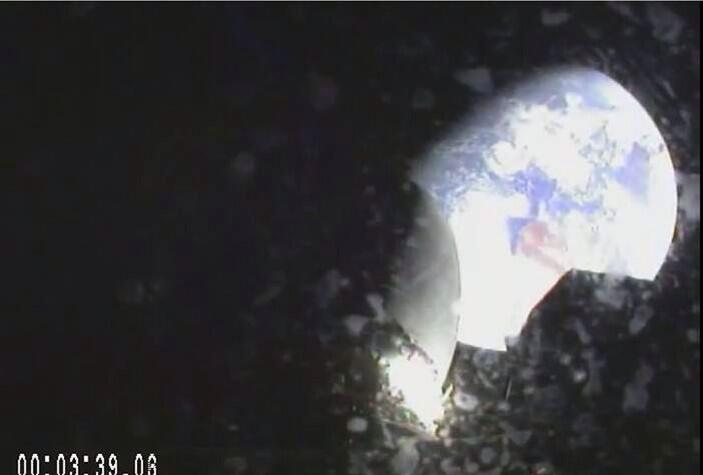
Nice picture from the space-x site- http://www.spacex.com/media-gallery/detail/90781/2601
Yep, same here!
Thank goodness for Kerbal Space Program. It's a marvelous backup.
It's so beautiful that I would have it on my wall, but I doubt it would print out nearly as nicely as it appears on-screen.
OK, staying up and watching Neptune All Night in 1989 as our first and last probe for it, Voyager 2, flew past it, and we received the first pictures was cool, but Space-X is about seriously getting out into space potentially in an long term economical way.
http://www.spacex.com/sites/spacex/files/styles/media_galler...
Engaging with those simulations also makes watching movies like "Apollo 13" into a whole new experience, too.
Congratulations to everyone involved, and I can't wait to see what they do next.