Because that's not how it happens at all. Companies don't hire more staff than they require. If McDonalds needs 10 employees per shift to operate, they're going to hire 10 per shift no matter if they cost $8/hr or $16/hr.
The amount of work determines the number of employees, not the other way around.
To properly phrase your example, yes it is depend on "work", but work is dependent on revenue. If McDs needs 10 employees per shift where they generate $800, each employees total cost per shift cannot be more than $80, which works out to about $10 CTC (cost-to-company) per hour in an 8-hour shift.
If you now mandate that the worker salary MUST be $12 or higher than $12, McDs is losing money. So you either pray for an increase in business (sales), or cut costs (ie, fire people) and automate.
And lower-skilled jobs are easier to automate. It's easier to automate fast-food checkout by having (for example) iPads for people to place their orders, so your human workforce can just be the cooks at the back and the janitorial staff.
The consensus is less conclusive on specific effects on minority groups. I've seen at least one paper showing short-term unemployment increase in minority groups. I've also seen at least one paper showing increased employment/earnings in younger, more affluent teens.
Some of the recent well-cited studies:
http://www.irle.berkeley.edu/workingpapers/166-08.pdf (2011) Looking at 1990-2009 CPS data: "Including controls for long-term growth differences among states and for heterogeneous economic shocks renders the employment and hours elasticities indistinguishable from zero and rules out any but very small disemployment effects. Dynamic evidence further shows the nature of bias in traditional estimates, and it also rules out all but very small negative long-run effects."
http://onlinelibrary.wiley.com/doi/10.1111/j.1467-8543.2009.... (2009) "A 10 per cent increase in the minimum wage reduces employment by about 0.10 per cent (see column 4 of Table 3). But even if this adverse employment effect were true, it would be of no practical relevance. An elasticity of −0.01 has no meaningful policy implications. If correct, the minimum wage could be doubled and cause only a 1 per cent decrease in teenage employment."
Not even an iota.
Businesses need those employees anyway. And the impact of an increased minimum wages is minimal. They pay them less not because paying them more would drive them out of business or really eat into their margins, but just because they can.
And it's not just teens. TONS of people work on minimum wage jobs that are older, including over fifty.
People who don't have those skills and experience (e.g. teenagers) will find it harder to justify their value to job creators, creating a vicious circle as they can't get experience without employment. If I have to pay $10, I'll seek to employ people who are worth $10+.
Youth unemployment is 34.6% in California[0] - the next generation of workers can't afford this.
[0]http://www.governing.com/gov-data/economy-finance/youth-empl...
http://www.bls.gov/web/empsit/cpseea10.htm
The question is, how many people are working minimum wage jobs who aren't teenagers.
http://www.igmchicago.org/igm-economic-experts-panel/poll-re...
Here's a real survey of actual economists, who largely agree, weighted by confidence, that "The distortionary costs of raising the federal minimum wage to $9 per hour and indexing it to inflation are sufficiently small compared with the benefits to low-skilled workers who can find employment that this would be a desirable policy."
And, economists are reasonably mixed (split between schools, I believe) on the belief that raising the minimum wage to $9 per hour would make it noticeably harder for low-skill workers to find employment, and no one strongly agreed or disagreed. The evidence, the science, of economics, is mixed, as has been demonstrated by a comprehensive meta-analysis by Doucouliagos and Stanley. You can find a graph and other analysis here:
http://www.cepr.net/documents/publications/min-wage-2013-02....
So, in summary, economists mostly believe the benefits of raising the minimum wage outweigh the distortionary economic effects, and none were willing to make strong assertions on the effect it might have on unemployment. Everyone, put down your pitchforks and take off your party insignias, let's just raise the minimum wage a bit and see what happens, because it benefits a lot of people and there is scant evidence of a downside for a marginal increase in the wage floor.
QED.
* Perhaps three, if my sarcasm detector is off?
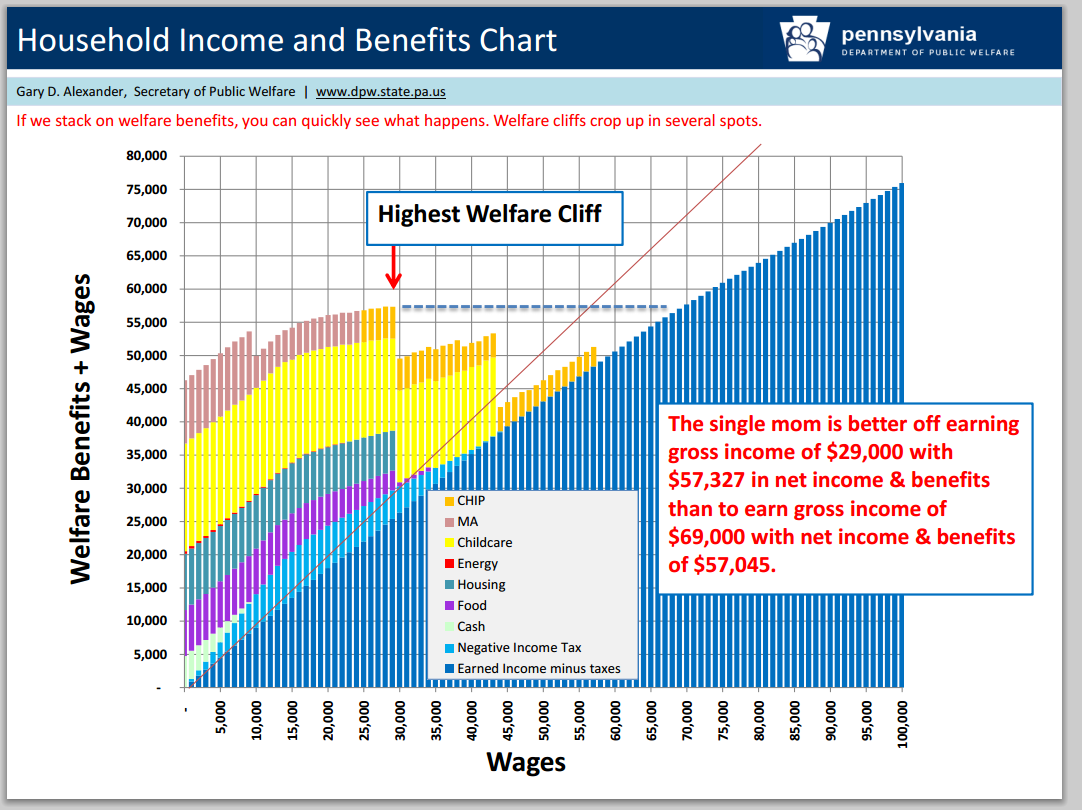
1) There is a welfare trap, and it is real. The more needy you are, the more your welfare programs are robbed with each wage increase. The marginal rate is very high and in some situations can exceed 100%.
Here's what the welfare trap looks like for low-wage families, in one graph: https://lh3.ggpht.com/-_-6Fsycanmw/ULO_5kk3fxI/AAAAAAAAAU4/y...
taken from: http://johnhcochrane.blogspot.com/2012/11/taxes-and-cliffs.h...
If you follow economics there is an astonishing difference in the quality of discourse between the two sides--the pro minimum-wage crowd does not seem aware of the data working against them.
2) There is furthermore research suggesting employers respond to minimum wage by scaling back future employment plans and by causing workers to work harder. Part of the reason minimum wage jobs are so awful is if they weren't, they would not be worth the money.
3) People think of minimum wage as a redistribution of wealth from evil corporate employers and rich consumers to the poor and needy. Notwithstanding who is evil and who is good, that is basically the effect. You can accomplish the same thing in a much simpler, market-friendly fashion: pay the poor for working. A minor version of this program exists--the earned income tax credit. It does the same thing as minimum wage--redistribution of wealth--without the overhead, without reducing workers' negotiating power, and without pricing new low-skill workers out. It can be done in a fashion that greatly reduces the welfare trap. For a while, this idea had broad bipartisan support, from Milton Friedman and Paul Krugman among others.
But now economists argue about minimum wage because it's an attractive political issue. Famously, Paul Krugman's opinion on minimum wage changes depending on who is president.
Bleh. Imagine if climate scientists or evolutionary biologists made political compromises. Worse yet, imagine if they started believing their own compromises.
4) Surveys are not of particularly high interest when it comes to discussing economics. Talking about theory, data, and consequences is a better use of time. Surveys are only social proof--backup evidence--when there is not a confident consensus.
There's a wealth of real-life evidence that shows what actually happens when the minimum wage is increased. So put away all the theories about what should happen, and look at the extensive data on what does happen.
It turns out this is a lot more complex than just "higher price of labor = lower supply of jobs". Offsetting the higher cost per hour are lower turnover, lower training costs, upgraded skill levels, higher worker productivity, and higher demand when workers spend their bigger paychecks.
Believe it or not, the data shows that modest increases in the minimum wage do not reduce employment in any significant way.
"The report reviews evidence on eleven possible adjustments to minimum-wage increases that may help to explain why the measured employment effects are so consistently small. The strongest evidence suggests that the most important channels of adjustment are: reductions in labor turnover; improvements in organizational efficiency; reductions in wages of higher earners ("wage compression"); and small price increases. Given the relatively small cost to employers of modest increases in the minimum wage, these adjustment mechanisms appear to be more than sufficient to avoid employment losses, even for employers with a large share of low-wage workers."
Of course, it's worth noting that the first two impacts listed (reductions in labor turnover; improvements in organizational efficiency) could themselves have an impact on new hires and hours worked.
Genuinely curious, I couldn't find any good metanalyses at first glance...
To most economists, it is wrong to think of the minimum wage as a tradeoff between distortionary effects, and a benefit to the workers. In particular, why do we want to benefit workers on the minimum wage? It seems that the people we really care about are people with a given (low) yearly income, and we can easily give/take benefits from them using the tax system.
To the extent that economists support a minimum wage, I assume it would be because it forms some kind of "default contract" that is less prone to cheating (e.g. promising one wage and delivering another).
Maybe because they need the money?
Have a look at the minimum wage in every developed country compared to America. Now have a look at the standard of living for the average person on the street in all those countries compared to America. You have your answer.
Comparatively, America is a developing country.
However, if all states have a 10$ minimum wage then there's no easy substitute, except for going to another country, but that's much more complex.
It looked at contiguous US states, where one raised the minimum wage and one did not. It measured the gain or loss in jobs with all these "natural experiments".
This study found minimal effects on employment when comparing the states that raised minimum wages against those that did not.
What are you referring to? It could be republicans, Black people (yes, look at a map), poverty, etc.
Rather than paying people more to flip burgers, I think it's better policy to top them off with cash and incentivize them to earn more money by getting better jobs.
The EIC is a form of Negative Income Tax that was originated by Milton Friedman. http://www.econlib.org/library/Enc1/NegativeIncomeTax.html
Adding a state-level EIC would be considerably more administratively complex for California than changing the level of the existing minimum wage -- which, even granting for the sake of argument that such an approach would be desirable ignoring administrative costs, might strongly disfavor that approach.
> The EIC is a form of Negative Income Tax
No, its not.
The EIC is a means-tested social welfare program that has a benefit curve inconsistent with a negative income tax (particularly, it has ranges where more qualifying income increases the beneft, and ranges where it decreases the benefit, whereas the subsidy from a negative income tax is strictly non-increasing with additional income.)
It will be something around $0.70 less than that, comparing 2013 dollars to 2016 dollars.