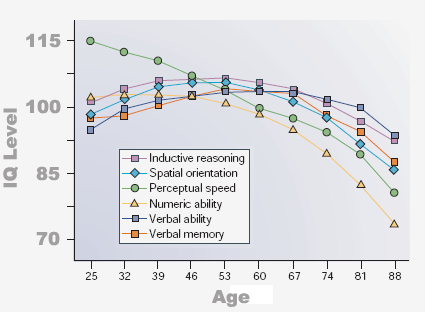
I feel like I've become significantly less intelligent over time, and I can't figure out if that's really the case, or if it's a different issue that simply makes me feel less intelligent.
When I was in high school, everything I learned was simple -- everything was a piece of cake. I would program my TI calculator (with a list of assembly opcodes next to me) at the back of the class and basically ignore the lesson and then get the highest grade on every test. Same in chemistry. Every standardized test I took (SAT, ACT, etc.) gave results in the 99th percentile. Same with the AMC and AIME. I graduated 1/200 in my class. I had all kinds of interesting programming projects in my free time from age 12 to 18.
Then I went to college: a STEM school. The first semester went fine; I got all A's. The second semester, I got my first B ever. The third semester, more B's. Eventually a C. My final GPA ended up being 3.5, significantly lower than anything I had been used to. I couldn't stay awake during lessons in class. I was sleepy all the time despite getting good sleep (8-9 hours) every night. I never skipped class, but I may as well have considering how sleepy and groggy as I was. This had never been an issue in high school. I don't ever remember getting sleepy in class then, even if the lecture was boring.
Suddenly, new subjects became incomprehensible. The ease at which I previously absorbed new material was gone. Nothing "clicked" anymore. I'm in graduate school now and still nothing "clicks". I attend department seminars where visiting professors present their research, and it may as well be alien gibberish. I feel like I'm just faking my way through grad school at this point. I can still manage A's and B's in classes without ever understanding the content only because of the way the grading system's designed. Luckily, I seemed to have retained my programming capabilities.
I can't figure out what caused this. One option is physical: perhaps something chemically changed within my brain. Virus, physical trauma, getting older? No idea really. The other option is environmental. In high school I only had dial-up internet access, so anything I wanted to download, I had to really want. It was an all-day ordeal to get a 3 MB file. It was almost impossible to goof off online. Nowadays I get on the internet and just get distracted. I can't get into side-projects like I used to be able to. I still have the strong desire that I used to, but not the motivation. I don't know where it went; why would my personality just change for the worse like that? I almost wonder if skimming huge amounts of information online has somehow re-trained my brain to not absorb knowledge anymore.
Has this happened to anyone else? Have you figured out a way to reverse the process? I would love more than anything to have the incredible clarity with which I used to understand new subjects rather than this fuzzy, muddy feeling with everything I try to learn.
Like you I got into the habit of getting distracted online. Failing university was a sufficiently strong blow to my ego that I finally "woke up" and attempted to analyze what went wrong in my life: I came to the conclusion that my addiction to random bullshit on the internet had completely eaten my mind. The constant procrastination had eventually caused me to sink into depression, thus worsening the cycle even more. It got so bad I was unable to concentrate for more than 2 hours on the same subject. By contrast I used to read several books a week on various subjects.
I decided to drastically change my lifestyle. I cut away all non-essential internet use and went cold turkey. I forced myself to read again, at least 2 hours per day. I took on a strict diet and exercise regime. I took every opportunity to meet new people and see my friends I could find. I reduced my consumption of media (especially fiction). I practiced meditation. I distanced myself from the screen.
The point of this rambling post? It worked. I slowly but surely got back to my previous levels of intellectual involvement and curiosity about the world. I do go on Hacker News once in a while but it's an occasional small treat after I've worked hard. I'm not going to pretend to be a doctor and diagnose your life based on a single post, but I think you should at least try to do the same thing I did. At least consider cutting out the non-essential internet. You have nothing to lose. Keep in mind that it's a long term goal.
tl;dr It's possible to reverse the process
You just quit procrastinating cold-turkey though? How did you force yourself to read? Every time I pull out a textbook at a time that isn't the night before a test or HW assignment I fall asleep reading it or end up staring at the wall instead.
Meditation is an interesting idea... I've never given that a try before.
Then you move to a hard science university and slowly start realizing that you must actually work and study 8 hours a day or more just to keep up and the subject is basically a bottomless pit, there is no end of it and you could spend thousands of lifetimes studying a single subject and still feel like you are only scratching the surface. This is also where intelligence has lesser and lesser significance (almost none). You may notice that good work habits, good organization habits (anything from note taking, listening, attention to detail, to times you study, to light in your study room), and social skills (who you associate with in school is more important then intelligence) and the ability to stay motivated and inspired by your subject etc. matter way more and are a better predictor of academic success.
I had similar feeling as you (I did pure math undergrad and pure math grad school). You are not slowing down mentally, you are just getting fatigued and saturated and getting into more and more esoteric and fringe areas of your subject study. You have to know that most of those visiting professors are lone experts in esoteric razor edge thin subject and they get incredibly excited when they hear there might be another person somewhere across the globe who might have remote interest in roughly the same thing as them. That's just to give you some perspective. I'm sure when you look back at those courses you took years ago and that you thought were incredibly difficult and challenging, you find them trivially easy and boring. That means you have grown by order of magnitude.
Once you've gotten past basic calculus, you can't learn as much because all the resources are poor. Sure, you can read research papers (which are written for people who already understand 90% of them), or a PhD thesis (maybe a better option, as PhD students pad them with lots of exposition to make up the page count); but they suck compared to a well-designed undergrad text. Did you learn calculus by reading a single proof, or did you do a lot of example questions? How much are you practicing the basic techniques, or are you just saying "yeah, in principle that bit's already been done ... nothing to do there".
You also sound like you are losing motivation, and suffering a bit from "impostor syndrome", both of which are very common in grad school. You need to learn when to relax, when to push yourself, and when to just keep plugging. I find that forcing myself to relax when I'm getting distracted can "reset" my ability to focus. If you find yourself reading something that's just crap (this sentence?), look away from the monitor for as long as you can.
After I was diagnosed (which was a lucky coincidence) and started to take medicine it all reversed.
Ask your doctor. The test is a simple blood test.
Feeling like you don't get stuff in grad school could be, because you lack the foundation you should've built earlier in college.
The solution might be as simple as: Get the foundation right, learn that stuff from the first years again and learn it in such a way that you have a good understanding. And then digest grad school material the same way.
As you get more advanced and specialized in your level of education, the material gets harder and the peer group gets more focused on a narrower area or field.
Even if grading is not done on a formal curve comparing students to each other, a test aimed at graduate students' skill level is going to assume a greater level of baseline knowledge, and more facility with techniques and tools of the field. So it will take more of even a 'gifted' person's time to perform far above average at graduate school.
The sleep disruption thing is another possible explanation. Another comment mentioned sleep apnea. You might want to get that checked out.
I went in the army for a while, infantry. It did help make me feel even more stupid. I developed a different motivation toward knowledge, preferring to sharpen action oriented decision making instead of analytical thinking. Might seem odd just said like that, but placed in an environment where all that matters is making roughly good decisions quickly, all the time, does unsharpen your ability to think at length.
At that point, a couple years in the army, I thought that intelligent past I had was gone. I'd look at books I used to understand easily and feel uninterested and unable to grasps anything in it.
It went like that until I found about programming. When I saw my first line of VBA (!!) while trying to make an Excel spreadsheet, I was baffled and utterly confused. I thought I was beyond my reach, but I still tried out of necessity. And eventually more and more complex constructions of VBA came within my reach. And then I understood that my lost ability to think analytically was not lost, it was just untrained. As I realized I loved programming things, I jumped into anything related I could read. All those cryptic things became understandable, now that I had motivation.
Fast-forward three years, I think I'm now much "smarter"/able than I ever was. I also perceive that my smartness has little to do with some magical gift that fades away out of my control. It seems to have much more to do with how motivated I can be about a topic.
All that to say, you shouldn't diagnose your apparent inability to think as a consequence of you becoming more stupid. You might just be demotivated and still very able, given a little practice and warm up time.
Two suggestions:
Are you eating a healthy diet? I know from experience that its easy to let this slip at your stage in life (my guess: early/mid twenties) and poor diet made me feel tired and foggy. If you think this needs attention then you might want to take a vitamin/mineral supplement as a temporary measure while you sort it out.
Also, lifestyle. You say "I get on the internet and just get distracted" and "skimming huge amounts of information online". Try taking some time away from laptops/phones/tablets. Go outside and think with a book and some paper. Get some exercise, if you're not doing that. Get quality sleep and avoid using screens just before sleep [1]. Practice avoiding distraction [2].
Good luck.
[1] http://well.blogs.nytimes.com/2012/09/10/really-using-a-comp...
[2] In my opinion, managing distraction this is going to be the critical life skill for the next fifty years.
You're not alone.
Try regular exercise , skip the junk (food, internet,drugs) and try meditation.. If your issue is stress, those will really help.
Consult a general doctor like an internist, then a neurologist, then a psychiatrist, in that order.
This self proclaimed smart person, with heavy emphasis on the self proclaimed part (check out the incredibly smug About page) apparently needs Lyme disease to feel the plight of the oh so pitiful stupid people. News flash, half the population is dumber than average, stop acting like Lyme disease is a cute self reflection on intelligence.
I am not attacking your smartness, and please get well soon, but don't be a pretentious asshole. God. South Park's "Smug Alert!" episode perfectly encapsulates the culture of this place sometimes.
Over and out.
Intelligence can mean many things, but I like to think of it in terms of "brain power"; the amount of abstract thought you can hold and process, your brain's RAM and CPU power so to speak.
The term depression is very broad and probably encompasses numerous as-yet-undefined sub-categories, but his description is very much like my own experience: A dulling of the mind. It's like downclocking the brain's CPU and emotional coprocessor from 2Ghz to 200Mhz. Thinking became slow and required more effort, analytical capabilities pretty much went away and I didn't have the spare capacity to really enjoy anything. A song or a movie I knew I liked just didn't register because my brain wasn't capable of processing it the way it used to. Learning became uninteresting and a chore and problem solving became near impossible. In short, I felt really dumb. I knew I wasn't, but I couldn't "smarten up" however much I tried. Knowing this, not being able to enjoy learning, problem solving or experiencing something was the worst terror of depression.
The experience left me wondering about the immutability or genetic predeterminism of "intelligence". If we broadly define intelligence as "brain power", I know now that it can vary a great deal. I wonder how much of this brain power is predetermined through genetics and how much is affected by the environment. We know that diet plays a large role and that certain diseases affect the brain in this way. How much of a person's "dumbness" can be removed by changing the external factors? In addition, I think broader aspects of intelligence such as analytical abilities, memory and "abstract capacity" can be taught or improved through training. I know my own "intelligence" certainly has required lots of training through the years, not to mention the knowledge that plays a large part of it that had to be acquired.
Probably not true. What if the mean is skewed by outliers like incredibly smart people or incredibly dumb people; we could very well be living in the world where most of the people are stupid and the average is what it is because of a very few incredibly smart people.
Humorous tangent apart; I can't even imagine thinking like this so-called smart person. If I feel the problem is too easy, I am always trying to figure out harder problems to solve. So much so that I am comfortable with the feeling of being stupid and being befuddled. It merely means I am pushing myself to the edge.
P.S. Loss of intelligence is devastating. If you do not believe me, shut up and try it for yourself: tell a doctor you have frequent migraines and ask to be prescribed a drug called topiramate—stupid in a pill. Just don't come whining to me when it destroys your career and alienated your friends.
You have to work for it. Some people got help from their parents when they were young, and some didn't. Some had one day of their life the idea to learn something or train, and some didn't.
The "predetermined talents" thinking is one of the biggest myths alive.
And I wouldn't equate any of that with what it's like to have a low IQ (what is traditionally thought of as "stupidity.") IQ is a measure, basically, of how little evidence your mind needs to recognize a pattern--thus, low-IQ people being thought of as "dense," and thus sufficiently-high IQ being able to do things like deducing all of physics from a few static pictures[1]. Being dumb doesn't feel like having a bad memory, or thinking slower, or not being able to multitask. It feels like looking at a square peg and a grid of shape-holes, and not (quickly) realizing that "shape" is a relevant property that the holes differ by, such that you should select a hole based on the shape of the peg.
It should feel genuinely alienating to try to picture yourself "dumber" than you are--like that you, which you would be, is hard for you to empathize with; like they'd solve problems in entirely different ways, out of necessity for not recognizing patterns as easily. And then you can reflect that intuition to understand what it would be like to be more intelligent than you are: someone who would also solve problems in different ways, for seeing their structure more easily; and someone who would have a hard time empathizing with the decisions a version of themselves, reduced to only your intelligence, would make.
---
They really don't know what causes anxiety, or clinical depression. The are having a horrid time finding the true cause of these ailments. If anyone is seeing a MD who claims to know what causes depression and anxiety see someone else. It gotten so disappointing in the research community; very few companies are actively even looking for the root cause to these horrid diseases. So many people took these tri, and hetrocyclic drugs for depression, and if they worked--it was most likely placebo. Yes--panic attacks, and generalized anxiety respond to benzodiazepines most of the time, but hey are addictive, and no researcher who is smart would Not claim to know how they work. I wish you well.
I truly believe the best medicine is knowing you are going to get better. The placebo effect is sometimes stronger than any antibiotic. I sometimes believe the placebo effect is the only verifiable existence of God? When I am sick, I do a little research on the Internet, but have found it's better to just believe the medicine will work. Oh yea, I try to chose my doctors well--Board Certified who actually tried to keep current after years of practice.
True in spirit, but untrue definitionally. The thing is, the psychiatric profession still basically subscribes to a Behaviorist theory of mind when it comes to treating neurological problems. There's no consideration of what's going on in your head when you have a neurological malady; your head is a black box, where drugs go in, and altered behaviors sometimes come out. "Clinical depression" isn't the name of a specific thing that we know goes on in the brain (in fact, it seems to be a whole cluster of things); rather, clinical depression is "the thing which taking an SSRI usually makes lessen." When a psychiatrist says you may be clinically depressed, what they're really saying is, "you have symptoms that may be manageable by the effects of this or that drug." They have no idea whether they're treating the root cause, or just masking it, and a lot of them don't care. They just want to see your behavior alter, like a rat given a swim test.
And really, thinking of things like SSRIs as "medicine" is part of the problem. SSRIs and the like are crutches--given to you to lessen the symptoms of a problem enough for it to stop being overwhelming, so that you can actually manage to make it to the CBT-practicing therapist every day, have the energy to find the the better job to get away from your horrible boss, etc. I wrote more on this here: https://news.ycombinator.com/item?id=6347620
(P.S.: In this case, though, if I might be a bit more pedantic: I didn't say that all those maladies in my post were caused by those imbalances. I said that inducing those imbalances, in the way that Lyme disease does, will mimic the symptoms of those maladies. Clinical depression may not be "just" a serotonin imbalance--but inducing "just" a serotonin imbalance tends to produce the symptoms of clinical depression. ;)
(P.P.S.: note that I never used the word "disease" or "illness" once. See my link above--these words don't apply to things like nearsightedness, so they don't really apply to the kind of problems neurological imbalances manifest as, either.)
When it comes to depression, the primary factor isn't really a "placebo effect". It's true that most of the treatments do no better than a fake pill, but they also do no better than doing nothing at all and just waiting.
Moods have cycles. You tend to go to the doctor for treatment when your mood is UNUSUALLY BAD. Some random time later, you'll probably feel a lot better. Maybe the seasons will change and you'll get more sunlight, or things will get better at work, or just...random fluctuation.
If at your MOST DEPRESSED you go see a doctor who believes in treating depression with pills, he'll assign treatment A. You try that a while; it doesn't help. So he has you switch to treatment B. Still depressed. Treatment C. Now you start to feel better. A believer in medicine takes that to mean "Drugs A and B don't work for you, but C cured your depression!" But you were certain to be taking SOMETHING when you got better, so maybe it's just a coincidence that you were taking C at the time that happened.
...they'd solve problems in entirely different ways, out of necessity for not recognizing patterns as easily. And then you can reflect that intuition to understand what it would be like to be more intelligent than you are: someone who would also solve problems in different ways, for seeing their structure more easily...
Let me unpack this a bit; it annoys me to end that every person depending on his/her coterie ( think technology coteries, humanities coteries, political/legal coteries etc) seems to nourish his/her own definition of what intelligence is and how - if at all - it can be measured and quantified on a nice linear scale.
Surely we all agree that such a definition and quantification is useful. I hope that is not up to debate. Only the most hyper egalitarians, insisting on the absolute equality of social statuses of all humans, would refute the utility of such quantification.
For instance, most learned, secular and urbane people do not think twice before frowning on religious zealots. Their views and outlook of the world seem like they belong in the stone-age. Whatever their scriptures say or hold, a religious devotee has to suspend the most basic premises of logic and reason to be able to subscribe utterly risible notions of how one ought to conduct his or her life based on preposterous doctrines.
In essence they almost invariably have to belong to a lower order of intelligence (if you set aside the atypical cases of candidates who are esteemed scholars, scientists and technologists, who are nevertheless fervently religious, of whom we can be sure there are more than a handful).
Surely we should be able to define - using certain parameters whatever those are - and quantify this "lower order of intelligence" in an objective manner.
After all we just cannot describe their quantum of intelligence through purely the notions - as moronic those notions might be - they subscribe to. There has to be an objective assessment.
Since such a quantification is useful - for purposes of classification or otherwise - what then is the most current (more or less universal) consensus on the measure of intelligence?
Obversely, when defining stupidity, is there no single measure that more or less captures "the congenital lack of capacity for reasoning"? [1]
But I think, in your comment, what you're doing is conflating intelligence with rationality. Raw intelligence doesn't help you to notice when you have an ingrained-but-senseless belief (thus predicting precisely your "candidates who are esteemed scholars, scientists and technologists, who are nevertheless fervently religious".) One of the primary properties of modern religion is its non-falsifiability -- it makes no predictions about your everyday experience you could keep track of to form a sense of "how it's doing." Because of this, a religion can sit comfortably in your mind alongside everything else you "know", and no piece of evidence you run into will ever rub up against it and wear it away.
Noticing that you have beliefs that aren't causally attached to the rest of your experience is a skill which you have to learn explicitly. This set of skills (instrumental rationality) together are a multiplier for the productive output of your intelligence, but they don't make you any more or less intelligent. Really intelligent people might come up with these skills on their own, as meta-patterns that seem to hold between pattern in different disciplines, but most anyone can learn to be more instrumentally rational by being trained in these skills by someone else. You can't learn to be more intelligent. (Though good sleep, exercise, and stimulant drugs all seem to help... at least according to IQ tests.)
I might go out on a limb at this point and suggest that defining religious people as stupid is not particularly helpful, even operating from your own assumptions as stated in your own definition. Some intelligent people might happen to disagree with your assumptions as well, but I'll leave that argument as well outside the normally appreciated scope of HN discussion.
Lyme disease does not 'make you stupid', but it can make you very ill. One of the possible symptoms is depression, memory loss is another so the symptoms the author describes are very much in the realm of the possible.
If you're ever bitten by a tick and you see a bulls-eye pattern around the bite get yourself to a doctor and make sure you are prescribed anti-biotics right away, do not wait (for instance until your holiday is over). I can't emphasize this enough. I don't like anti-biotics for many reasons when they are used without a good reason but Lyme disease is no picnic and the earlier you deal with it the better your chances of complete recovery. Wait too long and you're in for a world of trouble, in case you think I'm exaggerating please read the wikipedia page on Lyme disease or have a chat with my brother in law whose life is pretty much determined by Lyme in a very advanced stage.
If I get an unexplained rash with flu-like symptoms, even if I don't see a tick, I'm taking antibiotics just in case. Better safe than sorry.
Yes, that's the right attitude to take with this disease. The main criterium is that you've been in or are in a region where ticks are found, combined with warm/hot weather.
Areas to avoid: long grass, shrub and forests.
He was on three weeks of antibiotics and the rash s-l-o-w-l-y disappeared over that time. He has no obvious ill effects thus far.
More likely, what you experienced was anhedonia, a symptom of certain types of depression. Anhedonia is technically defined as the inability to experience pleasure from once-enjoyable activities, but those I know who've suffered from it have often described it in terms very similar to yours. They say things like "I just didn't care about anything," or "it was like I was bored of being bored, but too bored to do anything about it."
To simplify depression -- a neurologically and idiosyncratically complex phenomenon -- as the "absence of emotion" is to mischaracterize the affliction. There are other shades of depression in which emotion is, if anything, severely heightened and labile. Pure, raw, unfiltered anguish. The absolute lack of hope. Like the shit they talk about in the Harry Potter books, when the dementors suck out your soul (incidentally, Harry Potter author J.K. Rowling battled with severe depression, and she modeled said dementors off of the suffering she went through).
It's a shit disease.
I get so tired of seeing this. We can't even really define intelligence but I'm guessing this is based on a previous assumption that IQ was static, which we now know it not to be. We need to remember, also, that IQ is not a measure of intelligence.
I'm not sure if those two belong in the same sentence. If we were to come up with a point system that measured beauty in women, for example, you could measure pronouncement of cheekbones and thickness of lips, etc. While Angelina Jolie would score well, so would Jocelyn Wildenstein, and Emma Watson would score poorly. Such a system might have "some predictive power" for large population sizes, but could never measure "beauty".
Intelligence is qualitative, like beauty, not quantitative, and therefore could never be expressed individually as a number. We would do well to bear that in mind.
Makes the whole piece pretty condescending.
I've been diagnosed with major depressive disorder, generalized anxiety disorder, panic disorder, ADHD-Inattentive type, and probably other things that I can't remember right now. I think most of these diagnoses (panic disorder being the only viscerally clear one) are to explain the disparity between my IQ scores throughout the years and my lack of performance in school and life in general. Which, by the way, I know is the dead-horse of tropes for internet comments...
As a result of these diagnoses I've taken several classes of medications and several instances within each class.
SSRI/(S)NRIs: Prozac, Cymbalta, Lexapro, Wellbutrin, Strattera, probably others
Stimulants: Adderall (XR), Ritalin
Benzodiazepines: Klonopin, Xanax, Ativan
Weird hypnotic sleep drugs: Ambien, Lunesta
I feel like there is a very complex matrix of factors that have contributed to the way I am now (I used to be a pretty normal, social, outgoing, intelligent, excited kid who got bad grades, now I'm kind of a weird dude) and I can't determine the cause. If the cause is depression, I'd like to take the right medication to help with that. If the cause is medication, I'd like to stop taking medication. If this 'slowing down' feeling is something other people my age (25) feel, then maybe I don't need to make a big deal about it. The way the author described his neurotypical self reminds me of who I was 13 years ago before that first diagnosis and that first prescription. I want to feel that clarity again.
Right now I feel like I'm brute-forcing through life. And it's working. But I feel about 1/10th the joy/passion I had when I was a kid. Which is a symptom of depression. So I take drugs. That make me feel slow, and prevent me from being deeply depressed. Which might not even happen. I am stuck in a strange loop, but slowly mining my way out.
Some relevant links on all that: http://www.highiqpro.com/wp-content/uploads/2012/03/cognitiv... http://www.brainhealthhacks.com/wp-content/uploads/2011/01/f... http://qph.is.quoracdn.net/main-qimg-fd832e64253819688a4eaaa...
There's also work on reversing cognitive decline with stem cell therapies: http://www.impactaging.com/papers/v4/n3/full/100446.html
These drugs make people stupid.
It is.
> not going to make fun of it.
Thank you for that. Lyme is a very easy to contract disease depending on where you live and the progressive symptoms are devastating.
I found this helpful for ignorant folks like me http://www.cdc.gov/lyme/faq/
EDIT: Yes, I should ask a doctor, but given the medical situation where I live, it is quite hard to get good advice.
I'm a linux sysadmin in a 24/7 data processing/medical environment. Last november, I fell off my bike, without a helmet on. (I was on paved paths on a college campus during a football game; if I had been playing in traffic or moving quickly, I would've been wearing a helmet. However, I was moving at walking pace and SOMEHOW went over my handlebars. I have no memory of the accident.) I received a closed head injury, cervical spine injury, and had bleeding on the brain, and was borderline for concussion. I spent the night in the critical care unit and they wouldn't let me sleep. It was a pretty serious injury and I was on painkillers due to migraines for years.
For several months, I tried my hardest to do my job. But I didn't "grok" things. I couldn't code in the languages I'd known since the late 90s. I couldn't learn new things -- learning Ruby, even with the help of codecademy, was epic fail. I'd go through the classes and put any old thing in to make it work (thinking it wouldn't), and get 100% without understanding WHY it worked. I couldn't keep up with technology and wasn't reading HN and the other news sources I normally keep up with.
Eight months after the injury, I suddenly understood my first languages again. Another month after that, I could learn new things, and picked up Ruby and Chef inside of a week.
The worst part of it is that I didn't know that I was stupid. I thought I wasn't trying hard enough, and I pushed myself into feeling horrible about the whole thing.
The entire experience has given me a lot of sympathy for people who say that they can't do something because it doesn't feel understandable to them, even after they've been shown and guided through it.
I meant "months". Obviously, not everything's back where it should be. (And this is the truth. After my injury, my brain is not the same tool it used to be. I troubleshoot in the reverse order I used to. I skip items in checklists that I remember reading clearly and damned well know are there. Even though most things came back without much struggle, I'm having to re-learn certain small things that used to be second nature.)
Wear your helmets, kids.
To my layman understanding of psychology, and especially what intelligence research has been uncovering over the last few decades, the exact opposite is the case: - intelligence is far from an immutable trait - we do a lot to influence our own intelligence (perhaps far more than we realize, since much of what we do is due to implicit socialization/upbringing)
If you're going to use an analogy to a physical characteristic, than I'd suggest using weight not height: yes there are relevant genetic traits, but they're only a fraction of the story.
Waldo's trying to describe a state of being. You can argue about whether Waldo really knows what long term depression is really like, but that's separate from learning what it feels like to experience a set of symptoms which he has never previously fallen victim to.
He's not claiming to be an authority or an expert, or to even claim that this some how makes him special. He's claiming that he understands depression better now, having experienced it.
We should all hope that Waldo feels better soon. He is anything but stupid.
By the end of the first day I felt a general malaise. By the end of the second day I was feeling something I've never felt before, or since. Everything, and I mean everything in life seemed without value or purpose. The only thing that kept me functioning and not immobilized as a curled up ball in bed were the expectations of my family and job (which was also for family). Even so, I could tell I wouldn't be able to keep that up much longer.
When I come home, my two young daughters would run up and want to talk to me. While I admit, I sometimes lose patience for them when I'm tired, in this case I patiently let them explain what had happened so far that day, but the entire time, without exception, I could only think about how I wanted this to be over so I could sit down and do... what? Nothing seemed worthwhile. No TV, no book, no computer. I realized I might as well go lay down on the bed. My goals and ambitions were also gone. I didn't want to work, I just wanted to be left alone.
I lasted another day on Mucinex before I decided this was definitely not healthy, regardless of how much less phlegm I had to deal with, and stopped taking it. I felt normal (if stuffy) within a day or two.
I'm not saying this is the same as depression, I really have no basis for knowing. All I know is that if that's what people that are depressed feel like, I feel very, very sorry (and terrified) for them. The idea of the ramifications if that lasted long term are horrendous. If I survived it long term, I'm fairly certain it would be at the cost of ruining my life.
Interestingly, a friend of mine said he had a similar experience with Mucinex DM a few months later. I didn't get into the details with him though (although I had already described my experience before). It seemed too personal to ask for more detail, considering my own experience.
Back when I was younger I got Lyme disease at the age of 13. I got treated for it by some quack without antibiotics and then went on with my life - essentially untreated. Between the ages of 14 and 17 I have barely any memories. There are snippets of events that I can recall in my memory, but in total they must be less than 20 snippets over the course of 3 years of my life. If I try my very best to go back to other moments in there, there is nothing, kind of like after having had a few too many drinks and being unable to remember how you got home, but then having that feeling for about 3 years of your life.
Much like stated in the post, your memory is affected by Lyme disease. You actually still have the capacity to think complete thoughts, but after only a few seconds your thoughts are gone.
One of the few snippets of memory that I have left, is the sudden strong realisation that I tried my very best to remember what had happened in the last 7 days - and the complete and utter inability to recall even one single event over those 7 days. I wasn't even able to remember what I ate for lunch 3 hours earlier, or what I had been doing for the previous 5 minutes. I remember getting really upset that I felt that that memory was also fading and I kept on repeating it in my head to prevent it from disappearing. It was scary.
I am apparently fortunate enough to continue functioning well after Lyme disease, but I can guarantee you that the experience being written in this post is absolutely identical to the experience that I had.
It's bizarre, it's scary, but fortunately for Waldo: he won't remember a thing anyway.
But man such a strange feeling. Depression was a first for me i don't know if its from the toxins that inhibit certain stuff or psychological but its strange. Anyway get well soon and don't believe the lyme stuff you read I can assure you. You reach 100%. Just don't have unprotected sex as that shit is real depression material !
If you find yourself frequently outside where ticks are prevalent, invest in a permethrin based repellent that can be applied to your clothing. Ensure that you wear pants and long sleeve shirts whenever possible. I've been using a permethrin based clothing spray for years and have not found a single tick on me in that time. I can personally recommend this brand: http://www.sawyer.com/permFAQ.html
The described experience makes it hard to distinguish between reduced intelligence as such, versus disbalances in motivational/emotional systems that affect what you[r brain] choose to do, instead of the ability of what you can do. Both can be limiting, but in very different ways.
The main symptom for me is the continual feeling of pressure in the back of the head, and a bit of tenderness over the greater occipital nerves. I can still program somewhat effectively, but my short term memory is horrible, and quick-thinking is down the tubes. It's fairly similar to a mild/moderate hangover.
I would not say that I am dumb or truly have the same experience as someone of low IQ, but the whole experience has instilled a bit of resentment towards the Silicon Valley mindset that every dev must be a quick-thinking, 10x wiz kid. I am not an A-player at this point, but by putting in a few extra hours a week I can keep up with the devs on my team, and I try to make sure my output is somewhat on par.
Fortunately, botox has made a tremendous impact (takes pressure off the nerves), and I'm getting surgery soon so fingers crossed I can make a solid recovery.
In much the same way, I lost the use of my dominant arm for several months during graduate school. I always had respect for those with lifelong physical disabilities, but the insight I gained during that period resulted in even more respect. During that period I had one really supportive professor. But, I also had a second professor that I wanted to do much violence to - simply so that he might gain much needed insight. Since I graduated, the second professor has tried to get me to collaborate with him and I refuse to primarily because of his lack of basic respect for others' abilities (both disabilities and capabilities that exceed his own understanding).
Thanks to Waldo for sharing his being Charlie Gordon. I hope he recovers.
I would also seek a second opinion from a neurologist if you have not already. If you feel that you have cognitive impairment now, then the neurologist may feel that a brain MRI is indicated. This may not affect management, but may provide you with prognostic information.
The symptoms sound pretty bad if untreated. Good to know more about it to pay attention while traveling, these endemic diseases are often hard to diagnose.
We're all dumb. Lymes just made you dumber.