http://www.thepowerbase.com/2012/11/android-community-demand...
If you thought some of Samsung's early Android phones were too close to copying the iPhone, you've seen nothing. Xiaomi phones blatantly rip off design of other manufactures, especially Apple. They are not even coy about it.
http://www.nytimes.com/2013/06/05/business/global/in-china-a...
As far as the OSS comunity goes, this is probably a career limiting move by Barra right here.
http://www.nytimes.com/2013/06/05/business/global/in-china-a... .
That's NOT what the linked article says at all. It says the the founder, Lei Jun, is is positioning himself and his company as figurative heirs of Mr. Jobs by carefully cultivating a Jobsian image here, right down to his jeans and dark shirts.
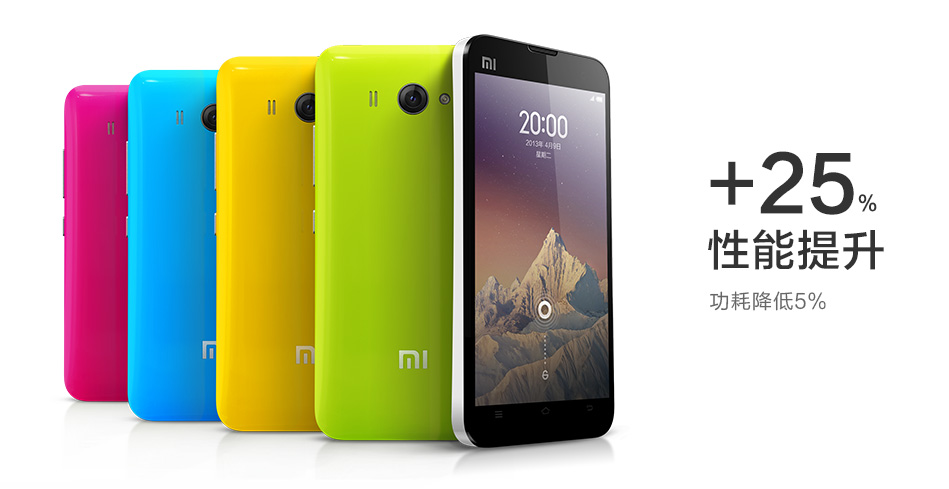
It does say He is also selling millions of mobile phones that look a lot like iPhones, but they only look like iPhones in the sense they have rounded corners. If you look at a pic of a phone (eg http://p.www.xiaomi.com/zt/130718/images/m2s_26.jpg?130809) you'll see they are a lot less similar than many phones sold today - specifically the two-color shell makes it immediately obvious they aren't a complete iPhone clone.
http://www.trustedreviews.com/news/budget-iphone-5c-release-...
Yet not even about Android or the mobile market in general, a comment about the feeling of OSS community gets voted to top...
So, as this balance of power shifts to Asia, it's going to be Android that reaps the benefits, not other platforms. Of course, it remains to be seen to what extent Google also benefits from this but at least they will have accomplished their goal of preventing a single company from locking down mobile and boxing their services out of that platform.
isn't that what they're supposed to be doing?
we should at least see how this plays out, maybe he'll quit in a fit of rage because they won't listen to him. who knows.
During the course of the meeting, it was my client that was kissing butt for a shot at getting some business in the Chinese market, and would pay this Chinese company for the privilege.
At the end of the meeting, my client quipped "don't spend too much [money here]" to which the Chinese visitor responded, "I'm Chinese, of course I spend too much."
The whole meeting was definitely a wake-up call for me, especially after hearing what came from a Chinese national in their early 20's.
EDIT: I will also note that things weren't all roses for the Chinese company trying to operate in a capitalistic fashion. There is a lot of (probably justified) paranoia that the Chinese government would come knocking and severely interrupt their business.
Stories like this represent a global shift of power, financial resource, and more importantly, talent.
is just plain wrong. If you it makes you feel any better, you're not the only one around here that makes those kinds of emo analysis.
GPL license simply does NOT work in China for two reasons. 1)IP protection is sadly ineffective due to the impaired legal system. In practice, GPL=Appache in China. 2) Consumers hate to pay for pure services without goods delivered due to misconceptions from long lasting low cost of human labor. In practice, free full version software plus charging for premium human support does not work.
These two things are changing slowly but any one interested in China market should never ignore them, especially the 2nd one. Xiaomi will be sued outside China if they violate the GPL license. That's a risk they can't ignore.
About Link #2: For a lot of overseas Chinese like me, NYTimes is notorious for holding biased views towards China. This actually undermines its credibility compared with less biased media like BBC.
I bought a Xiaomi phone for my father recently and I've been Samsung and Apple client for a long time.
IMO, Xiaomi has done a very impressive job to improve Android OS for non-geek people. One of those nice built-in features is seamless fine grain privacy/access control of each app. Another is built-in 3G traffic optimization and metering which is important because 3G data plans provide smaller quotas in China.
Xiaomi brings a lot of merits from IOS to Android not by simply copying designs. They did a good job to solve the pain points for their audiences, who are mostly first time smartphone users. They mainly compete with feature phone vendors other than Samsung or Apple before Xiaomi gains huge traction.
My father was very glad to switch to Xiaomi after my several failed attempts of replacing his beloved feature phone :)
Even I myself plan to buy a Xiaomi to replace my buggy Samsung S3 (never-rooted, less than 1 year) if it's going to release a high-end model.
Here is the original Xiaomi phone
It's iPhone copycat because obviously it has Round CornersⒸ.
There are tons of MIUI roms out there available for download, try it yourself and see if you can find iOS there.
So you did want to get all anti-chinese here. Your statement would have been just as valid without the 'chinese' qualification.
If you look at my comment history, you'll see that I'm highly critical of US companies' attitude toward privacy, but it's naive to think that the same thing isn't happening in China.
I have several friends who have lived/worked in China, and I always hear very conflicted reports. On one hand, that there are plenty of smart, capable people, that the tech industry is booming, that it's well on its way to displace {Silicon Valley|USA|etc.}.
On the other hand, I also hear that it's impossible to do business without running into corrupt organizations/officials, that ruthless copying is celebrated more than true innovation, and so on.
Would love to hear more takes on the topic.
What you heard is all true, and those are actually not really conflicting point of views. The situation in China is very unique and cannot be fully explained without going on and on about the culture and its current political/economical climate.
A few points to note though: Tech people there are smart, educated, and very, very hard working. However the number one thing they all value is "efficiency", or rather: "the efficiency of getting things done". I've talked to people from Tencent, and one guy laughed at American companies approach of writing good, scalable, maintainable but very often over-engineered code. Over at Tencent they very often do whatever it takes to be first to market, and if needed to be, refactor everything 6 months down the road, and rinse wash repeat. It's the only approach that works for them in a hugely competitive market (also the largest one in the world). Company management wouldn't tolerate coding practices that very often serves no purpose other than to stroke the ego of senior software architects.
One may argue the merits of that approach, but if you look at how well services like Weibo, QQ, and Taobao scale (I think Taobao handled the largest E-commerce single-day-ordering in the world last year without having any major problems), it obviously works just as well as the western approach.
So an extension to this mentality is that whatever method it takes to get things done is the best and most celebrated method. Even if it includes brutal copying of a competitor's business model, or bribery of a government official, or direct corporate espionage being employed. The Art of War never mentioned any code of business conduct.
I have a hypothesis that a hardworking American engineering with a super-competitive dog-eats-dog Wall Street mentality may do very well in China, or even enjoy it, but I would never go there with any sort of idealistic vision of an "utopia".
Things happen there happen very fast, and a lot of money flows around very quickly, countless opportunities come and go on a daily basis. It's an amazing place that can make and crush people in the blink of an eye, so in the end, it's really up to what kind of person you are and what kind of lifestyle you want to pursue.
Would have liked to get the chance to meet your father, sadly I'm leaving Nanjing on Saturday.
I can not say this for China Unicoms WoStore App/SDK or BesTV. But I personally know that both of the later two things are made by low paid workers. I think that is still one of the reasons why they can make just a rewrite/refactor because salaries are low and working time is super high. But this will not be possible anymore as salaries are rising especially in Shanghai.
The big problem with chinese entrepreneurs is that they dont understand or like they idea or serial entrepreneurship. To sell or merge with another company is considered for your company to have failed not a successful exit. They dont care about having lots of money but having the power of being the CEO of a major corporation that is listed on some stock exchange, they will do anything to get listed even if they dont need the money and know that the stock will tank as soon as the IPO opens. What ends up happening is there are tons of great small tech companies but no giants because the small companies refuse to merge together to compete with giants like google and microsoft. Only giants like tencent and baidu who have become chinese giants on their own can compete globally. This is the big reason why there are few hardware giants coming out of china, there are tons of small hardware companies like xiaomi that refuse to sell their patents and IP and eventually die taking their tech with them. Xiaomi is extremely popular in china and their phones are quite good for the price, they are serious competition for google, samsung and apple in china.
Hope my limited English skills delivered a more macro perspective for you.
From what I hear, starting a company takes about 6 months of pain, but once that's over and you are capitalized with 100k RMB, you get a pretty guaranteed Z visa, so once you get started, it goes fairly smoothly.
However, my personal feeling is that there are two kinds of opportunity in China. The first is the expat market, also companies wanting to expand to China. This is large enough to be comfortable (at least in Beijing). The second is the larger Chinese market, which is where everyone starts seeing money trees. My opinion is that the "opportunity" in the Chinese market only exists for those who are functionally fluent in Chinese, have a solid grasp of the culture, why people do the things they do, what motivates them. This would mostly be local Chinese, or American-born Chinese (or equivalent) with parents from China or Taiwan. A white expat has a nice market in other expats, but Chinese values and habits and their expression is very different from what white expats' default thinking is.
And then, of course, there's the issue that if you upset any apple carts with "disruptive" startups, the owners of the apple carts might exercise some of their guanxi, which means you'd better have some stronger guanxi. You can imagine how good the guanxi-fu of foreigners is.
The thing is that the startup situation here (at least in Shanghai) is actually really good. College students are encouraged to go for their own companies. There're many policies to give benefit for this, like cheap office rent, lower tax rate and many thing else. Investment are relatively easy to get, according to my knowledge. The startup scene (can't find a word to describe this) is also very active. People have these and that kinds of meetups. Many chances of exposure are also available and really accessible, like "Starup Competition" (basically people go there and introduce their products and then most people get a medal), magazine/video exposures are also there. Personally I think it is quite good. The focus starts to move to mobile gaming and mobile apps and such.
I just want to say that the environment is quite good. It's not what most people imaging that government and large companies come and harass you everyday. It's just a successful startup is equally hard, as anywhere in the world.
Xiaomi is a Chinese company... plenty of xenophobic, insightful, or whatever comments to cover that topic in this thread.
The story sort of hints that Barra's girlfriend was either poached by or traded-up for Sergey Brin (forgive my language, it's terribly sexist... but that little tidbit in the middle of this article is not there by accident and kinda paints that picture). Who knows? I don't... and other than being an interesting HR case study who cares?
What's completely missing from this article is how Barra impacted Android? I've seen him at I/O. Ok? So what else? He's a quick riser... must have done something... but what? What's not going to get done w/ Android now that Barra is not at Google? Perhaps that kind of information will be forthcoming.
EDIT: Spelling, grammar
I don't know if leaving google is news anymore. The average google employee only stays just over a year before moving on to something else.
http://www.bloomberg.com/news/2013-07-29/why-are-google-empl...
http://www.huffingtonpost.com/2013/07/24/least-loyal-employe...
PS: The real number you want when comparing working conditions is turnover and even that get's influenced by rapid growth.
Its ..
>>The median employee tenure at Google is just more than one year, according to the payroll consultancy PayScale.
"Brin and Wojcicki, both 40 years old, had been married for six years and have two children. They are not yet legally separated.
The possibility of a reconciliation of the pair is unclear, since Brin has become romantically involved with a Google employee, according to sources. This is further complicated by the fact that that employee had also at one point been involved with another Googler."
[1][1] http://allthingsd.com/20130828/google-co-founder-sergey-brin...
In general product management does what you might think of "brand management" and "design language" so if Android needed roundier iconography I expect Barra was the guy to sign off on that, or if Samsung was getting too aggressive in making it a "Galaxy" phone instead of an "Android" phone he might get involved in that. I don't have inside knowledge, its just the kinds of things that role does in tech companies. That is why I wouldn't expect to see any sort of explicit impact statements wrt to Android. Rubin leaving on the other hand suggested that Android was going to become less the lede and more the flavor. Google has spent a lot of effort on making "Chrome" a more inclusive brand than Android which I find fascinating from a strategy perspective.
While it's possible some product managers have done that, they don't typically get involved in minutiae like that. Product Managers at Google are more business focused, figuring out what the teams should focus on and keeping them pointed in the right direction based on the market and feedback from their customers + users.
NOTE: Nexus 7 2013 recently had GPS and touch problem and required another OS update to fix them. In fact, Nexus phones never had good product quality ever since Nexus One.
Yeah... no.
Nexus 4 is built by LG, and a $249 price looks plausible without losing money. If you can identify one phone that did the most to push carriers to providing reasonably priced month-to-month plans with no overages it would be Nexus 4.
There is plenty to criticize about Android branding, OEM relations, and the Nexus program trying to take on too many issues at once, etc. But the products themselves don't seem to be the problem.
Regarding Nexus product quality, it is well known problematic. I never saw any Nexus phone with good camera, battery life, wireless reception. The customer service is problematic at best. These problems existed ever since Nexus One.
It seems that is their plan. Release a phone that doesn't gouge the customer on price, then lower the price a few months before the next release.
Whoa. Doesn't that seems like weirdly intimate details that really didn't need to be mentioned in a published article?
Plus, gossip sells.
But if he left because of an uncomfortable personal situation, then that is highly relevant to onlookers, because it removes unwarranted questions about the state of Android at Google.
And if the suggestion is that perhaps personal issues nevertheless were a factor, then they still could have done without most of that gossipy detail.
It's distasteful, no excuses.
It's interesting to me that they hired Mr. Barra away from Google. Perhaps he already had a working relationship with people at Xiaomi?
Welcome to Beijing, Hugo!
Who knows why he chose to come here? This is quite a personal decision.
I hope most of it isn't true.
how it succeed? it has a miui os, it is 10% owned by qualcomm,made them get cheapest and newest chip, and it's pure sales is online, which made it a huge treat to other mobile phone maufactor.