And it took them to the Moon.
"This display does not place a particularly heavy load on the computer, but when added to the existing load, was sufficient to generate the 1202 alarm."
---
"102:38:26 Armstrong: (With the slightest touch of urgency) Program Alarm.
102:38:28 Duke: It's looking good to us. Over.
102:38:30 Armstrong: (To Houston) It's a 1202.
102:38:32 Aldrin: 1202. (Pause)"
http://www.dailykos.com/story/2012/08/25/1124164/-Neil-Armst...
---
"102:36:18 Armstrong: (To Houston) Our position checks down range show us to be a little long.
102:36:21 Duke: Roger. Copy. (Heavy Static)
[In a post-mission analysis, Apollo Descent and Ascent Trajectories, Floyd Bennett notes that, at PDI, Eagle was about 3 miles farther downrange than planned, due to [..]"
->
... after that, Armstrong selected a landing site visually, and landed the lunar module manually. :)
[Mission Control] Thirty seconds. (Just Mission Control telling Neil Armstrong how many seconds of fuel he has left for landing) :)
Browsing through the Apollo 13 "spacelog", it's interesting how a lot of the lines in the Apollo 13 movie are very similar to the ones in real life.
Nowadays, we don't have price tags on anything anymore. Prices are fetched from a database using the UPC as a key, so if the computer's down, the buyer is out of luck. At a previous employer, we sold specialty goods to contractors, so we had strong relationships with our customers. I drafted a plan to print up pads of paper sale forms that looked more or less like our (80x24 greenscreen) order screens, so if we lost connection to the mainframe, we could still move product from the warehouse to the customers; we'd just give them the product and bill 'em later. It was a risky move, but not really any riskier than sending our customers across the street to our competitors. To my knowledge, they've never had to use the manual system, thankfully.
We may not be "completely dependent on computers" just yet, but we seem to be getting there.
The LEM software was supposed to be capable of a fully automatic landing, but none of the astronauts rode it all the way down.
David Mindell's book "Digital Apollo" goes into these systems, and their development, in much detail; the discussion of the LEM user interface is in chapter 8.
After some minor conversion, the Atmega/Arduino has almost exactly same storage space and RAM. Only, the Arduino clocks at 16MHz. Still, awesome regardless.
So I think I've some idea how the AGC operated.
If I was going to the moon today and had the choice of flight computers. Hands down, I would choose the Apollo 11 AGC over an iPhone A6 processor based system.
On my long term list of things to-do is get back into electronics and learn Ada (mostly because it's a million miles away from PHP).
Try implementing Unix utilities (cat, ls, echo) in it for a weekend of fun. :)
Looking at Ada I see a lot of similarities, it looks like "home" to me.
Emulation was always popular, and it is a type of virtualization. Few people wanted to emulate the same platform they already had. Pure software emulators were pretty slow in the 1980's, unless the target platform had the same cpu as the host.
My family had an Amiga and we had both a bridge board and an A-Max. The bridge board was a full PC on an expansion card, so its not really a VM. The A-Max was more like a VM. Its hardware contained the Apple ROMs and a floppy disk interface because the Amiga floppy drive could not read Mac disks. The software used the ROMs and Apple floppy drive to emulate a Mac.
Now that I think about it, I think the real reason was ram and to a lesser degree hard drive space. My first encounter with virtualization in Linux happened when most people were running between 8 and 64mb of ram. 64mb of ram was very expensive. That's a pretty big constraint.
http://www.amazon.com/The-Apollo-Guidance-Computer-Architect...
John Pultorak built a Block I AGC (think "version 1") and provides all of his work in the Public Domain here:
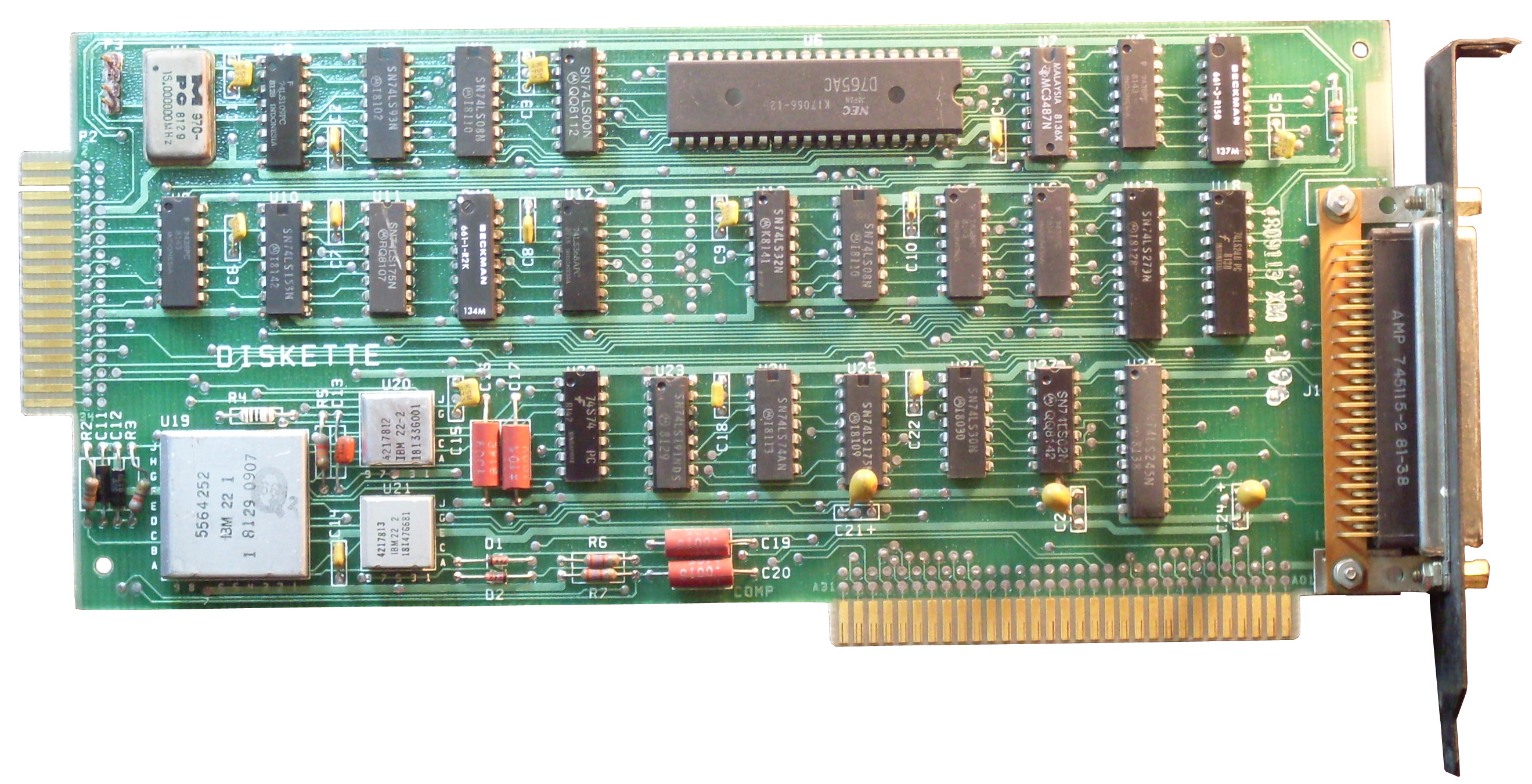
I recently got ahold of my PC from storage again and when I opened it up I was surprised that the floppy drive uses up one of the five 8-bit ISA slots, even though it has very few simple chips. (The XT has 8 slots.)
(Pic of the floppy controller. http://upload.wikimedia.org/wikipedia/commons/a/a6/IBM_PC_Or... )
"Another significant improvement included the addition of extra "brain power" to allow the orbiters to perform more complex functions. Viking orbiters possessed two 4096-word, general-purpose computers that could operate in parallel or tandem modes. These replaced the small special purpose computers contained in Mariners 8 and 9. The capability for more rapid picture taking allowed for better site surveys and special regional studies. This capability was augmented by tape recorder systems that could store 2.112 megabits per second, with a capacity of 55 TV pictures-over half a billion bits of information."
Think of the original Sinclair ZX81 with 1K of RAM and 8K ROM. Swap out the Z80 for a 6502 to get approximately the same register count. Without a screen to worry about (it took up too much RAM + CPU time) and you could do a lot, e.g. 1K chess or, as the adverts said, run a nucular power station with it. You could also service I/O with hardware interrupts.
Half of 1 MHz is 500 KHz not 500 Hz ... it may sound slow but the PIC uCs we were using in the '90s were clocked at 20 MHz maximum and executed about 4 MIPS. For the 1960s, that computer really was rocket science!