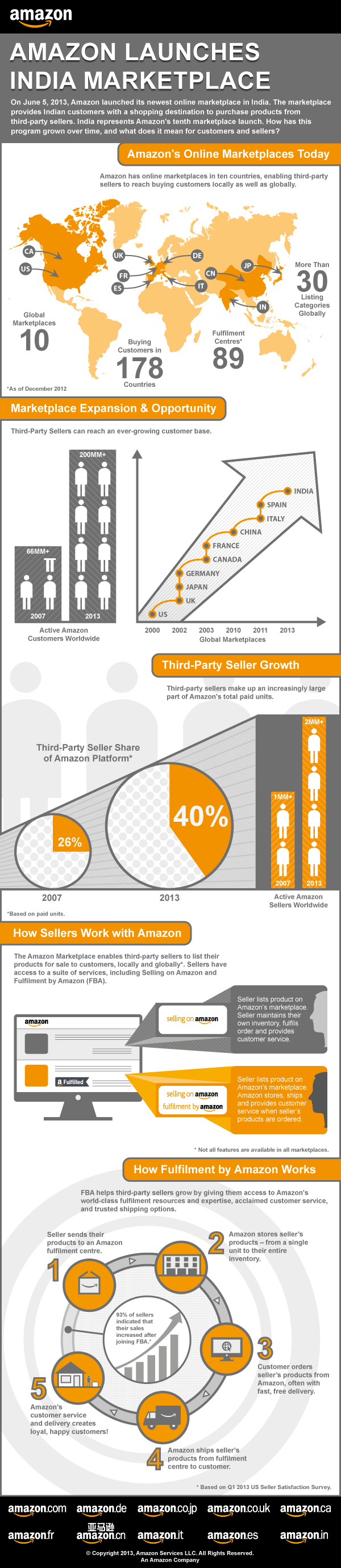
Instead for now they are an intermediary. The end customer pays Amazon the money who passes it onto the actual seller (after taking some commission). Amazon might even handle the logistics for some sellers. But the transaction is between the marketplace seller and the customer.
Until Amazon is granted approval to become a seller on their own right, their impact on Indian e-commerce will be much more limited than it would be otherwise.
There are a lot more fundamental issues in ecommerce space.
(1) Low penetration of credit cards - Banks have slowed down considerably their efforts to market credit cards. RBI regulations don't help either. Besides both of these, people have a negative feeling towards credit cards. So credit card usage is low. Cash is king and debit cards and direct bank transfers are next.
(2) Payment is a pain. Paying via credit card, debit card or bank account goes through a two step authentication process which is fraught with failures. There are multiple sites through which payment is routed => Seller site -> Payment gateway intermediary -> Bank site -> (enter password to authenticate payment) -> Back to intermediary -> Back to seller site. This long chain is breaks more often than not. And when it breaks, it becomes a pain to get your money back. Buying something online, especially for some one new is a heart-in-your-mouth experience. Again, RBI guidelines prevent any change in the payment process. It is easier to use Cash on Delivery (CoD).
(3) Two and three means that most customers prefer CoD. But CoD is a pain for merchants. There is no guarantee that customers would end up completing the sale. Most purchases are impulse purchases. But in case of CoD, you receive the product after 2-3 days, long after the impulse is gone. So the rejection rate for CoD sales is high compared to Credit/debit card sales.
(4) Logistics is another nightmare. The companies do not have scale and are quite expensive compared to the cost of goods sold. They are also not reliable. Delivery management and providing customer support for late/missing shipments forms the bulk of support cost. So any medium/large ecommerce company starts its own courier service. Suddenly these companies are not just ecommerce companies, they are also managing a completely new and different business.
(5) Low internet penetration and usage.
(6) Wafer thin margins. The margins are already thin. It is spread even thinner by offering free shipping. Shipping used to be free for any product of any cost. Its only now that companies have started charging for shipping. These thin margins mean companies won't be breaking even any time soon. Its a long haul game and its going to leave quite a few dead companies in its midst.
Its inevitable.
Here's an article quoting Snapdeal CEO as saying that inventory model is dead in India: http://www.livemint.com/Industry/D2Xufph6zu7w9ZYg8Ze0dM/Snap...
For example; with Amazon in the UK and can order before about 5pm (often later) and have it arrive tomorrow. That even works for some marketplace sellers.
Is there comparable service from Indian retailers?
(I ask out of genuine interest to see how the markets compare!)
(Note #1: I have gotten some items the next day, but it was out of luck. If you live in Mumbai, New Delhi, or Bangalore, this will happen occasionally that the warehouse on the outskirts of the city will have the product and you'll get it the next day. But it's just not close to guaranteed.)
(Note #2: I heard or read something that Flipkart, often known as "India's Amazon", will soon be offering expedited shipping for an additional fee).
a) You franchise out "ecommerce" physical shops. This is a physical location where customer can come in surf ecommerce websites and place an order.
b) There is someone at this shop who will collect money on behalf of ecommerce websites. This could be cash credit debit whatever. Make these shops available at every nukad (every street). Hell give other shop owners these ecommerce terminals (just like sim card selling process or prepaid minutes fulfillment process) .
c) The packages are shipped to this shop or your home. Since these shops are conveniently located, near train stations, in airports, malls, picking up packages is not an hassle.
d) serve complimentary hot tea while people are shopping.
The actual order is fulfilled at an warehouse just like amazon.
India also has loads of tiny convenience stores, I think this is an excellent idea. It also simplifies the logistics. The eCommerce company only has to build out a supply chain to the convenience store instead of having to deliver to each customer or rely on the Indian postal service.
(I have lived both in India and Japan)
The amount of delivery people in Beijing, especially near lunch time, is quite impressive.
If you are saying that Japan is still very much a cash based society, what percentage of transactions are done in cash and what percentage are done via mobile phones, judging from your personal day-to-day experience?
These days anybody who can order things through internet, actually orders things through the internet.
Just wondering if you are an Indian or if you are staying India?
I would go for it.
It looks promising.
Indian book prices, especially for foreign books which are published in India, is quite low.
http://www.flipkart.com/feynman-lectures-physics-mainly-mech...
Price: Rs 236
http://www.amazon.com/The-Feynman-Lectures-Physics-Vol/dp/04...
Price: USD 38(about Rs 2100)
That's almost a 10 fold difference. The paper quality isn't good, it's mostly paperback[1], but paying 10 folds for a hard cover isn't worth it. Books which aren't published locally(imported) are an issue. Prices are too steep compared to books which are published here.
http://www.flipkart.com/algorithm-design-manual-0002/p/itmdy...
Price: Rs 5163
[1]: In the examples above, both books are low quality paperback books.
One way competition reduces prices when sellers start undercutting each other in the first case. That doesn't apply to books in India. No one is making astronomical margins on books which can be cut down.
The other reason prices reduce is when competition leads to reducing production cost. It can be because of expanding market, technological improvements, improving supply chains.
Amazon may be able to make some difference in establishing better supply chains. But beyond that I do not see how they can help reduce the book prices in India. There has already been enough bloodbath in the online book retailing in India, so lack of competition is hardly an issue.
The "end result" thanks to "protectionist legislation" is not as straight forward as people imagine.
If it was wouldnt Alibaba have been allowed to buy Yahoo ;)
This pulls in a web font (woff) to display ₹. If Javascript is disabled it shows up as "Rs" instead. A fair compromise instead of images everywhere.
They'll probably get to it eventually.
Screenshot: http://i.imgur.com/Og9xMtn.png
Policy: http://www.amazon.in/gp/help/customer/display.html/ref=mk_ss...
Think "amazon.co.tw/password_reset.php"
Addresses that most "western" countries consider expected (ex. 1 Apple Loop, City, State Zip) don't exist here. Companies literally print on ads "On ____ Road, near ____ Terminal behind ______ City, State".
If Amazon somehow figured this out for India delivery - they'll do great.
Lastly, a 30 day return policy (or any return policy) is unheard of here. Electronics, clothes, anything I bought here strictly said no returns no matter what (even if defective).
30 day return policy? Check out flipkart.com, amongst others.
Two friends have started a sort of startup for books and movies and their inventory is comparable, though with a shitty interface for which I have shamed them many times.