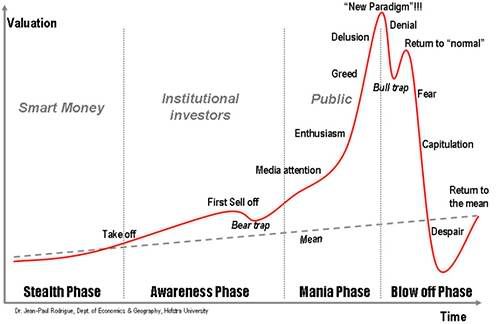
Holy cow. Bitcoin was at $145? I wrote a comment 6 days ago expressing shock that it was at $100, since the last time I checked it had been at $60.
If a 45% rise in one week coming on the heels of a 300% rise in one month doesn't raise your eyebrows, I don't know what will.
I continue to watch this unfold, fascinated, popcorn at the ready.
It's obvious people aren't using bitcoin to shop, but instead using it as an investment.
In one quick moment heard mentality will respond by "cashing out" their bitcoins for money (something that is actually accepted and can be used to by things) and this will create a chain reaction. One by one everyone will flip out, won't want to miss out on their cash, and start purging their bitcoins for ever lower numbers until the currency is devalued.
There will be another crash, people will forget or think "things will be different this time", and will once again start building the next bitcoin bubble. I think I might actually buy some during the crash when they're real cheap. Every year bitcoin's popularity rises and more people get suckered into it.
What does this mean, practically? A Gaussian distribution is a bad fit for the data. Using the more appropriate Normal Inverse Gaussian (NIG) distribution [1], we find that this is an event that would be expected once every 3 1/2 years. Still seems high since just last August we saw a -24% day.
Just not for 150 bucks.
I think there are a lot of people like me, and therefore I doubt it can crash really hard. There is no panic moment because I can afford to lose all my "investements".
The major exchange getting DDOS'd, a popular online wallet service provider getting hacked, and a plunge in the price of Bitcoins perhaps.
All of this days after the discussion around here was about BitCoins usurping major currencies. I don't get it.
everyone is finding new mines and bandits are active on the more remote ones. So prices get crazy. Bit coin will be like that until we approach the ceiling limit for bitcoins.
when that happen we will have the stable diamond market we have today. but limited by the algo and not by some cartel owning all the mines and buying all the new ones that are discovered to keep diamond supply stable artificially.
until then, enjoy the roller coast!
How can this volatility then be attributed to Bitcoin, and not the other currencies it is valued in? I freely admit, I'm less than a novice when it comes to ForEx, but a statement like
> "The value of bitcoins, it turns out, is highly sensitive to media coverage," wrote Reuters' influential financial journalist..."
seems to me to be exactly the opposite, i.e. media coverage is causing other currencies to fluctuate and the Bitcoin valuations are just a reflection of this.
But Occam's Razor is not on your side.
Even if it were just supply, the supply effectively changes all the time because not all bitcoins are on the market all the time. If I forget I have bitcoins, they're not part of the supply (of course, the rising dollar value might make me remember…).
A major volatility event in BTC will have an almost non-existent effect on FX markets - were every bitcoin exchanged for dollars in one day, it wouldn't even make up 1% of that day's FX trades globally.
A major volatility event in a major world currency (USD, GBP, EUR etc.) would have a massive effect on pretty much every market - it would effect FX, Futures, Fixed Income and Commodities markets, not to mention stock markets and derivatives markets.
Given the absence of the later, it's pretty safe assumption that the volatility is in BTC and not conventional FX markets.
Because if you were correct, that would meant the USD appreciated about 20% overnight which obviously it did not do.
I don't understand why a Magic the Gathering site is the big exchange still, and yet people keep creating wallet providers (which is kind of cookie cutter and inessential), vs. an exchange (which is inherently centralized, very technical vs. UI/UX centric, security sensitive, technically interesting, and a natural monopoly). There's some value in being a wallet provider with great funding/redemption options, but that's a hard business which touches a lot of regulation and legacy banking.
I think the big opportunities in BTC are: hardware/trusted wallets, trusted cloud-hosted wallets, an exchange provider, and most interestingly, derivative issues (currencies, instruments, contracts) with BTC as the underlying. Not "yet another web wallet provider".
A wallet provider is essentially retail. An exchange is where wallet providers should be going to offload risk, ideally with the exchange itself taking zero risk; let market makers do it. The only thing the exchange needs to do is publish prices and handle execution/settlement (which is trickier due to the lack of a "bitcoin-USD", "bitcoin-JPY", etc., but can be approximated by retaining USD, JPY, etc. balances on account.
I think you answer your own question:
...an exchange (which is inherently... a natural monopoly)
MtGox would have to stumble very, very hard to create an opening for another exchange, which would have high start-up costs (because of those interesting security and technical challenges). If you were sufficiently deep-pocketed and bullish on Bitcoin, sure, but most are chasing lower-hanging fruit without an incumbent leader in a natural monopoly role.
I'd agree that wallet provision is a weak opportunity, except perhaps as part one of some deeper strategy.
I think some are attempting to take on MtGox obliquely: Ripple/OpenCoin via its network's distributed books and TradeHill via its recently-restarted professional investor services.
Or at least that's how my calculations go - while I've got the technical and financial background to make me tempted to write a derivatives platform for BTC, I already make a decent salary and my perceived risk vs profit calculation doesn't work out to a number that would make it worth my while. Unless I get bored enough to do it anyway!
That's not true. Largest BTC2PLN exchange bitomat.pl lost it's wallet about two years ago. Mtgox bought them with their customers, covered for the mishap and started trading in PLN with very convenient PLN money transfers. In the meantime another exchange was created bitchange.pl but after bitcoin price crash it was closed. It was reborn with same software as pln.bitcurex.pl and now has larger volume of BTC2PLN trade than mtgox. It doesn't take fee on trades though.
So multiple exchanges are possible.
As has been said, a wallet is easy and could be run with minimal effort as a side project. I think you'd need a lot more than technical knowledge to be able to manage an exchange.
(IANAL of course, and IANAS7)
(It would also be awesome to get a 401k to offer BTC, even if it has to be within a "self directed" fund. I think I know someone on hn who has family members in the 401k administrator business...)
One of the worst part of the bitcoin community right now is the number of armchair speculators who have absolutely no idea what they're doing and think it's clever to go into the bitcoin IRC/forum and allcaps that people need to start selling their bitcoins because "ITS GUNNA CRASH" in a baseless hope that it will drive the price down.
I've stayed out of bitcoin because the market drivers are non-transparent. There are a lot of speculative investors in the market that are waiting for more gains before they close out their positions. Whenever these investors close out you have the potential of increasing the amount of liquid bitcoins in the market. Presuming demand is growing at a continuous clip this would drive the price down to a lower level.
Wash, rinse, repeat.
Saves us a lot of this. :P
Edit: Also, spreads of over 10% among different markets? Yeesh.
Having said that, I don't believe that it will go back up, most speculators will probably be ready to sell after today. It's also hard to say though, because it looks like the volume of bitcoins traded today are equal or less than other days. I can't say for sure, because Mt. Gox isn't loading properly and I'm looking at an unfamiliar set of graphs.
People keep talking about the bubble bursting. Most people don't realize that last time bitcoin flopped, it only lost 30-50% value initially, returning to a value that was still higher than just 2 months before the crash. Bitcoin spent 5 months in a steady decline, not 5 hours. Most early speculators made a profit, even if they couldn't sell until after the crash.
As much insanity as people are predicting, everything will probably be drawn out. If you have bitcoins and are nervous, now is a fine time to sell. If you think bitcoin will keep going up and you bought more than 30 days ago, you will probably be able to come out ahead even if you are wrong.
But you have to appreciate that most of Bitcoin is speculation. Bitcoin seems safe because it is inherently deflationary. That brings an unproportionate amount of speculators to the currency, and causes the deflationary properties to exaggerate. After enough time, the currency will become clearly overvalued. The free market will take care of that in a cyclic fashion.
As long as Bitcoin is used by people for it's anonymous and cryptographic properties, it will be subject to this hyperdeflation/crash cycle. The exiting bits don't last long and ultimately don't make the currency gain or lose terribly extraordinary amounts of value. After a crash, I'm sure bitcoin will still be worth at least $60, which is still fantastic if you bought back when it was less than $15.
But all of this is what makes Bitcoin irrelevant to the global financial system.
A currency can't be used for daily purchases if you have to account for cyclical periods where you just shouldn't spend them!
Couple this with the fact that this time enough of the mainstream media is paying attention, and Bitcoin won't recover. I'd bet a Bitcoin that this is the highest valuation of Bitcoin over its career as a highly interesting experiment in economics.
My take on it is that it's a mistake to think it's a currency. It has a lot more in common with gold, but without the heavy lifting.
In fact, exchange risk could lead to something akin to a bank run - the exchanges only keep a small reserve of national currencies and Bitcoins to handle orders and are essentially acting as market makers. But a big swing in the demand for either Bitcoin or real currencies could push the exchanges into a tight spot. If they don't have enough Bitcoin, obviously, the price rises until the demand for Bitcoin subsides. But if they don't have enough (say) dollars, then the price must fall. And there's a natural death spiral: as the price falls, particularly after such a big run up as has happened recently, people might suddenly decide that it's time to get out. But that only increases the demand for (scarce) dollars. And so the value collapses.
Here's the real Bitcoin security question: can someone precipitate this situation? Maybe someone who benefits from a collapse of the Bitcoin price (say a law enforcement agency that wants to affect the Silk Road business or, if you don't like that, then say any entity with a significant short position on Bitcoin exchange markets). This is not a question I've seen previously addressed in Bitcoin literature or even musings on the various Bitcoin forums. It's a security economics question. I'm interested in the answer.
By the way, my current favorite term for such a situation is the "Goldfinger attack" on the theory that while Goldfinger wanted to steal the gold from Ft. Knox (in the novel version), such an adversary wants to invalidate the coins in Mt. Gox.
Right now, it is clear that the rise in price is due to investors who see the potential of Bitcoin, thus they are hoarding Bitcoins in anticipation of future avenues that could accept Bitcoins.
All it will take to unleash liquidity in the Bitcoin market will be a major online retailer to announce they accept Bitcoins as a currency. Otherwise, the vast majority of Bitcoin transactions will be trading in iliiquid markets and paying for underground goods and services. Bitcoin isn't going to shake up the traditional goods and services market unless a major online retailer signs up.
... and with a very illiquid market and an immature set of market makers in the currency, it is going to be a while before Bitcoin is legit. Not to mention potential regulatory issues that WILL crop up at some point.
Bitcoin - good luck. I think it can work, but will it work is a whole different story.
Here, this may help: http://scholar.google.com/scholar?q=Bitcoin
I seem to recall a global Skype outage shortly after MS purchased the company, and this is eerily similar. I would haphazard to guess that most BTC transactions are USD->BTC so the USG would definitely be interested in that.
[1] http://i158.photobucket.com/albums/t106/OnlyObvious/CDOs/bub...