For what possible reasons? Are people going to be doing these things recreationally? Cause otherwise you're talking about scanning the entire world's population, including the very young, the very old, the mobility-impaired, and those without easy access to US-based facilities (i.e.... people who are part of the small fraction of the global population who do not live in the US), twice over, every 18 months.
What possible use could there be for doing this?
I recognize that the presser says the scanners will be deployed "around the world," but let's be real, this will probably be 80% US.
I've encountered this attitude before, and I always find it perplexing that there are people who are annoyed by, even hostile to, the idea of frequent health telemetry.
What possible use? How about giving people greater visibility inside their own bodies without having to navigate the labyrinth of the healthcare machine and without having to justify themselves to actuaries?
There’s a reason most people don’t get medical scans every checkup, they’re simply not necessary for the majority of (healthy) people.
The whole argument that "you'll worry yourself sick" is such patronizing trash. It's obviously programming that came from the insurance industry, and you lapped it right up.
My wife's a cardiologist and hypochondriacs with smartwatches have become a frequent occurrence because healthy young people despite regular check ups have convinced themselves their watch telling them their pulse got high that one time must mean they're dying and they'll show up not one but five times.
The same is happening with so called "sleep optimizations" which themselves can produce insomnia as people start to self-monitor and enact sleep efforts.
The fact that doctors like your wife think that people who are concerned about their health and want more information is a problem tells me everything I need to know about your (and her) worldview. You've dressed it up as being pragmatic, but the reality is that you're arguing for censorship and against freedom of information.
Surely, whatever this is giving you, getting a scan once a month must be plenty. They need a billion people to get a scan every month.
Going forward into the future and not measuring more accurately because we are worried about false positives in our current limited understanding is a very conservative take.
Um, that's still a tumor.
I mean, with that much data, you may be able to understand under what timeframe a tumor is actually of concern. What's so bad about having some false positives?
I think this is currently seen as too expensive to do for people who have lower risk, but I mention it as an example of something that one could check for more routinely given much cheaper ultrasound scans.
Prophylactic ultrasound exams are also apparently much more plausible on medical cost/benefit than prophylactic CT exams, because the CT exams very slightly increase one's cancer risk (https://xkcd.com/radiation/), where ultrasound doesn't.
(At a friend's doctor's suggestion, I started taking alkali citrate supplements and switched from almond milk to oat milk; I now apparently rarely get kidney stones.)
Hopefully it doesn’t become Gattaca.
The point is to generate an enormous unlabeled dataset. Historically, ML for medical imaging depended on a small number of labeled images - small because you needed to have an expert study the image and label it as healthy/cancer/etc. But the "GPT breakthrough" was that it was better to use vast unlabeled datasets - in the case of LLMs, text - than small labeled ones.
We are well on our way to that classic scifi trope of the villian being introduced as they soak a special tub of goop. (Dune, GOTG, Star Wars)
To the extent you can really call pointing their behaviour out as victimizing them, I would consider bad PR to be a fair tradeoff.
Umm...the same use we get out of an annual physical or dental checkup.
Early detection of disease, as well as every kind of physical issue with the body you can imagine.
The incredulity of the question seems rooted in the medical culture of our current time. It's easy to imagine a science fiction future where scans happen not every 9 months, but daily, in your home, and the idea of not constantly checking your full body would be as strange as not brushing your teeth is to us...
It's like if LeBron announced he was switching to bowling and was going to revolutionize the sport, then rolled a gutter ball.
Never underestimate the audacity of a software engineer with a new toy
> It's like if LeBron announced he was switching to bowling and was going to revolutionize the sport, then rolled a gutter ball.
Well, if you replace LeBron with Jordan, and Bowling with Baseball ..
As a layperson, I'm mostly familiar with the concept of "get scanned, and a professional evaluates it"... are there scenarios where the approach of "imaging every few weeks, to make decisions based on trends" is currently done?
(From reading other comment threads here, I suspect the general answer is: other body-scanning startups have proposed the same thing, and it hasn't made sense)
As an aside, I could probably benefit from allergy shots, but the idea of having a regularly scheduled errand to do during the workweek is pretty unappealing, so I never seriously consider it.
The resolution of typical DICOM images is much less than what they're saying they are actually capturing, so the reconstructed images they're showing are just terrible for no good reason.
But I suspect there is a bigger fundamental physics issue with this entire thing... I'm not convinced they can penetrate fully inside and all the way around a human with only non-ionizing energy, especially from that far away.
Without those kinds of details, radiologists just expose themselves to: oh so you're telling me this doesn't work as well as the machines you paid ~millions of dollars for and are currently charging your clients a lot to use? Mmm I wonder why.
It's not clear that we have the health infrastructure in place to know what to do with frequent, low resolution, whole body scans of the human body. How often do anomalies show up and then go away? How often are anomalies purely a scanning/data processing artifact? Who reads the scans and makes recommendations about follow-ups, if any? I think this is the kind of thing that sounds exciting and with low direct risk, but with all kinds of questions that are not only unanswered, but apparently unconsidered.
This is exactly my thinking. There are decades of longitudinal studies behind the recommendations physicians make based on given levels of e.g. cholesterol in a standard blood test. And critically, those depend on standard protocols around administering and testing samples.
This would be brand new and would not have any of that infrastructure. Which all tech starts at, good. But I would expect Midjourney to need to dig in for a few decades to get and analyze clinical results and outcomes.
For body scans, I think about how few people would know if they have e.g. three kidneys (or other distortion), and how that impacts/doesn't impact their health.
Most people do not undergo autopsy after death, so it's possible there are correlates between good/bad health outcomes that frequent scanning would eventually reveal. But it would take significant time for this to be apparent.
> We’re starting by just giving you detailed body composition maps — and we’ll be submitting regular test results to the FDA for increased capabilities.
As far as I understand ultrasound there's no reason you couldn't do this, it's just infeasible to do a full body scan with a hand probe and you get covered in goop.
There is a part of me that thinks it would be cool to get cheap full body scans. I like being able to see inside of myself. I can think of a lot of situations where the low-fidelity images coming out of this (they're not good compared to real medical imaging, if you've ever looking at MRI/CT up close) could be useful for coarse analysis of certain conditions that come and go or need to be monitored over long periods of time.
What I don't like is the idea of getting people to do full body scans every month just to be safe. This might sound like a good idea if you haven't looked at the literature on preventative full body imaging. Looking for bad things inside the body sounds like a great idea on the surface.
The problem is that imaging, especially when it's as rough as these ultrasounds, and possibly worse when augmented by AI guessing at what it's seeing, can lead to a lot of unnecessary procedures. The net effect can even become more harmful than the number of real problems it catches. There's a long history of research on this as many companies have tried to commercialize full-body scanning in the past. It frequently leads to situations where there's an unknown or ambiguous spot on the imaging that the person reading the scan can't rule out, which turns into a lot of anxiety and eventually more imaging, biopsies, or unnecessary surgeries. It's easy to think "better safe than sorry" until you realize how often these benign but ambiguous findings show up on full body imaging.
So my initial thoughts on this are that it would be good to make cheap ultrasonic imaging accessible as an as-needed service to use for specific conditions. I do not think it's a good idea to go down the road of trying to scan the entire population once a month and then run it through AI to see if anything pops up. The number of false positives would be overwhelming and lead to a lot of unnecessary procedures to calm the resulting anxieties.
For sure, we have to be realistic about what processes will systematically have error, and if we can't stop a doctor from doing bad things with a piece of data we should shield them from it, but the tools to make scalable, calibrated risk estimates based on large data dumps is getting better every year.
There are physical limits to detection and technical parameters that make some situations indeterminate even for the best of the 'gud'. It is frustrating that, hearing an argument from many different individuals over a long time, you assume that each speaker is missing the critical insight that you possess.
> but the tools to make scalable, calibrated risk estimates based on large data dumps is getting better every year.
So your suggestion for indeterminate scans is more scans? There is no 'large data dump' personalized to you except for your own imaging.
> if we can't stop a doctor from doing bad things with a piece of data we should shield them from it
The doctor isn't the problem, it's the people who would be seeking out monthly imaging without symptoms
If the false positive rate is demonstrably low, I can't see the risk. People who think they need a doctor will go to a doctor with or without a fancy scan. People who want to play armchair physician will play armchair physician with or without a fancy scan.
> So your suggestion for indeterminate scans is more scans?
The solution to imperfect evidence is consistent and calibrated risk estimation of both disease and intervention.
If Midjourney says "maybe you have cancer" but your doctor doesn't take it seriously, you might sue if you do end up with cancer. You might even win, regardless of whether "wait and see" was the right approach.
Meanwhile, if your doctor gives you an unnecessary CT scan that rules out cancer, hospital both earns $$$ and the doctor doesn't face legal consequences. Your increased chance of cancer risk from the radiation isn't something you can realistically sue over.
Exactly this. I mean, even if the scan is really indeterminate, at a minimum you can simply wait, then scan again. If it's truly something serious, it will become determinate at some point. Doing this is still better than nothing and carries no risks of unnecessary procedures.
If the scans are cheap and fast enough, the solution is to not do anything until you’ve observed the mass in question grow over time, not just be there.
Is this some AI hallucination post?
Their numbers would suggest these 1 billion people, getting scanned by 50k scanners, have each scanner doing 20k scans a month. 31 days, 24 hours, we have 744 hours in which to do these. That's 20k scans/744 hours, giving you 26.8 scans/hour. One scan'll be 2.2min. 2 minutes 14 seconds.
If this machine is 200cm big, lowers at 5cm a sec, that gives you 40seconds to lower. One minute to scan. 40 seconds to get you back up, presumably. Even if we're generous and double that, you're at 2 minutes just to lower, scan, and yeet you back up.
Giving you 14 seconds between scans. To clean, maintain, etc. Seems like this machine will output investor AI hype, bacteria, and false positives.
I linked the spa statistics because there's the question of how they'll even get the room for these machines but whatever.
Now, there's a lot of other reasons to be skeptical (e.g. there's no information on what all of this imaging could actually resolve), but please don't shoot the message.
They're not claiming they'll perform a billion scans. They're trying to build enough machines that if absolutely all of them were run at 100.00% capacity it would be theoretically possible to do a billion scans a month.
Yeah, that's not just 'cart before the horse', it's more like cart before the wheel. They make a bunch of extraordinary claims yet offer zero evidence, info or even a plausible hypothesis on how those claims might be possible at the scale, timeframe (2027) and unit economics implied. Thank goodness they really thought through the accent lighting for a calming user experience though. Otherwise, I might have been concerned they're not serious. </s>
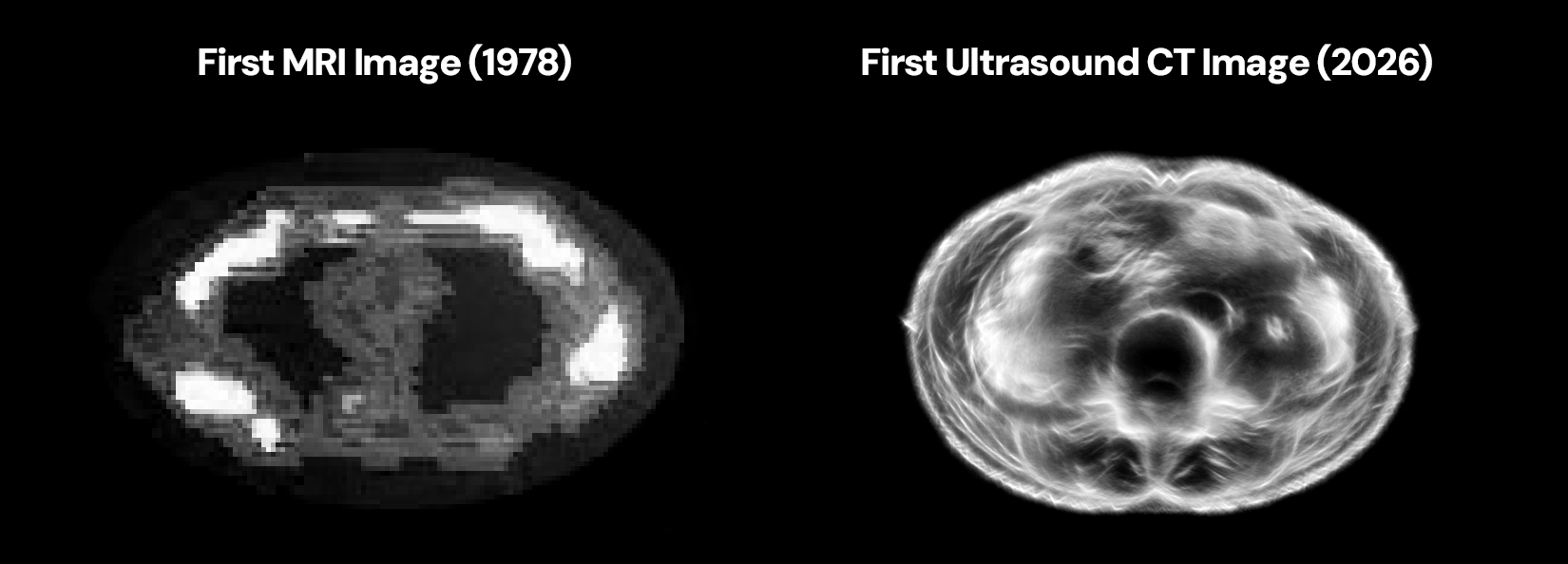
https://cdn.midjourney.com/static/medical/media/first_mri_vs...
More seriously, I assumed that CT Ultrasound image is from Butterfly's actual FDA-approved handheld medical device, not the Midjourney 360 submerged ring - as there's no evidence that is working. Since the Midjourney site has no helpful information, I just asked a friendly AI to do a comparison of what's actually proven to work in the Butterfly chip which Midjourney licensed and this 360 degree, full body, submerged concept - and essentially what's not been proven to work are those three differences: 360 degree ring of 40 butterfly chips, full body at once (requiring solving distance and speed challenges as well as a massive signal processing problem to extract and denoise signal), and doing it submerged.
If it is then wow!
Is this a dystopian Spa, where full scans cost 50k, and basic ones are 1-5k?
> That, collectively, we can begin to change our relationship with our bodies and start to ask questions like: if we can catch things early, can we change our lifestyles to correct them?
We can already ask this question...
> And seeing our bodies change over time, alongside our actions, how much can we improve our health, our minds, and our lives?
Again, we can already ask this question
> We think it's completely possible that with enough early imaging in the future, the world could avoid 30% of all deaths and 50% of all healthcare costs. The cultural, physical, and mental health benefits of all of this are hard to comprehend, but also hard to overstate.
What? I have no idea what is meant here by "hard to overstate".
> You want as much data as you can get about your health as quickly and as cheaply as possible. In other words, you want a technology optimized for getting as many “megabytes per second per dollar” of information about your body.
Thanks for including the "megabytes per second per dollar" unit breakdown, I didn't understand the first sentence at all without that!
> And we live longer, healthier lives, better lives.
More AI slop
> When you step into the water, you’re standing on top of a platform. The platform is connected to rails and begins to descend into the water - an elevator gently lowering you at around 2 inches, or 5 centimeters, per second.
More AI slop. You'd only be done in 60 seconds if you're exactly 5 feet tall