Imagine that: building expertise in-house and within the governmental org results in better planning and management and thus outcomes.
The train operating companies are mostly privately owned but they do not build the infrastructure. Quite a few are state owned though (LNER, Thameslink, Scotrail, Northern...)
Timetables, expansion any kind of change to rail running is approved centrally in DfT. The private operators are just that, they only run the trains to spec, on the track provided. In some cases they don't even run the stations they stop at.
What is criminal, and why the same mistakes that keep on being made, is that there little apatite or budget to retain expertise in house. This means that the DfT is reliant on consultants for most things.
THis would be fine if the people making the decisions were not people like chris grayling or grant schapps, who have no care for long term issues, only short term career success.
It costs a shit ton more, and there is less accountability. Its basically like asking claude to design the system for you. Sure it appears faster, but in the end it you'll have to redo all of it manually with no context.
The whole great british railway shit is basically just re-branding the regional franchises, and nothing more.
We tried this early on with sound transit in Washington state, and because engineering work is boom and bust on a project by project basis, the model just doesn't work. The good people left for better jobs, and we were left with a team that basically couldn't produce, leading to massive delays on the next set of projects.
A morbid equivalent from the Middle Ages: bigger medieval cities had their own headsman, and they solved the risk of underemployment by sending him on external "jobs" to smaller towns where executions were rare.
Or by govt orgs by contracting it out.
Both styles have resulted in massive delays so much so that it has become a meme that metro will be inaugurated 100yrs into the future
Maybe if Govt hired actual engineers like they do for railways then metros will be prioritised
I guess this is what vibe coding in the real world looks like.
The reason for delays are more boring: land acquisition, coordination among nhai, state pwd, railways, utilities, etc etc. But overwhelmingly land acquisition is the main bottleneck. If land acquisition fails or isn't exactly as you planned then you have to tweak the project itself which ripples delays all the way into the construction contracts, safety approvals, NOCs etc etc. After you resolve that, flyovers and roads are simultaneously being constructed in most cities since they are all expanding so you have to coordinate with that. And india from pre-independence has utilities placed under the middle of the road, as opposed to the sides of the road. Now this is not an iron clad rule (nothing is, in india) but it's generally true. This means that you also have to coordinate with utilities. And most of them were laid in the last century without any record left of where they were laid, so you can't even plan ahead you dig and you find out you've slashed a utility line. Each coordination point above is an NOC and all put together it takes time.
However, all are perpetually delayed
Pune metro line 3's construction status was 85+% for over 1yr now
Land acquisition was over a long time ago. Progress on road is just invisible despite being built by a private company which will operate it for the next 30yrs
So, it is an India problem, not a government problem.
Look at the memes for Pune metro line 3 and for Karnataka metro (forgot which line)
There is so much thievery of public funds it's just corruption disguised as incompetence and the public believe it every time
Some flagrant cases:
https://en.wikipedia.org/wiki/Ciudad_Real_International_Airp...
https://en.wikipedia.org/wiki/Castell%C3%B3n%E2%80%93Costa_A...
https://maps.app.goo.gl/8BRnx8eQFfihvHmv5
https://english.elpais.com/elpais/2019/05/17/inenglish/15580...
The 2008 crisis had a special flavor in Spain, cajas de ahorros (privately owned, but politically controlled banks) worked with politicians -surprise- to grant mortgages (i.e. lending someone else's money) to buyers of the housing constructions they themselves had their fingers in, at a time regular banks were already wary of the direction of the housing market. It wasn't uncommon people being told which bank to go to to obtain a mortgage that'd be usually refused.
So out and out corruption is rare in the UK. For example Farage has just received 5 million in dodgy money, which is more money than all of the previous political money scandals since Mandelson.
But to your point, most of the time and money in uk infra is spent trying to navigate planning laws and nimbys
Or you could go for the Greensill scandal [2] with David Cameron who may have made as much as up to $60 million from it.
Nick clegg received $20 million + from working for meta after being in power.
There are so many more to choose from, Farage has just been the most obvious and worst at hiding it.
[1]: https://en.wikipedia.org/wiki/Controversies_regarding_COVID-...
We rarely have impediments such as a minority government who can't change laws
You don't need to dig too deep to connect the dots.
In rail, it's more like is that there's nothing for 20 years, then the government announces one project. Everyone piles onto that one project and gold-plates everything because they already know there's not going to be any more projects after this one for 20 years.
Then the project overruns by billions.
The government pays, then vows not to make that mistake again, so they don't have any more projects for 20 years.
Rinse and repeat.
A much more healthy cycle is like the Italian build-out of high speed rail, where they have multiple projects going, working their way from one city to another, and the line is usable after each part is done.
(in the case of HS2, a lot of the blame can be laid at the feed of NIMBYs, and the government pandering to them. Oh you lovely Tory-voting home counties voters! Yes, it's essential we preserve this ancient forest and that protected species, I know, so important, we'll make the entire line underground for your part of HS2, of course we have the extra billions to pay for that. Fuck you, you dirty northerners. I've just had to stump up a fuckton more than expected to pay off my voters, so I'm cutting your part of the line. You'll be lucky if HS2 goes north of Birmingham)
Crossrail, Transpennine Route Upgrade, East West Rail, MML upgrade, Borders railway, Thameslink upgrades
This reads a lot like GB News announcing in Feb 2026 "The "biggest scandal in British history" [South Asian child grooming/rape gangs] has been blown wide open this week as an independent inquiry into the grooming gang epidemic heard harrowing testimonies. Rupert Lowe, Independent MP for Great Yarmouth, launched the proceedings on Monday"
Despite Andrew Norfolk being "2014 Journalist of the Year" for breaking the scandal in The Times and writing about it since 2010.
And despite a 2003 TV documentary reporting on an 18 month police and social services investigation, the Ivison Trust trying to bring it to national attention since 2010. the Independent writing about it in 2010. The former Home Secretary talking about it on Newsnight TV in 2011. A 2011 National Crime Agency (NCA)'s analysis. Convictions of Rochdale gang members in 2012. A 2013 NCA analysis. Rotherham council commissioning the independent Jay Report in 2013. A 2014 investigation into the Rotherham Council by the government. Andrew Norfolk winning two other awards for his reporting on it in 2014. The largest investigation into that kind of thing in UK history in 2017. A 2017 report from a thinktank. In 2017 a former Policing and Justice minister urging the Attorney General about it. A 2017 article in The Sun by the MP for Rotherham about it and the media attention that got. A 2020 report by the Home Office, a petition by The Independent with 130,000 signatures pressuring the Home Office to release their report. A 2021 investigation by The Times, A 2023 article by The Guardian, A 2023 announcement by Prime Minister Sunak starting a taskforce... but now The Right is trying to tell people that nobody has noticed it and the mainstream media isn't covering it.
But yeah, sure, the public "believe government grift every time" and weren't angry about the COVID PPE scandals, or HS2, or any of the rest of them, at all, only YOU noticed.
Good info though mate well done
The rape gangs are truly horrific and one of the worst things to happen to Britain in recent history
1) BART 'works' for a subset of the population.
2) ACE train is one route only, from Stockton to San Jose.
3) Caltrain is one straight line. Caltrain has a bullet train that takes an hour for ~20-30 miles.
4) There is a ferry service for some parts of north bay.
There are probably dozens of other bus systems and ferries and what not, all incompatible and disconnected.
When people from bay area (and the big tech companies) tell you they are the greatest minds on the planet solving (or going to solve) world problems, look at their public transit and think. Then weep/laugh.
Source: I lived in the North bay, East bay and South bay.
Producers make what will sell but without any incentives, subsidies or regulation this would be a mess of profit chasing, unsafe practices and fragile supply chains.
In my view, the value of the public sector is in setting the rule of the game for private actors in exactly this kind of way (rules and incentives) instead of the politics of picking winners and losers directly or making direct decisions about what to build where, etc. Rule makers play the meta-game of designing how the game works and they leave agents free to play as they wish.
Is there any food market in the developed world that is not heavily subsidized by the state?
I do wonder what it would be like if our system was designed to feed people rather than to make money.
It's baffling that in Florida the land of oranges you see little cups of pealed that say product of Spain and packaged in Thailand. I know supply chains are complex and labor costs are a big factor but still.
But the level of efficiency achieved thanks to the development of technology by private companies is what keeps them efficient around the world.
San Jose Didrion to SFO (4th and Townsend} is 48 miles highway distance.
You will not beat the bullet train during rush hour. It would like take you an hour and a half if lucky, probably closer to 2 hours driving
Thw CalTrain being “one line” makes perfect sense because it runs parallel to the Valley
No the system is not perfect, but it is still one of the best in the country, except for NYC and maybe Boston
I mean, there are a lot of poorer countries (especially in europe) that manage to solve this in a much better way, so this kind of proves OP point that raw purchasing power is not equivalent to the standard of living.
I went to NYC and also various other countries, easily understood the train/subway system even if it was in a language I don't understand. Except for Italy.
The benefits of good public transport are so mind blowing that it's difficult to explain unless you have lived on a city that has it.
Whenever I see discussions like this, I always feel the standards that most public transportation advocates consider "good" or even "acceptable" are far lower than mine.
Mine - Seoul, Tokyo, other East Asian cities.
Most public transportation advocates - Maybe NYC, many even lower.
Factors - reliability, cleanliness (both cars and stations), reach, safety (both actual and perceived, and both violent and non-violent).
Give me the Seoul or Tokyo subway and I'll gladly ditch my car (actually...no, but I'd only use it for excursions outside the city).
This is because when you are building a subway every one wants their station. The map above may look like straight lines, but if you look at the real map, the north of line 10 is not straight at all, it's more zig zag.
We are trying to make transportation work for everyone and we end up with transportation that works for no one.
Also, the subway closes at midnight, and by Spanish standards, that's early. I was stranded twice (because different stations close at different times) until i decided that I would never take public transport in Madrid again
I can just move to Madrid and move anywhere in the city for around 1-2€ per trip without upfront investment of 20.000€ for a car, plus insurance, maintenance, fuel and taxes.
However, even if such a thing did exist, you still have to contend with traffic and total road capacity. So, for instance, taking local systems (details will vary by city, but not much), a double-decker bus is ten meters long and takes ~100 people. A tram is 55m long and takes about 550 people. A commuter train is 160m long and takes a thousand people (and doesn't share roads, of course). A car is 4-5m long and typically carries one or two people. Take any large city, attempt to replace the public transport with private cars, and there simply _will not be space_.
Fully-segregated metros in particular can also be much faster than cars in urban areas; they don't have to contend with traffic or intersections at all.
A horse knows how to navigate any kinds of terrain, while a car requires constant microsecond attention, extremely stressful, if you lose focus, might end up dead, worse kill a lot of other people! Horses don't need roads to be built, or the elaborate supply chains of fossil fuels, and trillions of dollars per year in subsidies.
Even buses get exclusive lanes in some cities.
You can zip over people trapped in traffic on their personal cars. It is quite satisfying.
- Areas with few/no cars are nicer to be in. To breathe, to talk quietly and hear others talking, to walk around safely.
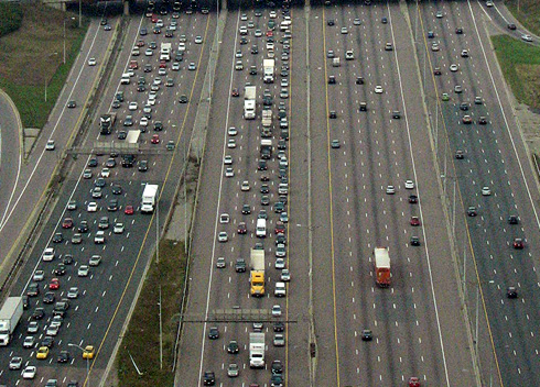
- Transport moves more people in less space and less overall investment. Toronto Highway 401[1] is an eighteen lane road and it moves fewer people per day than Metro line 1.
- Low car areas are better for local economies. People object to reducing traffic saying it will hurt local businesses, and the opposite is true. Where it's nice to exist outside of a car, that attracts people, and local businesses thrive.
- Reduced costs on health services from reduced pollution. Fewer doctor and hospital visits and prescriptions, for lung infections, breathing problems, asthsma and COPD in London after Low Emissions zones.
- Reduced environmental impact of fewer cars, fewer trips taken by car.
- Many people can't drive; all children, many injured or disabled people, many poorer people, many elderly people (can't or shouldn't), some people with e.g. DUI convictions. Some 20% of households in the UK have no access to a car. A matter of fairness and not prioritising the wealthy car owner.
Personally:
- No need to find parking, return to that carpark.
- Transit is more spacious. Being strapped into a carseat, elbows hitting doors, head hitting roof, knees hitting steering wheel, shins hitting dash, feet constrained in footwell, surrounded by explosives "for your protection" is a really unpleasant place to be.
- Less concentration needed. Driving requires constant attention. Even when transit is crowded, you don't have to do anything.
- Implemented well, transit takes priority over cars at turnings, crossings, junctions, roundabouts, and moves faster. Toronto trams do this especially poorly, apparently.
- Freedom. No need for a government approved license and ID. Not beholden to dragging a ton of steel boat-anchor around everywhere with you.
[1] https://3.bp.blogspot.com/-IRDiOiNYl9s/UEwAA79O2NI/AAAAAAAAG...
Agile regulations against NIMBYism and a world-class civil engineering industry with HQs in Madrid also help.
A good analogy is to ask what would need to be true for Madrid to replicate the AI hub in SF? Great VC, top engineers, certain risk-taking mentality, etc.
So, it's not easy. The environment that creates a fabric for radical innovation is quite different from a statist mentality, although hopefully, both are not mutually exclusive.
An ironic downside of America’s leadership in tech and finance is that there is tremendous brain drain out of the public sector.
I agree with this. In general jobs with the government are seen as high quality jobs from my understanding. Another commenter mentioned that the high salaries in the private sector in the US brain drain away from the US public sector. In Spain salaries are much lower, so this is perhaps less of an issue in certain fields.
- Cost of labor is insanely high due to cost of housing. Short of jumping straight back into the 19th century, setting up temporary housing and bringing in guest laborers this is pretty much non-negotiable.
- Not a ton of expertise left in the country since there's 2 new subway tunnels a decade AFAIK.
- The grift has got to be worse here than in Spain. There if you get $40k in kickbacks that's a nice bonus, here that barely covers your rent for the year.
And then even if you bring the costs down, you have to figure out the taxation. Several billion per mile is the running rate and you may be able to bring that down but then you have ongoing costs. Muni's farebox recovery is only 1/4 of its budget so unless you're making existing lines redundant, there's new ongoing cost. Obviously the choices there will be to go into the pockets of the middle class or not do it at all.
This is not the reason. Labor is expensive even in parts of the US with low housing costs.
The real, simple reason is the US has a more prosperous economy where the average worker has more opportunity than their Spanish peers. Just look at unemployment rates. The US is at 4.3% right now compared to Spain's 10%. Even at the peak of the GFC the US barely had over 10% unemployment. In the meanwhile Spain has had over 10% employment almost the entire time the past four decades. Of course labor is cheap when that many people are jobless.
Relevant: https://en.wikipedia.org/wiki/Baumol_effect - drives a lot of effects in the US where automation paradoxically makes non-automated industries insanely expensive (though not the whole story for certain niches e.g. healthcare and education)
I had a lady parade around my neighborhood handing out fliers saying that extending the bus stop to our neighborhood was going to bring rapists and pedophiles into the neighborhood. I thought she was an odd one out and insane so I made a joke about it at a neighborhood event a few weeks later.
Turns out, I was the odd one out…
* Fear that a metro will bring in "undesirables" (i.e. poor / lower-class people)
* Concerns about noise (whether real or imagined)
* Some people just hate change
In US suburbs, a lot of people are going to drive even if they live next to a train station. So there’s no convenience or property value benefits. To them, they only see downsides.
What struck me is a complete lack of urgency and accountability, combined with out-of-control meddling by politicians pursuing completely unrelated goals. The project spent several years in EIR and initial planning, which is to be expected. Then for over a decade, San Francisco's board of supervisors held the project hostage because they wanted to demolish a freeway south of where the actual project is, while bolting on an unrelated and unrealistic tunneling project (the "Pennsylvania Avenue alignment") and taking over the governance of the Caltrain board (Caltrain is the least dysfunctional transit system in the Bay Area, so the Caltrain board was not too keen on this proposal). Eventually, after wasting many years and tens (hundreds?) of millions of dollars, the balance of power on the BoS shifted and they agreed to stop holding the project hostage, restructure the board (TJPA), and re-hire staff to actually plan the tunnel.
I've seen multiple project managers/directors come and go, and countless community input meetings happen discussing completely hypothetical project concepts. The money set aside for the project from the original Transbay budget is long gone, and numerous funding opportunities have passed by because the TJPA and its stakeholders were not ready to plan and submit a viable proposal in time.
Here are some things I would want to change going forward:
- Transit projects should be centrally planned by the state government (i.e. a regional subdivision of an agency similar to Caltrans) with structured opportunities for resident feedback and authority to override most input from local governments. This should include exemptions from CEQA and other review, and strong eminent domain powers.
- The Caltrans-like agency should have independent regional metro divisions (i.e. Bay Area, LA area, etc) with dedicated sources of regionally collected funding as well as a mandate to own and lease out land adjacent to transit stations as part of its funding. The divisions should have budgets to retain project management staff who accumulate long-term experience and manage multiple projects. They should have the independent authority to issue bonds and be required to publish construction efficiency and ridership statistics.
- Labor unions should be systematically prevented from influencing the course of planning, construction, and project execution. Unions meddle and cause many delays and project complications.
Unfortunately, even a structure like that is not a panacea. If you look at CHSRA, it actually has some of the features that I listed above. When CHSRA was first started, the planning process fell victim to meddling from state legislators (most famously the one who forced the route to go through Palmdale), followed by many wasted years fighting NIMBYs and doing useless planning. Ultimately, the only hope I see is to insulate the planners from political interference, set them up with independent funding, have one agency head who is responsible and accountable, and reduce the veto powers that California grants to citizens and governments.
And moreover, CHRSRA, while it is certainly delayed and over budget, appears to be a fairly well-run program with delays due primarily to external issues created by state & local government. It doesn't help that it receives nearly universal bad press, but I think that'll change by next year as they start laying track [connecting the stations and above grade crossings that have been long built].
Utilities were generally public prior to this. Now we have private equity buying up utilities because the profits are guaranteed [2]. While electricity prices are regulated, capex on infrastructure isn't so they can simply boost profits by "investing" in the network ie creating extra capacity for data centers to be sold electricity at sub-market rates.
Lots of expierments were done and empirical data analyzed on the tragedy of the commons and it never matched the theory. Ultimately, this resulted in Elinor Ostrom winning the 2009 Nobel Price for Economics for disproving it with empirical data. Yet people still quote it.
Look at the list of metro systems sorted by length [4]. They're almost all Chinese. The 4th largest is in Chengdu, which only opened in 2010. In 16 years it's now the 4th largest in the world.
Pretty much any argument you can use about how China is different will have a contradiction by counterexample. Difficult terran? Chongqing. Old cities? Beijing, Shanghai. City too large? Good one.
It's not any single factor that allows for this. It's managed at every single level. For example, China has standardized rolling stock to a handful of variants so you avoid an entire procurement process (and grift). The UK spends billions of pounds to build an otherwise completely unnecessary tunnel under the Chilterns to protect the views of something of the most expensive property in the country [5]. Not in China. Audits of the Second Avenue Subway showed a host of corruption such as so-called "ghost jobs" [6]. Beverly Hills and Santa Monica fought the LA Metro extending into their areas because it might bring in the poors.
[1]: https://www.garretthardinsociety.org/articles_pdf/tragedy_of...
[2]: https://finance.yahoo.com/news/pe-buys-utilities-power-ai-18...
[3]: https://www.forbes.com/sites/artcarden/2019/08/07/elinor-ost...
[4]: https://en.wikipedia.org/wiki/List_of_metro_systems
[5]: https://www.theguardian.com/business/2026/jan/19/hs2-tunnels...
[6]: https://secondavenuesagas.com/2018/01/01/inside-times-deep-d...
Hardin did not argue that private industry was more efficient. His paper described that with an unmanaged, private, unregulated open pasture that has no property rights, individuals will exploit it until it collapses. It wasn't used used as justification for privatization, if anything it was the opposite.
Ostrom did not argue that unmanaged resources don't collapse. Instead, she showed with data a third way of organising which was more involved with self-governing, communal rules to manage shared resources without resorting to either a private corporation or government control.
I'm still on team democracy, and we'll see how long it takes before China regresses to the norm of dictatorships. Xi has already broken the term limits. Nothing suggests he won't slowly lose his grip on reality like most dictators. But for now China has its charms.
p.s. I don't think Native Americans are a factor in most of the west except Canada and the USA.
It's worse that this: It's being taught to pretty much every student of economics during the first few classes, Ostrom sometimes being quoted as a counterpoint but not always.
Which utilities do you believe were government-funded or government-owned in the West? I will grant you most water supplies. Which other utilities?
or currently nationalised: https://en.wikipedia.org/wiki/State-owned_enterprises_of_the...
Electric, Gas distribution, British Petroleum, British Telecom, Bank of England, other banks like Bradford & Bingley, Royal Mail, regional water companies, shipbuilding, aeroplane, car, iron, and steel manufacturing, nuclear power, canals and waterways, coal mining, munitions factories, pubs, zinc smelting, airlines, Ordnance Survey Mapping, National Highways, BBC and Channel 4 broadcasting, The Crown Estate, Nuclear Laboratory, UK Hydrographic office, Meteorological Office, Genomics England, Student Loans Company, Civil Aviation Authority, Porton Biopharma...
Where are these utilities that were public, then were privatized? Not AFAIK in the US where the intercity and freight rail lines, telegraph lines, telephone systems, natural-gas-distribution networks, electrical grid, cable-TV grid and last-mile internet networks started out private. Maybe in Britain? But if so, the person I replied to should make it clear that his critique applies only to Britain.
Also, a shared apartment costs as much as you say. Not a room (source: idealista.es).
Purchase prices are high, but I'm curious as to what you consider a bad neighborhood, given the overall safety statistics in Spain, and Madrid in particular.
Housing affordability is a real problem, but misrepresenting data is counterproductive, as it can be easily disproven.
I can't confidently say whether one feels more comfortable working construction in a globally VHCOL city like NYC or SF or in a MCOL city like Madrid.
Once I had finished I could earn 3 to 4 times more on several places.
They were also extremely creative taking foreign systems, studying the patent and modifying it to pay zero to the creators of the patents. This was done with things like the aluminium beams for electricity delivery that I think was developed by Italians, or the tunnelling machines that had all the pieces replicated inhouse.
The article also makes a big deal out of country-level factors like the system of autonomous communities, governance, in-house expertise etc.
But all of those should apply to Malaga as well, which also built a metro in the 2000s. But that one became a city-wide joke for always being supposed to open "this year" and that continued for at least 5 years...
There was definitively none of the cheap or fast involved in that project, a relatively limited line to make travel to the airport more convenient which still couldn't deliver. Today it actually operates, but I think the rest of the network (it was supposed to be a "proper" metro system and not just isolated lines) is still vaporware. Haven't lived in Malaga in many years, though.
This is under-appreciated.
> I believe that the U.S. suffers from a distinct lack of state capacity. We’ve outsourced many of our core government functions to nonprofits and consultants, resulting in cost bloat and the waste of taxpayer money. We’ve farmed out environmental regulation to the courts and to private citizens, resulting in paralysis for industry and infrastructure alike. And we’ve left ourselves critically vulnerable to threats like pandemics and — most importantly — war.
> It’s time for us to bring back the bureaucrats.
* https://www.noahpinion.blog/p/america-needs-a-bigger-better-...
Even if you do outsource some level of tasks, you still need in-house folks who know something so you don't get fleeced.
Woah, this is really a “worst person you known just made a great point” moment for me.
Wait... did you build your own tunnel boring machines? Or just spare parts for them?
Now, operating a tunnel-boring machine, that's a different beast, but you'd have to do that either way. Probably should get outside help if your engineers and scientists haven't planned and dug a tunnel in their life.
As for the patent side, I kinda give them kudos for that.
(What is with German public transport ticket-buying apps? They all seem to be very broken.)
So, after having lived in Barcelona and Madrid... Both metros are excellent, but besides covering a smaller area, I still prefer Barcelona metro than Madrid one. IMHO, Barcelona metro looks more like the one in the german cities and Madrid metro looks like London one.
Said that, this year Madrid metro users have been quite angry at some line closures at the same time than tunnels were fixed at the same time in the city. It is mostly a managing problem as well, as some of the trains (quite old in some cases) are still being rented instead of bought.
Line 7B grew up as well but in San Fernando de Henares some buildings got structural cracks and some houses (over 50) had to be bulldozed.
Metro works from 06:00 to 01:00, but there is nothing before of after that time. In Barcelona, for instance, Monday to Thursday works 5:00 to 00:00, on Friday 5:00 to 02:00, and from 05:00 on Saturday to 00:00 on Sunday non-stop. That has been for some years now and means lots of drunk people not taking the car.
In Barcelona, metro schedules are tighter as well. In Barcelona, in rush hours you may have a train every 2,5 minutes, in some cases less than 2 minutes. In Madrid it's more like 4 minutes. Trains are newer in Barcelona, too (and wider because most lines use iberic gauge), but that was because until the 90s Barcelona trains had some asbestos on them.
Anyways, a metro is not only about the trains, it's also about the stations. Most of Madrid ones have conditioned air and have better lighting than not only the Barcelona ones, but the European ones as well. But, again IMHO, signage in Madrid metro is HORRIBLE. Most of the signs are on the walls, when you are walking on a crowded corridor is easy to take the wrong direction. I need a magnifier to read the metro plan on the wagons. Also, it takes some time to understand that it "drives on its left" in a country where everything else "drives on its right". Not a big thing, but if you come from somewhere in Europe it may take you some time until you get used to all of it.
If you look at the physical map, you will see that it visits multiple towns that are not in a straight line from Madrid. This causes the line to "zig-zag" and what should take 20 minutes in a straight line becomes a 1h 15min ride.
People use it because Madrid has started being hostile to cars and the only two alternatives are trains (which is pretty good, takes 30 min) or buses
It's also not 24/7, closes at midnight (and if you are going out in Spain, you will stay way later than that)
I am also heavily distrusting of the "75 percent of passengers described themselves as ‘very satisfied’". The infrastructure might be ok now, but the frequencies are getting worse (except when the pope visits, in that case they apparently have the money) and in rush hour everything is packed.
> The PP candidate for Assembly President, Alberto Ruiz-Gallardón, promised to deliver 30 new miles (48 kilometers) of metro by the next election, compared to the 14 miles (23 kilometers) the PSOE had delivered during their previous 15 years in government. With this pledge, the PP won a majority and Ruiz-Gallardón was duly elected president.
It's hard to see that working in the US, even if we eliminated the jurisdictional patchworks, because what will happen is one candidate will promise 1000 miles and the other will propose destroying existing infrastructure, but they'll also make competing promises on homelessness, affordability, and various culture war issues, while jockeying for supremacy in media prominence, and then whichever one gets elected will build 0 miles and say it was somehow the other one's fault. It's just hard to imagine any sizable electorate in the US actually voting based on an issue like how quickly and cheaply public transportation is built. If we had the kind of people who care about stuff like that, we wouldn't have the problems we have.
The article is in French, but geology is the key factor. Do you need to bore rock or sandy soil with tar? Is the area seismically active like in Los Angeles? This affects the cost and timeline of metro construction more than just wages.
Which is basically "Soul of a new machine" for municipalities with all the political mess this implies. How do you get stuff done - and at what price.
* https://ifp.org/transit-abundance-playbook/
that gives specific recommendations to makes things quicker (in the US?).