You can live in a well-insulated fully electric home powered by renewable energy and have most things you need within a walk, bike, or public transport ride away, _OR_ use an electric car for the things that aren't. If you combine that with a mostly-plant based diet (or at _least_ swapping chicken for most of your beef and lamb) and have 2 kids or fewer you're... basically there.
The main reason most people can't do this is because of political choices, not technological limitations.
Granted this doesn't include luxuries like jetting halfway around the world for a 1 week holiday or living in a 4000 square foot house in the desert and driving a studio apartment an hour to work every day, but really, is that a better life?
I've seen people on social media seriously claiming that coal plants are cleaner than wind energy or solar energy. It's aggravating. Never mind that it's easy to show that for the same amount of energy output, you get a similar amount of tons of coal ash yearly to the amount of materials it went into building a wind or solar plant...
I go back and forth if they are bots, or somehow people who are just really susceptible to this kind of garbage shill clickbait.
It's not that people are not willing to make sacrifices. We repeatedly did this in times of famine or war. Europe during WWII is a perfect example. Another good example of a major cultural shift in response to a new threat was the AIDS epidemic. The entire sexual revolution went out the window and we're now in a world where young people have a lot less sex than ever before. We like to talk about gender and sexuality, but we do a lot less with it, so to speak.
Anti-consumption / degrowth arguments face an uphill battle because they basically say "you should live a harder life". There should be less stuff, the stuff should be more expensive, there should be less of you. So you need a good answer why this is the right choice. Doing it "for the planet" doesn't sound too convincing because we're also a part of the planet and most people feel entitled to it. It's hard to get others to make real lifestyle sacrifices because you showed them some photos of koalas or coral reefs.
Because koalas don't cut it, we started giving increasingly apocalyptic, doomsday-type answers, all the way to renaming "climate change" to "climate crisis" or "climate disaster / catastrophe". That was probably a mistake. It created a sense of inevitability (so might as well have fun while you can) and undermined the credibility of the proposed solutions. Is it really going to save us all if I'm sorting my recyclables into five different bins?
So in a sense, I think this is a PR disaster more than anything else.
The only way forward is developing as much solar, wind and nuclear as possible, driving down energy prices. Obviously stuff like carbon tax can help accelerate the process, but mostly it's happening because renewables have become the cheapest way of generating energy in most parts of the world.
Government mandates for e.g. large nuclear construction, geo-engineering, BEV adoption, or other similar proposals would have had an impact. These all exposed the real tradeoffs which would need to be accepted of cost, hardship, or whatever the opposition to nuclear was.
The environmental movements of the last 60 years focused on impossible goals which were easy to rally behind.
What I don't see is these anti-degrowth people discussing substance with pro-degrowth people. No discussions about the merits of the idea that planet's carrying capacity has been reached or exceeded. Both camps seem to treat their thesis as a given, a religion even.
What are you talking about? The united states is currently ~-30% off peak carbon emissions.
I really felt _sure_ that billionaires and monarchs and rest of the ruling class flying their private jets to meet their private mega yachts before attending very important meetings in luxury chalets where they lecture the filthy commoners about how horrible and greedy they are for not wanting to eat cockroaches and pay them more taxes for the greater good was going to do it. Are you sure that a few more decades of that won't finally convince people how awful they are?
> It is simply not possible to get enough people to reduce to make an impact. The failure of the environment movements over the last 60 years are proof. The only way is ‘up and out’ developing clean, cheap methods of energy generation and lobbying to get that infrastructure built out as quickly as possible. At this point, investing more in Fossil fuels is a joke and anyone claiming “coal” or whatever is the future
If only the "environment" movements had failed. They were instrumental in destroying nuclear power, with support of fossil fuel interests. The coal industry has had no better friend than the anti-nuclear "green" movement in the past 50 years.
> is simply a conman or a clown.
There's lots of conmen and clowns around. The trick is not sniffing out the ones twirling their mustaches and adjusting their monocles while demolishing orphanages, it's the ones who tell you things that make you feel good that are the dangerous ones. That's where the "con" in conmen comes from.
superficial and incorrect
If you’re skeptical of scientific authority and lack those skills… as well as the critical thinking required to read the research and distill your own conclusions, there is basically no way to convince you. You can’t find objective truth yourself and you don’t trust the resources that can.
Doesn’t matter anyway, you as an ant in a large colony barely matter, no one needs to convince you. Capital needs to understand it’s in its interest to fix the problem and it will be fixed. Until that, get an A/C and contribute to the problem.
You’re looking at Capital as a monolithic block. The problem is that the majority of the Capital at the moment sits with the block that can only function by burning more fossil fuels and mowing down the last of the forests to extract natural resources. The private equity firm that owns private beach resorts will never be able to convince the trillion dollar petro giants that they need to find alternatives.
The areas to be rendered “uninhabitable” in our lifetimes are all poor. Hence the disconnect.
The geography isn't as constrained, but what holds is that to rich first world countries, climate change is -0.5% GDP. A meaningful impact, but non-catastrophic and diffuse. To poor countries, it might mean death and suffering at scale.
The rich will move away, and the people left behind will be the ones who don’t have the capacity to make any other choice.
There will always be outliers who don't believe something. But even for the people who do believe climate change is real, there is a huge variance of how we should address it. Most people have more immediate problems. Many take the same type of argument as the infinite population growth is good crowd - future tech will save us.
Climate scientists could help convince skeptics by correctly predicting future events. Skeptics could vet the predictions immediately to avoid late refutations. They’d look foolish if they tried to downplay the events if they didn’t raise concerns at the time they were predicted.
Looking fairly at things, predictions along the lines of ‘An inconvenient truth’ did not help. ( A UK high court ruling found at least 9 errors or exaggerations in the film. )
Demonstrating predictability should increase acceptance.
These are already out there. Extreme weather events are happening with all increasing frequency. But as with the slow boiled frog, when is it a crisis? The denier just claims we have always had extreme weather events, and they are correct (and this sidesteps the argument).
You were a skeptic; you tell us?
OTOH to actually solve the problem we'd need geoengineering and cheap energy e.g. from fission.
Just spamming more solar does not help during winter, and EU solution seems to be "maybe you should just die".
Geoengineering (depending on how it is done) is prime hubris. Are we sure we won't screw things even worse?
Getting anyone to look beyond the next quarter or year is almost impossible. Decades out ?
fuhgedaboudit …
It's the difference between Chinese planning philosophy versus the West's.
This is true about the instantaneous state of the governments of the US and China rather than some intrinsic permanent cultural quality.
I mean you may get feedback making things worse or not as bad - that's a bit uncertain.
We should define climate skepticism, to avoid indicting a strawman. I'd start with my definition, as someone with unorthodox views on climate that often place me at odds with progressives.
It may be easier to start with the elements we agree on. Is the climate changing? Yes, obviously, visibly, measurably. Do human activities, including burning of coal and hydrocarbons, likely have a causal, contributory impact? Absolutely. Is the adoption of cleaner sources of energy: solar, hydro, geothermal, wind, nuclear, as well as investment in transmission and storage upgrades, a good thing? Unquestionably. Is climate change causing a growth in a class of threat to human life and prosperity (e.g. heat deaths, coastal flooding, extreme weather events, etc.)? Of course.
As for the areas where I diverge from progressives: Do I expect any amount of reduction in human activity, including reduction of coal and hydrocarbon combustion, reduction of overall energy usage, reduction of living standards and growth targets, to make any difference in the magnitude of the coming climate change at all in the long run? No.
The earth has both heated and cooled by orders of magnitude more than worst-case projections before humans started burning hydrocarbons.
Earth's climate is changing, yes, but historically, over the last 500 million years, the global average temperature has been as low as ~11° C at times; as high as ~34°C at others. You're reading that correctly: strictly natural processes that predate humanity itself have repeatedly changed the global averge temperature by as much as ~23°C. Ice ages occurred with zero human impact, just as the Cretaceous Thermal Maximum and global atmospheric CO2 levels exceeding 1000ppm occurred with zero human impact.
If you were to measure the full range of earth's climate variation over the history of the earth, and attempt to assign and attribute causality to all sources of that climate variation, you'd find that both the presence of all of humanity and the sum impact of all of human activity is an insignificant footnote. If this duration were a football field, humanity itself would be the last centimeter of grass in the distance of that football field; the period in which we've been measuring the climate is a thin slice of a single blade of grass.
The potential and capacity of natural processes to raise global average temperatures by 23° C has always been present, and nothing we can do will eliminate that potential and capacity.
The focus of human climate concern, accordingly, should be preservation of human life and wealth through adaptation to a changing climate, not futile efforts to prevent change itself, or an irrational alarmism that seeks to instill a widespread sense of anxiety over a process that cannot (and never could be) stopped, and for which the sum of humanity is not responsible for.
Build AC in Seattle. Set up better floodgates in New York City. Winterize the grid in Texas. Fix building codes to make houses more safe from hurricanes in Florida, and develop better solutions to stop the destruction of homes from wildfires in Colorado.
And yeah, do invest in alternative sources and production of energy. Energy is good. Energy is prosperity - it's causally linked to GDP, it's a direct requirement for quality of life / comfort / happiness. We need renewable energy. We need dispatchable energy. We need zero-emissions energy. We need energy that works at night, when it's cloudy, when we run out of oil, and when the wind's not blowing. We need better storage, better transmission. More energy, more sources, and lower costs for all of humanity.
We can't stop the world from changing, and trying to is foolish; we should accept that it is changing whether we try to prevent that or not, and focus on protecting and improving quality of life for all of humanity in the face of this always-changing environment on this little blue dot instead.
This will not be enough to mitigate the ice age pattern that will occur if the AMOC collapses. https://climate.mit.edu/ask-mit/what-would-happen-if-atlanti... You'll have to deal with massive cooling and draught, particularly on the east coast.
This right here, it should be a Manhattan Project level of urgency, but at global "Hail Mary" level of cooperation and effort.
And the best part is that it's not like that investment is wasted -- it's foundational and will allow us to do incredible things with it.
Meanwhile the President of the United States is actively cancelling such work and doubling down on coal. Wheee!
I mean you have two separate points here, one is "adapt" and the other is "nothing can be done", which itself can be picked apart into different specific things that can't be done, such as on the one hand getting everybody to behave themselves conscientiously with one mind, and on the other hand unilateral geoengineering.
Disclaimer: For myself, I do believe in personal changes, e.g. consuming less (red meat, flights, gas etc). Not because it makes a big impact but because that's just my personal morality and it makes me feel better to do it. On a societal level it's tougher because most/many people's brains don't work like that (I think).
Brand climate science as “woke” and get the government to slash investment in non-performative research, monitoring, and development.
Instead, manipulate/lobby representatives into doubling or tripling investment in technologies that maintain the status quo, and incentivize/subsidize subpar solutions with public dollars.
All while your allies do the opposite and jump ahead.
- solar/wind/batteries have a fundamental economic advantage already, and there is further runway for gains in efficiency, yield, and cost reductions. All its competitors are, generally speaking, tapped out in terms of economic costs and efficiencies
- population declines are currently an inevitability of urbanization and techno-capitalism, less people, less pollution
- contrary to #2, it is likely that life extension will start to come into play for the billionaire class, and that will mean the rich elites DO need to think about the future
However, I agree, those are glimmers of hope in the grand scheme of the current system
...so the answer is to accelerate the burning, but not for the sake of burning more, but to focus on getting to true clean energy sources which will allow us to economically unwind the mess before the whole house of cards collapses, i.e. fusion + global scale solar (maybe even space solar and microwave beam down) + boatloads of batteries.
Nuclear should not be off the table. It’s safe, it’s well understood, it’s reliable and is a very cheap way to create base load capacity that renewables like solos and wind can build out on top of
We also know very accurately that we're between two ice ages. Shall we manage to both not cook ourselves in the next few hundred years and master climate before the next ice age comes.
For only about 12 000 years ago you did not want to be anywhere in the northern hemisphere when, in a few decades, it cooled dramatically (may I add: not due to human activity):
https://en.wikipedia.org/wiki/Younger_Dryas
Shall we be able to delay the next ice age? Should we just focus on the next 200 years or should be begin to think what we'll be able to do to prevent us from freezing to death in 10 000 years?
Also... We've got those AIs now (if I read HN correctly on a daily basis): how comes climate is not all solved already due to all the perfect apps and models AI generates for us?
1) We know that the Earth was much warmer in the past, including the Medieval Warming Period. We know that the Alps were warm enough so that the Iceman could pass through them without protection from the cold, and yet he was found encased in ice.
2) We know that the Earth is cooler now than in the past. And it's also hotter than it was in the past.
3) We know that previous historical temperatures had nothing to do with human-produced CO2.
Until someone can reconcile these facts, and they can say distinctively that the rise in temperature we see right now isn't the same reason as before, I'm going to believe that temperature will moderate and cool, just like it did in the past.
I live in California, where we were experienced a ~10 year drought. These same scientists claimed this was the "new normal" and everyone was in a panic. Then we had 2 years of rain and everything was back to normal for the last 4 years. In fact, it's better than normal. We are almost in summer, and there isn't a single area of California that is in drought conditions.
More importantly, no one is mentioning the "new normal" anymore. No one declared "we were wrong, sorry!" instead everyone is acting as if it never happened or that it's going to go back to drought conditions. The reaction is not scientific. It appears that climate science is driven by science fiction and ideology rather than actual science. And I'm quite sure there will be many people who comment "Just you wait and see!" but that's driven by ideology and not science. I prefer to follow actual science, and science to me suggests that climate will always continue to oscillate, on geological timeframes.
Have you considered that one of the reasons it's not the same as before is because it's rising at a faster rate than before? It's not just that the temperature is changing but how fast it changes. If it happens slowly enough everything has time to adapt. If the rate of temperature increase happens faster than everything has time to adapt, there's problems.
> 1) We know that the Earth was much warmer in the past, including the Medieval Warming Period. We know that the Alps were warm enough so that the Iceman could pass through them without protection from the cold, and yet he was found encased in ice.
While true that the Alps were much warmer during the Medieval Warming Period, that was a regional weather change, not a global event, the change we're seeing now is global, and sustained, not just in one regional area.
Also, I'd recommend doing some additional research on Ötzi, the Iceman you're likely talking about. First, he died much earlier than the Medieval Warming Period, so they aren't even related. Also, I don't think very many people would describe him as found without protection from the cold, considering he was found with many different animal skin coats to protect him from the cold. And the fact that he died, frozen and encased in ice, further shows how it was indeed actually cold enough to be very dangerous.
> I live in California, where we were experienced a ~10 year drought. These same scientists claimed this was the "new normal" and everyone was in a panic. Then we had 2 years of rain and everything was back to normal for the last 4 years. In fact, it's better than normal. We are almost in summer, and there isn't a single area of California that is in drought conditions.
It totally is annoying how the drought conditions have been communicated to the public, for sure! However, California having a drought for 10 years and then being fine for 4 years is exactly the kind of weather whiplash and volatility that is intensifying due to climate change.
- the warming in the Medieval Warming Period is modest compared to projected modern warming
- The Alps are currently "warm enough" to be crossed without special gear much of the year. Otzi was found wearing multiple layers of hides and furs that would have provided good protection against the elements and is supposed to have been killed in late spring/early summer, not the depths of winter. Glaciers are active things and where he was found could be some distance from where he died.
- Yes the earth has been warmer and colder in the past, climate scientists are aware of these facts, it can also be true that climate is changing quickly in ways that may be very inconvenient for many modern humans.
- Regarding California climate, I don't know who "these same scientists" were, and popular press about climate change is often misleading and superficial. I have lived here for ~35 years and we have had a handful of very wet years but most of that period has been classified as "drought". Yes at the moment we are not but this was a very poor water year and we've benefited from carryover storage from last year. As far as I know, the scientific consensus is still that California is getting warmer and drier on average, and the large year to year fluctuations do not nullify that trend.
Would you indulge me and see if this one chart might change your mind? It includes each of your data points.
This has literally been done, you're just ignorant
And for some perspective, this is only one of many other huge changes that huge populations will react violently to in the next 20-50 years. Good luck to us all.
On engaging with deniers, he realized that denial was the only rational choice those people had. Climate change meant that their way of life, their livelihoods, history, homes, family and more, was gone.
Disbelief was a way to have control over the impossible.
But just because it’s also their fault doesn’t hinder them to blame the government.
Who do you think will MAGA blame for the consequences of climate change?
Nobody should ever adopt sustainable practices from which you only benefit when everybody else does, in which case a minority of people who didn't adopt sustainable practices also benefit. That's just bad economics.
And then there's all the wealthy hypocrites who criticize the middle class while they make weekly flights with private jets. And dont forget the coal powered data centers, I wouldn't be surprised if there's some hypocrisy there from the epstein class too.
we're jumping to a catastrophe when it might just ring, and whatever the environmentalists who prioritize it qant to do about it might change something that doesnt need changing, and result in actual catastrophe when the ringing stops
Unlikely. The government will be the only one who can bail them out.
However, I do think we have time to prepare for the worst case scenarios, and individual countries and states can do that efficiently on their own.
Improve evacuation routines in floodable areas, build greenhouses to deal with cold snaps, ensure there are air conditioned buildings to deal with heatwaves, have distributed local production of electricity, keep strategic food reserves stocked, and so on.
Edit: Not saying that such efforts are the solution by any means, but they will help.
Historically, that's not correct. The Montreal Protocol to reduce CFCs in response to the hole in the ozone layer is a perfect example of us doing this.
I realize the world has changed and maybe it's not possible in our current political climate, but we have worked together as a planet to solve these type of global problems before.
I can't agree with this, the efforts are several orders of magnitude different. Sure humans worldwide can cooperate on small things and do so regularly. The olympic games spring to mind. Or the ISS.
The Montreal protocol was great, don't get me wrong, but it basically boils down to "Hey you couple of hundred thousand people in a small part of industry, please use chemical Y instead of chemical X. Otherwise carry on."
The effort required to stop global warming is entirely different. It will affect billions of people, entire industries will be terminated permanently, millions will be unemployed, rich countries will suddenly be poor, global trade will grind to a halt.
And we can't even be sure that effort will actually work.
https://www.nytimes.com/2026/05/26/climate/emissions-worst-c...
Still work to be done, and also plenty of reasons for optimism. Batteries, motors, and carbon free generation only get better.
Instead of trying to push with a string (coming up with new non fossil energy sources) we need to ramp down fossils production using regulation, international agreements, emissions trading etc. Otherwise we'll just keep using both fossil and new energy sources.
maybe the _very worst_ ones, but there are still plenty of devastating worst case scenarios that are highly plausible and even more so now that Trumpistan dgaf about global warming or reducing fossil fuel emissions
But. The level of international coordination with vaccine rollouts and agreements between countries was way more than I had initially expected. Of course this feeling depends on what your own baseline expectations are.
My takeaway was that if the conditions arise that we all decide to do something about climate change (because of political conditions or because of actual effects) we (humanity) are willing to make big sudden changes
Global warming is much trickier though. Covid had hundreds dying daily, it was very direct and undeniable, and the cure was cheap and efficient once it was developed.
Global warming has no clear signal (oh look, another heatwave) and no clear cure at all, let alone a cheap and efficient one.
Did we forget the DoD running anti-vax propaganda campaigns because the USA's vaccines weren't ready as quickly as Sinovac's: https://www.reuters.com/investigates/special-report/usa-covi...
The comparison with Covid is also striking because the only reason a global "don't travel too much" solution couldn't work is due to the nature of capitalism. It's not like we couldn't feed everyone. It's just that some people with too much wouldn't gain as much for a little bit. Which is the same root cause of why solving climate change is impossible without radical change.
Unfortunately, I don't know the answer. I'm quite certain it's not to maintain the status quo, though.
Saddest part is that it used to
The Ozone layer problem was exactly this: coordinated global concentrated effort.
I doubt we can do that again though.
It was so much smaller though, and nobody really had to pay for it - not with money, not with suffering. The kind of sacrifices made for the Montreal protocol can be done a thousand times without moving the needle on global warming.
And when the judgement day come, you are going to deny everything you have paid them? That was the whole contract!
I get that we can't help but be dumb and consume and enable some entities to be so rich. But then we should not blame the rich!
On the other ... the End of Time on Earth is quite probably far less than 5 billion years in the future, and quite possibly only a few hundred millions. Given the regeneration time of fossil fuels (tens to hundreds of millions of years, and possibly not even then if, e.g., the lignan hypothesis of coal formation is correct), time to evolve a future technological civilisation might not exist.
That's still excluding recovery of other mineral wealth, e.g., iron, copper, and other resources, many of which do date back billions of years (e.g., BIFs, banded iron formations, which date to the Great Oxygenation Event or subsequent eras, 1--3 billion years ago. Fortunately, iron is abundant, but rich ores are useful. The scarcity of other metals, particularly high-efficiency conductors (copper, silver, gold), and low-prevalence alloying elements (e.g., tin) could be far more problematic.
It was 48 C this week in some cities. The power grid was not ready for the amount of AC power needed, and it turned into blackouts. You're sitting in a dark cube that has been cooking for 12 hours, hoping something might happen. A healthy 25 year old would die in 6 hours.
Even if you do not want to accept climate change is a thing, you can accept the current state of the world is affecting people.
https://www.indiatoday.in/science/story/north-india-heatwave... for anyone curious, and that was almost a month ago. Pakistan is also very vulnerable.
Or you could choose option three: do neither and go on Twitter to do some political point scoring: "The Democrat Party is going to use this three day Indian heatwave (they have one every summer) and their climate hoax to open our borders back up to illegal immigration! We must stop them! Vote against the Demonrats this November! MAGA!"
No point in letting a good crisis go to waste.
The Internet was a mistake because it expected every person to become a paradigm of rationality, yet we are at the end of the day stupid hairless monkeys that can be easily swayed for the promise of a banana.
Ignoring the current state of the world is basically a sport for American Republicans, unfortunately. There's an entire political party, a news network, social media sites, and the worlds first trillionaire all aligned around the idea that the current state of the world isn't their problem and the ideal of "fuck those other people".
Pouring resources into pretending climate change doesn't exist has been a central goal of their movement.
If the true costs were accounted for, Capitalism would work great. The problem is a lot of the costs are left for someone else to eat.
PSA: the is (as well as pp) parameter is for tracking. If possible try to trim it.
If you really want to save time on watching the video, stations began monitoring in 2004 and in 20 years since the AMOC current calculated "bandwidth" dropped from 18 points to 16 points and physicists estimate that the drop is about 1 point per decade, and that AMOC will begin shutdown phase only after dropping to 6 points or less. In about 100 years if the trend holds. Even assuming gigantic errors or extreme climate change acceleration , it still won't decrease 100 year time by x10-x20 times less to make it happen in one decade.
So in short, it's all bad and the trend is always bad to worse, just like the real emissions (unlike estimated PR "emissions" which are usually discussed by politicians). But AMOC specifically almost certainly won't stop in our lifetime. Our kids, though, won't be as lucky.
Trump Admin Just Rolled Back $368M Ocean Monitoring System https://www.newsweek.com/ocean-observatories-initiative-cut-...
https://www.cnn.com/2026/06/13/politics/judge-ruling-nationa...
> At South Carolina’s Fort Sumter National Monument, a sign that included details on the looming impacts of climate change, including information on how “rising seas could inundate most of the fort’s walls and flood the historic parade ground” was removed in its entirety.
https://edition.cnn.com/2026/06/03/climate/ocean-monitoring-...
> Be kind. Don't be snarky. Converse curiously; don't cross-examine. Edit out swipes.
> Comments should get more thoughtful and substantive, not less, as a topic gets more divisive.
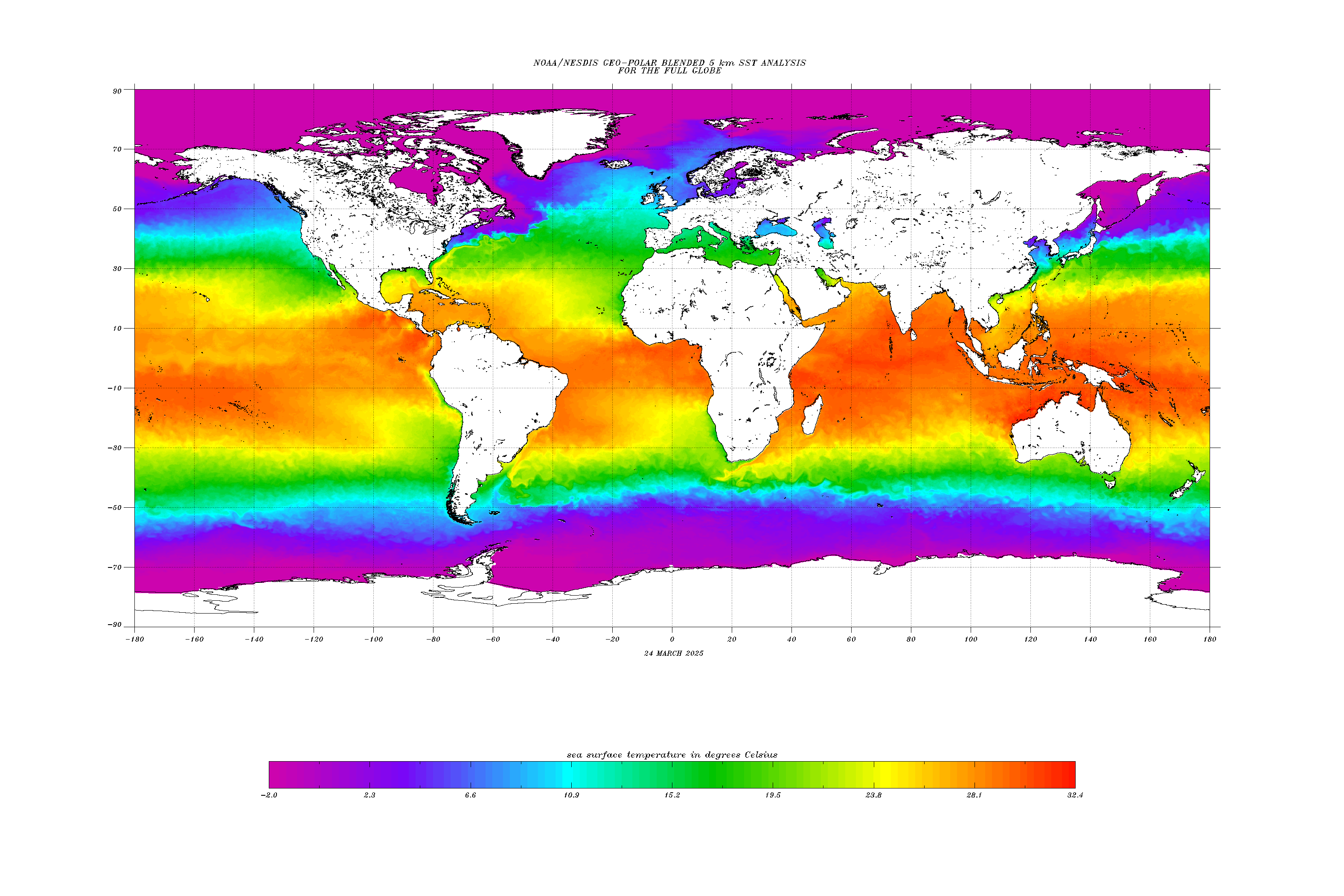
https://www.ospo.noaa.gov/data/sst/contour/global_small.cf.g...
Don't mistake "I don't understand the science" for "the science behind climate change is weak". Go out, learn some coupled atmospheric modeling PDEs, and build a climate model yourself (Claude can help). It'll only take a few days. You'll learn a lot about what's known and the sources of uncertainty.
Now, looking at the image in the article, there is a massive cold blob right there where the Labrador Current joins the Atlantic, but no mention of the theories that I've read about years ago, just that it is mysterious
https://en.wikipedia.org/wiki/Atlantic_meridional_overturnin...
If the evidence on worrying climatic events does not exist, we don't have to ignore and discredit it.
https://oceanographicmagazine.com/news/trump-administration-...
I'm joking, but apparently there are influential people who really believe it's a good idea (see: governor or Utah and his statements on AI data centers recently)