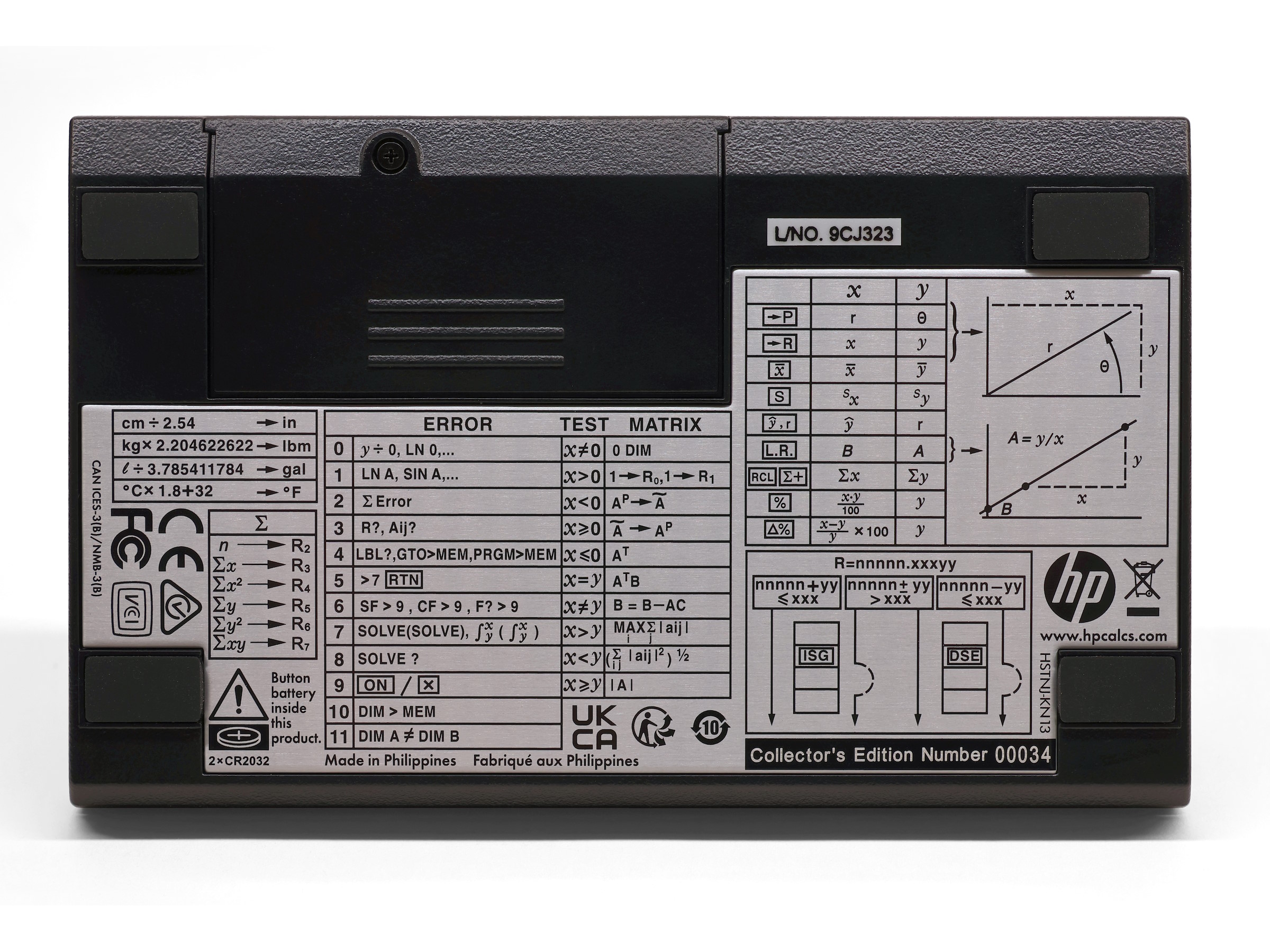
But the 15c 'Collector's Edition' had some issues, and I wonder about the build quality and reliability of this new one, too. Plus: my guess is you can get an original working 16c on eBay for less than this is going to cost.
Honestly, it pains me to say it but I'd recommend a SwissMicros DM16L instead: https://www.swissmicros.com/product/dm16l
I logged on for the first time in a while to actually talk about nerd things. God I loved the 80s-2000.
Build quality deteriorated (from impressive heights) more than 25 years ago, when HP's calculator manufacturing moved to China. Not on account of China itself, but it was definitely a cost-cutting measure, and higher-end calculators were becoming an endangered species even then. For example, keycaps used to be double-shot injection molded, so the legends could never wear out; no more, now they're silkscreened like with everyone else. The new key mechanism could never reach the robustness and reliability of the old one, which is a problem if you're used to every keypress felt in your fingertips being correctly registered.
(Not everything was premium quality. On my late 15C, the faceplate logo wore out and the soft sleeve crumbled to dust after a couple of years. But the machine itself continued to work flawlessly until an unfortunate accident with a space heater.)
Additionally, the new Voyagers (1x series) are not running on the original, custom HP "Nut" CPUs, but on ARM microcontrollers, presumably via firmware emulation. It's impressive that the whole things works so transparently, but as I dimly recall, there were problems with that emulation in the first 15C Collector Edition runs, supposedly fixed now.
So, if you buy a new Voyager these days, you're getting a convincing replica of the originals from the '80s, nothing more. Caveat emptor.
They really had no choice, Japanese brands like Casio and Sharp were making dirt-cheap scientific calculators in the '80s, I had one in high school and used it through college. The HPs were intriguing but I could never afford one.
They could have kept their standards up and sold a few to the few people who would pay for them, but that would have been a number that went down every year. A calculator as a veblen good probably would not have worked.
I do still have a mint HP48GX but never use it for the same reason. The successor the 49 had normal math as an option but it was not as iconic.
Then one day a guy some two classes above me handed me a HP calculator to try.. and the RPN immediately clicked with me, I could just enter arbitrary long calculations without ever messing up anything or having to keep track of parentheses in my mind. From then on I never looked back and I was on HP calculators ever since (up to and including the Free42 on my phone today).
I have an original HP-16C as well, I used it a lot back in the day, until calculations and transformations of hex, octal and binary was so ingrained in my mind that I didn't really need it much. It's in a drawer, but it's still good. I think I'll make some more use of it now that I'm near retirement age and just doing retrocomputing.
I've heard about the supposed loss of quality of later "HP" calculators, and I may not want to buy this one anyway (as I have an original), but I'm also waiting for someone to review the keys. The keys! That's HP calculators as I learned to know them.
RPN but also something like Gnome doesn't match. So I use things like KDE that have huge amounts of configurability. I also deeply hate processes and methodologies at work and I often ignore them leading to endless stress for my more bureaucratic coworkers :)
TL;DR, me not liking RPN doesn't mean I think it's bad. It's just not for me and that is more a 'me' thing than an RPN thing.
I'm the opposite. I can't use a non-RPN calculator. Getting the numbers out of my head and onto the stack is how I achieve clarity in what I'm doing.
I used the 49 in high school until I wore out the substandard keyboard. Then I did what I should have in the first place and bought a 48GX which I still have 20+ years later.
Personally I'm not very flexible in that way, I want my tools to adjust to me not the other way around.
But a fake lookalike 'collectors edition' of a device that can have only nostalgic sentimental value? Why does this exist? Who falls for this?
Calculators are very useful, using them is a forgotten art. While it no longer makes sense to plot anything on a calculator (I use Mathematica for that), it is still a great tool.
I have a 16C and I use it, but only when developing embedded software where I need to wiggle bits. It is very useful for that, especially with one-key switching between bases (HEX/BIN/DEC).
I can technically do the same thing with Emacs Calc, but there's something about the physical layout of the buttons that just makes sense. I suppose I could also use a software simulator of the 12c, though.
People on big tech salaries with too much money.
If I saw an original one for sale for 10 credits or less I'd probably buy it as a curiosity piece, but no more than that. I do use a desk calculator but still have my trusty Casio that I bought over 20 years ago.
I own one because a while ago I bought, one by one, iconic world changing calculators to collect. I like having physical history. This re-release seems like a very nice bookend to that collection.
I have a few 42S though so probably don’t need it.
Edit: also three 15C and some slide rules. Think I have a problem.
I bought a 15C in the 1980s, and have enjoyed it ever since. It is like a rock. Despite being treated roughly over the years, nothing is wrong with it apart from some dents in the metal parts and my name, scratched on the back. I suppose I've replaced the batteries a couple of times, but that's it. This thing just refuses to die.
The main thing is that the keys still work like on day 1. And I've never seen a calculator with keys like this, with such feedback that you never need to worry about double-presses or missed-presses.
I just love the thing. If it died, I'd buy one of these new versions in a flash. But I think it will outlast me!
This is also the thing I'm most suspicious of with all these retro remakes - it's the physical hardware aspects that get screwed up so often.
If they get this right it would be legitimately surprising.
It is probably the finest piece of electronics I've ever owned.
If this would be a 42, I would definetely buy it. My 42 is a gift from my father and time did not only good to it.
/edit switched UPN to RPN, as I got the translation wrong
Still nice to see, though the SwissMicros calculators are also very good and will be tough to compete with.
SwissMicros calculators are also now the host of a Free Software HP48/50G clone effort that is quite far along and usable already.
[0] https://commerce.hpcalc.org/images/15c-ce-back-medium.jpg
[1] https://upload.wikimedia.org/wikipedia/commons/4/47/HP-15C_C...
(These days it's stored safely away with batteries removed, so I don't use it that much anymore. For convenience, I usually just use either Droid48 on my phone, or Emacs Calc at my computers.)
In high school it was mind blowing.
But I didn't do anything serious with programming. Normal languages seemed annoying, usr/rpl useless limited as it was to a 4 bit calculator.
Maybe if someone had told me usr/rpl is just lisp. But, it's for the best. I loath computer screens today.
(Edited) Actually it's not so much the door but the housing.
Pity the international shop is down
https://play.google.com/store/apps/details?id=org.ab.x48&hl=...
If you want a concrete example of something it's good for, a while ago I had to write code to read the value output by a Neptune water meter. These meters use a very strange and inefficient signaling protocol, where each individual data bit has a start, stop, and parity bit. I had to write a program to read the data out of a packed 8-bit buffer, validate it, then convert it to a number, which involved a bunch of bit operations.
Obviously a physical device isn't necessary for stuff like this, it's more something that's nice to have than something that's absolutely necessary for low level development. For example, Windows comes with a programmer calculator but it's not programmable and it doesn't use RPN so this is a little bit nicer for me.
I doubt there are competent and cost-effective engineering teams in existence who could exactly match HP's numeric libraries in a $150 calculator that's guaranteed to sell a tiny number of units.
Learned a lot of RPN programming on those things!
I saw one in the wild a couple months back but had to say it didn't live up to my memories. Super slow and clunky interfaces compared to our modern touch screens.
I have too many calculator apps I hardly use, but nevertheless .. love to collect.
The specific ergonomic feel of those buttons remains unrivaled.
There’s a difference between this and the Casio though. It’s a pretty, limited edition display piece. These are genuinely useful computation devices, for people who like using physical keys to solve problems more complex than a basic calculator could handle. There probably aren’t that many cases where someone needs to use a physical HP calculator anymore, yet some people just enjoy using them anyway.
The kinds of people who’d want to use a re-issued HP probably wouldn’t be too interested in that Casio, and vice versa.
The beauty of an RPN calculator was that nobody asked to borrow it.
If you replace the batteries, get the good Panasonic silver cells from Newark, not "compatible" alkaline cells. The silver cells were intact after two decades.
The 16C was an interesting model. It had a lot of potential capability with the different word sizes and bitwise operations, but I think it fell short in practice because the operations it could do just weren't that useful.
My favourite model is the 15C, it got me through four years of math, physics, and computer science university classes. The integration and matrix functions were super useful because it was hard to do some of that stuff in your head.
HP started my journey so to speak :)
I also had one of those mentioned in the article, just for nostalgia. Rock solid, RPN based, lovely product. The kind of product companies do not build anymore (products that will last you a lifetime)
https://www.swissmicros.com/product/dm16c
They are more portable and really good.
I still remember the way the buttons made a nice tactile thunk as you pushed them.
If you truly enjoy collecting HP calculators, watches, computers, ok.
Else
There's a sucker born every minute.
But my 11c is still perfect.