The CSU system is going to have to to make tough consolidation decisions soon because you can't have declining urban and suburban campuses at the same time.
Is this a political coalition thing or is there a real teacher-related reason they don't like it?
As others note, there are a lot of reasons for teachers to refuse or hate AI, though in my experience most don't know shit about it and just want students to stop using it as an expedient. I, for instance, take a look at the tiny Dell cubes that have barely powered our Windows workstations and hilariously bedraggled Prometheus units and anticipate "well, we can't even afford to update these pieces of shit, so I suppose as a 'Microsoft shop' we'll be on a upgrade path to CoPilot-enabled cloud computing or some bullshit like that, then it'll really be all over" so my primary concerns are infrastructural. But god yeah the AI writing I get, jesus. These kids think they're driving around in the AI equivalent of Lambos, but free tier CoPilot is a used 2017 Chevy Cruze.
Well, of course. Horse buggy manufacturers and drivers were dead set against automobiles.
As a hiring manager, I will immediately prioritize hiring graduates of that school. I can teach someone who knows how to code how to use Claude Code. I find the other way around quite difficult.
(not suggesting this is an effective or smart move).
So peanuts.
The public universities budget in California is something like 60 billion.
This isn't even a rounding error.
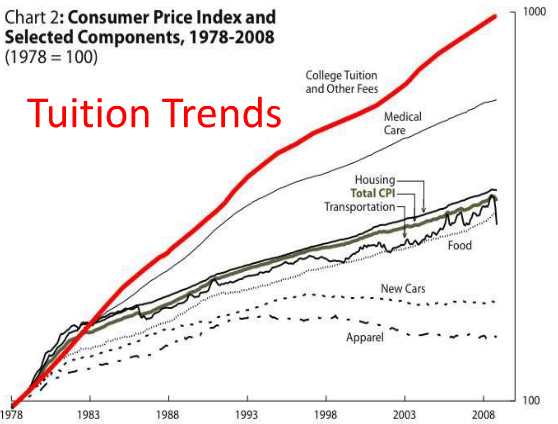
It's been literally the biggest grift of the past 50 years[1]. Education should be free.
[1] https://eliterate.us/wp-content/uploads/2011/03/Tuition.png
Sooooo... A few days of claude code "thinking", for a few hundred people?
The NYT often has a bias against AI, but the article's contents are actually a pretty reasonable summary of the different attitudes towards AI in academia. Then they went and slapped a terribly sensationalist headline on it, which doesn't seem well supported by the actual article.
This has been the case for essentially all newspapers since time immemorial. Reporters write the articles, editors write the headlines.
(* in keeping with this site guideline: "Please use the original title, unless it is misleading or linkbait" - https://news.ycombinator.com/newsguidelines.html)
The author does seem interested in supporting the headline, but I think they're too good of a journalist to pull off the outrage. It mainly comes through in passages like this:
After I pointed out to Janos that Marx himself would have had a field day with MarxGPT, he laughed… by interacting with ChatGPT, he and his students solidified its role in the public education ecosystem; and their ability to do so was the result of the transfer of almost $17 million of worker-generated public funds to a private, for-profit company.
They do get to AI critics eventually, though obviously ‘activists dislike X’ isn’t really proof for ‘X is tearing us apart[, Lisa!]’. Namely,
“We feel like a guinea pig for what A.I. is going to do to higher education,” Kenney said. The embrace of generative A.I., she went on, is “a step down the path of creating a really different kind of future citizen and worker.” This kind of student would be intellectually passive, less likely to see themselves as agents of their own lives.
This winter, the [critics at SFSU] circulated a petition asking the chancellor’s office to invest in protecting faculty jobs and academic programs rather than renew the OpenAI contract.
I don't understand why these are seen as mutually exclusive choices. I think I would be in both of these camps if I were a student.
So yes, both attitudes are simultaneously possible.
But since that’s not going to happen it’s in everyone’s self interest to use AI as effectively as possible.
It’s the world’s biggest Prisoner’s Dilemma.
it's okay to be in multiple camps when things change fast. its a survival instinct.
Isn't this one of the better uses of AI? Any librarian would have knowledge gaps and bias. Librarian-provided info is best-effort and not considered perfect. They're librarians, not subject matter experts. An AI could give (and cache, since books don't change) summaries of any book, and compare them, far better than a librarian except for niche areas a particular librarian might have read themselves.
But now ...? For STEM, at least, everything is digital. You don't need to go to the stacks to get an old journal article.
And yes, it's sad, and it feels like an era is ending. But that's because it is.
Why is it always the same kind of intellectually challenged people who need custom avatars?
https://www.youtube.com/watch?v=9YOEEpWAXgU
“Our professors were pretty anti-A.I., and then C.S.U. signed the contract with OpenAI and things changed,”
Ok, another corrupt university run by bribes.
This reminded me of back when it was popular on websites to use transparent video to have owners of companies virtually "walk" onto the webpage and talk directly to the user. Stuff like https://newimagemedia.com/videopackages/walk-on-spokesperson... There's a similar awkward period right now as people try to figure out AI.
What are we even doing here?