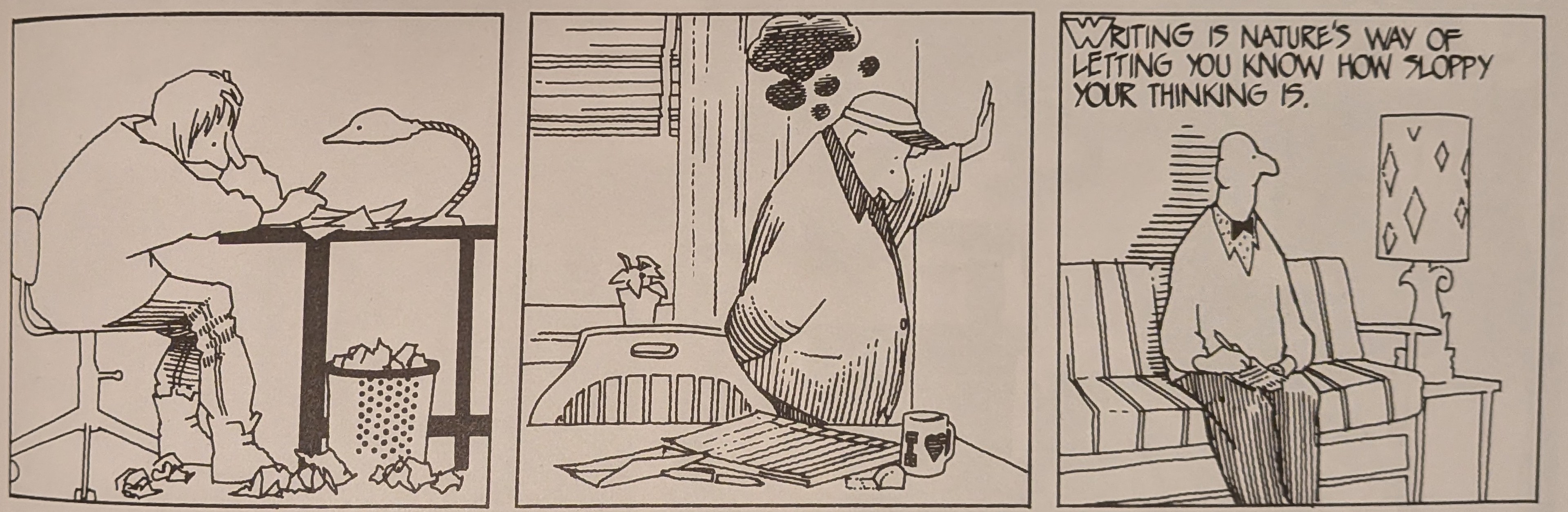
- Ira Glass
When I am teaching anyone any of these skills, the first thing I say is “are you ready to be bad at this for a long time?” Sometimes it catches people off guard. On the other hand, if someone says “yes” then I know that they are going to be a good learner.
I eventually got rather good, albeit slow, and now can easily finish a wall where you can’t find butt or tapered seams with a flashlight, with minimal sanding. It took many hundreds of hours over the years, and a clear idea of what the bar was, for me to get there. The results still bring me joy, but more also the intuition built up around working with mud translated to a quick ramp up for more ambitious projects with stucco and concrete.
And they had these minor-superhero things they could do.
Like he could hammer around a corner. You would think it wasn't a big deal, but he could put wire staples places where a beginner or a fancy staple gun couldn't reach.
Oh, I love this so much. It communicates so many important things in one go.
My kids must be absolutely sick of me saying in a dozen different ways "you just have to do it a lot."
This also reminds me of how I've often responded when people ask me about learning to code. I ask them if they're ok with sitting in front of a computer for many hours.
It sounds obvious, but most people (in my experience) simply aren't ok with that, and hadn't considered it.
I have done quite a bit of painting and caulking for a guy who's not in the profession. I despise both with a passion, though, especially caulking, and I have never once been satisfied with a single paint or caulk job I've done. I feel like I'm the embodiment of "be bad at this for a long time," although I'm objectively probably halfway decent at it.
That is to say I think Ira Glass' quote of "You've just gotta fight your way through" to get where you want to be seems especially meaningful in the context of something like painting, where most everyone _can_ do it (or writing / storytelling in Ira's case), but very few are actually good at it.
That is, verifying a solution is much easier than finding it!
P != NP
I think most of us have experienced this. I consider myself an above-average writer and I absolutely hate everything I write.
But the problem, for me anyway, is that it's exceedingly difficult to know what to work on next in order to improve. In that regard writing is entirely unlike a lot of sports.
My throws are bad? Better throw 100 passes a day, every day, until my muscle memory is there. I'm getting beat deep? Better work on my fitness. Maybe I'll never get to where I want to be, but at least I know why.
But improving one's writing is seemingly impenetrable, to me. I read what I write and it sucks but I have zero intuition about how to un-suck it. I fucking wish I could write like Heller, or Didion, or Tolkien. Not even in terms of writing novels but just the quality of their prose.
In the beginning it's great to practice your art by yourself with lots of safety, but sooner or later you're gonna want to to ask the public/community at large what they think of what you do, so you can get external feedback from people other's who love the same thing. I think this is probably the only way to actually get better, you need to connect with other people around it, and get their point of view. I've found this true for any creative endeavor I've tried to get better at.
Receiving criticism is probably as hard to get good at as giving criticism, so don't let the harsher stuff get into your skin as some people aren't so good at giving criticism, but you'll find lots of other useful advice that you'll agree with, and find directly actionable :)
Even if you don’t improve for 100 days straight, small successes accumulate. In a decade you will have transformed yourself.
There is just no way you won’t improve significantly if you keep trying new things and bring yourself to fail ever day.
What helped me was the saying “your first million words are gonna be shit”. I still distinctly remember, four or five years into writing every day, when things finally clicked, my voice came through, and my sentences became fun. It is delayed gratification to the max.
listening to narrations of vast variety of poetry and narrating something yourself will help you develop your specific voice and read with more intent.
you may not even need the "science of writing" this article describes. let yourself just... be with text.
How do LLMs do it? They don't learn by writing a lot they learn by reading a lot.
Does anyone truly think we’ll have another generation of nerds hacking away for hours by hand to hone their trade? Or will it turn into a craft like woodworking?
One of the worst parts of software is that you develop this deep expertise in something that has less to show for it to people than a guy dicking around on a guitar or someone who made a stool after 40 hours of experience.
People aren’t decompiling their iPhone apps to admire your handiwork and evaluate how thoughtfully you modeled the domain.
Will artisanal human-driven taxi drivers exist in the future? No, Waymo is even more expensive yet people prefer it. The human aspect turns out to be a liability and less of a human expression people would go out of their way to experience.
Damn, on point. So hard to go over that hump but so worth it, every time, in retrospect.
> "The secret of the creative process is in 98% of sweat, 1% of talent and 1% of luck."
That would not make me hate writing less.
That turned out to be the best life experiment we ever did together. They are teens now and dealing with far more writing every day than just a couple of paragraphs. The other day I found some cards they've written for Father's Day and other holidays over the years, and I can't even tell you how impressed and proud a parent I feel whenever I see their writing. That single skill manifested in improved overall literacy and discipline. My daughter received the Presidential Award of Academic Excellence. My son was accepted to an elite college with a scholarship. He's a competetive swimmer with dozens of medals. His team competed at the state level and even set state records. They are going to be fine. And the only thing I had to do is to teach them to face the thing they hated doing. One paragraph a day.
what country do you live in where this is a normal thing?
The comic has been quoted online many times, but I had to buy an old copy of Michigan So Far on eBay to actually see the comic: https://25thandClement.com/~william/links/img/Writing-Guindo...
I (now) fondly remember getting my first English paper back as a hs freshman with an F. Shook me to my core. I had, after all, gotten into this good school as one of the select few. That was a good lesson and it's served me pretty well.
Often it forces a clarity that only comes from writing ideas down in a way that's necessary to explain your results to your peers.
The process itself sucks, but the outcomes are often quite satisfying and rewarding.
Nowadays the intro/motivation/problem statement / related work (citation tax) / formulation/<actual results> / simulations / conclusions / futurework format is just soul crushing.
Today there is much more research being done and published, and fully reading a paper is a special case. Papers are now more structured, and the primary use case is quickly skimming over the paper to determine if it merits more thorough reading. (Usually it doesn't.)
But I actually do think it's good to force people to think about the "why" question a lot.
1. Write stuff
2. Make it better
3. Continue with step 2
It even is an algorithm.
1. Write down the problem.
2. Think very hard.
3. Write down the solution.
With science writing, in terms of published papers, this makes perfect sense. You want to avoid imparting your own biases and interpretations in favour of letting the data speak for itself. That means the author needs to quite severely “step aside” from a literary perspective.
What's the null hypothesis? Is it possible to disprove your assertion?
Some things that I have learned from of them:
Write for yourself first and get to the end. Rewrite to add in all those things you didn't put in the right place the first time.
Speak at least the dialogue out loud. Spread the description around.
Read some of the worst to remind you that even they got published. Copy the greats for practice on dialogue, or description or whatever you want to work on as deliberate practice.
Try different things like write your story as a game, or a puppet play, or stage play, or screenplay, or radio play. Draw a storyboard or animatic. Go to the park and write what you see. Have your characters in a room together and eat a pie.
However, I wonder if this workshop is still relevant in the age of LLMs...?
'Write shit. Edit it. Repeat.'
What a disappointment.
"Sucking at something is the first step towards being sorta good at something." - JAKE THE DOG"Good" Fiction writing is an inaccurate science but has a similar trajectory to what the author went through. To become good at it you _need_ to read other people's works (the good AND the bad stuff) to figure out for yourself what makes that writing stick out to you, and you need to learn to love to edit, and to show people what you did.
The most time consuming portion of the writing process is the editing process in my opinion. It's also my most favourite part. You take a half-formed idea and you cut. And you tweak. And then you cut some more, until paragraphs start to take the shape of the story you actually wanted to tell, and sentences become so load bearing you can't remove any of them without altering everything around it. It's a puzzle with no real "solution" other than what I feel works.
Really, it's only after I kept at this for a while (and put things out there and didn't get bad comments at all!) that I started to get a little more confident in myself and begin to go to writing groups and such. It's hard work but it's worth it, just like any skill.
It was through the language of English that I got to love writing and reading (mostly Audible). It was Writing in a Foreign Language again, but this time, it fitted more to my style, also because it’s straight to the point and you have so many of the same words to explain a specific sentence so well. I wrote more at https://www.ssp.sh/brain/writing-in-a-foreign-language just in case of interest.
Except there usually is a right answer, only it tends to be buried under several layers of “how do you want this to be interpreted?”
The one thing I have learned about writing is that the same sentence can have wildly different interpretations between people if it’s written sloppily enough. Your core meaning could still very well be there, but because the prose was sloppy, it opened the door to alternative interpretations that you cannot control.
Now sometimes there is no way to refine it further. But most of the time it can be.
And then, even after sharpening the prose, you need to take your reader into account. What works for an adult might not work for a teenager. When I was a kid, I remember having a doctor in the hospital ask me if I was nauseous, and I replied, “there is nothing wrong with my nose”. I had never come across that word before, and associated the sound that went into its pronunciation with the closest other word I knew - the word for nose. The doc had failed to take into account people with a more limited vocabulary, setting up a chance for medical misinterpretation - I had indeed been sick to my stomach, but because he didn’t ask about it in those simpler words, he almost didn’t learn about it.
Writing is even more bereft of context, and so you need to not only sharpen the prose to cut off undesirable paths of interpretation, but also write for what your audience knows. And sometimes this can be one hell of a rabbit hole in of itself.
I always thought that even very small children knew that. If someone wasn't aware of this for years even after many attempts, I wouldn't trust them to do any sort of research.
Somebody should have put a red line through every word of this.
disclosure: I used the science of editing this comment after writing it.
Storytelling is something that connects science and the science of writing for me. I've received advice to tell a story when writing scientific papers, but I haven't heard a concrete and sufficiently complete explanation of what that really means. For example, when describing a new model, what is the story you tell and how do you tell it? A book I find useful on the structure of storytelling is "Beginnings, Middles & Ends" by Nancy Kress. It helps me think about how to tell a story in a scientific paper, even though the book has nothing to do with that.
- Use a word like "science" to lure in the geeks
- (you don't even need to know what science is, its ok)
- Some of the geeks will push your headline to top of HN just because it had the right word in it
- Put some filler about life being hard in the article, so those who actually read it have to waste ten minutes of their lives (proving your point).
- Profit and glory!
Make a first draft that is bad, and improve it from there.