When my son, a pre-teen at the time went to Spain with me, things were quite different: A small town that even had stores targeting kids, places to sit everywhere, things to see, other people walking too. He could even go to the beach and be fine, as there's lifeguards. By the second week of the summer, you'd see group of new friends hanging out with no parents, just going back home for meals and sleep.
Build environments where children can be independent, and they might even want to be. But it's amazing how much modern-ish suburbia just has no place for you to even exist without a car.
That's not even the issue. Suppose that more people wanted to live in a city than currently do. The market implies that -- the price per square foot is higher in cities.
And that's the problem, when the city isn't allowed to grow. The existing city already has tall buildings, so if there is more demand than supply, to create more of it you need to add more somewhere else, i.e. build some taller buildings where there are currently suburbs. Which is the thing that's banned.
But then more people can't move into the city, even if they want to, because the units in urban environments are already occupied and converting more land to urban developments is restricted by law. So the existing units get bid up until the price difference is high enough to deter people from living in the city and everyone else has to live in suburbs or rural areas whether they want to or not.
A lot of small towns, even in the US, offer such things. Towns far from being a city. It should be more common though.
It's trendy to blame cars for this but the problem is fundamentally zoning. It's not that there is nowhere for you to exist without a car, it's that there is nowhere for you to exist there at all, and you thereby need a car to leave the vicinity in order to get anywhere you can.
If you want to build a cafe or an arcade or a hackerspace out in suburbia, can you? That's not even about density. If you could put those things there then people would and there would be something kids could walk to. But everything other than residences is banned, so of course there is nothing else there.
Peaceful quietness is so overrated by US and northern Europe. It feels creepy and dead to me, a liminal space.
Besides, modern insulation does wonders for blocking noise if that bothers you, not to mention the savings on your energy bill.
I want my streets to feel alive!
> you thereby need a car to leave the vicinity in order to get anywhere you can.
I hear your point but I think your causal model is misguided. It's two different things augmenting each other, not "one is a more primal cause than the other" (in my opinion, anyways). Like yes road diets in the suburbs won't 'solve' the problem by themselves, but the impact of the zoning changes you're pointing to may also have the impact of reducing car dependency in the area (although not guaranteed, I've seen USians drive even just half a mile). Cars collapse distance, and zoning policy eats up those gains greedily. SFH zoning spaces everything 10 miles apart, so all the residents buy cars because there's no alternatives. It's multiple threads reinforcing each other; I think if you dig into the ""trendy"" anti-car arguments you will find a lot of backing for mixed-used zoning policy as well because both types of changes are needed at once.
Is there a formal measure or comprehensive view on that question?
I lived in Manhattan (NYC). Walked a mile at a time (or more) without thinking about it. To/from work, in cold, in rain, etc.
Now I'm in NYC 'burbs. The train is 1.1 miles from my house. I walk that distance on occasion but not often. My wife drives to/from train most days.
Town is also 1.1 miles from my house, near the train. My daughter is about to be 8. I'm not far off from letting her wander into town on her bike (or on foot), but it's anywhere from a 10/15-25 minute journey depending on how fast you walk/bike and how often you stop.
I also live in what feels like a dense suburb. Many houses close to each other. Example: https://maps.app.goo.gl/KBcvG5vnnh48hGwY8
So, I think there's a difference between nothing to do and it's "close" - whatever that means to you, and there's nothing to do and it requires a 30 min car ride.
Those latter suburbs aren't far from me, and I grew up next to one good example of a suburb w/large houses and nothing much else (Dover, Massachusetts)
It may partly be psychological: in 'the city' there is human activity and you do not feel isolated, and you feel part of societal activity.
> I also live in what feels like a dense suburb. Many houses close to each other. Example: https://maps.app.goo.gl/KBcvG5vnnh48hGwY8
LOL: have you noticed the lack of sidewalks? Here are some examples of what is a "streetcar suburb", which was developed in the 1890s/1900s:
* https://www.google.com/maps/place/50+Geoffrey+St,+Toronto,+O...
* https://www.google.com/maps/place/150+Geoffrey+St,+Toronto,+...
* https://en.wikipedia.org/wiki/Streetcar_suburb
* https://en.wikipedia.org/wiki/Streetcar_suburb#Toronto
* https://en.wikipedia.org/wiki/Roncesvalles,_Toronto
A good portion of these houses were built before the car was invented, and while many folks park on the street (you have to pay for a permit), there are also lanes and garages for many of them. A couple of schools with-in walking distance, banks, churches, library, shops, etc.
Having exciting destinations helps, but children are perfectly capable of making their own fun.
Whether that can compete with the modern day "pre-made" fun of YouTube, Roblox and the likes though? That's a different matter.
We _have_ built these environments, you just choose not to live in them. Move to a city or other urban center. Your house might be smaller, and you might have to take public transit sometimes, but you will be happier and there will be no shortage of places for your kid to walk.
Those were for accompanied children because San Franciscans adapt by helicoptering their kids to keep them from dying whereas I saw unaccompanied kids in Taipei everywhere and Taiwan is a basket case for fertility with a 0.7 TFR.
If we move out of SF it will be because the compensatory mechanisms required to keep my children alive here will overwhelm their freedom. But if there are cities of the Asian or European form here where children under 12 can independently move around then I’d love to know from someone who also has children in such environs. Often, online, people provide advice on this subject while being childless themselves and that’s not useful to me.
NYC and Boston seem like the only east coast options and those are very expensive. What other options are there on the East Coast?
Tourism also balloons real estate prices even more than is usual everywhere nowadays.
But the children friendly aspect of society described above is 100% true. It hasn't degraded at all compared to when I was a kid.
I'm Italian so the situations is similar if not worse back at home.
This is an important point. In my hometown, I spent a lot of time playing in vacant/double/unused lots. Those lots are all gone and have been turned into parking lots or mini-McMansions. It breaks my heart every time I visit my parents' house and I see that our old soccer, football, wiffleball field and all of the trees we used to build forts have been replaced by cheap houses whose lawns are covered in a rotating cast of inflatables.
I can't fault the landowners for cashing in on their spare property but it would seem that the town could do with more localized parks. If anyone has been to Alphabet City in NYC, a lot of vacant lots were turned into community gardens and they're incredible little oases to stumble upon and relax in for a few minutes. I wish the town had had the foresight to do this with some of the aforementioned lots.
This is a major aside but another major change is that >50% of the trees which used to dot my hometown are gone. They either fell, died or got in the way of the power lines and were not replaced by the town or property owners. The streets all used to be covered in leafy canopies, everybody's houses were a few degrees cooler and all of that wood prevented a lot of the noise pollution from the Metro-North and I-95 from making its way through.
Well, say what you want, but the communists knew how to build neighborhoods.
Between all buildings there was always a 30-50+ meters green space with benches, places for kids to play, walkways, etc.
I remember in the early 90s how lively and safe it was. People spent a lot of time of the day outside. Grandmas had their benches, looked the kids, play, adults would gather and have a drink, etc.
Today? It has all been swallowed by cars. As progress and money came the entire neighborhood has been swallowed by cars. Kids are confined in a single area. You rarely see people outside. People sit at home.
For reference, this is my old neighborhood, albeit the street view is a decade+ old (half the areas are from 2013 because since then entrances to cars have been gated and are only for private cars), but if you stretch the imagination and try to put people around and benches and kids playing areas you can get the sense:
https://www.google.it/maps/place/Osiedle+Kopernika/@49.81596...
This is very bizarre to me. I never once thought about a chair as a child. _If_ you got tired you just took a seat anywhere or just laid down.
An empty lawn was the perfect place to play any number of things. Even better was when 2 empty backyard lawns connected and there wasn't much/any landscaping for some really big activities.
Towns and cities with less car dependency more gracefully transitioned into the post-internet world, where 3rd places and community are easy to maintain since the library/bar/office/school is a 5 min walk away.
It would be cool to live in a very dense Tokyo kind of place though. Tokyo is like a playground it is awesome!
When I was growing up in the suburb, there were kids outside all the time. Yes, some friends lived across town in another suburb, but we just biked there instead of walking.
Now when I visit that same suburb, there are no kids in sight. I still see adults of parenting age, so I assume there are still children in the neighborhood, but they're just indoors. The density of the town didn't change, but rather people's attitudes towards where kids can and can't be seem to be what changed. I also suspect the declining birthrate and having fewer kids is contributing to the problem too.
My 5 year old bikes to school, accompanied by an adult. It’s a bit more than half a mile away from the house.
I’d like to tell him he can do this on his own next year, but there’s a single intersection he has to cross that makes this difficult.
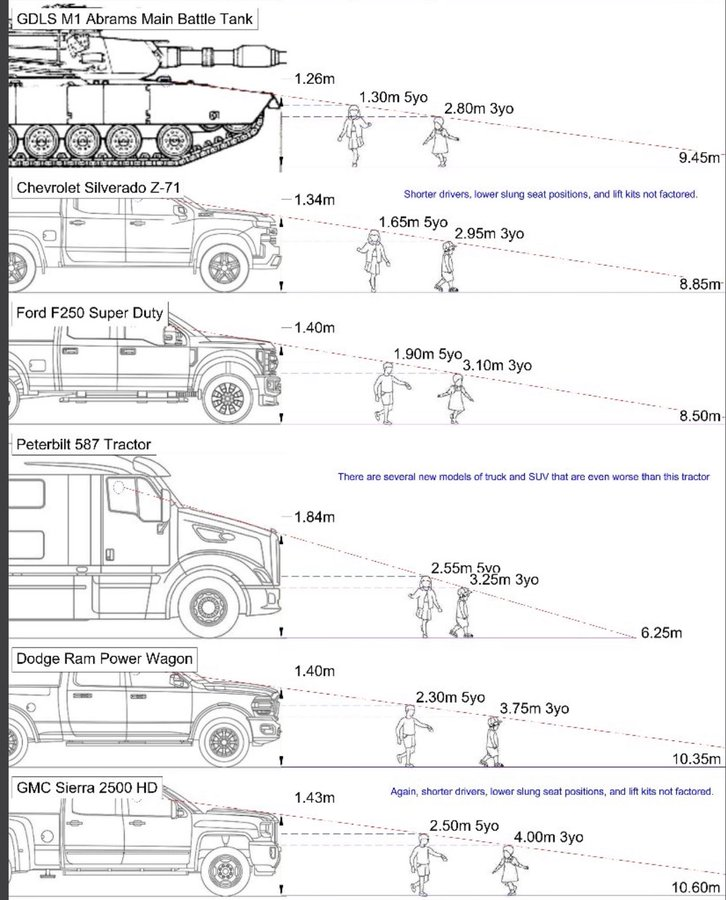
I’m not worried about him getting lost, abducted by a stranger or any host of movie plot scenarios. I’m worried about vehicles. Specifically pickup trucks and SUVs.
40 years ago a 5 or 6 year old mostly had to contend with sedans with hoods lower than 30 inches. Today there are large numbers of vehicles twice that high, where even an adult can’t look the driver in the eye at close distances.
The Insurance Institute for Highway Safety says:
Vehicles with hood heights of more than 40 inches and blunt front ends angled at greater than 65 degrees were 44 percent more likely to cause fatalities.
I’ll probably let him bike alone anyway. But it’s a different equation because of the cars.
In another comment a few days ago I reminisced about how I was let running alone for hours on end when I was very young, and how that was normal.
It's a bit hard to reconcile both events now. I gained a lot of independence and had real unrestricted fun, but in hindsight I might've died a few times.
My idea, even if it might be traumatic, is to show the kid a few clips of people being hit by a car and getting mangled, with all the gore visible. Especially people following the laws and being careful. I miss /r/watchpeopledie as it was actually very educational.
Yeah, that's called living! I definitely got myself into one or two dangerous situations growing up. I couldn't imagine a childhood where everything is safety railings and padded walls.
If you want something with a gut punch related to car safety, check out British vehicle PSA advertisements. Holy moly are those grim! They’re memorable, focused, and unflinching.
Personally, I’d go with some mini-documentaries or after-the-fact breakdowns put out by local American TV stations. They take it slow, film on location, and try to have a takeaway lesson.
The onus here is on municipal and federal governments to make roads and cars safer.
When I was young my dad took me out to the curb and warned me about the dangers of being on the street. He pointed out how fast cars were going, how being hit could be really damaging, how animals not infrequently died from being hit. He also warned about getting excited while playing games and inadvertently running into the street. Even bicycles were a danger. Everything changes at the curb. Having a good imagination, I took the lesson to heart.
How much of our "safety" culture around kids is because people don't have basic life skills and aren't passing them on to kids?
"Safe Routes to School" are programs in the US and there's one here in Washington; Seattle has their own partial adoption of this, and I'm hoping to lobby my suburb into adopting it as well.
The school principal won't allow my son to walk home alone because of the traffic, but the traffic is only present because so many parents drive their kids to school.
i don't know how true this is. residents care about the speed of cars. the trend in government is more holistic public land allocation (ie street design) in almost all growing communities.
they aren't tall enough to roll over the top, even a smaller sedan.
being defensive around stupid people is a lesson, teach the child to always be aware when near a road.
No wonder kids are being made to make do with alone time on digital devices. That's all we have left (and they're trying to control that too, for good and bad reasons).
> Vehicles with hood heights of more than 40 inches and blunt front ends angled at greater than 65 degrees were 44 percent more likely to cause fatalities.
I'm not sure that height matters for a young kid and, 40 years ago, there weren't abs and sensors that will brake for you. Plus, drunk driving rates were much, much higher and the vehicles were significantly heavier.
I don't have any insight on the answer but I'd be curious if the rates of kids dying as pedestrians/cyclists have gone up (per mile, which would be hard to track down and sway the numbers significantly).
ABS in aviation goes back to the 1950s in planes and the late '60s in cars.
It’s a perfect example from the article. “I totally would let my kid leave the house, but [made up danger]”
It’s too bad the district no longer lets middle school or high school students do crossing guard jobs anymore.
It's a bit of a meme/trope to observe that an M1 Abrams tank has better forward visibility than many pickup trucks:
This is a big one for me. Not that long ago I just about got into a fistfight with some asswipe who drove his Ram through a crosswalk in a school zone, while children were crossing. With a crossing guard.
And somehow he thought I was the jerk for flipping him the bird as he went through.
In practice, if somebody is right in front of my grill where I can't see them, they were close enough for me to notice them before they got there without me having to be on high alert for people.
I'm not putting this here as a truck-vs-car thing or whatever, I'm just trying to people a realistic idea of where the blind spits are that actually cause trouble in my experience.
Why? It's not like drivers have to pay up when they hit someone, as long as they weren't drunk. And in the unlikely event that a driver does get made to pay the big risk is medical bills, so the incentive is to make sure the car is set up to always kill anyone they hit.
And I consider myself relatively lucky in that part of the US where I live, despite being in a relatively rural region, is remarkably walkable. As opposed to most places in the US, which are effectively micro islands when it comes to getting anywhere on foot.
Then lets also add on how loitering is treated as such a great offense. That traditional areas for young adults to just "hang" (cafe, bowling alley, arcade) have increasingly priced them out. That a teenager hanging out on their own is often suspected to be "up to something"
In a time before the cell phone, we apparently let kids wander unsupervised more than we do in an era where they can get a hold of their parents at almost any time? It's ludicrous.
Maybe I was lucky to not get severely injured or abducted, but I do feel it helped me become a more resilient and independent person. I moved out of my parents' house at 18 and never had to go back for more than a few weeks. I have persevered through a widely varied array of very difficult situations.
In some ways, I'm not sure I would've made it as far as I have without those experiences as a kid. Of course, maybe I could've done even better if I had stayed home and studied more, and maybe avoided some of those difficult situations? But I am glad to say I am okay with how things turned out.
I definitely believe overly sheltered kids are missing something important. There is a better balance we can strike, I think.
Only solution I found was to move in the middle of nowhere and buy acreage. No other kids but at least the Karens can be trespassed and the child snatchers are too underfunded / too far of a drive away for them to bother us over a sad faced Karen calling.
The other option that's really going to piss some people off when I say, but matches my reality, is living in a few ghetto neighborhoods when I was broke there were literally so many single moms that the child snatchers could not possibly punish all of them and the kids roamed because momma was at work and they were protected from the Karens/CPS by having critical mass.
Like you, it wasn't always easy, but I think made me a stronger person overall.
When the statistics are vastly in one's favor, it isn't luck.
You fell for the trap that caused this whole issue, you were about as likely to get abducted as struck by lightning.
Existing without spending money works a lot better when you perceive and comply with social norms. At a mall, you're unlikely to meet loitering enforcement for reading a book in the food court all afternoon while sipping a drink you brought from home. You can meeting your local walking club there too and walk for miles chatting without purchasing anything -- if you're not bowling over the shoppers.
But if you camp out in the entrance of the mall and roughhouse with your highschool buddies, your antisocial behavior will drive away customers. Perhaps you can't perceive this, or perhaps you do perceive it but don't care -- either way, once you're making shoppers uncomfortable, you're a strict liability.
This doesn't mean you can't be kicked out for other reasons. But you get a lot farther if you play to your audience.
My guess is that combatting gang crime was a major reason.
I was online in that age group by the late 80s. Just as in your story, that started me down a path of not going outside as much, even though the other kids would be outside doing outside things. Why would I go out and play basketball or something else I didn't like when I could instead be online talking to people with shared interests?
The summer I was 16 I spent more time away from the computer, hanging out with other teenagers I met on the computer, than I would have otherwise.
> [...]This evidence tells us something important about human development: children want to explore together and build independent peer cultures that are partially distinct from the ways of adults. Yet since the early 1970s, many Western countries have increasingly limited the social and physical independence of children.
> In physical spaces, we restrict the movement of children and refuse to let them play and explore without us. But that doesn’t mean they won’t look for ways to escape.
> In the past two decades, children have found a new place to roam: the endless jungle of the internet.
https://psyche.co/ideas/have-online-worlds-become-the-last-f...
The norm in the 70's was for younger kids to have multiple groups of friends, at least until they were old enough to ride their bike across town.
When you spent time with larger groups of kids, like at school, you could make friends based on shared interests.
After school, your friend group was based on proximity.
They might not be amazing friends, or life-long ones, but they were friends.
The Wikipedia page on Loitering [1] is wild. A surprisingly large number of places seem to have criminalised "just existing somewhere".
I have been arguing for almost my entire life, as a European immigrant, that built environment and automobile sprawl shapes relationships and cohesion. I was constantly dismissed and told that these are superficial differences, that people are just as lonely in dense, transportation-rich urban jungles, and that motivated people in the right cultural context can defeat any environmental obstacles to friendship and connection.
I hope the tide on that is starting to turn. Built environment isn't everything, but it's a lot.
The biggest difference, imo, is the number of families.
I lived on a small street with a cul-de-sac. Maybe 35 houses or so. At least half had kids aged 0-15.
I now live on a street about the same size with my kids. There is one house with ~7-10 year olds, two houses with 3-5, one house with a couple of teens, one house with a baby.
Nothing else really matters, you can't expect kid communities to self generate at these densities.
This is a big factor. Although the gender side of things is kind of loaded, it used to be broadly the case that a two-parent household would often have one primary breadwinner and one home-maker. Nowadays, both parents need to make money which means that the 'home-making' needs to be done after both parents have finished work. So at 6pm, you're cooking, not hanging out at soccer practice. After that, you need to do the washing up, hang out the clothes, etc. There's just less time for leisure. On top of that, there's a lot of folks (probably some of them reading this comment) paid very well to keep folks indoors consuming, instead of outside meeting people.
When I was young, that block had maybe 1-2 cars parked on the street, visibility was good and you could kick a football and ride bikes out there safely. When I visit now, there are so many cars that it's sometimes hard to find a park. I would guess the bulk of it is residents who don't want to shuffle cars in the driveway or have their garage full of other stuff rather than the cars.
I would not want my kids playing out there unsupervised.
In addition to not having practice as you said, my thoughts:
1. Camera phones and social media have trained all young people to be aware that anything they say or do could be reported on
2. A lot more overt moralizing about power, gender, and race dynamics by young people makes people hesitant to interact outside of their group
3. Racial and cultural diversity have increased, and people don't reach out across those barriers as freely and easily as within their own homogeneous culture(s)
Yeah, big trucks have started showing up in Norway too unfortunately, it's making it much harder to keep our environment of freedom and responsibility :(
https://cdn.masto.host/federatesocial/media_attachments/file...
That didn’t stop me from biking and exploring all over from age 6-7, which seems unthinkable now. I think it was mostly just more risk tolerance and less flashy warnings about danger. Like my dad biked around the same block so why not let me and there was not much more thought given to it.
Your suburb sounds nice but I guess Im just saying that level of community wasn’t necessary for kids to have freedom.
I’m convinced that’s more of the explanation than we realize. Adults in a lot of places move about almost entirely by car and often look down on other modes of transportation, to the extent that having your kid walk or bike while you have a car in the driveway seems wrong, like if you shopped at Whole Foods for yourself and fed your kids on gruel.
However a hefty portion of that accident reduction is attributable to other safety improvements. Cars are far safer now than in the 70s, so are kitchen appliances, electrical outlets, playground design, etc.
And at the same time, child suicide rates are way up, which research attributes directly to the decline in independence.
We joke about having a main child and an emergency backup child, but deep down it's not a joke, it changes our behavior.
I've seen it too many times: CPS or COPS (!!) called on children "unattended" outside -- even when it's really obvious their parents are watching through a window. Let's ALSO not gloss over the fact that CPS & police are used by neighbors to harass each other.
Let's say the simple truth: *US Culture is a literal abomination and its getting worse not better*
most parents can, its just illegal now.
But that pressure is on the parents too. There's this weird two-way feedback loop.
Single child household has made parenting culture neurotic. Because if you screw it up it ends your entire bloodline.
But the neurotic attitude makes child rearing feel like such a burden, people can hardly imagine doing it more than once...
I am told this attitude does not produce beneficial outcomes in the children either. Apparently people grow up healthier when their parents are relaxed.
(We get a babysitter for our dates, but they're too scared to leave their kid -- no judgement... that's just how it is).
Even going from one child to two.. suddenly you don't have numbers on your side in dealing with things.
But, that overprotectiveness is very much an American phenomenon - exported a little but not that much yet.
Damn, I'm glad I got to grow up then.
"We've planned a trip to the woods for next week, it's expected to be minus twenty Celsius so please make sure they have appropriate clothing, hats, gloves, boots. Also we will have a fire so make sure they bring some sausages and a hunting knife so they can cut sticks for the fire and to hold the sausages over the fire."
No. 2 son came home with a plaster on his arm after one such excursion, I think when he was about ten, and explained that one of his friends had been careless with his knife. There was no drama, the teacher carries a first aid kit for precisely this scenario, his friend was firmly told to not be so stupid, and the teacher used it to explain to the class why knives need to be properly handled.
When I was a child, I always had with me a multi-tool Swiss army knife, including at school, because I was very frequently building various things, or disassembling others to see how they were made. That early experience was very influential in becoming a successful engineer.
Decades later, as an adult, I was astonished to learn about the so-called "no tolerance" policies of many US schools, where the possession of even a small knife or even of less dangerous tools may be a reason for severe punishment.
Obviously, as a child, starting with the second day of school when 6-year old, I have always gone to the school and back, every day, alone, even if initially that was about a half hour of walking and then the later schools required long commuting by public transportation. Also none of my colleagues have ever been brought to school by someone else, and like me they did not have any contact with their parents since morning till late in the afternoon. All this was considered normal at that time.
In high school, many kids had rifles and shotguns in their cars to go hunting after school. Then we were old enough to keep our mouths shut haha.
200yr ago they'd have used some Victorian morals bullshit or religion to the same end.
When I was a boy I wanted a pocket knife b/c a friend got one and I saw it as useful. My Dad vetoed that until....I joined the Boy Scouts! Mom paid for a new official BSA knife along with the uniform. I promptly cut myself once with the knife, despite warnings from Dad. Doing so is a rite of passage for a knife-owner, I believe.
Fast forward to today. I've almost always carried a pocket knife and found it enormously useful. For my ~30th birthday my Dad finally bought me an Uncle Henry's 3-blade pocket knife about 3" long. It is finely made, always sharp, but difficult to fiddle with and not really very practical. I think of it as his acknowledgment that I am ready to carry a knife!8-) I'm glad I didn't have to ask him for a penis, though!
That little knife always sits atop my file cabinet. Someday I'll pass it along to someone else to perplex them. And I carry a folder of my own choice in my pocket.
Stuff like training wheels, bike helmets when you are just doing leisure rides. Don't get me started with bike helmets, people wear them and do risker things, drivers drive less careful around them, and you get a false sense of superiority instead of being more careful. If you're on the road/off roading, sure, but now you can get fined in some place for not wearing is one small example of safetyism taking over.
Don't get me started with bike helmets
I'm someone who advocates for rolling back helmet laws because they decrease ridership, but helmets are a fantastic example of reasonable PPE, not overactive safetyism.
A form that is still extremely rare. No-one seriously advocates helmets for car passengers, for example, even though the injury rates are very similar.
> be hit by a car
Cars don't hit people, drivers hit people.
> They don't prevent you from doing anything you would otherwise do.
They're annoying enough that they do, in practice if not in theory. To say nothing of the fact that drivers pass you closer and more dangerously if you're wearing a helmet.
> helmets are a fantastic example of reasonable PPE, not overactive safetyism.
Quite the opposite.
I usually wear a helmet but am opposed to such laws not because they decrease ridership but because they decrease our freedom to do stupid shit.
Sure. They should be widely available, cheap or free for kids, public awareness campaigns funded, etc.
> not overactive safetyism.
Not once they devolve into laws. That would be overactive safetyism with the second order effects worse than the cure - as you note earlier in your comment.
I know I simply stopped riding my bike altogether once my mom decided (as a young teen) out of the blue helmets were now required. That or I'd bike a block away, stash it in the bushes, and grab it on the way back home.
And for me it was simply comfort (sweaty!) and the fact I'd forget the damn thing everywhere and be forced to go back to get it/pay for one out of my allowance if I lost it.
Especially with E-bikes, which are operated at higher average speeds.
Besides being an mc person I always considered bicycle helmets a useless compromise in that they don't provide true protection like full-face motorcycle helmets do. You're still as likely to leave half of your face on the obstacle, so either don't bother or wear something that would prevent that.
But the article doesn't consider whether restricting children's wanderings is the REASON it is so much safer for children now.
"We have so many fire-safety rules in the building codes in Seattle. But get this: we haven't had any major fires since 1889! It's obvious we don't need these rules!"
It's true there is a cost to restricting children. But let's be a bit more realistic about the tradeoffs.
- stranger danger was worse in the 70s than it is now. - safety in numbers was better in the 70s -- if all kids are outside it's more likely to be somebody else's kid that is snatched. If your kid is the only one, ... - car danger was worse in the 70s. Cars are bigger/faster now, but there were more drunk drivers then. This varies widely by jurisdiction.
It's hard to balance the factors -- it's not clear whether or not it was safer to let your kids outside today than it was in the 70's.
> But the article doesn't consider whether restricting children's wanderings is the REASON it is so much safer for children now.
The article considers exactly that.
> Similarly, in an international study that looked at 7 to 15 year old children across 16 different countries they found that most english-speaking countries were in the lowest autonomy tier (12th- Ireland, 13th- Australia, 16th- South Africa). Americans weren’t surveyed, but countries like Finland, Germany, Norway, Sweden, Japan, and Denmark scored the highest on autonomy.
These countries are considered because they would generally be considered roughly as safe as one another (generally safer than America). These countries are the counterexample to your hypothesis: you can simultaneously have safe and independent children.
Whether we've hit the right balance of freedom VS safety is still very much worth discussing. But it certainly feels possible that the preventative measures we take have led to safer outcomes.
I just can't conceive it - how is this even a thing? What is the psychology of these adults doing this? How is the morality of this lacking? And how can there be so many people involved? Where is all this insanity coming from? How did it develop? How did it slip through the idea of safety in the neighborhood we used to have?
I don't understand how this is real, the scale is inconceivable (how can so many people be so totally demented) it's the craziest thing I cannot comprehend.
Stigmatizing mental help drives a lot of problems underground. So does our awkward immigration system that keeps all kinds of migrants in precarious positions, even legal agricultural laborers.
Our president has the strongest personal ties to the most prolific sex trafficker in recent decades, second only to Gladwell. Yet he has suffered no legal consequences for his association, nor even serious investigation. Epstein himself seemed afraid to name him under oath, and yet privately called him "the dog that hasn't barked". This leader of the nation bragged to journalists of sexually assauting people, and over 20 victims say it's true. And roughly half of the voting public still checks the box with his name on it.
One correlation with "safetyism" this article doesn't mention: the rise of the two income household (https://www.pewresearch.org/social-trends/2014/04/08/after-d... for the US; the UK appears to be similar.) In reality when we kids were running wild about the town, someone was watching us out their windows. If we got into (or more likely caused :) ) a problem, adults, usually a housewife, would show up quickly from somewhere. Even when we were off in the woods there was a sense that we could find a house where a grown-up would help us if needed (like if some kid's little brother ruptured his spleen on a dare, which actually happened.)
Nobody would call Child Protective Services - you knew it was little Billy who threw that rock that hit Jimmy, so-and-so's kid. You would tell Billy's dad, who would make sure he didn't ever do _that_ again, and that would be the end of it. Now I imagine police and lawyers would be involved. It seems we don't have the informal social connections any more, which were largely driven by someone just being around.
The above link BTW shows that "only" 50% of mom's were stay-at-home in the 1970's. In my specific time and place, many of the moms who did work outside the home had jobs that revolved around the school schedule (i.e., working at the school, or some work schedule that allowed them to be home when the kids were not in school.) The ones with full time jobs like my single mother, supporting three kids through full-time work, were a rarity back then. Maybe my brothers and I had excessive freedom because there simply wasn't anyone to watch over us - fortunately we all turned out more or less OK :)
By beating the child?
He's very loved by them, BTW. I didn't meet him, but they always talk with admiration of him.
I grew up in the late 80s / early to mid 90s. We were allowed the roam around until dark. But that was also a more natural thing to do, as there weren't a whole lot of things to do inside (we had to ask very nicely if we could stay inside to play).
But as I got into my teens, indoor activities became more accessible. Everyone had a computer, the internet became a thing, you suddenly had more options than to just bike around or play. As I got into my young adult years, I noticed that team sports and things like that had dropped off significantly where I came from. Even in my small rural town we'd have 3-4 soccer teams in my age group...10 years later, they could barely string together a single team of teens to play for our town team. Many kids had simply lost interest, and were occupied with other things.
"Hey can I go visit X?"/"Can X come play?" "what time? did you already call to ask if it was ok? What did their parents say? Who's going to drive you, their parents or me? how long? Our house is too messy for visitors."
Very quickly I got sick of having to play 20 questions. It was far easier to just add my friends on skype, spin up hamachi, and host minecraft servers for us to play together online. No exhausting negotiation sessions with my parents, no worry that the scheduling won't work out, I just get to play.
Definitely not a universal experience, in that regard. But I think its definitely a component of it. Why bother trying to fight for the permission to be independent out in the world, when you could be digitally independent far more easily?
I tried to go outside a few times. Learned the hard way that it wasn't allowed. Plus many other kids weren't allowed outside either.
The NES was a radical departure in how games were played and how good they were. You'd never spend all day in front of the Atari, but you could with the NES.
Add to that the steady increase in the availability and affordability of cable tv, then VCRs and video rentals, and now the TV is even more central to the ordinary person's life. Then came computers, the Internet, etc.
I think there is definitely something to kids just not being as interested in going outside. Why would they be? All their friends are in the magic box in their pocket. Outside is where you get sunburn and ticks that make you allergic to meat.
Of course around the same time my older brother, and all our friends were doing the same. So it was just natural to spend less time outside or hanging out with friends in person
Absent these forced meetings, parents barely know their neighbors and consequently, their kids barely know anyone even two doors down.
For me growing up in 2000's suburbia, the closest kids around my age that I knew of were about one mile and major road crossing away, but to get to a friend it could be a lot more. I think kids out in a group doesn't feel like a safety concern to most people even now, but if they have to travel 5+ miles solo just to meet up with one other person, that's where the issue might lie.
By the time I was 14 or so, many of them had moved to other parts of the town, typically 2-3 miles away. By this age I was comfortable riding a bike or walking to visit them, though equally as often we'd ask our parents for a ride just to save ourselves time or because we were bringing heavier stuff with us.
I did have a few friends that were farther away, about 4+ miles, and I rarely if ever made it out that far on bike or foot. That was a mix of the distance and the type of roads I'd have to take or cross to get there.
And of course in high school there was the standard minimum of one student death per year per school, usually related to driving. So teen deaths seemed more prevalent than younger ages.
Then when I was ~12 we moved further away. Probably 3-4 kilometers and I would still ride in.
I had friends scattered all over the area between my place and school but I never needed any assistance from them.
Research in the late nineties revealed the actual percentage was about 9% and 10%.*
Are we over-reacting maybe but maybe not.
* I vaguely recall that in an episode of PsychologyInSeattle, a guest that was doing research into food addiction back then realized that over 40% of their patients had experienced some sort of sexual abuse when they were a child, this led them to expand their research into that subject and discover the full extent of the issue. I think the research they did put the figure for the general population at 16% but take these numbers with a grain of salt it's been a while since I listened to it.
"We live in a culture of safetyism. And it’s largely an English speaking phenomenon."
If you look at page 14 of this:
https://www.nuffieldfoundation.org/sites/default/files/files...
its far from clear.
I am also very dubious of the findings. The very low level of mobility in Sri Lanka contradicts what I see - especially relative to England. Most families do not have cars, for example. I suspect a bias to Anglophone affluent urban families.
Indeed, my children (3 and 5 year old) run freely around the half hectare communal yard of my housing company (which includes 12 apartments). Almost all kids here go to school by themselves either by walking or by bike, starting at the age of seven. I also see kids around this age playing without adults in groups on streets and parks all the time.
City planning gets a lot of shit here, but apparently we did something correctly. It might also have something to do with cities here being generally safe. I'm probably just as concerned about my children's safety as parents in any country, but it just isn't that scary out there.
Is the difference in actual safety or the perception of safety?
For example. Finland has a higher rate of traffic related deaths than the UK according to this:
https://en.wikipedia.org/wiki/List_of_countries_by_traffic-r...
but kids in Finland have a lot more autonomous mobility.
Was there a measure of danger to allowing a 12 year old that much freedom? Sure, probably. But to illustrate something that lines up perfectly with TFA... the worst thing that ever happened to me or any of my friends during this time, was when me and my then best friend were riding our bikes on the road between our homes, and he was struck by a car.
Were we ever worried about being kidnapped, or any of that crap? Hell no. That's not to say it couldn't have happened, but that wasn't on anybody's minds back then (I'm talking approx 1984 - 1990 or so).
That said, if I were a parent today, I think I'd be somewhat scared to give my kids the same amount of freedom I had. Which makes me a hypocrite I guess? Maybe I've bought into too much of the prevailing media narrative stuff myself.
Why? Stranger kidnappings are down since you were a kid. What media are you consuming and what is it saying? "if it bleeds, it leads" has long been an adage that the news talks more about violence than other things, so take the volume of violent stories with a grain of salt.
I think when you are a parent, you also understand that other people in the community are watching out for stuff like this, whether they have a stake specifically in your kids, or keeping your community a nice place to live. Other parents, the guy at the corner store, older siblings, the coach at the basketball court at the playground, the teacher who lives in the neighborhood, etc. It takes a village and if you aren't going to school or other community events, you can lose sight of the village that's out there.
Sure, and of course I know all that. But here's the pernicious thing about it... even being aware of something like "it bleeds, it leads" doesn't automatically make you immune to some degree of subtle/unconscious influence. Active effort can combat that, and I'd like to think that if I did become a parent that I'd be able to make that effort and make the right decisions. But I have no doubt that there would be some nagging doubt in the back of my mind.
And to make it a little bit more real... I'm still an avid cyclist to this day, and I'm acutely aware of the dangers of riding bicycles on the road. Especially in the era of distracted drivers who are "texting and driving" and given how vehicles have gotten larger when many roads have not necessarily gotten correspondingly wider. And proper bike lanes are still rare in many places. So yeah, if my kid said "Hey, I'm jumping on my bike and heading out to Bobby's house", I'd have some trepidation just about the possibility of them being hit by a car... no "stranger danger" / "chester the molester" stuff required.
That said, I'd be worried about an adult doing the same thing, and for the same reasons! I can even fully acknowledge that it may not be a rational thing to engage in road cycling these days, but I still do it myself, so... what can ya do?
Could it be possible that we're confusing cause and effect here?
I don't want to be on the 'overprotect kids' side of the argument, but I'm not sure the numbers argur cleanly in one direction or the other.
I also often think of selection bias whenever anyone says "I was allowed do a lot more and we were fine" in the context of child safeguarding; because it also sounds like a lot of kids were abused in the past, who don't speak up in that conversation.
I don't know. I worry I overprotect my kids, but I also am not sure how to price in small risks of massively negative events. I think that's the crux of it for parents - trying to weigh hard tradeoffs.
I live in an average California suburb. Average priced homes, relatively quiet street, not really any disorder or even appearance of disorder. When I let my kids play in the front yard - minding themselves - neighbors call the cops. I've written about this before, and it's not simply a matter of choosing to let your own kids have more freedom.
There are simply no kids outside anymore so if yours are, they stand out. Kids playing outside is now so outside the norm and neighbors on edge that they will call the police. The police will not ignore it, and you or your kids will have to contend with a police encounter. This has the effect of making parents perform a calculus every time their kids ask to play outside.
If there's a way to get neighbors to feel that kids playing in yards is normal, I'm all ears.
> The police will not ignore it, and you or your kids will have to contend with a police encounter
What if you just kept doing it? I’ve heard about similar situations where the cops would start to ignore your neighbors.
This is the step that otherwise smart people fail at.
"We were afraid of danger X so we did Y to prevent it and turns out it was a waste because not only did X not get worse, it got better! To heck with Y!"
And don't consider, maybe, things got better for that reason?
This is "only sick people take medicine" logic.
If you're tempted down this line of thinking you need to consider: If nothing had changed or they got worse, would that have been the expected results? What then would be the expected outcome?
Comparative analysis at a minimum, not just to other societies with different norms but attempting at least to find pockets that didn't change as much or as quickly, what happened there and in other sub populations where factors varied.
Otherwise you're just someone complaining how things used to be different, better in any way that fits a narrative that makes you feel comfortable or righteous or whatever.
Urban areas in the 90s , in projects and ghettos were basically war zones in terms of murder rates. They pushed the average murder & violent crime rates off the charts. Those have come down, but that doesn’t mean that the cities are now safe for 5 year olds to walk around alone.
Compare moderately sketchy parts of LA to Tokyo or Helsinki and tell me which one feels safe and which doesn’t . You can tell yourself “LA is so much better than the 90s” but you still won’t feel safe in the same way.
My hope is that agentic analysis that does this tedious methodical chipping away, comparative cross referencing of seemingly disparate datasets, will help shift society the tiniest bit away from law & policy making via hot takes that make even the well intentioned fall on their face with poor reasoning and the more cynical wield ambiguity a cudgel of control by any emotion they can incite, usually not the good ones.
I think adults / elderly completely lack perspective and compassion for kids. Berating them for using iPads, berating them for playing outside.
In reality there aren’t that many kids out socializing, and not many avenues for them to be free and be themselves. They are constantly monitored directly via their phones and indirectly via the E-Stasi .
When I was a kid in the 80s/90s there were kids just everywhere: parks, streets, malls , playgrounds, school facilities. We had to sneak into abandoned yards to find our own space.
Now adults are whining about a few kids roaming around being kids.
I had a friend get shot (some dumb-ass kid was playing with his dad's gun in the woods). One of the neighborhood kids was a Boy Scout and knew enough to tourniquet his leg. Another kid knew how to drive his dad's pickup truck, so we threw him in the back and drove to the ER. No parents around (until they showed up at the ER).
There was also a time when some creepy older dude used to come down to the woods where we all hung out and rode our BMX bikes. He was probably in his mid-20s. It was totally stereotypical. He used to offer us beer and rides in his cool Trans Am. We all thought he was a creep so we stayed away. One of the kids told his dad, and shortly thereafter the dude stopped coming around. I assume some sort of "street justice" took place, but I'm not sure.
Kids would get in fist fights around lunchtime, then be best friends by dinnertime. We lit stuff on fire, built ramps and treehouses with wood we stole from the nearby construction site, and we drank water directly from random houses' garden hoses.
Anyway, all of this stuff (and A LOT more) happened all the time. All the neighborhood kids stuck together and looked out for one another, even if we didn't necessarily like one another. Parental involvement really wasn't an option. Almost all our parents worked. And the best part: it was awesome!
However, I'm GenX and having all my friends and I roam the neighborhood from the time we got out of school until our parents got home from work with no supervision seems perfectly normal.
"Come home when the street lights come on" and television PSAs asking "It's nine o'clock, do you know where your children are?" were the norm in the 70's.
https://www.theatlantic.com/national/archive/2014/07/arreste...
Not leaving the front yard is unthinkable in many countries outside the US.
That's not necessarily the whole story. While walkable villages and cities would be a huge improvement in many areas of society and community resilience, however kids in un-walkable US suburbia and urban sprawl have had bicycles, skateboards, skates, or some form of mobility device since at least the 1950's. There have been dedicated bike lanes in some areas since around 1985-1990 and many have bike or multi-use trails. While not as fast or efficient as cars, it was how we got around before 15 ½ when one could apply for a learner's permit. About age 9 or 10 was when we were let loose.
When you have infrastructure that doesn't rely on cars, you will have schools and stores and communities right in your "suburb".
"Don't post generated comments or AI-edited comments. HN is for conversation between humans."
Why limit this to comments only? In this case the conversation was literally started by an AI.
At least require people to label submissions as AI-generated and then give users a way to filter that shit out. I don't come to HN to read AI slop.
We can't have a blanket rule to ban all AI-generated articles, because we can't review every article that's submitted and make an evaluation about how much it was AI-generated or assisted. If an article is badly written, whether or not it was AI-assisted, it should be flagged.
In this case, yes I can see the LLM-style of the writing, and I'd prefer writers avoided publishing work that with such obvious fingerprints.
But it got few flags on HN, no complaints other than yours and a good discussion, and the quality of the discussion is what matters most on HN.
It's slightly taboo, but I think people protect their kids more now because they are more precious to the parents. The average number of children per mother has plunged in the last 200 years, and investment required in them per child to get them to child-bearing capability is much higher also. Child mortality has dropped like a stone, so any harm coming to children is much less tolerable.
Parents have so much invested in their children - and so few of them to "spare" - that they get far more protection than before.
Modern establishments (businesses/governments) work by making people afraid. It is truly, the age of fear.
Let me quote M.I.B
>There's always an Arquillian Battle Cruiser, or a Corillian Death Ray, or an intergalactic plague that is about to wipe out all life on this miserable little planet, and the only way these people can get on with their happy lives is that they DO NOT KNOW ABOUT IT!
At some point we figured that there is good money to be made by making the people perpetually aware of how they or their loved one are going to die 24x7!
This seems outrageously high. The study says it is an "estimate". I'm willing to be their methods or assumption are seriously flawed. Would be curious if someone has looked into it.
I live in a low density, large neighborhood where kids 8-17 are out roaming all the time, the older half heading to adjacent shops and other neighborhoods. I recognize and know who most are and their parents. The common trend I see is a purposeful limiting of screen time.
But I wonder if part of why people worried less in earlier generations is that we were so close to the time where childhood actually was dangerous: 100 years ago in the US, 20% of kids didn't live to adulthood (mostly because of diseases we can now prevent). I wonder if that had some cultural impact on perception of relative dangers.
https://www.theatlantic.com/ideas/archive/2025/08/kids-smart...
As a parent of a 9 year old I often find myself keeping them on a short leash and need to consciously give them the freedom they crave. Reading these articles help me be more aware and courageous.
It's been spoken about a lot of times with philosophies such as 15-minute cities and there has been progress in Europe with promoting active travel and banning some cars from city centres. However, there's a lot of entrenched money and power that push for ever increasing numbers of cars and that's why the discussion ends up polarised.
Personally, I like Cory Doctorow's phrasing of "geometry hates cars". When places are designed for cars, more room is required for attempting to ease congestion (induced demand makes this futile) and parking, but facilities can be moved further apart as people are using cars to get there. That leads to more cars being used, which leads to more congestion, which leads to more space being allocated, which leads to facilities being spaced further apart. Rinse and repeat until cars are the only mode of transport which can be used.
- Less families with kids the same age in suburban neighborhoods
- Less community between neighbors
- More on demand entertainment inside the house
Basically it's more that there is less to do outside and more to do inside. Parents just want their kids to busy themselves, and inside is easier than outside now.
Nothing bad ever happened to me, and most people were actually quite kind and helpful to a 14 year old kid asking for help and directions. That sense of confidence in myself - that I could figure out how to pretty much do anything - has stuck with me in a way that a lot of my friends who grew up in sanitized suburban neighborhoods just don't have.
Kids really don't know what they're missing.
To be a devil's advocate - maybe lower frequency of crimes against children is a result of that red tape? Or maybe not. I don't know.
Regarding leaving the front yard, there are so many communities/streets with lots of interdictions like prohibition to play with a ball, this is ridiculous. Yes kids are noisy, I know I have a small football field next to my office where kids still hang out after school and play until way past sunset. They are still less noisy than traffic and they bring life to otherwise boring neighborhoods.
Yet a lot of the comments here suggest that kids would have more independence if cities were safer (particularly from cars).
IMHO, the answer is to improve safety by teaching children how to navigate dangers. Teach children how to cross the road; teach children to be aware of distracted drivers; teach children about situations to avoid (e.g., being in a blind spot).
Waiting for cities to be sanitized theme parks before letting kids out of the house is how we got into this mess.
My 14 year old has gotten into mountain biking so he's on his bike a lot. It's funny how proud boys are of scrapes and bruises. My 16 year old has taken up skateboarding which warms my heart as an ex-skater so he's been doing that more and more. Plus, the 16 year old has a driver's license now so he can get to a skatepark or hang out with friends without having to coordinate with me or his mom very much.
We raised out kids in an urban setting, Dallas proper. If i had to do it over I would have raised them in a suburb. There whole setup in the northern suburbs of DFW are just better for families. The public schools are acceptable, the parks are better, no gunshots every night, no vagrants shooting up or shitting on the sidewalk, more family oriented businesses the list goes on.
> For example, in Finland, the majority of 7 year olds are routinely allowed to walk or bike alone. And by 8, the majority of kids cross main roads, commute to school, and navigate their neighborhoods unaccompanied.
However, I feel the need to push back against this small addition to the main point:
> It's providing trigger warnings, so that people can walk out instead of face being uncomfortable in the classroom.
The article is about parents and parenting-culture _restricting_ a child's freedom, especially during important developmental stages.
Trigger warnings in a college classroom are for adults to casually and quickly let other adults know when content might trigger their PTSD (not simply discomfort) so they can make an informed decision about attending a lecture or not, given that it simply might not be worth their time if they won't be able to listen and learn in a clear-minded state. There are no restrictions to anyone's ability to make these decisions, simply a bit more information being provided up front to allow one to do so.
It feels rare to find authors online who both see the danger of raising a generation of children who are never taught that they are allowed to take care of themselves, but who also recognize the value of being kind enough to warn people when you are going to discuss sensitive topics in a lecture, harming nobody in the process.
edit: In fact, thinking a bit more about it, one of the large points the author makes is that consuming either traditional or social media, which is biased towards showing us negative content related to crime, violence, tragedy, etc, will prime parents to over-protect their children. And in the same article, claims that being warned about content that might provoke an intense emotional reaction is an overstep.
Maybe if these parents were also warned that "hey, I know you're just trying to catch up to the news, but reading about a child abduction 2 states over is actually just going to spike your cortisol and make you a worse parent", it would help a generation of parents self-select the media they consume, and help them avoid this trend?
My best friend lived in a sort of suburb (still very rural) but we'd spend all day biking around, meeting other kids, getting up to trouble, and making grand adventures to the store to buy mountain dew. This was all the way up until high school. After 14 I was too busy with school and sports in the academic year to do anything else, and in the summer I worked at a camp.
I talked to my mom about this recently and she said that 'kids can't just wander around anymore it's unsafe' and I'd argue that a child with a smart phone that constantly pings their location is a million times safer than whatever the hell we were doing.
I think the challenge is that parents are more anxious and video games and social media are way more convenient than anything outside the house, making a perfect storm. I don't remember leaving the house as much as a kid because there was that much to do outside, but rather we had exhausted all the activities at home. I feel like now you have unlimited options for entertainment at home so why bother, especially if your parents would rather you be at home anyways.
>But a massive new study, based on detailed interviews of nearly 30,000 people across America, has concluded just the opposite. Harvard political scientist Robert Putnam -- famous for "Bowling Alone," his 2000 book on declining civic engagement -- has found that the greater the diversity in a community, the fewer people vote and the less they volunteer, the less they give to charity and work on community projects. In the most diverse communities, neighbors trust one another about half as much as they do in the most homogenous settings. The study, the largest ever on civic engagement in America, found that virtually all measures of civic health are lower in more diverse settings.
>"The extent of the effect is shocking," says Scott Page, a University of Michigan political scientist.
>https://www.nytimes.com/2007/08/05/world/americas/05iht-dive...
https://www.ktvu.com/news/marc-klaas-close-foundation-3-deca...
My biggest fear for my kid out in the world is not abduction, but injury or death by automobile.
TV interview with parents taking their little kids to see Alien (1979):
https://x.com/TheCinesthetic/status/2058998742506954766
https://xcancel.com/TheCinesthetic/status/205899874250695476...
There's also one metric that I've heard that gives a lot of parents pause: while being out and about in the world is generally safer than ever in the US from a social standpoint, it's more dangerous than ever to be a pedestrian.
I was 7 years old
Well, we stopped letting kids wander -- certainly that has an impact on the statistics.
After checking the Wikipedia page, I realized that I was only 10 or 11 at the time. Somehow I remembered it as having been older – high school age.
The people in my life who consume conservative media are afraid. They all say the world is so different now. It is. It's safer.
The people in my life who don't consume conservative media aren't so afraid...
It's the context around you that is changing. Also, the digital divide is so strong that many old people and village folks see anything related to technology or complex online processes as alien things that they can't dare to deal with. They are basically living in the non-digital islands. The logins, MFA, password recovery, OTP, finding the correct web portal, filling in the right information - it's a nightmare for a common human.
Pedophiles.
They were always there, even inside of families and churches. Just underreported.
So we should go back to the 'good old days' and not report the crime? I guess ignorance is bliss. If there is more crime being reported in an area, that's a signal that it's more dangerous, and you should take precautions.
"Stranger abductions, the thing every parent imagines when they hesitate to let a 10-year-old walk to a friend’s house, were rare in 1985 and are rarer today."
It's the same with plane crashes. The problem is that it only has to happen one time for total devastation.
There are now grooming gangs in countries like the UK to worry about (which wasn't the case in the 80s and 90s). The Internet has made it much easier for predators to organize, share information, and get to your kids.
When I was 11, I was around people doing drugs, smoking, drinking, and lighting illegal fireworks off (nearly blew my fingers off a few times), all without my parents knowing.
The dangers were always there. Society just chose to ignore them in the those days.
It's a garbage world containing many garbage people and I think the "good old days" where you could just send your kid out in the morning and only see them at dinner never existed in the first place. It's just that predators can only prey on so many at once...
They're probably a lot safer in big numbers though, like if you had a group of 4 kids, each with cameras ready to film a potential attacker you could maybe give them ways in which they can protect themselves without necessarily needing adult supervision.
It's gonna be a hard problem to solve when I'll be a dad.
I call this "Shitarticlism" and it includes OP's article and also a bunch of clickbait I read. And Microsoft Learn.
If I work from home I see tons of unaccompanied kids going to school in the morning. I live in what is statistically the most crime ridden area in my city. My toddler has a drive for independence that will probably lead to him doing this himself in a few short years just need to impress road safety on him a bit more.
What? A child doing something without adult supervision? Next thing you know they'll start thinking for themselves, asking uncomfortable questions, or looking for forbidden books in the library. Better call the cops and accuse them of vandalism or something.
In general there is excessive alarmism, and the internet makes it possible.
Ppl are so stupid, they need online courses for locating their wiener when peeing outside their regular zone...
So basically the main change affected already the childhood of, what? 85% of the average HN reader, at least if they are from England. What are we talking about then?