> For the first time, California discharged just over 12,000 megawatts, equivalent to 12 large nuclear plants, of energy from its battery arrays. That’s enough to meet over 40 percent of the state’s energy demand.
Source: https://www.energy.ca.gov/data-reports/energy-almanac/califo... under Additional Information about the Data:
> The use of the terms megawatts and kilowatts as descriptive of battery energy storage is to effectively convey the instantaneous power contribution of battery storage as comparable to the power produced by grid-level generators. We recognize that energy capacity in the context of energy storage typically refers to the total energy a battery can hold in watt-hours, kilowatt-hours, megawatt-hours, etc. However, for statewide planning and reliability purposes, understanding the peak power capability of battery energy storage systems allows for the integration of data with the nameplate capacity of traditional power generation units serving the grid. It is in this context that battery systems are able to be effectively compared for their ability to serve the grid over short periods of time, typically two to four hours per day depending upon system conditions.
An array of batteries discharging 12,000 megawatts for ... 5 minutes? 1 hour? 1 day? is not comparable to a nuclear power plant generating 1,000 megawatts continuously 24/7 for months without refueling.
Also batteries are storage. They do not generate electricity. They store excess energy produced elsewhere, by actual electrical generation facilities, then release it later. You can't compare batteries to actual power plants.
Sure you can. It makes as much sense as comparing EVs to gasoline powered cars. Which is to say that it's perfectly fine if the question you're trying to answer is whether one can replace the other, which is in fact the question here. As long as the lights come on when it's dark out and your car goes when you hit the accelerator, does it really matter to you as a user whether the power to do those things was created right that second or created hours ago and stored until you needed it? An EV doesn't produce its own energy either, but that's irrelevant to the question of whether it can replace your gas powered car and that's why people directly compare them.
In most countries the peak period is a 4-5 hour window.
Clueless journalist conflates power (megawatts) with energy. They need physics 101. For electrical energy common unit is megawattHour (megawatt drawn for entire hour). A smaller unit would be megaJoule (megawatt drawn for 1 second).
That’s like saying “my gas tank can hold 500 horsepower”
Batteries are normally talked about in terms of energy storage, not power.
IE: Batteries overall have 0 power. Everything they make had to come from somewhere else. Actually, because of losses in the 20%ish range, it's probably more accurate to say that California's Battery Array is __COSTING__ 2 nuclear power plants worth of power in electrical waste.
----------
Talk about GW-hrs of storage. You know, the value people actually cares about?
Natural Gas would crush these numbers at far less $$ invested.
All of this crap is apples vs bananas. It's all fake made up metrics
Strangely enough: natural gas is probably the better comparison because at least natural gas is a peaker / grid stabilization technology.
Batteries are energy storage while nuclear I base load. It's the most nonsensical comparison I can possibly think of.
-------
Energy storage should be compared vs energy storage. How is a battery vs compressed air? How is Li-ion vs Lead Acid? How is Pumped Hydro vs Li Ion?
These 2 battery parameters depend on different constructive details of the batteries. The stored energy depends on the volume of the electrodes (or of electrolyte in flow batteries), while the maximum power depends on the area of the electrodes.
All combinations are possible, e.g. batteries with high maximum power and low stored energy or with low maximum power and high stored energy or with both high maximum power and high stored energy.
For specific kinds of batteries, it may be easier to build them for high stored energy than for high power, or vice-versa.
Because for any kind of energy storage device both these parameters matter, the animals, like humans, have not much less than a dozen of combinations of energy storage and energy conversion methods, each of them providing different capabilities for the maximum power and for the total stored energy, so that they are chosen for use based on the duration and the intensity of the required effort.
Same deal with energy storage. Yes energy capacity matters. But if you can’t put stored energy into the grid fast enough you get a brown or black out right away.
The reason why batteries are being talked at all is because we are missing the energy storage problem (hours, or even days. Some people want seasonal storage but that's impossible with our current levels of tech).
The so called lawnmower engine that stores energy slowly in the summer but delivers it slowly in Winter would be more useful than you might think. Especially because we have solutions for every other tier (capacitors/supercaps for seconds of storage, flywheels for small minutes of storage, batteries for large minutes of storage, pumped hydro / compressed air energy storage for hours of storage).
Bad comparisons are bad.
So why is California's electricity the most expensive in the country?
There's a bit more technical info on California battery storage here:
https://www.ess-news.com/2025/04/11/california-battery-domin...
Let everyone do what they were doing in 1980, and prices would be rock bottom by now.
Some quick googling suggests this holds in California too.
Solar was fundamentally supposed to be almost-free electricity. You put a bunch of panels up and free energy from the nearest star. The stark reality though is that the people and institutions in control of solar equipment (this includes manufacturers, tariffs, etc.) reprice their stuff to match the price of the dirty electricity. And then they reprice their stuff again to assume that everyone loves to borrow money. At that point it becomes not worth it at all.
No, I don't want a solar installation to pay for itself in 15 years. I want equipment that gives me free electricity starting next month. If it costs less than a months' worth of electricity and I won't have an electricity bill starting next month, I'm interested. If not, it's outside my budget and planning horizon.
Another less obvious thing is that Californians don't use much electricity due to mild climate and efficiency programs.
Fixed costs therefore get spread across fewer units.
This is a topic in some nations where electrification is seen as a way of driving down per unit electricity costs even as you use more for heating or transport.
Here's California: https://www.gridstatus.io/live/caiso?date=2026-05-15
Here's Texas: https://www.gridstatus.io/live/ercot?date=2026-05-15
This isn't the most advanced grid in the country, but it's just good business to displace the most expensive and dirtiest gas plants even if you still use gas for other tasks on the grid.
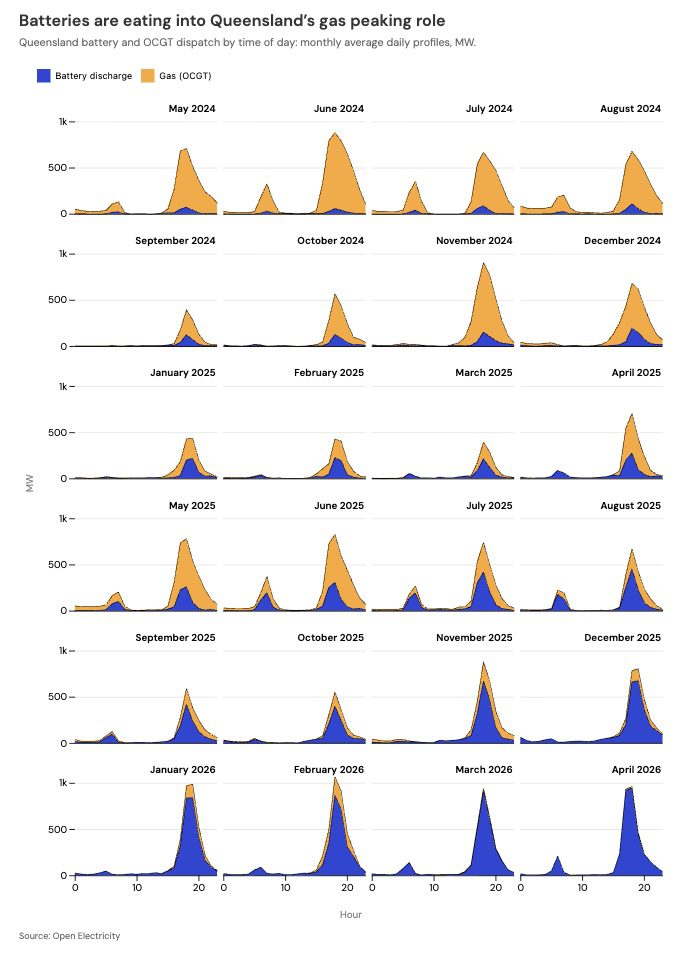
https://reneweconomy.com.au/wp-content/uploads/2026/05/open-...
The real thing delaying the energy transition is politics, we have the technology.
And on a really small scale, here in NL we can build our own home battery storage systems with cheap 15kWh or 32kWh battery kits from China. Combine that with dynamic energy contracts it's amazing.
A 15kWh setup is maybe 3500 Euro, and 32kWh around 4500 Euro. Lasts at least 15+ years counting battery cycles.
Assuming the most expensive nuclear power plant in the world, assuming the solar is free and you are only paying for the batteries, assuming costs in line with the cheapest grid-scale battery storage in the world, about 6.5h worth of that nuclear plant's output.
That's on the right scale to power California with renewables alone! That's within sight. Anywhere less sunny, powering things with solar and batteries alone would still be very expensive.
Building 3GW * 2 hours of battery storage at current prices is £1.75bn, so for the same money we get about 48 hours of storage.
https://en.wikipedia.org/wiki/Hinkley_Point_C_nuclear_power_...
I think they have slightly more grid batteries installed than California. UK have more people, but less money and less electricity used so I'd say they're doing better than California on battery deployment.
† Most modern power stations perversely need electricity in order to start them, so if your whole grid goes offline you're fucked, you go dark and your civilisation is now on a clock - a Black Start facility is a station which can go from black (no electricity) to running. In the case of Britain's pumped storage that's because "all" we need to do is allow the water to run through the generator. Once one or two Black Start sites are up you can use that power to start the other generators and restore supply to residents, and things get back to normal in a few hours.
[Edited to say that since we know there's about 20GWh of PSH the larger BESS can't be as small as I thought unless it's run a lot harder...]
Most nuclear reactors are about a gigawatt, but most nuclear power plants have multiple reactors. 3-6 GW per plant is perhaps a more likely measure.
Lets take your smallest "Nuclear plant" idea, if California owns 6 of those they run all the time but it needs 12GW extra at peak, where does that come from? If California owns 10 of those they run intermittently, you're still paying to have ten but not getting almost twice the benefit so your prices soar.
So the way you'd presumably fix it would be to... build loads of storage and own say 9 of these 3GW nuclear plants, drawing from batteries at peak then refilling them overnight. But wait, that's already what California did that you're unhappy about - so what gives?
Then we notice that in reality although you think "most nuclear power plants" would produce 3-6GW in fact California doesn't own ten, or eight, or six, but one such plant and it produces... drum roll... 2.2GW nameplate.
That extreme intra-day variation is also partially caused by California's cheap solar power: Cheaper prices draw demand to those hours.
In other locations, (some) people (partially) adjust their consumption patters to follow the cheap wind energy hours, and this leads to different consumption patters. Less intra-day variation but but inter-day variation.
If California's prices were wind-dominated (typically a little more wind at nightime), or nuclear or burning dominated (stable), it would not cause such large variation in the intra-day consumption pattern.
This electricity price figure is readable, but 10 years old, so today the variation in California must be larger than it shows:
From this graph we see that in the evening when solar power goes out, for next 3 hours (7 pm to 10 pm) California's battery array is as powerful as 12 nuclear reactors. Then the batteries are drained empty, and the rest of the night California survives by importing electricity from other states. And partially by running hydro power only during the nights, keeping it at zero during the day.
Using a measurement for power as opposed to energy is dumb with batteries
Managing the california grid is now completly different than any traditional grid in that peak power is managed seamlessly from solar/wind/battery power, not counting providing a significant, most?, of the daytime power, leaving just the nightime load running street lights and background loads. The stabilisation of costs, especialy durring a fuel crisis, is an invisible benifit that poorer countrys will be looking at as they plan there future grid updates, while struggling to keep the lights on right now.
12,000 megawatts, equivalent to 12 large nuclear plants, of energy from its battery arrays.
watts are power, not energy. for example, a tea kettle might require 2kilowatts. this does not tell you how much does it cost you to use the tea kettle, because it does not tell you how long the tea kettle is consuming 2kilowatts.