„Poland is the largest beneficiary of EU funds 2014-2020, with one in four euro going to Poland“
https://www.gov.pl/web/funds-regional-policy/poland-at-the-f...
Update: The comments below this are strange.
I ment: „Poland gets money, Poland transforms it into more money”.
Is Poland more efficient in it than other countries? I do not know. Would Poland have generated less money without it ? Probably? Is an annual investment of the 2-3%of the GDP into a country a lot? I think so?
I'm old enough to remember internal borders with passport checks in Europe, before the wall fell and Poland was still on the other side of that. Nice to see them moving on from that.
Thanks to the EU free movement of people, I've now studied, worked and lived in four different countries. I know people all over Europe. I currently live in Germany. Germany benefits a lot from the EU. Yes it costs money. But there's trade, access to skilled labour, etc. as well. And if you look at Poland, it's what sits between Germany and Belarus & Ukraine. So, there's a strategic relevance as well. Poland doing fine is good for everyone else in the EU.
I don't know. I want to agree with you, but a large part of the economic growth in Poland is off-shoring and cheap tax (~12% on contract) for tech workers. The average tech wage there now is pretty similar to the UK, and I don't really see many startups there - probably in part because of how bureaucratic their business system can be. I don't know if this influx of foreign money from off-shoring and surge in real estate pricing is sustainable or good in the long run.
Other than a massive influx of overdevelopment of flats in the cities (sometimes too rushed, I've seen reports of flat blocks subsiding because of cutting corners), I'm not sure where else the increase it.
Because that seems extremely implausible, and actually very insulting to the incredible success of Eastern Europe, before and after joining the EU, in closing the gap to Western Europe over the last 3 decades.
https://ourworldindata.org/grapher/gdp-per-capita-worldbank?...
Also some companies are moving their offices from Poland to India now.
Sure, its not ideally distributed, but nowhete is. Such economic success will drag many parts of the country up. Yes, jobs not paid the best will have to commute from further. But compared to where Poland was 2 decades ago (been there many times), its great growth and success.
Plus you guys have correct mentality to by far the biggest threat to Europe - russia. Not so common in eastern Europe, russian-paid politicians are quite successful in some places. But of course Poland has a history with russia to remember so thats luckily not an option.
An economic investment as well as one of solidarity. People forget that the EU is a peace project that ensures peace via economic cooperation. This nuance seems trivial but is actually massively important. I can see trust degrading in the US but being fortified across the EU.
Look at Hungary recently, they did a 180 not because of Brussels or Berlin saying they should. Hungarians are sceptical of both. However they do trust the Polish people who they see as genuine peers who are very pro-EU.
In the early 20th century Texas for instance was a poor state, a recipient of federal funds, but now it's an economic powerhouse. (To be precise I still think it's a recipient of federal funding but it holds its own now.)
It is for as long, as the EU exists in its current form. The rise of anti-EU parties in both Poland and Germany makes it a risky investment.
* It was pretty sensible EU directive implemented badly by national govt * It was pretty sensible EU directive implemented okay but communicated badly * Outright lie about the problem and the scope of it.
One example: The people complained that "EU will force them to pay to scrap solar panels"
The truth: Some countries added price of recycling into price of the solar panels, some didn't. Those that did had free recycling, those that didn't needed owner to pay a fee when scrapping it. So, naturally, buying solar panel from country with no fee was cheaper and scrapping it in country with fee was free. EU noticed that loophole and forced countries into including the fee in panel cost:
The truth: Poland applied it by just applying fee to panels bought before the rule unification
The lie number 1: EU forced that implementation on Poland. Nothing was forced, that way of "fixing it" (vs eating the cost was what Polish govt chose
The lie number 2: (and I have no idea where it came from) "You will have to scrap your panels made before this date AND pay for it".
Sometimes I suspect most of that is just russian propaganda using anything to undermine EU
Also, for Germany, and I assume, other EU countries, cohesion and economic strength of the EU is the most important value that exists.
And it's a good thing, but I wish Eastern European countries would recognize this and become more of a team player instead of shitting on EU.
Poland waited for Trump 2nd term, threatening the take some of the EU territory by force to finally transition from buying US weapons to buying from other European countries.
While what you’re saying may be true, and this prosperity may be good for all of Europe, I think there is a lot of resentment about who the beneficiaries of the EU structure are.
This is something I tell people I am generally politically/socially align with (liberals/progressives) when they start talking about “handouts for red states.” California and other areas were not developed on their own, they required years of sustained federal investment and interest in the area.
It obviously goes without saying that conservatives in the US need to stop demonizing taxes so much for the same reason/they need to recognize that as the some of the largest beneficiaries of federal tax dollars they are cutting their nose to spite their face (I believe Kentucky is still the most subsidized state in the US).
All of us should want our states cooperation with the federal government so we can all rise together, and we need to view investing in our neighbors as a collective good.
Two of the three are intrinsically tied to the locale. You can't move the National Forests to Manhattan. They closed the military bases in the most expensive areas like California decades ago to save money so they are mostly located in flyover country now.
Social Security actually is a welfare handout but retirees are choosing to move to red states. Unless one is arguing to forcibly prevent retirees from moving to the sunbelt, Social Security dollars will disproportionately flow into those states.
There is no red state "handout".
If they were to ask where you think this "federal investment" funding came from, what would you reply?
In a similar way, Western Europe benefited from a lot of investment after WW2, while Eastern Europe didn't receive the same investment then.
So the recent investment OP mentioned is just balancing the scales.
Europe is the outlier here. The rest of the world checks your passport when you come in their country because they like to know who comes and who goes for a lot of reasons including public safety, biosecurity and so on.
The fact that Europe has basically given up on trying to filter who comes in is not necessarily a model that is desirable for the rest of the world.
> Thanks to the EU free movement of people, I've now studied, worked and lived in four different countries.
You can do that without Europe as well. Do you think people did not move to another country or studied in another country before the European countries decided to remove borders? What about now with all the students moving to the US/UK/Australia/Canada?
The question is whether growth is objective and fair or whether it is not.
For comparison of wealth in Poland, ALL net-subsidies would have to be deducted, because this is essentially wealth taken from other countries, and distributed to poorer areas in the EU. I am not disputing that this leads to more growth; I am disputing the "country xyz is now rich" while not even mentioning the subsidies. And that reuters article does not mention that at all.
It also has to be mentioned because the crazy bureaucrats in Brussels want to aggressively expand eastwards. They think that the richer areas in the EU need to pay for that expansion. I simply fail to agree with that "logic" at all and I also consider it hugely unfair to richer areas. The richer areas made good decisions; now this is being negated by bureaucrats in Brussels. That is unfair. (This is not meant against Poland, but against the constant expansionistic agenda from Brussels.)
Did you recently crossed borders? On many the checks are there again, because of fear of immigration terrorism or something, so the people could see, politicians were doing something to make them feel safe (but what I could see when passing borders, especially between poland and germany, were looong lines of trucks, so much for free flowing goods).
Not sure of the current situation, though, but last summer and autumn was horrible with checks (probably still better than what was before, but having experienced the real open border situation, having them restricted again is frustrating).
Quick ID check happened once - when I was traveling with bus across border.
Back in a days it was a lot, lot slower and more detailed.
Pretty different from having a chance to be stopped by a random check while crossing.
This is not a "present" given to Poland. This is ensuring a better life for all Europeans.
But the result is inarguably positive. Those countries had only recently become democracies after decades of military dictatorships or otherwise unstable third-world style governments. Today they're the most dynamic economies in the EU in many respects, and their democracies are well established and functioning.
The EU doesn't get nearly enough credit for how it transformed the continent. People have forgotten how nearly all European countries were in a very bad shape after WWII. Fascists had remained in power in Spain and Portugal. Soviets were orchestrating communist takeovers in countries like Italy. It's a small miracle that the liberal democratic economic order won so quickly and decisively.
(The techbros hate it for a different, if related, reason - they aren't nearly as successful at capturing regulators, astroturfing and controlling discourse, and otherwise taking charge of that second entity as they are with the hapless US federal government).
In what sense are they "dynamic economies"? Their GDP per capita has barely increased at all over the past two decades, they're mired in debt, and haven't produced a single new company that's significant on the global stage.
It was after that US/Russia sponsored this communist takeover of our country that the new puppet governments have thrown the natives into extreme misery until someone from the EU decided to reduce the levels of corruption and misery. We simply swapped one master for another and hasn't been good for our land.
So please don't compare our country to whatever "solutions" brought by the same entities who caused our problems in the first place. We needed almost 50 years to remove socialism from this country and reduce the venezuelan/cuban style poverty forced upon us.
They are still getting half of what Belgium is getting and unlike the overwhelming majority of bureaucrats in Brussels Polish farmers actually produce something useful.
I rather have workers get the money than more corporate welfare.
It is a tax haven, with one of the highest GDP / person in the world, why is it, by magnitudes, the biggest recipient of EU largesse / person??!
Additionally a lot of the EU's institutions are based there or have offices there, some of which might count as investments as well.
Lastly, everything there is really expensive. So you need to invest a larger amount to achieve the same thing as elsewhere.
Another argument: Poland's GDP had already been growing at a similar pace before it joined the EU (but after it got rid of communism).
Furthermore, as the GP hints, EU funds earmarked for Poland don't necessarily remain in Poland as investment. Much of that money circulates back into the pockets of contributing countries. You have to look at the entire paper trail to understand where money is actually ending up.
Also worth noting: Poland didn't receive a dime of reparations after the War. Germany (and with later contribution by the Soviets) had unleashed such mind-boggling destruction on Polish cities, towns, cultural inheritance, industry, etc. that only the so-called Swedish Deluge matches or exceeds this devastation.
The EU presents certain clear economic benefits for member countries. Nobody disputes that. But the patronizing and paternalistic narrative of some countries - reminiscent of their goofy rationalizations for their occupation of that region during the 19th century - need to go away.
[1] https://www.pap.pl/en/news/poland-largest-recipient-eu-funds...
> I ment: „Poland gets money, Poland transforms it into more money”.
I have noticed that absolutely every time Poland's success is mentioned, someone from EU steps in to downplay it. A self-serving bias. Seriously, that type of comment is absolutely everywhere. Any YouTube video. Any Reddit post. In last couple days I have seen it about dozen times, last time today here: https://www.reddit.com/r/ArchitecturalRevival/comments/1t6k7...
And each time it's some unsubstantiated remark, not once do those people actually bother to check what the actual amount of subsidies did Poland receive over the past 22 years, or how does Poland fare against other EU members. They always imply that ALL THIS SUCCESS is thanks to EU.
For the record: Poland received in total about as much as its yearly budget is in 2026. Other recent EU members also received more-less the same or, per-capita, much more! Did you bother to see how other EU countries developed in that time?
Growth-wise, since 1990, Poland's economy grew substantially each year (even before joining the EU in 2004) and is only behind China: https://pbs.twimg.com/media/F5Z8u1mWMAAHtUU?format=png&name=...
Seriously, look at that damn map. Find other EU members on that list.
Ergo, Poland must be doing something EXCEPTIONAL if its combined growth FAR SURPASSES not only any other recent EU members but ALL BUT ONE country worldwide? It can't just be that relatively small amount of the EU money, or the EU membership itself, can it?
So, for f*ks say, how about western EU shuts up and acknowledges IT'S NOT ALL THANKS TO THE EU, will it?
I am personally a big fan of the EU, but those downplaying comments are so annoying I can't but think it's some sort of jealousy. Credit where credit is due to POLES themselves.
You could just as well claim the growth is thanks to NATO membership because, if you look at Ukraine and Belaraus, it's quite plausible as well.
If anything the decades of communist occupation destroyed the work ethic.
We have a famous saying "whether you stand or lay down, you deserve 1000zł".
Even without funds distributing EU cash, a common market works as a leveller this way and pulls up the poorer countries, because if you can live work and operate anywhere, people naturally pick the cheapest and easiest places to start a business serving the EU.
Spain and Portugal were the previous beneficiaries and everyone benefits really as jobs are created everywhere.
This is far better than a situation where larger economies dominate all others forever.
Would you say that The US and Mexico should be forced to implement free movement of people, goods, services and industry with a new North American Union capital in Mexico city?
If not, what is the difference?
Mind you that Polish workers are the next in line to be screwed if Ukraine joins the EU.
Ever closer union is the official slogan of the EU, this is working as intended.
So when German workers got screwed when Poland joined EU it was fine, but Poland is where you draw the line?
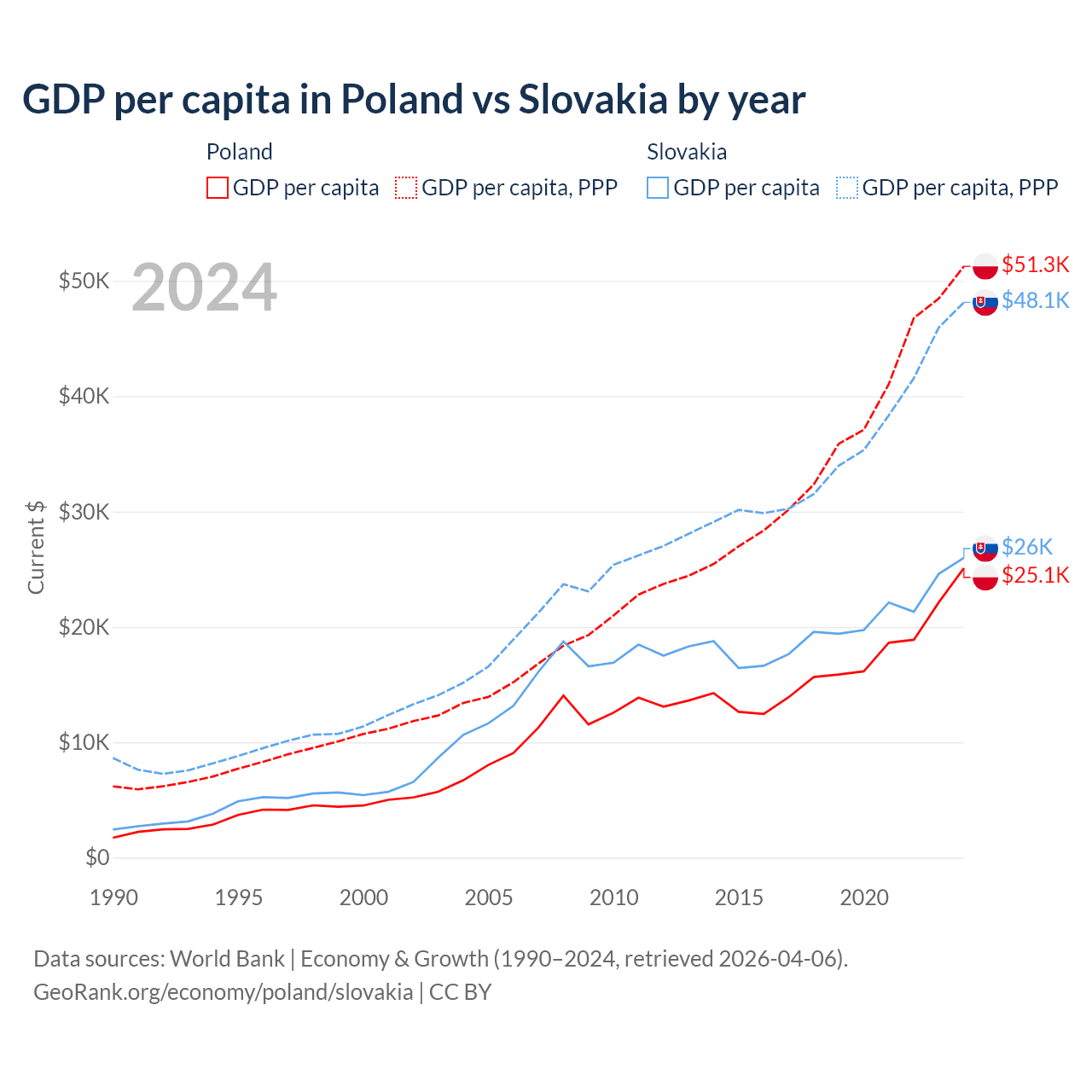
https://georank.org/assets/img/charts/economy/poland/slovaki...
As someone who has lived in both countries its such a hilarious anxiety.
What's hilarious about it? It seems pretty well-rooted given the actual history of the two areas.
- 1939: Germany invaded in 1939, officially starting World War II.
- 1941: Germany occupied the rest of Poland after attacking the Soviet Union, which had previously occupied Eastern Poland.
- Teutonic Order/Prussia: Throughout the 13th–16th centuries, the Teutonic Order fought numerous wars against Poland.
- Medieval Period: Records show invasions by Margrave Gero (963), Margrave Odo I (972), Emperor Otto II (979), and multiple campaigns by King Heinrich II between 1003 and 1017.
Intergenerational trauma is a real psychological phenomenon.
A „hilarious anxiety” is an incredibly naive world view.
But Germans making huge mistakes out of misguided idealism is still a problem. And given the size and influence of Germany, the rest of the continent has always to process those mistakes as well.
It's not trivial that this works. In Hungary we messed this up big time, hopefully it can get fixed now.
Some moron always show up with the "but it was all the EU subsidies" talking point, which is quite frankly part of racist tropes of eastern Europeans being dumb and worse than westerners. Could you imagine them accomplishing anything on their own? That's ridiculous. It's us, the western saviors, who did this with our penny subsidies!
And yes, my own take why this does happen is that there was certain order to the region in the past centuries - the West was modern and wealthy, the East was backwards and poor and all was in its natural place. This new situation is unfamiliar and needs a sort of explanation that would preserve the balance somehow. In short, they cope.
Ireland were in a similar position for instance (received €40bn in EU subsidies in the first 45 years of membership; now a net contributor).
EDIT: Net contributions seem to be $3bn/year (total, independent of tech) while loss for other EU countries due to corporate tax evasion is $6bn/year.
Of course these countries have 5-10m inhabitants so in term of raw GDP and industrial power they can't compete
https://georank.org/economy/bulgaria/hungary
It is not true for the entire EU budget: the 2014–2020 MFF allowed up to €959.99bn in commitments, so Poland’s €77.6bn cohesion allocation was about 8.1% of the whole EU long-term budget.
For context this is like 0.7% of yearly German overall public expenditure go to Poland. And this money per year is also like 5% of state budget spending.
a big share of this money goes back to foreign companies in form of sales and contracts.
When Western countries got money via the Marshal Plan:
https://en.wikipedia.org/wiki/Marshall_Plan
Poland had... "friendly" Soviets "supporting" their country for almost 44 years...
The comments are questioning what you wrote, which implies without evidence, that a small amount of EU money relative to Poland's own GDP, in just 6 years, is somehow entirely responsible for Poland's growth.
The EU gets huge benefits for that investment, the CEO of GM gets a multi-milion dollar pay packet.
Next time, please check how many Poles left Poland for western EU since they joined.
If it was the EU contributions that were the dominant force here, Germany could… simply do the same and prop up its own struggling economy with money printed by the ECB. Instead, it prefers to see it crumble under an obese welfare state that largely funds inactive third-world fake asylum seekers. So clearly, there’s way more nuance to economic success than simply having funds redirected from one account to another.
If you talk about asylum seekers (which may be a valid point), notice also that German social security institutions are filled to the brim with Eastern European claimants.
Utterly false: nationals of Poland, Romania, Bulgaria, Czechia, Slovakia, Hungary, Estonia, Latvia and Lithuania account for approximately 4.9% of all SGB-II Leistungsberechtigte (~256,000 of 5.24 million as of December 2025).
> The Marshall plan also did not involve the US having completely free access to Germany economically and move all their companies to Germany for cheaper wages.
This is such a bizarre point. The openness of the common market goes both ways, you do realise that, right? For more than the first decade after the accession of the Central Eastern European countries to the EU, Western European countries saw an influx of workers that were well educated (or skilled in trade professions), which helped fill the gaps in their labour market. So if you were going to try to draw an analogy here, you’d also have to point out that the US didn’t import millions of Germans after the war into its own labour market. Well, barring some rocket scientists who had built weapons of mass destruction and death for Hitler.
Anyway, yes, that’s how the common market works: companies can move operations to countries where labour is cheaper (in Poland), but other companies have encouraged labour to move where they already operate (in Germany). And what’s forgotten in this discussion is that the cohesion subsidies are in fact a form of compensation for the inherent imbalance that a pure common market would exhibit. That’s why it took years in negotiations for those poorer countries to decide under what terms they’re actually willing to open up their markets, and in many cases it’s been a very controversial issue.
It's unfortunate that 0th order thinking jumps to this framing, it's one reason I always laugh when people talk about SpaceX taking 'government handouts' without these folks realizing the 100x ROI the government got out of their investment. All investments are 'hand outs' but not all 'hand outs' are investments.
Clear thinking at a large enough scale will prevent a populace from self destructing due to stupidity about this topic.
The lion share of this budget has been defrauded, fraud is only slightly less widespread than in Hungary. Piles of (only) documentation are produced by professionals then funds are funnelled to the families of local authorities. Honestly I'm confused, maybe that's indeed how EU funds are suppoused to work?
At least Poland does it legally.
Think of it as defense spending
Eh, as an American I've spent many hours reading Europeans railing against the United States here on HN.
Not once has a European ever given the US credit for the Marshall Plan.
I actually look forward to seeing the EU become the global hegemon so they can learn about how much "fun" it is. The US can sit in the stands eating popcorn just like Switzerland.
How can you honestly say that though. A blatant overgeneralization of a large group of people, but this has been a recurring theme on HN lately.
So I would agree that people spouting anti-US sentiment have been conveniently downplaying, leaving out, or haven't been educating themselves on, this important part of US-European history, but what's new.
In the meantime, streets have been named after Marshall, plaques and statues have been erected (including recent times) at least in the more Western parts of continential Europe where much of the Marshall Plan funds ended up, and its extreme importance is quite an ingrained part of WW2 school history education. Just as one example, Arnhem was largely rebuilt using these funds and has historically paid homage and still does today with such tributes and memorials.
Perhaps there is a miscommunication. What I meant to say is, I have not seen it mentioned a single time over many hours of arguing on HN about the US/Europe relationship. It's not an 'overgeneralization', simply an observation.
>In the meantime, streets have been named after Marshall, plaques and statues have been erected (including recent times) at least in the more Western parts of continential Europe where much of the Marshall Plan funds ended up, and its extreme importance is quite an ingrained part of WW2 school history education. Just as one example, Arnhem was largely rebuilt using these funds and has historically paid homage and still does today with such tributes and memorials.
That is nice to hear. But it doesn't seem to stop US-bashing from being the continent's trendiest hobby. I never saw a European say to another: "Hey now, they did do the Marshall Plan for us. Maybe the Yanks aren't always bad."
The problem is that US establishment politicians have traditionally sold US foreign policy to voters as "a responsibility to uphold freedom and democracy" and so forth. Then Americans hear directly from the supposed beneficiaries of this "responsibility", and the sentiment is overwhelmingly negative. The American voter feels betrayed, and wants out of the arrangement. It contributes to (1) anti-establishment sentiment, and (2) isolationist sentiment.
The condescending attitude of Europeans ("NATO is mainly to benefit US interests, you American fool", without being very specific about those interests aside from vague handwaving towards the Middle East, where most of us want less involvement anyhow) is not helping matters.
https://en.wikipedia.org/wiki/Polish_material_losses_during_...
And don’t forget the Partitions and The Deluge, too.
Crazy how people just like to pretend that wealth acquired before 1950 somehow just appeared there naturally.