Terminal apps were obsolete once we had invented the pixel. Unix just provides no good way to write one that can be used remotely.
well that's the issue, isn't it?
the graphics options that we have are slow and complex, and they don't solve the problems like a terminal and therefore the terminal persist.
consider something like grep on multiple files. it should produce a list of lines found. the graphical terminal takes that list and displays it. it can distinguish the different components of that list, the filenames, the lines matched, the actual match, etc. because it can distinguish the elements, it can lay them out nicely. a column for the filenames, colors for the matched parts, counts, etc.
grep would not produce any graphics here, just semantic output that my imagined graphical terminal would be able to interpret and visualize.
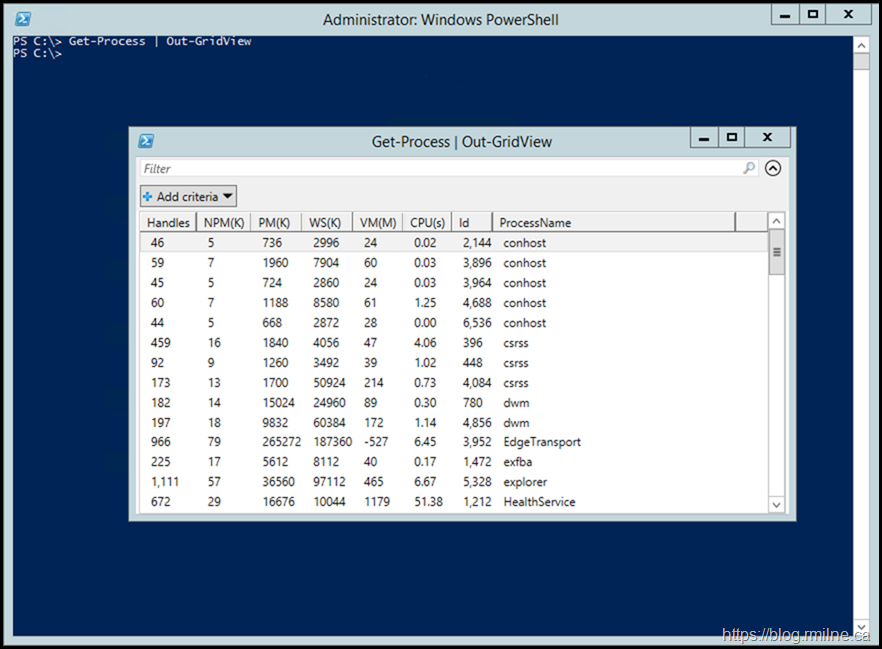
https://blog.rmilne.ca/wp-content/uploads/2020/04/image_thum...
PowerShell cmdlets output .NET objects with properties, in that example Get-Process makes an object-per-running-process with properties for Name, Id, and more. Out-GridView takes arbitrary objects and draws a resizeable GUI window with a list of the input, properties as columns, sortable, filterable, and has options to use it as a basic "choose one of these and click OK" user-prompt. It works with the grep-analogous cmdlet:
    select-string '<regex>' <filename(s)> | out-gridview

    # shorthand
    sls foo *.txt | ogv
If we're talking about things we imagine in terminals, one I have wanted is multiple windows for making notes, similar to having a text editor open constantly reloading a file on any changes and running some terminal commands with tee into the file, but better integrated - so I could keep a few useful context results but ignore logspam results; and "keep" in another window without having to copypaste. Something better integrated - it always gets all command output, but disposes of it automatically after a while, but can be instructed to keep.
PowerShell, for instance, has Format.ps1xml[0] that allows you to configure how objects get displayed by default (i.e. when that object gets emitted at the end of the pipeline). Such a concept could in principle be extended to have graphical elements. How cool would it be to have grep's output let you collapse matches from the same file!
[0] https://learn.microsoft.com/en-us/powershell/module/microsof...