That makes me feel even more strongly about throwing proprietary and predatory codecs in the trash and opting to use AV1 et al wherever possible, it's better anyways and surely close to a decade after coming out, we'd expect devices to support it well enough.
A lot of people, myself included, are still using quite old hardware. The GPU in my daily driver is ~10 years old at this point. Between crypto, COVID, and this AI craze raising GPU costs by insane amounts, it hasn't made sense to replace it with something newer. I know I'm not alone on that...
Literally 2 meters from my desk is a 2x RTX-4090 server and many times I just use my 8 year old GPU anyway so you don't need it.
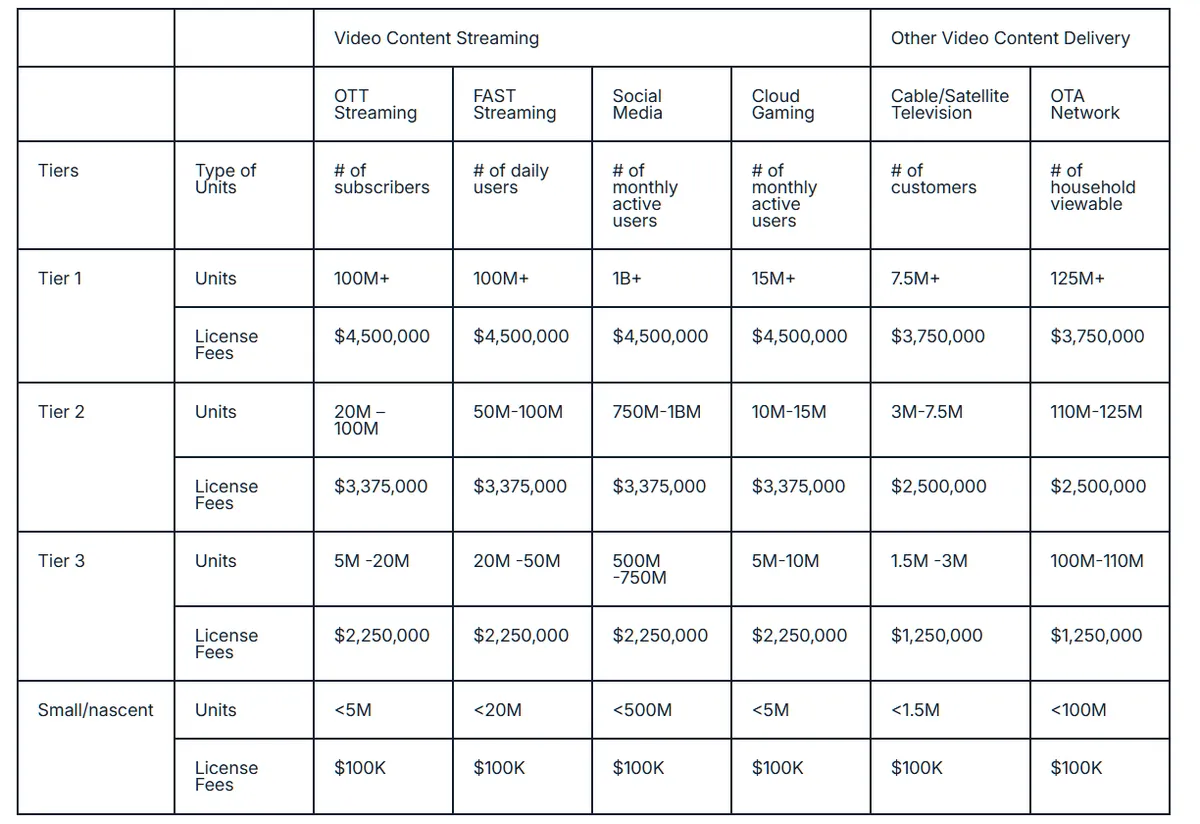
I very much understand how the licensing alliance likely was bothered by the fact that they are leaving money on the table, when TikTok's revenue per user is $50 a year, and a cable subscription is easily $800 per year, with the high-end reaching $2000. The big players aren't going to notice much. For the small players, nothing changed.
[1]: https://cdn.mos.cms.futurecdn.net/3wzYaofEETCfXdQmREx9BK-120...
https://www.techspot.com/news/111865-dolby-sues-snap-over-vi...
I, for one, am happy about this. Nothing makes me happier than to see patent trolls eat themselves alive. Also, being an open source advocate, I appreciate when propriety technologies that are "good enough" can finally be used by open source applications. Unless you are pushing a ton of video, or working with high resolution (4K, 8K)/ high bit-rate videos, AVC/h.264 is perfectly fine.
Some patents remain valid in USA, Brazil and a few other countries.
So that firm might try to squeeze every penny they can before the expiration of the patents.
I, for one, am happy about this. Nothing makes me happier than to see patent trolls eat themselves alive. Also, being an open source advocate, I appreciate when propriety technologies that are "good enough" can finally be used by open source applications with broad support. Unless you are pushing a ton of video, or working with high resolution (4K, 8K)/ high bit-rate videos, AVC/h.264 is perfectly fine.
https://meta.wikimedia.org/wiki/Have_the_patents_for_H.264_M...
As fhn points out, there are now truly open video codecs available (open specification, royalty free, unencumbered by patent terms) that are able to compete with the patent-encumbered ones on technical merit. Seems curious that the patent-holders would want to hike prices in this way and validate the motivation behind the truly open codecs.
Also, the article mentions the licensing fees for H265 were also increased recently. It doesn't seem to give a figure, a quick web search turns up 25% [0] or perhaps 20% [1]. Perhaps I'm missing something obvious but I'm not clear on how the change in price relates to the patent dispute between Nokia and certain laptop manufacturers.
(It seems the H264 fee increase affects streaming providers only, whereas the H265 fee increase did not, as it affected laptop manufacturers.)
Old licenses are grandfathered in previous pricing. So this isn't about milking, but likely a tactic specifically aiming at certain companies. But I am wondering why they bother to do this at this stage of the game.
I am hoping we could further innovate on top of H.264 to have a better patent free video codec.
Also, let's not forget that the majority of devices still don't have AV1 hardware decoding support. For example, Apple only recently (2023) added support with iPhone 15 Pro and M3 Macs.
Apple has been actively obstructing open video formats for a long long time—Apple is the reason there isn’t a baseline format for <video> in the HTML5 spec, for instance. (Or at least there wasn’t when the spec was still a well-defined document with a version number; I see no merit in keeping track of the “living” one.) Incidentally, Apple is a member of MPEG-LA and claims to hold numerous patents covering both AVC and HEVC.
At this point, whatever harms befall Apple’s users due to lack of Apple’s lack of format support are entirely Apple’s fault.
Like many other such frivolous patent lawsuits, Dolby hopes to either scare the other company into making a deal in order to avoid bigger legal expenses, or to establish a legal precedent if their cunning lawyers can convince a technically incompetent jury that the H.265 patents are applicable to AV1.
This is the kind of trial that should have never been decided by a normal jury, but only by a panel of neutral experts in this field.
As a side note this isn't always superior - recently discovered my desktop uses way more power with hardware decode than software. Counterintuitive but issue isn't per pixel efficiency but that it keeps the GPU in a higher power state
Instead of paying the ransom, a streaming company should transcode their movies to a royalty-free format, like AV1 or VP9.
Even big companies like Dell have preferred to disable the H.265 codecs in the computers they sell, instead of accepting similar demands for greatly increased royalties, and I think that it was the right choice.
The patents are still valid in USA, Brazil and a few other places.
If you're just hosting videos on your website you are probably using High Profile which was standardized in March of 2005, i.e. more than 20 years ago. That doesn't stop VIA and MPEG-LA from claiming they still have relevant patents, but that claim is dubious and hasn't been tested in court.
The alternative would be lavishly funded public research, which sounds great to me! But is that going to happen?
Existing licensees are grandfathered in to the old price.
Maybe Google should finally make good on their threat to only stream YouTube in royalty-free standards.
Also known as rent-seeking: "The act of growing one's existing wealth by manipulating public policy or economic conditions without creating new wealth. Rent-seeking activities have negative effects on the rest of society. They result in reduced economic efficiency through misallocation of resources, stifled competition, reduced wealth creation, lost government revenue, heightened income inequality, heightened debt levels, risk of growing corruption and cronyism, decreased public trust in institutions, and potential national decline."[a]
Sigh.
---
Hopefully the Licensing Alliance never ever ever gets another customer ever again. Hopefully no one uses any of their new encodings. This is an untrustworthy company, that always have been out to fleece the industry and hold back humanity. Licensing Alliance embodies Lawful Evil, is a stain on the patent system as a whole. It's hard to find the words for how awful, how enraging this cabal is. Ugh. What an evil drain.
We should be able to use computers for audio and video, and it shouldnt involve kings ransoms to some jerks who are better at paperwork & lawyering.
All that work on av1 and av2 looking more and more civilization ally essential as times goes on.
Also I'm not responsible for whatever happens if you do this.