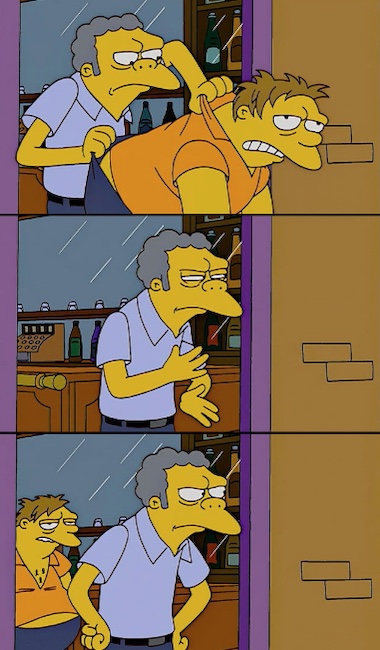
And they will try again tomorrow. Until it passes.
> Also compared to whom?
Why compare? The fact that there are worse regimes than the EU doesn't make the EU even a single bit better. Lesser evil is still evil. Let us strive for good.
... I mean this is how all parliamentary systems work. It's more _visible_ in the EU than in others, I think, because the council/commission are more willing to put forward things that they don't really think the parliament will go for (in many parliamentary systems, realistically the executive will be reluctant to put forward stuff where they think they'll lose the vote in parliament).
But there's not really a huge difference; it would just be _quieter_ in most parliamentary systems, and you wouldn't really hear anything about it until the executive had their votes in place, brought it forward, and passed it. I actually kind of prefer the EU system, in that it tends to happen more out in the open, which allows for public comment. And public comment and pressure is a huge deal for this sort of thing; most parliamentarians, on things they don't understand, will vote whatever way their party is voting. But if it becomes clear that their constituents care about it, they may actually have to think about it, and that's half the battle.
You can see it the other way around, without the EU, Denmark and others would have already implemented ChatControl in their country. This is driven by member states (Denmark), not the parliament, after all.
With the former approach, every country is allowed to try different things, some amazing, some dumb, and learn from the amazing and dumb things that others have done.
In the latter, there's only one governing body, and whatever that body said, goes. There's no science or statistics, just sides shouting their arguments at each other, calling people names.
Both the EU and the US used to heavily lean towards the former approach, but they're slowly but inexorably moving towards the latter.
There are many reasons to abolish the EU, but the topic here is chat control.
> You can see it the other way around, without the EU, Denmark and others would have already implemented ChatControl in their country. This is driven by member states (Denmark), not the parliament, after all.
Would they? We don't know. Would the government of Denmark be ready to commit political suicide by insisting again and again on something so unpopular?
The whole premise of the EU is to allow various unelected interest groups to push unpopular regulation to the EU member states without any consequences.
Once laws are passed they aren't revoked. So it's just a matter of political climate. Just wait for people to get a little more negative, a little more paranoid (which has historically been "helped along" in various ways)-- a law only needs to pass once, and then we're stuck with some stupid bullshit forever.
It doesn't really seem like how you'd want to design it.
And not being able to deny the Holocaust doesn't mean you don't have free speech
> directly elect some kind of president
We do not need a president with over-powers, and electing directly one does not solve anything for democracy, as the recent history in countries like the US and France shows. The point of directly electing a president is giving that role more power. The current structure in the EU is not so much president-centric either executive or legislative wise, but more like comission-centric, which is what imo has the biggest problem in terms of democracy in the EU.
They do.
> directly elect some kind of president
I get the impression you're coming at it from a US perspective, and it's not that, and doesn't intend to be for now. The president is elected by majority of the MP's who have been elected by the people of their respective countries. Almost like the US electorial system, except it's done internally because people generally only vote for their own best interests and not that of the entirety.
Perfect, no, it can be slow and a lot of red tape, but what system isn't flawed.
Many EU nations are not presidential, and personally I prefer parliamentary republics than presidential ones.
...
We do? What did you think the European Parliament elections every four years were for?
> directly elect some kind of president.
Why? Nowhere in Western Europe except very arguably France (France, as always, has to be a bit weird about everything, and has a hybrid system) has a directly elected executive. True executive presidential systems are only really a thing in the Americas and Africa (plus Russia, these days).
Like, in terms of big countries with a true executive presidency, you’re basically looking at the US, Russia and Brazil. I’m, er, not sure we should be modeling ourselves on those paragons of democracy.
> They have no accountability, no checks and balances.
The parliament has the same accountability and checks and balances as any national parliament, more or less (more than some, as the ECJ is more effective and independent than many national supreme courts).
You're missing a [citation needed] on that.
> Furthermore, the next massive threat to digital civil liberties is already on the agenda: Next up in the ongoing trilogue, lawmakers will negotiate whether messenger and chat services, as well as app stores, will be legally obliged to implement age verification. This would require users to provide ID documents or submit to facial scans, effectively making anonymous communication impossible and severely endangering vulnerable groups such as whistleblowers and persecuted individuals.
In a democracy, we don't kill our opposition. If they hold views we don't like, e.g. that security trumps privacy, they're going to litigate them. Probably their whole lives. That means they'll keep bringing up the same ideas. And you'll have to keep defeating them. But there are two corollaries.
One: Passing legislation takes as much work as repealing it; but unpassed legislation has no force of law. Being on the side that's keeping legislation from being passed is the stronger position. You have the status quo on your side. (The only stronger hand is the side fighting to keep legislation from being repealed. Then you have both the status quo and force of law on your side.)
Two: Legislative wants are unlimited. Once a group has invested into political machinery and organisation, they're not going to go home after passing their law. Thus, repeatedly failing to pass a law represents a successful bulwark. It's a resource sink for the defense, yes. But the defense gets to hold onto the status quo. The offense is sinking resources into the same fight, except with nothing to show for it. (Both sides' machines get honed.)
Each generation tends to have a set of issues they continuously battle. The status quo that persists or emerges in their wake forms a bedrock the next generations take for granted. This is the work of a democracy. Constantly working to convince your fellow citizens that your position deserves priority. Because the alternative is the people in power killing those who disagree with them.
Pass laws that actively enhance privacy, that make it technically (e.g., require E2EE) and legally harder to surveil citizens, that require data minimization, that impose retention limits, that require higher standards for accessing surveillance content (e.g., warrants); pass amendments to constitutions, etc. How do you think current privacy protections happened in the first place?
Going on offense not only improves privacy, it forces the other side to use their resources playing defense and trying to keep up.
The 'one battle after another' defensive perspective is for people who have half-quit (I'm not talking about the parent here, but more generally). It fits the culture of despair that permeates every political grouping but the far right - they have plenty of initiative and creativity, and certainly don't hold back and play defense. You can do that too.
Maybe a more familiar analogy: It also fits the behavior of exhausted status quo market participants, companies that have lost their drive and innovation and are hanging onto their old ways instead of aggressively moving forward.
Without going into full detail on the procedure I'm imagining, such an outcome would bar consideration of equivalent legislation for several years and require a supermajority at several stages of the legislative process to override.
It’s a double-edge sword though: if something you dislike gets votes, it’s never going away.
I'm not saying you unalive your opposition, but you do need to make them suffer consequences if they push the boundaries to get what they want.
Perhaps this is bad news for "messenger and chat services, as well as app stores" who solicit "users" to exploit them for commercial gain, for example _if_ users are unwilling to accept "age verification" and decide to stop using them. The keyword is "if"
The third parties know it's possible for capable users to communicate with each other without using third party "chat and messenger services" intermediaries that conduct data collection, surveillance and/or online ad services as a "business model". Thus the third party "tech" company intermediaries strive to make their "free services" more convenient than DIY, i.e., communication without using third party intermediation by so-called "tech" companies
But users may decide that "age verification" is acceptable. For many years, HN comments have repeatedly insisted that "most users" do not care about data collection or surveillance or online advertising, that users don't care about privacy. Advocates of "Big Tech" and other so-called "tech" companies argue that by using such third party services, users are consciously _choosing_ convenience over privacy
Perhaps the greatest threat to civil liberties is the mass data collection and surveillance conducted by so-called "tech" companies. The "age verification" debate provides a vivid illustration of why allowing such companies to collect data and surveil without restriction only makes it easier for governments that seek to encroach upon civil liberties. While governments may operate under legal and financial constraints that effectively limit their ability to conduct mass surveillance, the companies operate freely, creating enormous repositories that governments can use their authority to tap into
That most implementation will try to collect far more data is the real concern.
Trilogues should be burned down, closed doors meetings with Ministers writing laws from their own services.
> This means on April 6, 2026, Gmail, LinkedIn, Microsoft and other Big Techs must stop scanning your private messages in the EU
It had already passed and started?
Facebook and others have been scanning your private messages for many years already. Then someone discovered that this practice is illegal in Europe. So they passed the temporary chat control 1.0 emergency law to make it legal. The plan was to draft a chat control 2.0 law that would then be the long-term solution. But negotiations took too long and the temporary law will expire on the 4th of April (not the 6th) which means that it will be illegal again for Facebook and others to scan the private messages of European citizens without prior suspicion of any wrongdoing.
Chat Control 1 says, eh do it anyway if you want on a voluntary and temporary basis until the Courts get around to saying no.
Chat Control 2 says you have to. Until the courts finally get around to striking it down in 15 years.
Passing legislation takes about as much effort as repealing. (The exception being if the legislation spawns a massive bureaucracy.)
Chat Control 1.0 was de facto passed. It's now being unpassed. We don't have to win every time. Just more.
For Americans, imagine if only Republicans ever got to propose legislation and only Democrats could vote on it. That's more or less it.
Otherwise it would be trivial for a government to intentionally fail to pass anything they disagree with, and thus act as a de facto dictatorship.
They even used a teddy bear image.
https://www.eppgroup.eu/newsroom/epp-urges-support-for-last-...
"Protecting children is not optional," said Lena Düpont MEP, EPP Group spokeswoman on Legal and Home Affairs. "We call on the S&D Group to stop hiding behind excuses and finally take responsibility. We cannot afford a safe haven for child abusers online. Every delay leaves children exposed and offenders unchallenged."
Personally, I feel there must be other privacy-preserving ways to address child abusers than mass surveillance.
Also, for the record, here is the list of parties that lobbied for this for Mrs Düpont, alongside very few privacy-focused organisations. Not sure why Canada or Australia are lobbying for EU laws.
ANNEX: LIST OF ENTITIES OR PERSONS FROM WHOM THE RAPPORTEUR HAS RECEIVED INPUT
- Access Now
- Australian eSafety Commissioner
- Bundesrechtsanwaltskammer (BRAK)
- Canadian Centre for Child Protection
- cdt - Center for Democracy & Technology
- eco - Association of the Internet Industry
- EDPS
- EDRI
- Fundamental Rights Agency
- Improving the digital environment for children (regrouping several child protection NGOs across the EU and beyond, including Missing Children Europe, Child Focus)
- INHOPE – the International Association of Internet Hotlines
- International Justice Mission Deutschland e.V./ We Protect
- Internet Watch Foundation
- Internet Society
- Match Group
- Microsoft
- Thorn (Ashton Kutcher)
- UNICEF
- UN Special Rapporteur on the right to privacy
https://www.europarl.europa.eu/doceo/document/A-9-2020-0258_...
> The Commission’s failure to identify the list of experts as falling within the scope of the complainant’s public access request constitutes maladministration. [0]
> The Commission presented a proposal on preventing and combating child sexual abuse, looking in particular at detecting child pornography. In this context, it has mentioned that support could be provided by the software of the controversial American company Palantir... [1]
> Is Palantir’s failure to register on the Transparency Register compatible with the Commission’s transparency commitments? [1]
(Palantir only entered the Transparency Registry in March 2025 despite being a multi million vendor of Gotham for Europol and European Agencies for more than a decade)
> No detailed records exist concerning a January meeting between European Commission President Ursula von der Leyen and the CEO of controversial US data analytics firm Palantir [2]
[0] https://www.ombudsman.europa.eu/en/decision/en/176658
[1] https://www.europarl.europa.eu/doceo/document/E-9-2024-00016...
[2] https://www.euractiv.com/news/commission-kept-no-records-on-...
They really have no shame, do they? https://www.bbc.com/news/entertainment-arts-66772846
Kutcher defended a rapist in court when they thought they were anonymous (they weren't), the same rapist who bragged about assaulting their underage peer/co-star to Kutcher, and then harassed the children of the plaintiffs[1] in his trial where he was convicted and sentenced to 30 years to life:
> Another plaintiff stated that she and her neighbors observed a man snapping pictures from her driveway, and later that night, broke a window in her 13-year-old daughter's bedroom.
[1] https://people.com/tv/danny-masterson-church-scientology-sue...
The age verification also has nothing to do with children.
They are using rhetorical tricks to confuse voters who are clueless. I have seen how this works on elderly people in particular, and mothers who are not tech-savvy.
https://www.eppgroup.eu/newsroom/socialists-are-responsible-...
> Internet Watch Foundation (IWF), the Canadian Centre for Child Protection (C3P), the International Justice Mission (IJM), ECPAT, the Children's Rights Network, World Vision, Terre des Hommes, Innocence in Danger, the World Childhood Foundation, the Stiftung digitale Chancen, the Children's Rights Network Germany, SafeToNet Foundation, Thorn, Ecpat network, the Brave organization, the PR agency Purpose, Justice Initiative, Oak Foundation, Eurochild, Missing Children Europe, Molly Rose Foundation, NSPCC, Hopewell Fund, Heat Initiative, Children’s Investment Fund Foundation
In the past two years, the Internet Watch Foundation (IWF) has been spearheading the lobbying efforts. The CEO of the IWF is Kerry Smith, and she sometimes shares her delusional beliefs on Linkedin in addition to her blog.
Many of these groups receive funding to lobby for Chat Control from the Hopewell Fund, Oak Foundation, and Children’s Investment Fund Foundation (CIFF). The British billionaire Alan M. Parker controls the Oak Foundation, and British billionaire Christopher Hohn controls the Children’s Investment Fund Foundation. The Hopewell Fund is controlled by Arabella Advisors (rebranded to Sunflower Services), and they work hard to conceal the sources of their dark money.
Sources for the organizations:
* https://netzpolitik.org/2022/dude-wheres-my-privacy-how-a-ho...
* https://balkaninsight.com/2023/09/29/europol-sought-unlimite...
* https://balkaninsight.com/2023/09/25/who-benefits-inside-the...
* https://www.lemonde.fr/en/les-decodeurs/article/2023/09/26/t...
* https://theintercept.com/2023/10/01/apple-encryption-iphone-...
* https://www.politico.eu/article/one-man-spam-campaign-ravage...
* https://www.heise.de/en/background/Missing-Link-Prevention-a...
The Spanish Prime Minster Pedro Sánchez can also be added to the list of Chat Control supporters.
It is not exceptional for most MEP from a member state to be in the opposition at the national level, particularly in contexts where it is seen as a protest vote. Turnout is usually low for European elections, so they tend to swing a bit more than national elections.
If you look at local politics and news they are all lobbying massively for it (or some people do). The reason is usually "for sake of the children". Parents in particular are heavily in favor of chat control.
France has had really strange tendencies lately, e.g. when they arrested Telegram founder.
> In early October 2025, in the face of concerted public opposition, the German government stated that it would vote against the proposal
German MEPs also voted against this one.
(Note that the German government and German MEPs aren't the same thing here.)
> The European Commission wants a backdoor for end-to-end encryptions for law enforcement
https://www.techradar.com/pro/security/the-european-commissi...
Told you so.
Did it work? One political party (EPP) didn't like the result of the previous vote and so they forced a re-vote.
> After the European Parliament had already rejected the indiscriminate and blanket Chat Control by US tech companies on 13 March, conservative forces attempted a democratically highly questionable maneuver yesterday to force a repeat vote to extend the law anyway.
https://www.patrick-breyer.de/en/end-of-chat-control-eu-parl...
(Edit: word choice)
https://howtheyvote.eu/votes/189270
Just pointing this out because yesterday there was the myth around that "chat control is pushed by the conservatives", obscuring the actual political dynamics in the EU about it.
EPP wanted indiscriminate scanning instead, not targeted one.
Mass surveillance isn't really a question that projects well onto the left-right scale, and attempting to make it fit a left-right question is more likely to distract than provide a useful understanding.
While your examples were on the economic left, they were clearly authoritarian.
Less tight.
Of course our national govts have been pretty woeful ever since, but in 2029 we will have the opportunity to vote for genuine, dramatic change, with strong options on both the left and right side of politics.
Regarding the creeping surveillance state, Reform UK have explicitly stated they will repeal the awful Online Safety Act.
This is how we wrestle control back from the establishment.
Someone somewhere really really wants this and has the time and resources so it’s an inevitability.
Saying that it doesn’t matter is just defeatist (and unfortunately always parroted on HN) and plainly wrong. Defeatists have been proven wrong time and again.
We will see many new initiatives, old wine in a new bottle. Any bet that EU diehard bureaucrats will change tune, not the goal. They are going to use the so called salami tactic.
Death of free speech by many cuts, so to say. It is in the left wing DNA. Have a look at German history regarding "Landes-Verfassungsschutz" units. It is disturbing to read this article here: https://de.wikipedia.org/wiki/Verfassungsschutz_Nordrhein-We...
And back then already it was the so called center-right party ruled against this left wing initiative - imagine, first thing you do right after WW2 is ramping up a control unit to control freedom of speech.
Please value free speech. Agree to disagree, but remember: those who live by prohibitions will ultimately use this tool against you as well. Consider wisely what is something you dislike personally and simply exercise your right to not listen to certain voices or appeal to prohibition.
Prohibition becomes a tool and everybody knows that people love to use their tools. And since I have a law degree, often times what you plan is not what is finally what courts decide, how they apply the law.
Freedom rights are fundamental.
it is more than that. since 2021 an EU interim regulation (2021/1232), set to expire on 3 april, was allowing companies to voluntarily scan messages. this vote was about the renewal of that regulation. since it has been rejected, the regulation is no longer in effect.
So to him they are probably left-wing.
Also - wasn’t this program voluntary? This seems like the height of backslapping. Would have been better if they just sat on their hands and did nothing in the first place.
You described 95% of EU's work.
This gave companies permission to do things which would ordinarily be illegal under the ePrivacy directive, but did not make it mandatory for them to do so. That permission is now revoked (or will be when the derogation they were trying to extend expires in two weeks).
Chat Control is, quite simply, mass surveillance of every citizen of any age. Let's call a spade a spade.
I don't have many opinions on this but this sort of lazy logic would make me nervous. 36% is not a small number and that's before the folks doing this activity find out that private message is less patrolled.
I highly doubt they have given up here too
EPP (Christian-democrats, ie. centrist to somewhat conservative parties): >95% voted against. These mattered more than any others
Patriots for Europe (far-right, even racist): 2/3 voted against.
"Green"/progressive parties: ~90% voted in favour
Socialists from anywhere on the spectrum (from just-barely-left-of-centre to communists): >95% voted in favour
Laissez-faire parties (meaning rightist, but not racist): largely voted in favour.
https://howtheyvote.eu/votes/189574
Leftists and Green parties desperately seem to want ChatControl (not just this vote), against literally everyone else, but especially against centrist parties.
If anything it proves the opposite.
Look at how laws are passed in russia for example for comparison and let me know what similarities you see.
This is sad that this has gotten this far. If they wanted to pass a law to blow up citizens, do you think European Parliament would seriously consider it? It is exactly the same calibre of idiocy.
I would expect German authorities to issue arrest warrants and properly investigate this.
For context:
If terrorism is defined as using violence or threats to intimidate a population for political or ideological ends, then “Chat Control” qualifies in substance. Violence doesn’t have to leave blood. Psychological and coercive violence is recognised in domestic law (see coercive control offences) and by the WHO. It causes measurable harm to bodies and minds.
The aim is intimidation. The whole purpose is to make people too scared to speak freely. That is intimidation of a population, by design.
It is ideological. The ideology is mass control - keeping people compliant by stripping them of private spaces to think, talk, and dissent.
The only reason it’s not “terrorism” on paper is because states write definitions that exempt themselves. But in plain terms, the act is indistinguishable in effect from terrorism: deliberate fear, coercion, and the destruction of free will.
The only way to really stop this would be to pass legislation that permanently strengthens privacy rights.
Someone should sell calendars based on when this typically gets proposed as well as dates throughout the year when past instances of check control came up against key procedural hurdles.
Any time a scumbag politician tries this again:
"Mr. Jones, secretary of communications for the state, TTL (Time-to-live) left. 2 Hours? 1 Day? 1 Week?"
It would stop fast.
Anyone want to build this? There is a lot of money being left on the table.
I am having a deja vu. Groundhog Day.
The above should be adjusted. This is not an end; it will continue in another form. Another name. Another proposal. The lobbyists behind this will not give up. They are paid to not give up.
I don't think any of those few should have ANY power of us, The People. That includes both EU commission as well as EU parliament. Yes, I know the EU parliament is heralded now as "our heroes". I don't trust any of them at any moment in time: https://en.wikipedia.org/wiki/Qatar_corruption_scandal_at_th.... And that's just one known issue. How many more unknown issues are there?
Also, Leyen should go. She is too suspiciously close to a few companies, always promoting things. She did so before her time in the EU too.
Cf. the recent Mandelson-McSweeney messages inquiry, where it was dropped at some point that messages might not be available for retrieval because he happened to have message expiration on. People are justifiey concerned how come there are completely off the record electronic communications within government offices.
The cost in modern polity is worn entirely by those trying to prevent new laws. Civil liberty groups will run out of funding before they run out of legislation. Its a systemic issue that requires change.
And before someone wanders in here and suggests a bill of rights, they dont tend to bind legislators, they just force your civil liberty groups to test the legislation in court.
The ostensible reasons for mass surveillance fail. That's very interesting.
-The Spying Menace
-Attack of the conservatives
-Revenge of the marketing conglomerate
-A new hope
-Chat Control strikes back
-Return of the Pirate Party
Etc,etc.
> We decide something, then put it in the room and wait some time to see what happens. If there is no big shouting and no uprisings, because most do not understand what it is about, then we continue - step by step until there is no turning back. – Jean Claude Juncker, then President of the EU Commission
They will try this again. And again. And again. They will never stop.
They are not your friends.
Until we meet again.
Now let's start preparing for the next one.