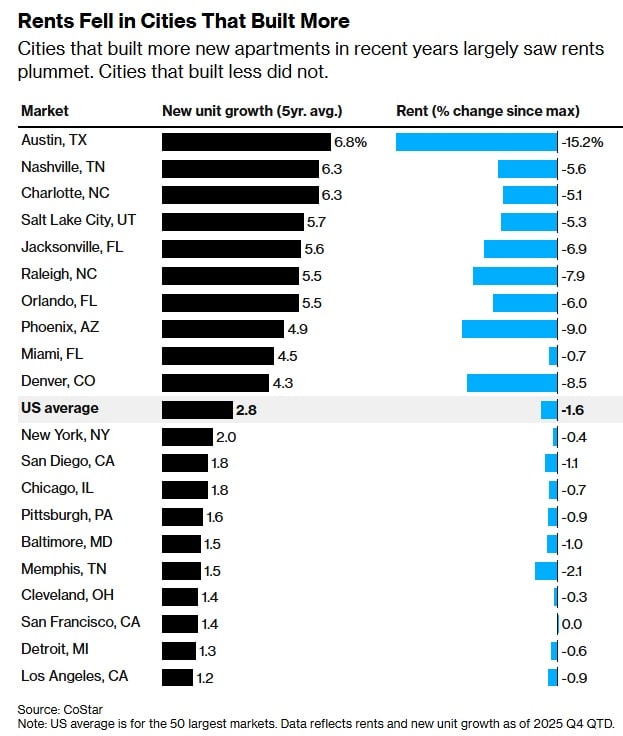
Build more housing. Keep law and order.
No it doesn’t need to be “affordable”. Yes rent control is a terrible idea.
Just build more housing.
Note: that the US already has plenty of housing and housing costs basically go up in areas of low crime relative to economic opportunity. If you build housing, but allow crime to rise, you have wasted everybody’s time.
There are many stories of solidly low-to-middle class families who lived in an area where property prices soared, and had to choose between bankruptcy or moving out, because they could no longer.
The only people who benefit from this are the investors and landlords. So allowing housing prices to surge is literally taxing the poor for the benefit of the rich.
Buildings also deteroriate - ask a civil engineer. Building something that lasts 50-100 years is much cheaper than something that can be maintained economically indefinitely. If you own a house with copper or PVC plumbing, that they go bad after 40-50 years, and fixing burst pipes quickly gets expensive.
Why do countries allow housing prices to rise then? Simple, it allows banks to have a massive portfolio of loans, where they get a steady source of income for literally decades, while also getting a massive portfolio of real estate they can use as basis for leverage to grant loans (which they profit off of).
Governments can then tax the banks and get some of that money without the dreaded specter of increasing income taxes.
The only problem is that the everyman gets stuck with a 10,25, and now 50 year old loan (with a similar increase in price) for the very same median house.
Incentives are typically the strongest force to watch, but so are various cultural/political narratives people come up with. People clearly don't all vote in our own economic interests in many situations. I'd assume this is largely because in the current information ecosystem, people don't understand what's in their economic interests.
I've never understood this: If I replace a single home with 20 apartment homes, I've raised the value of the whole property at purchase time no? You're already dealing with home valuations that have faaar outstripped wages, the only way you go any higher is to build more homes on the same property.
Counterintuitively, the "I don't want to live next to apartments" line of thinking actually seems more potent in the regular NIMBY headspace? Like people will forego higher valuations to keep their suburb a suburb.
I’ve learned a long time ago that we’re not always aware of how incentives drive our own behavior, it just happens naturally. This is exactly what’s happening with housing.
similarly they oppose because "gentrification" even though the evidence is that gentrification is net positive, even for those already living in the area. gentrification or not, people leave at the same rate. Those who stay see their income/wealth rise compared to the case of no-gentrification.
These bills permit the construction of denser housing near transit, force cities to actually meet housing quotas, allow the state to override a city’s zoning to permit more housing if they don’t make a good faith attempt, loosen the rules to build ADUs, and many other changes.
Is it ideal that we had to get to this point? No, but housing wasn’t being built.
So yes, it really is "just build more housing." The problem is: why would you build more housing as prices fall?
The answer- essentials can never be a non-government interferring market. This can be by creating artifical oversupply by buying up oversupply for foreign aid or bio fuels(food production). In the case of housing, this is by having the goverment continually construct housing.
This is the beauty of the free market because it guarantees three things:
[1] Real estate is generally a good investment and will hold value or appreciate in the long term, because supply will adjust to demand shocks to rescue values
[2] If people want to live somewhere, houses will be built for them to live there
[3] Real estate developers and construction are solid, safe businesses with great unit economics because building may decrease prices, but may still increase demand
It's when you constrain and restrict a market that players have to adjust and then you get crazy scenarios
It's not like homebuilders in Austin flee for North Carolina when the margins shift slightly.
we can also make it cheaper to build. easing taxes on imported materials, bringing in more skilled labor, expediting permits, and even direct subsidies like tax breaks
There are some inherent costs to new housing. Work of professionals involved, cost of materials, compliance with all technical regulations, some profit for the developer, connection to infrastructure. Let us mark this unavoidable cost by C. It is a component of the current prices.
Then there is the component N, which is deadweight cost caused by zoning and non-technical regulations. I am not saying that it should be 0, but it is in our interest that it is kept in check, maybe 20 per cent of C. As of now, in some places, it well may be 120 per cent of C, even though it is really hard to calculate.
This component of the final price directly enriches no one, it is pure friction caused by special interests of various parties that don't want to see any new housing either near them, or anywhere (landlord cartels that hate competition - indirect enrichment).
Even C is now a formidable figure. Modern homes are basically industrial robots, they are much more complicated from the inside than they were 100 years ago. But there isn't really a reason why they should be horribly expensive.
If as a regular office person you can buy a home for, say, 5x your annual income, it is not unaffordable. That is well, just normal. Not completely everyone is expected to own their home.
The problem is that nowadays, the multiplier in many places isn't 5x, but 10x or 12x. That is just way too much. And given that C cannot be easily massively reduced (unless some sort of massive robotization of construction work happens), you really need to attack N.
The data is here: https://fred.stlouisfed.org/series/AUST448BPPRIVSA.
Not all buildings require elevators, intelligent thermostats, triple-panel windows or electric car plugs. Especially when you are experiencing a housing crisis.
> already-near-zero margin on real estate development
What do you think homebuilders do? Just close up shop when the market dips?
The answer is there are companies in the business of building homes. If there is profit to be made, they will keep building. Most of the issues we have today are caused by extreme and dysfunctional regulatory regimes that destroy the return on investment by extending the process out. More time sitting on the property before building = lower investment return, and other investments end up making more sense.
Profitability is not black-and-white. Real estate investments can still be profitable if prices fall.
There are different types of real estate markets too. Working class homes in suburbs are not the same market as upper middle class apartments in an urban center.
A very interesting type of investment is high-density housing in catchment areas of new public transportation hubs. Those tend to be so profitable that they can even finance the investment in the public transportation service.
All you need is willingness to invest.
Theres no problem here. Thats how the system should work
Why is the margin so low when the prices are so high? Is it because the value of housing is already priced into the value of land?
> The problem is: why would you build more housing as prices fall?
Why would you want to? When you stop being able to sell more houses, that's the sign that you've built enough.
No other good behaves like this. A midsize sedan didn't increase in price (in real term) over time, while new cars improved.
New houses don't really improve that much over time, yet are getting more more and more expensive.
Why is that?
1. Houses are unaffordable for many Americans. To get houses to prices where they'd be affordable again would require a housing prices drop that would likely be, market-wide, significantly low enough to put a ton of people underwater on their mortgages. What is society/the government meant to do about that? Is it an insurmountable floor on how low we can get housing prices? That floor feels very close if so.
2. We've been promising the last five generations (or more) of Americans that a house is an Investment, capital I, an excellent place to keep your money. How do we overcome the political pressure to turn a house into a depreciating investment for the length of time required to get housing to be affordable again? What kind of politician would put their neck on the line to piss off every boomer and 75% of gen X and 30% of millennials, or whatever the house ownership distribution is?
So human beings with thoughts and feelings can live indoors. It's not hard.
As long as construction costs remain below the value of the units all-in, there's profit motive for developers to build.
So which way is it now?
You know, like how a discussion about war might reference the various recent wars that everyone knows about; it's not limited to just the content of the article.
Many other implementations of affordable housing further raise the barrier and thus even if any is built it doesn’t help widespread housing affordability issues.
Rent control is just another flavor of housing affordability policy that often (always?) backfires.
Crime, social peace, and economic opportunity are very linked. A lot of house prices in urban areas are wildly distributed and often the increase cost is to buy distance and safety (often just a couple blocks) from high crime areas.
It's a "yes, and" problem though, mostly. Let the market build what it can, and if you want to pursue social housing, do that too - just don't let the perfect be the enemy of the good and delay the reforms while you try and put together all the social housing pieces.
The same goes for homelessness. Feel good sound good solutions are popular. Housing the homeless is not.
BTW I have this weird crazy hypothesis that there might be a connection between homelessness and insufficient housing supply. Like, people not in a home, and not enough homes. I know it’s a stretch.
Sometimes I feel like there are other problems like this that we don’t really want to solve but want to pretend to solve.
Property ownership is at the very core of entrenched power, and the foundation of rent-seeking and wealth asymmetry.
If you look at even the Monarchs of long past - it wasn't their 'titles' that made them powerful - it was the economic rent that came along with the land ownership.
Even in more open market economies, property is still is basically long term economics lording over short term economics of wage earning workers.
Being able to kick someone out of their home almost arbitrary basically puts working class people at the 'total whims of the market' and it's one of the most disruptive concepts imaginable.
If we take the view that 'housing is about housing first - only about investment to the extent it does not disrupt housing' - then a different perspective takes shape.
Many Canadian provinces have 'basic rent controls' and it does not generally prevent new housing development.
If anything, providing 'housing stability' is probably the best way to create base prosperity, so those people can go out and spend on all the other things.
There might need to be some degree of leeway here and there for certain kinds of density challenges, but that can be had with rent control
There is almost unlimited land in North America to build on - if in one spot it's a bit difficult - build elsewhere.
If people want to have 'density' then incorporate an area and 'build density' in that area.
Also it does need to be 'affordable' but that can work with regulations.
Edit: our housing problems are about screwed up management, it's actually not even an ideological problem underneath. Like 'rent control' the way it is framed scares some people, but its literally province wide in Ontario, Quebec and it's a 'non issue' for new unit hinderance. Even the nimbyism stuff can be worked around: if people don't want high-rises next to them, it's their right, but there's a lot less opposition to 'mild density' especially if it fits in local cultural and aesthetic context. We can have our cake and it eat on housing. I think we invent ideological lenses because it's easier to frame 'narratives' than it is just weird policies, special circumstances, hiccups, different municipal things going on all at once.
The reason is that you can’t produce more land. Fixed supply will also warp economic markets and create terrible incentives (land speculation).
If you want the best solution, you implement a land value tax. If you want the 2nd best solution, tax property (Land + Building value). If you want the worst solution, implement rent control.
It creates all sorts of problems that wouldn't exist otherwise. For example, if you've been in a rent control house or apartment for 10+ years and are paying significantly less, what happens if you want to move? Or just need a bigger place? It's a huge impeediment to mobility and flexibility.
Also, you have an adversarial relationship with your landlord. They want you to leave so they can raise the rent. They'll skimp on maintenance, turn off the heat (even when it's illegal) and generally make your life miserable until you leave.
The solution to these problems is social housing, meaning the government becomes a significant supplier of affordable, quality housing. The very wealthy and the real estate industry don't want this however because it will decrease profits.
> Property ownership is at the very core of entrenched power,
In the literature, there is a distinction made between private property and personal property. I'm fine with people owning their own home if they want. That's personal property. Private property is when we allow people and corporations to hoard housing. I'm all for making it financiall punitive to own more than one house.
It's funny how this question might have the greatest divergence in answer distribution between people who do and don't know what they're talking about
Other candidates are "is debt good" and "is property tax better or worse than income tax"
Broadly, our housing problems are bureaucratic in origin and I think bureaucracy is indeed an ideology.
No. Rent doubled.
I don't know if Austin or DC is an outlier, but considering how many states sued property managers and their rental management software providers over price-fixing, I'm leaning toward Austin. In the rest of the country, building more doesn't lower rents. Lowering rents lowers rents. And you have to force landlords to do so.
I suspect most of the rent increase is due to inflation (sticker price). Nonetheless rents are still rising, which means 60k units were not enough to outweigh demand.
When you aren't building more housing, for whatever reason, rent control is the only thing that prevents domestic 'immigrants' into your city from making all the residents homeless.
Since cities can't stop migration into them, it's the only tool they have to protect their existing residents.
---
PS. If you believe in trial-by-combat for housing, why not a similar approach to border control? It's the same concept, open it all up and let the market decide whether your existence is worth it.
There are billions of honest, hard-working, capable people who will happily pay more than you for where you live, do your work for less pay than you're willing to accept, and would love to live... Wherever you currently feel entitled to live.
What gives you any right to deny the market from improving the welfare of your landlord and employer?
Also why should cities prioritize protecting residents based on how long they've lived there? Everyone counts the same.
Rented apartments are a commodity with features. Owned houses are fixed assets with different economic rules.
Build more housing? In a place like Austin, you can just keep building out, basically. To a point. Eventually cities doing this reach a limit. Houston and Atlanta are pretty much at or beyond that limit.
And it's not that building low-density SFH housing is the most economic. It's simply the most subsidized. Every road, every parking space, every sewer pipe, every water pipe, every utility pole, every school, every hospital, every police station, every fire station... they all add factor in to the true cost of housing and the more spread out things are, the more expensive those things become. Taken to extremes, look at the billions Houston spends now to add just one more lane (because this one will totally solve traffic) on, say, the Katy Freeway or the ring roads.
Yes it does need to be affordable. NYC is the posterchild for this. Nothing that's getting built on billionaire's row will ever trickle down to being affordable housing. They build ultra-luxury housing because it's the most profitable and it does absolutely nothing for anyone else because these units are just ways for non-residents (mostly) to park wealth and not pay their fair share of taxes.
Rent control is the wrong solution for the right problem and it's typically American. By that I mean it forces the solution onto private landlords who are going to do everything possible to get out of those obligations and deliver subpar but compliant housing. And they'll demand tax breaks for it. When in fact the solution is for the government to supply a large chunk of the housing market ie social housing. But there's a pervasive and wrong idea that we can only solve problems in the private sector and that's nothing more than a wealth transfer from the government to the already-wealthy.
"Just build more housing". Yeah, and then you get Houston. Cities need to be planned. Cities require infrastructure. And one of the most important thing cities need is public transit infrastructure, something sadly lacking in virtually every American city.
The core to so many of these problems is that we need to stop treating housing as a speculative asset. Owning two or more houses should be incredibly difficult and expensive and should be taxed punitively. By this I mean the capital gains on non-primary residences should be 80% and property taxes should be significantly higher.
Also taxing homeowners harder doesnt really solve the problem. CA has insane taxes, SF especially has a giant budget. They just waste it. I dont believe that once the govt raises taxes they will suddenly become efficient and competent.
The idea that the more spread things out the more expensive they are is sound theory. However in practice, per capita taxes in a city are often higher than the rural or suburban regions. One water main should serve more people in a city and its cost amortized across the population should be cheaper.
In practice, cities tend to have tons of programs that drive taxes up. They are free to do that, not necessarily bad, but also not efficient from a tax payer perspective.
But let's not miss the point of the article. This is a right-ward shift of the supply curve. It means that the economics of building the next unit got cheaper. That's the point.
I've seen a lot of neighborhoods across the USA, and Austin making way for higher-density housing on urban corridors (Lamar) is like, duh, this is more live-able. There are new towers along rail and bus route, townhomes packed in, and behind the tree line it's now possible for some single-family lots to become duplexes or fourplexes. And rather than McMansion ugly, the new Austin residents are dressing those up to look pretty darn cool.
There is a lot more to be done to remove supply-side barriers in every city.
- an austinite.
Building enough housing that rents go down is the same thing as lowering crime so not much of an issue there.
Homes for people. Not investors.
At least the latter has been equated with fascism in recent years. That's why it's become such a problem.
Also "Wipe out a whole boatload of techbros who artificially inflate prices". Nobody is talking about that part of the equation.
Austin was one of the places a lot of tech folks flocked to when everybody was working online. RTO and layoffs have wiped a lot of them out. I'd estimate almost 1/3 of the tech folks that were floating around last year are now in other cities.
The article directly contradicts you:
> "A key piece of Austin’s strategy has been to encourage the construction of affordable housing."
There is enough data now from around the world that shows that it is important what kind of new housing you build. Building all new luxury units does not lead to lower rents.
Another big factors for Austin is probably the significant decline in population growth in the past few years. But sure, keep spreading blanket statements and misinformation...
I know that there are many "free market" type of dudes on here, so keep the downvotes coming. But he truth is that an unregulated market in housing does not work. Even the "freedom" state Texas has understood this.
It’s not NYC or SF, but this suggests that those would be more affordable if they just built more housing.
Housing should not be a speculative investment or a wealth growth vehicle.
Housing must be a commodity.
> Build more housing. Keep law and order.
Safety (law and order) increases housing costs, as you say. It's desireable on its own, but it does not solve housing cost. NYC is very safe and very expensive. Crime is way down in most of the US, and housing costs are much higher.
the little old lady living in a rent controlled apartment is a big part of why rents are high in that area: she was part of what made the community thrive. we would do well to compensate her for this.
Yes, it does need to be affordable, and a certain percentage of it needs to be non-market housing. Housing isn't an elastic commodity. Get real.
Do I get to demand affordable housing overlooking Central Park in NYC? Beachside in Malibu?
If you want large incentive for development at scale you need to allow developers to make fat margins or else you wont get too many of them. Yes you can use affordable housing to do that. Eg: in the article they got higher density and exceptions (aka “fat stacks”) for building affordable housing units.
This is all policy tradeoffs at the end of the day. Eg: a tent is not “housing”, why? Because of reasonable policy. Same thing with housing codes etc. All directionally wise/good. But at the same time you can have bad affordable housing policy.
I do think housing is elastic and a cities policies around that elasticity determines if they will thrive or stagnate.
And don't get me wrong, asbestos and lead are wonderful construction materials. Cheap, durable, and high quality. It's just a shame it causes all sorts of health complications when we use them, right? I mean, it would definitely make housing cheaper, but also cause all kinds of health problems.
Keeping crime low matters too, because people pay a premium for safety, and high-crime areas often face weaker investment and worse long-term housing outcomes. And “cutting red tape” does not mean legalising asbestos or lead pipes, which is a straw man. It means reducing delays, exclusionary zoning, parking mandates, and other rules that limit safe housing production and raise costs for no good reason. Housing is absolutely a complex social problem, but complexity does not erase the role of supply. More safe housing plus safer neighbourhoods will not solve everything, but it is still one of the clearest ways to reduce pressure on rents and prices.
For most Americans, A house is their primary savings account, retirement plan, and probably where they keep majority of their wealth. We don't build new housing in old neighborhoods because it would de-value the investment of too many people. Until we can solve this problem (where people are incentivized to pull the ladder up behind them), we will always have housing shortages. It's just too profitable.
First, awareness of the futility and selfishness of "growth elsewhere" as a solution is much higher in younger people — and by younger, I mean currently under fifty. Generational turnover in Austin had been eating away at the NIMBY majority, and conversations about housing in Austin have long been polarized more by age than by left/right political sentiment. There's a caricature, with a strong vein of truth, of the old Austin leftist who has Mao's little red book on their shelves and thinks apartment buildings are an abomination, and Austinites of that generation are experiencing mortality. At the same time, younger people are adopting more and more urbanist mindsets compared to their parents.
However, I think a much much bigger factor was the influx of younger people, especially young people with experience of larger cities, diluting the votes of the older NIMBYs. Austin has been shaped by growth for half a century, but its "discovery" in the 2000s and very brief status as a darling of coastal hipsters (remember that term?) has had a lasting effect on Austin's popularity and its demographics. It's been twenty years since it was the "it" place for Brooklynites to visit, but in that twenty years, it's had a lot of exposure for young urban dwellers, and some of them discovered they liked it and moved here, bringing their comfort with dense living and their appreciation that growth can bring a lot of positives.
Personally, every homeowner I know in Austin has seen their houses depreciate significantly this decade, and I don't think it changed a single person's mind about Austin's housing policy. People who opposed the reforms are bitter about the outcome, and people who supported the reforms say it sucks for us personally, but it's what we set out to accomplish, and we're glad that it worked.
If you allow for increases in density, that house (actually the land beneath it, but still.) becomes more valuable as it's redeveloped. So that American homeowner does benefit, by unlocking the upside of "evil gentrification" (or actually, density increase).
> Logan and Molotch's “urban growth machine” remains foundational in urban theory, describing how coalitions of landowners, developers, and politicians promote urban growth to raise land values. This paper argues that under financialized capitalism, the dynamics have inverted: asset appreciation now outweighs productive investment, and urban land is increasingly treated as a speculative asset.
I think there probably are balances where people could generally be happier with new construction and that opinion could be clear enough to overrule those who would never be happy with it. Things like:
- ways of having locals vote on new development with small enough constituencies that they can be paid off (ie some of the gains that would have gone to developers or other positive externalities can be captured by those who are more effected) with lower taxes or new roads or parks or whatever
- making residents vote instead of having consultations will lead to less bias in favour of the most obnoxious
- allowing apartment blocks to vote to accept offers of redevelopment (eg you get a newer apartment; more apartments are added to the block and sold to fund the redevelopment)
- having architectural standards that locals are happy with for new buildings
- allow streets to vote to upzone themselves (I don’t love this as it’s basically prisoners dilemma – if your street does it, land value increases and you gain; if every street does it land value only increases a bit but now you are upzoned)
I basically think that there are developments that can be broadly appealing and we are in a bad local minimum in lots of places of having bigger governments trying to push development on unwilling smaller governments/groups
Suring property prices is a relatively new phenomenon (as in, post-WW2). The true origins of NIMBYism, at least in the US, is (you guessed it) racism. Long before segregation ended, and long after, there was economic segregation. Redlining [1], HOAs [2], the post-WW2 GI Bill [3], where highways were built [4][5], etc.
In fact this is a good rule of thumb: if you're ever confused why something is the way it is in the US, your first guess should pretty much always be "because racism".
[1]: https://en.wikipedia.org/wiki/Redlining
[2]: https://www.furman.edu/fu/placing-furman/what-are-racially-r...
[3]: https://www.history.com/articles/gi-bill-black-wwii-veterans...
[4]: https://www.npr.org/2021/04/07/984784455/a-brief-history-of-...
[5]: https://www.bloomberg.com/news/articles/2017-07-09/robert-mo...
We certainly will not see zoning reform until the Boomers die.
This is true for California, where people (foolishly) rely on their home value as their retirement plan, which further incentivizes NIMBYism.
But in places like Texas (and other areas with affordable housing), the house is just treated as something you pay off to have a low housing cost in retirement. And your investments are your retirement+savings account.
It is the businesses around downtown who are pushing the save downtown campaign. I imagine the businesses contribute a fair chunk of revenue to the city now and have some influence .
Relative to say parts of Redwood City, or Palo Alto. Menlo park has a fair amount of student-ish 4 Unit lots, so it not all zoned SFU.
And, of course, once the development is complete, and the value of their land goes up, so too does their rent....
I like the approach of making downtowns walkable and having a bit of parking at the periphery of downtown, along with good public transit. Encourages people to use public transit to get to town in the first place. Downtown residents can use transit or a zipcar or equivalent when the need to get out of town, instead of devoting a ton of space downtown for storing their cars.
Not sure if that approach is really practical, but if it can be made to work it is much nicer.
To be fair, I am boycotting the (similar) underground garage over at Springline because they're clearly made only for people in Range Rovers or whatever. They have those AWFUL ticket machines, set too far back (to avoid getting hit) and too high to access from a normal car.
What a lot of the new buildings in Austin are doing is putting an attached garage directly behind a 4 + 1 mixed use development - the street-facing facade is the apartments and shops, and the garage is directly behind (and usually attached) to the apartments. You basically never see them.
A better comparison would be ATX against San Jose.
Just like how the "rich" residents of Santa Clara county know that you want to live in Campbell, Los Gatos, Menlo Park, Los Altos, Loyola, etc, similarly rich Texans and Austinites live in the Hills.
The reality is the residents of Menlo Park and Rob Roy don't want your type, and in a lot of cases tend to be the same people as there aren't many places left where you can trail run, bike, eat Michelin star ramen, and not pay income tax.
Just because we make good money in tech, it doesn't make us "them". I highly recommend reading the works of Pierre Bourdieu with regards to cultural capital.
The majority of it is not Bel Air...
And this pattern repeats across the US. Add in the fact that people want to freeze the area they moved to in time (like suburbs refusing to increase density, even urban yet car reliant neighborhoods panicking if a single parking space is removed: https://hudsoncountyview.com/outraged-jersey-city-residents-...) and we get constant blockers to housing supply growth we so desparately need.
Its been frustrating watching the half baked measures to make housing "more affordable" by making mortgages cheaper when really they need to stimulate the supply side. It seems like an easy political win IMHO as long as you can sell it up front- stimulate GDP by juicing house building, and everyone gets cheaper housing. Just keep it under control lest you end up in a China type situation.
It's built upon untrue assumptions
- infinite buyers / sellers
- perfect information
- no switching / transaction costs
---
The article itself has 3 different year ranges provided so I'm not sure how you can use it as evidence. Plus overall the rent is still up by a lot since 93% - 4% is still at least 80%.
- Rents increase by 93% from 2010 to 2019
- Housing increase from 2015 to 2024 (this overlaps with when rents increased ...)
- Rents fell from 2021 to 2026 by 4%
Correct. That's why when there's more housing you're more likely to find what you need.
I put this question to grok; its response:
> Unfortunately, Australia's legal, regulatory, financial, and practical systems make this extremely difficult (bordering on impossible at any meaningful scale).
Crazy that the reason we can't have an order-of-magnitude reduction in the cost of the most important thing people need (shelter) is not due to resource constraints, but man-made ones.
You say that as though reduction in cost of housing is a universal desire, but it isn't.
Suppose a couple of years ago you took a $500,000 loan to buy a $700,000 house, which you'll be paying off for the next 10 years. Would you like the market value of your house to decline substantially during that time?
If there's enough of the population bought into property, it won't be politically feasible to allow the value of homes to decline.
that is why we build suburbs - they get anound this by being right next to a place with everything you want in a city
The existing smaller cities just slowly wither.
Existing homeowners of the capitals have little interest in real estate prices dramatically dropping - would you?
Maybe if you flood the market with 30% more housing units like Austin you get the Econ 101 effect. On the other hand, apartment owners realized intentional vacancy is a profitable strategy, which alone seems to defy that basic interpretation.
The mechanism by which new construction drives down rents is that people that need a new apartment are in less competition with existing residents in older worse apartment buildings.
So the newcomer from SF moves into the expensive new apartment, which means that there's less competition for decades old apartments, which means that when one of those is vacated there is less price appreciation on that product.
If there is a scarcity of apartments what happens is that when a decades old apartment is vacant it is filled by a wealthy newcomer and the landlord increases the rent accordingly.
My understanding of the situation is that luxury apartments do indeed gentrify neighborhoods (i.e. they increase the local rent and drive displacement of locals that can't keep up with those rent increases).
However, across the entire city, it slightly eases rent pressure by providing additional housing supply.
So, like you mentioned, if you get enough housing across many neighborhoods, you can drive down rents. Otherwise, that luxury complex in your neighborhood might only be helping ease rent pressure in other neighborhoods.
I think that might not be the right cause and effect relationship. The actual cause is increased demand. This creates both the increased pricing of existing stock and an incentive to build new stock.
They can only get away with that when there is a housing shortage.
It can, but not in isolation.
It requires a couple additional variables such as population demand (rate of growth of Austin has reduced since the COVID boom [0]), existing stock (Texas had a building boom and bust in the 1980s [1] that decoupled it's housing market from the rest of the US), and a shift from buying to renting.
That said, the peers I have who work in professional real estate (not realators - as in actual MDs for REITs or multi-generational landlord families whose parents went to school with Governers and Mayors) are starting to shift away from real estate to equities because of headaches around succession planning and reduced margins.
What is ending up happening is megacap REITs like Equity Residential, Essex, Avalon, etc are buying out older groups, taking stakes in new developments, and shifting away from selling condos to perpetually leasing. At their size they can afford to have significant amounts of unleased units becuase they would have made up the cost via higher rent on leased units, tactically building high margins condos and SFHs in high appreciation geographies, or loss harvesting in order to subsidize commercial buildouts like data centers.
Naively saying only construction will reduce prices is false, and if the consolidation aspect is not solved (and sadly, it won't be) it would only lead to an even worse situation.
Additionally, these are hyperlocal problems and what may work for Austin may require significant retooling for Chicago.
[0] - https://www.bizjournals.com/austin/news/2026/01/28/austin-be...
[1] - https://www.nytimes.com/1986/09/14/business/john-connally-s-...
If the older buildings are able to raise prices 20% with no increase in vacancies after the new build, the new build not coming in would mean those older buildings rent would be bid up more than 20%.
The people moving in who could have afforded the 30% more expensive luxury units will just have to pick from the older units and outbid lower income people for spots in this low supply, growing city (under no other scenario could you crank up rent on aging stock 20% without losing to competing landlords).
According to TFA, it seems so.
Which is great, because it's further evidence that we should do the same thing everywhere.
I'm sure the analysis is welcome though and I hope policy makers try to learn from this. We could densify most american cities quite a lot more.
You can look at other neighborhoods such as palms in Los Angeles, which has the most aggressive housing build out in all of California. Median rent has increased - sometimes more housing can create more demand
"Density at all costs" ignores a huge set of tradeoffs that are equally as damaging to a city. Things such as urban form, street experience, long-term adaptability, integration with existing fabric, economic resilience, etc. These are the things that make a city work in the long term.
I’m a big proponent of building more housing. But a lot of it is being doing in very short sided ways that lead to huge externalities.
My hometown has had a huge push to add more housing to make things more affordable. What happened? Rents went down for a couple years then right back up. Except now the city has a bunch of more soulless condos and is horribly congested.
Sometimes preserving things and keeping them nice and simple even if it’s costs a bit of a premium is better.
> From 2015 to 2024, Austin added 120,000 units to its housing stock—an increase of 30%
Compare that to the following [1]:
> The [...] government [...] intended to build 400,000 new homes annually, including at least 100,000 social housing units. This target was significantly missed from 2021 to 2024. In each year from 2021 to 2023, fewer than 300,000 new homes were built.
So, the city of Austin alone build on average 12,000 new housings each year, while all across Germany, they failed to build 300,000 new units. That's roughly a 1:25 ratio.
So, how much bigger is Germany than Austin, Texas? More than 80 times bigger.
Is that just because big projects don't scale linearly? I would think that that's definitely one factor. Also, I'm not convinced that economy of scale laws apply here, given that this is not one company building 300,000 houses.
But it does show a number of problems inherent in Germany's current situation: (a) shortage of skilled laborers; (b) high cost of labor; and (c) exorbitantly much red tape. These three points alone are among the most frequently cited factors that companies feel inhibit business, and it holds across disciplines.
[1] https://www.wsws.org/en/articles/2025/08/20/vmjm-a20.html
In the U.K. people are indoctrinated from birth to believe that you work hard to save your money to buy a house and the value goes up so that you can retire with a valuable asset. Flooding the country with new property would completely upend that foundational part of U.K. culture.
If the governments of European countries wanted more property to be built, they could make it happen. The problem is, there is no appetite, they're walking a very fine line: more property must be built but property values cannot go down.
China is an extreme example (and has quality issues) but they have been building more than 10 million new homes per year for a long time, and now have tens of million of vacant homes that nobody wants to buy. That's a nightmare outcome for most Europeans who plan to retire on the value of their home.
The U.S. is fairly unique among western economies in that investing in the stock market has been a normal part of wealth building for the hoi polloi and while homes are important assets, they're not everything. In Europe, investing in the stock market is still novel, property is still the asset.
In Amsterdam the Green Party is celebrating making homes more affordable to buy…. By kicking out the people who were renting them. And they continue to say only 20% of developments can be market rate, aka for everyone. When you’re new to the city because you just got a job at booking.com or whatever you only can hope to get a flat in that 20% - the rest isn’t for the likes of you!
Does the red tape also stop the Syrian refugees from working in construction? It's a genuine question and I am not trying to be disingenuous.
The last time I was in Germany, I aw several constructions projects in Cologne and Frankfurt. However, I rarely noticed any non-white construction workers. This was quite unusual for a Texan like me because Mexican laborers drive all the construction in Texas if not most of the US.
There are 9 billion people in the world, roughly half of them are perfectly capable of doing manual labor.
There is plenty of skilled labor, and the cost is frankly not that high, you just need to let them work.
Can we be serious here? There is one and only one cause of "high housing prices" and that is a political choice to make housing expensive.
Don't tell people what they can or can't do with their property.
Don't prevent people from being brought in to build stuff.
Do these 2 things and housing will be built if the price is truly high. Anything else is bullshit.
> "Rents fell. In December 2021, Austin’s median rent was $1,546, near its highest level ever and 15% higher than the U.S. median ($1,346)."
Of course having more housing should, all things equal, lower rent. But all things certainly weren't equal, especially during this time period.
For comparison, in San Francisco December 2021, the median one bedroom was $2810. In San Francisco March 2026, it was $3597, an increase of 28%.
https://www.reddit.com/r/texas/comments/1grxqur/the_austin_t...
This appears to be a correction to an unsustainable market.
Not sure the idea of housing being an asset which endlessly accrues value is good for anybody involved, long-term. Open to disagreement, though! I’m no economist.
The idea that supply and demand don't apply to housing is quite popular:
https://www.jstor.org/stable/27397156
And the very few academic articles that try to refute housing supply lowering prices get a lot of press:
https://hellgatenyc.com/take-that-ezra-klein/
Even when it's not peer-reviewed and contradicts a ton of more serious research attempts, a bid of research which rarely gets popular press coverage.
It's like climate denialism, there's huge demand for denialist positions and very little research to back it up, so the press does not reflect the research.
Very broadly speaking, people mis-estimate effect sizes in economics by orders of magnitude. Induced demand is just their foothold to claim an effect exists, before they go about claiming the effect size they want to see.
Yeah, and when we add lanes to roads, the average speeds increase and commutes get shorter. Right?
Also, if the government gives me $1 billion, then I'll be rich. But what happens if the government gives everyone $1 billion? Everyone will be rich, right?
All three of the five things most economists say about house building - and each one will hit house owning voters hard making it hard to replicate.
But none the less a triumph of common sense :-)
If you are in your terminal home, you also want low prices until the week before you eventually sell your house, as Texas has a high property tax rate to make up for the lack of state income tax.
In a negative way?
I am strongly opposed to building homes in stupid places, worsening traffic or overburdening infrastructure. This is why I tend to strongly oppose ADUs. If you want to turn my neighborhood into a dense urban environment, fine, but buy my house and my neighbors' houses, bulldoze them, and build proper urban density.
I also have a lot of skepticism regarding our housing shortage. You can go find people making the same arguments about housing shortfalls in 2006(underbuilt for years, new family formation, prices will remain high...). But then something happened, and it wasn't that 10% of Americans suddenly died. Suddenly we had more homes than we needed. Why? Because housing demand is related to economics. Now that we're slowing down reproduction and kicking out or scaring off immigrants we're likely setting ourselves up for another round of oversupply. "Good!" Well, tell that to the soon to be unemployed home builders.
No amount of evidence will convince these people, because they already made up their mind ahead of time: their ideology says the market can't help, so the market can't help, period. Any evidence to the contrary is a plot by billionaires or something.
This has been studied to death. But just like soybean farmers in Idaho voting for tariffs on China it seems a category of urban renter is more wedded to ideology than self interest.
The Austin metro area's population is up [1][2]. Austin's GDP is up [3]. Migration per se doesn't explain a phenomenon that is robust across cities, countries and centuries.
[1] https://www.macrotrends.net/global-metrics/cities/22926/aust...
[2] https://en.wikipedia.org/wiki/Austin,_Texas#Demographics
Austin had 23%(!) apartment vacancy in 1990 after a collapse that started in 1985.
It wasn't until about 1993 that prices returned to 1985 nominal values.
At the time it wasn't code changes that caused this but excessive lending by Savings and Loan banks. You can research the S&L crisis that required a federal bail out. This cause massive bankruptcy and the creation of an entity all the Resolution Trust Corporation to sell all this near worthless property for pennies on the dollar. This affected all of Texas and also Louisiana and Arizona.
For Austin this was great as a whole as rents were ridiculously cheap for 10-15 years and it was an economic and cultural catalyst, drawing in hordes of young people from around the country.
Public housing also has many models. State owned. State funded but via cooperatives. Part state. state assisted co-buy. There's lots of models and so it is also a bit bogus to talk as if public housing has one shape.
I don't like the tone of input here, there is jeering and name calling and ACKSHEWALLY type responses so I am not going to continue, I just wanted to say: don't forget the lessons learned in Austin may not extend world-wide.
Can you cite a version of it that worked?
It's a win-win for our tenants. Prices seem to be stable and there's no rush for them to lock down a house RIGHT NOW.
It's sure not good for my bottom line as a landlord for them to keep adding homes and keeping rates up. But it sure seems like a no brainer for society at large.
In Melbourne I've never found a good source for this, only general averages; and my suspicions are that we just build shitboxes and claim the rent is lower on average, capturing something like shrinkflation rather than affordability.
The Austin metro area's population has been monotonically increasing [1]. Increasing housing supply decreases prices. If you want to reduce housing costs, flood the system with housing.
[1] https://www.macrotrends.net/global-metrics/cities/22926/aust...
I think the other thing not mentioned here is that Austin saw a huge influx of home buyers in 2020-2024 - most everyone I met during that time that moved from West Coast bought at the high and left within 2-3 years after realizing they couldn't handle the crumbling infrastructure and hot summers. Many of them have been holding onto these properties and trying to rent. This only put more pressure on another group - those who bought properties specifically for short-term rentals (e.g. Airbnb). Those who did stay are see massive headcount reductions in tech industry. Meanwhile there are many natives who would love to live closer but are stuck with properties purchased in '21-'24 in Round Rock, Georgetown, San Marcos, Taylor, etc.
So IMO this a perfect storm of not just building housing supply (which is great - the best thing the city has managed to do in the past 15 years), but also significant demand correction.
As someone born and raised in Austin and a homeowner within the city - I am ecstatic about decline in rents and home values. Austin became what it is in part because it was affordable.
We have no nearby mountains, hot summers, poor infrastructure, poor politics, a heavily polluted coastline --> there was no reason for it's prices to be as high as they were.
I say this with a bit of righteous anger though because the moronic democrats in California want to virtue signal about housing and homelessness but they make it downright as difficult and expensive as possible to increase housing supplies. The democrats in California have done nothing but make our problems worse, even as there are states we can look to with proven examples to solve our problems. Nope... more housing lotteries and BMR units will be required instead of just making it easier to actually build..
And then they'll act so surprised when the populists without a plan show up and win the national elections.
He says that building housing does bring prices down, but not very much. In his paper they argue that income inequality is a big driver of making housing unaffordable. (Not billionaires, but more those making more than the median income vs the rest) Because (among other reasons) those with higher income have leeway to spend more on housing versus those at the lower end of the income scale who can’t spend more on housing even if they get a raise.
https://www.youtube.com/live/ai76174930Q?si=R-FYO86COepRADhE...
Building a little reduces prices a little. Building a lot reduces prices a lot. If the prices are very high, then it's very profitable to build, so unless stopped by regulation, you will get a lot of building. Even if building merely keeps the price from going up as density increases, the value provided by living in an area goes up from agglomeration effects as it grows.
What this article says: *The median apartment rent in Austin has dropped X% over the past 5 years*
What this article does not say: *Apartments in Austin cost X% less to rent now than they did 5 years ago*
It's completely possible for the cost of the average apartment in a city to go down, while the cost of existing apartments increases. How does this happen? The enshittification of rentals. Units get smaller (apartments in Austin are shrinking), they get built near highways (air pollution), they lose amenities like parking, they pop up places where they previously weren't allowed (smaller ADUs, basement units, see article), they get subdivided (landlord throws up a wall and turns a large 1br into a cramped 2br).
If supply and demand were really working the way its heralds claim, then we'd see the price of existing units going down. This article offers no evidence that this is happening. I don't believe for a minute that it is.
Instead, it's the same story as always: your rents will keep going up. You can move somewhere cheaper and shittier if you want. The people who profit will congratulate themselves while decrying the thing they actually fear: rent control.
https://www.statesman.com/story/business/real-estate/2025/05...
They show Austin rents going down, eg Zillow's Observed Rent Index: https://www.zillow.com/research/data/
Similarly, the tested and proven solution to homelessness is providing housing up front. Don't have any requirements (employment, sobriety, etc) blocking housing. Those things are easier to achieve with a roof over your head.
Like, yes. At a base level, you need enough supply to keep prices down. But, the entire point of supply and demand is that it is two curves that intersect. And the demand curve, if pushed up, will also increase prices. Could you over supply such that you drive down the unit costs in a way that keeps prices down? Of course it is plausible. It is not typical market behavior, though. For that, you need excessive spending by someone.
Everywhere you look, Australia, Canada, UK, EU this is just a massive issue for young professionals with long-term disastrous downstream political consequences, and yet, the solution is so simple but hardly ever implemented in these countries.
Just BUILD MORE HOUSING. Mass build everywhere. Vast amounts of land is available. Just build homes and apartments everywhere!
Also those people will saturate downtown making it lose its culture.
I'm always amazed at the American way of "just throw money at the problem".
Hey, here's a good way to improve 'housing affordability' locally: dumb down schools. People with cash will move out and prices will fall. Something suggests me it's not the solution really lol.
Affordability is relative. System always balances itself on the level that barely over 50% of people can afford housing (because it's a democracy). There's no fixing to it unless one abolishes either democracy (so no one cares what people want and developers have a free roll building as much as they want), or market economy (when the Party provides housing as it pleases).
interest rates for construction loans, reduced funding, labor and material costs, all contribute to the amount of housing built.
there is a bond being debated in the ca senate now that will help by giving loans for construction.
https://calmatters.org/politics/2026/01/2026-housing-agenda/
1) "b- to c-tier" cities that build build build build build (austin, slc, phoenix)
2) de-industrialized cities that already have the housing stock (chicago, baltimore, detroit, pittsburgh, philly, worcester)
3) struggling smallish towns and cities that leaned into building better downtowns (there's a billion of em)
Austin is not what people pretend. Same with Denver or SLC.
There are no tier 2 cities. Its like countries. There are first world, and third world. And thats it.
:-)
Increased supply lowered prices for the same levels of demand?
Seems unlikely.
Even adjusting for inflation, and even if the measurement of inflation is decent, it would still need to go down by another 20%.
For reference, I moved to Austin in 2018, my rent for my apartment was about 1200/month. In 2022 (the year I left), my rent jumped suddenly to 1600/month despite new apartments near me, and all of the apartments I looked into had similar jumps. And anecdotally speaking my coworkers all reported similar massive rent spikes.
It feels more like this is associated with the tech industry cooling significantly in Austin so they can't get away with pricing bumps. This isn't to say new housing doesn't help, but it certainly didn't prevent me from getting fucked on rent.
Small incremental changes probably just get absorbed without visible impact on rents.
If you want a success story, look a Vienna. That's what actual community and housing looks like and its because of the exact opposite of what econ clowns on here believe, non-market housing.
As annoying as NYC (and driving) are, there are downsides to unlimited housing and lack of zoning - as it turns out, the same states that do this sort of thing we all praise, are the same laissez-faire philosophies that oppose communal public transportation and walkable urban communities.
The quality of construction in these new builds is generally very bad. If you compare a Texas home built in 2025 with one in 2015, I can guarantee you will find shocking differences once you pull back some of the drywall or have kids jumping around upstairs. I had a 2023 build for a year before I realized I had a hot potato situation on my hands and decided to bail.
The new builds used to command a premium, but in some communities the situation has completely inverted. Buyers are coming in and explicitly avoiding anything built in the new millennium. Information is flowing so much more freely around real estate and the unspoken bullshit scams prevalent within. We've now got home inspector influencers on TikTok showing first time homebuyers exactly what to look out for. We didn't have these kinds of information channels when I was shopping for my first home.
We need affordable housing, not more housing for rich people, made by rich developers. Just because my house is worth $3M and I have $3M in stock options doesn't mean I'm rich. I'm working class, I had to come back from paternity leave to log-in to Slack on my laptop every damn day, and tell Claude how to write this damn software!
Did you sign the petition to block the apartment building down the street? It would RUIN our neighborhood!!
As an aside, I am not part of the problem!! I care about poor people!!! I am a good person!!!!
Oh you want proof? Look at my front lawn: "In this house we believe black lives matter, science is real, love is love..."
Proof point 2: look at my Tesla! "I bought this Tesla before I knew Elon was crazy!"
Plus I voted for Kamala. I'm GOOD. People in Kansas are DUMB and BAD.