Do you have any examples or resources that worked well for you?
Writing prompts and writing code takes about the same amount of time, for the same amount of text, plus there's the extra time that the LLM takes to accomplish the task, and review time afterwards. So you might as well just write the code yourself if you have to specify every tiny implementation detail in the prompt.
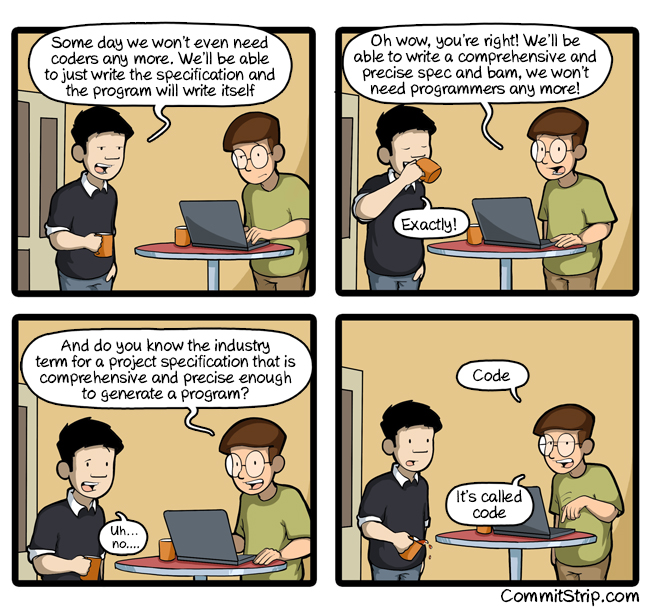
A guy with a mug comes up to a person standing with their laptop on a small table. The mug guy says, "Some day we won't even need coders any more. We'll be able to just write the specification and the program will write itself."
Guy with laptop looks up. "Oh, wow, you're right! We'll be able to write a comprehensive and precise spec and bam, we won't need programmers any more!"
Guy with mug takes a sip. "Exactly!"
Guy with laptop says, "And do you know the industry term for a project specification that is comprehensive and precise enough to generate a program?"
"Uh... no..."
"Code. It's called code."
Of course there are some systems where correctness is vital, and for those I'd like a precise spec and proof of correctness. But I think there's a huge bulk of code where formal specification impedes what should be a process of learning and adapting.
?
I'm still struggling to move past the magic trick of guessing what characters come next to ascribe understanding of "how" and implying understanding?
Using this particular example, if you simply paste the exact code into the prompt, the model should able to reproduce it. Now, you can start removing the bits and see how much you can remove from the prompt, e.g. simplify it to pseudocode, etc. Then you can push it further and try to switch from the pseudocode to the architecture, etc.
That way, you'll start from something that's working and work backwards rather than trying to get there in the absence of a clear path.
It is important to start a new chat so the model is not stuck in its previous mindset, and it is beneficial to have tests to verify that the simplified code still works as it did before.
Telling the model to generate concise code did not work for me, because LLMs do not know beforehand what they are going to write, so they are rarely able to refactor existing code to break out common functionality into reusable functions. We might get there eventually. Thinking models are a bit better at it. But we are not quite there yet.
For example I am developing a game using GDscript, LLMs (including codex and claude) keep making scripts with no classnames and then loading them with @preload. Hate this, and its explicitly mentioned in my godot-development skill. What agents can't stand is a failing test. Feels a bit like enforcing rules automatically.
This is a stupid idea but it works wonders on giving taste to my LLM. I wonder if I should open source that test suite for other agentic developers.
One thing that is fairly low effort that you could try is find code you really like and ask the model to list the adjectives and attributes that that code exhibits. Then try them in a prompt.
With LLMs generally you want to adjust the behavior at the macro level by setting things like beliefs and values, vs at the micro level by making "rules".
By understanding how the model maps the aspects that you like about the code to language, that should give you some shorthand phrases that give you a lot of behavioral leverage.
Edit: Better yet.. give a fresh context window the "before" and "after" and have it provide you with contrasting values, adjectives, etc.
You need to think about what "good taste " is to you (or find others who have already written about software architecture and take their ideas that you like). People disagree on what that even means (e.g. some people love Rails. To me a lot of it seems like the exact opposite of "good taste").
A lot of prompts about finding the right level of abstraction, DRY, etc.
An earlier example (Opus 4.5 + Gemini 3 Pro) is here: https://github.com/stared/sc2-balance-timeline
I tried as well to just use Gemini 3 Pro (maybe the model, maybe the harness) it was not nearly as good as writing, but way better at refining.