At least this has the merit of being posted by the author, even if it was posted to HN 3 days ago.
It would be really useful to be able to cross-reference items more easily, and then to merge discussions and comments, but I suspect that won't happen.
Anyway, interesting talk, interesting idea. Thanks to you and your father.
After studying the effects these plants had on air quality for the past 15 years in a building in New Delhi, India it was found that there was a 42% probability of increasing blood oxygen by 1% simply by being in the building for one hour. Compared to other buildings in the city, eye irritation was reduced by 52%, respiratory symptoms down by 34%, headaches by 24%, lung impairment by 12%, and asthma by 9%.
They were also able to reduce the fresh air supplied to the building and still meet industry standards for healthy indoor air, netting a reduction of energy costs by greater than 15%. With buildings consuming 40% of the world’s energy, this is a big deal.
Mother-in-law’s Tongue (Sansevieria trifasciata) . . . One requires about 6-8 such waist high plants per person in the bedroom
This seems like a large number of plants to fit into a space. Any tips on fitting them in without having them dominate the space?
It takes up a lot of space, but it shares that space with the cubicle walls, so in a strange way it takes up very little space.
I guess what I'm saying is be creative.
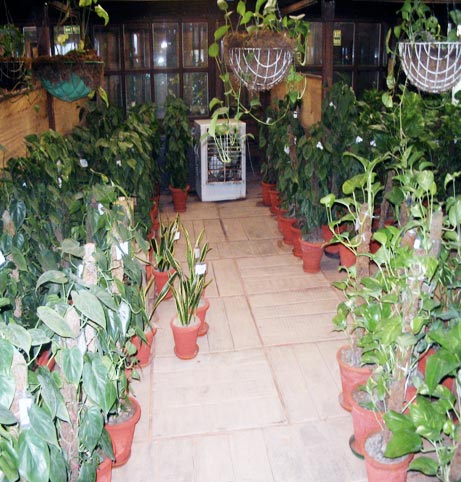
Do you have any pictures of how it looks inside the building?
Picture of one of the building plant rooms -
http://greenspaces.in/images/pbc_greenhouse_1.jpg
http://greenspaces.in/images/pbc_greenhouse_2.jpg
One of the things that is done in the building is that air is passed through these rooms first, and then circulated through the building.